The Brutal Truth About Gated Content Failure: Why Lead Magnets Are Dead
The Download Button Nobody Clicks Anymore
If you’re still hiding your best insights behind a form wall, you’re not generating leads. You’re generating friction. Gated content failure has quietly become one of the most expensive mistakes in B2B and B2C marketing today, and nowhere is that more visible than in South Asia’s fast-maturing digital markets. A 2024 Forrester report found that 83% of B2B buyers now research independently before engaging any vendor, preferring instant access over form-fills. In Bangladesh, where mobile-first users consume content primarily through Facebook, LinkedIn, and YouTube, the expectation is the same: give me the value now, or I scroll past you. The old lead magnet playbook, built for a slower internet and a less informed buyer, is collapsing. And most marketing teams have yet to notice.
Why Gated Content Failure Is No Longer a Theory
The numbers are hard to ignore. Globally, average landing page conversion rates for gated content dropped from 23% in 2019 to below 10% in 2024, according to HubSpot’s State of Marketing report. That’s less than one in ten people choosing to trade their email for a PDF. The other nine? They bounce, they find a competitor who gave away the same information for free, or they simply move on.
In Bangladesh, the situation carries additional weight. According to DataReportal’s 2024 Digital Report, there are now 44.7 million internet users in the country, with 96% accessing the web via mobile. The average Bangladeshi internet user spends roughly 9 hours and 52 minutes online daily, but their tolerance for friction is near zero. A form wall, a CAPTCHA, a mandatory phone number field: each one is a reason to leave. Local digital marketing practitioners consistently report form abandonment rates above 70% for gated assets in Dhaka and Chittagong markets.
The brand damage from this isn’t just about lost leads. When a potential customer hits your gate and leaves, they carry an impression: this company doesn’t trust me enough to share what they know. In a market where brand reputation spreads through community networks, WhatsApp groups, and Facebook communities faster than any ad campaign can run, that impression compounds. Research by Edelman’s 2024 Trust Barometer showed that 63% of consumers in developing markets are more likely to buy from brands perceived as knowledge-generous. In Bangladesh’s competitive sectors, from fintech to FMCG to EdTech, that perception gap is a real competitive disadvantage.
Global comparison: Drift’s 2024 Conversational Marketing Report found that ungated content pieces generate 3x more shares and 2x more return visits than gated equivalents. Companies like HubSpot, Wistia, and Canva famously removed their content gates and saw pipeline increase, not decrease. The Bangladeshi market isn’t behind on this shift. It’s simply not being served by agencies and in-house teams still operating on legacy playbooks.
The Behavioral Science Behind Why Gated Content Fails
Understanding why gated content failure happens requires a short detour into how people actually make decisions online. The mechanism is well-documented in behavioral economics.
The Friction-Trust Paradox
Gated content creates what psychologists call reactance: when people feel their freedom of access is being restricted, they value the content less, not more. Daniel Kahneman’s work on System 1 thinking is relevant here. The brain’s default mode avoids effort. A form is effort. So even if the content behind the gate is excellent, the brain’s first signal is ‘this isn’t worth it.’ A 2023 Baymard Institute study on form abandonment found that 27% of users will abandon a checkout-style form simply because it asks for too much information. The same psychology applies to content gates.
Zero-Click Content and the Attention Economy
Zero-click content is the direct response to this behavioral reality. It delivers the core insight, the actionable takeaway, or the key data point immediately, without requiring any action from the reader. The concept became prominent when Rand Fishkin of SparkToro documented that over 60% of Google searches in 2023 ended without a click, meaning users got their answer directly from the search result page. The same pattern is playing out across social platforms. LinkedIn’s algorithm, for instance, actively suppresses posts with external links in favor of native content that keeps users on-platform.
For Bangladeshi marketers, this has a direct operational implication. A post that shares the full framework, not a teaser, performs significantly better in organic reach. Meta’s 2024 algorithm updates for Facebook similarly reward content that creates on-platform engagement rather than driving off-platform traffic.
The Causal Chain: How Gated Content Erodes Brand Equity Over Time
The damage from over-reliance on gated content isn’t immediate. It builds across a predictable chain:
| Step | Action | Brand Impact |
| 1 | User hits a content gate | Immediate friction; negative first impression forms |
| 2 | User abandons without filling form | No lead captured, but a negative brand data point is created |
| 3 | User finds same info ungated elsewhere | Competitor gains trust; your brand loses positioning |
| 4 | User shares competitor content | Competitor’s thought leadership spreads; yours does not |
| 5 | Your SEO weakens from low dwell time | Content visibility drops; fewer organic discovery opportunities |
| 6 | Sales team receives fewer warm leads | Pipeline quality suffers; sales cycle lengthens |
| 7 | Brand perceived as closed, not authoritative | Long-term trust deficit in the category |
This seven-step chain explains why brands don’t notice the damage until it’s significant. Each step feels minor in isolation. Collectively, they shift your position from category authority to category wallflower.
The Five-Step Zero-Click Content Framework
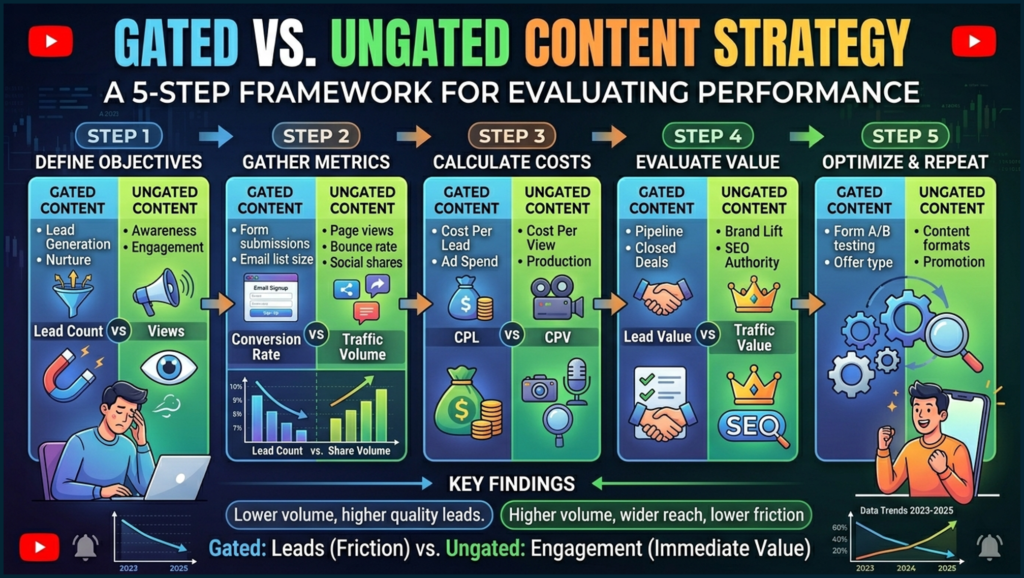
Switching from gated to zero-click isn’t about giving everything away without strategy. It’s about restructuring what you give, when you give it, and what you ask for in return (which is engagement, not email addresses). Here’s a framework built from what’s working for growth-stage companies across South Asia in 2024-25.
Step 1: Audit and Classify Your Existing Content
Pull every gated asset you have and assign it to one of three buckets: Evergreen Insight (ideas that don’t expire), Tactical How-To (step-by-step guidance), or Proprietary Data (your own research). Only proprietary data has a defensible reason to remain gated. Everything else should be ungated immediately. Leadership decision: Who owns content governance? If no single person does, this step stalls. Trade-off: Your email list growth rate will dip. Your content traffic and shares will rise. Metric: Track organic content shares within 60 days of ungating.
Step 2: Redesign for Immediate Value Delivery
Reformat your best gated PDFs into long-form LinkedIn posts, detailed Twitter/X threads, or native articles. The goal is to answer the reader’s primary question within the first 100 words. This is where Bangladeshi brands consistently fail: they write teasers instead of articles, hoping to drive a click to the gate. Stop. Give the answer. Leadership decision: Accept that your content team’s output metric shifts from ‘leads captured’ to ‘content reach and saves.’ Trade-off: Sales may initially resist because the email list signal disappears. Metric: Content saves, shares, and organic reach per post.
Step 3: Create a Content Depth Ladder
Zero-click content works at the top of the ladder. But depth still has value. Your free content should naturally lead readers toward a higher-depth engagement: a live webinar, a community, a personalized audit, or a paid product. The ladder looks like this: Free post (answers one question) leads to Free deep-dive (answers the category) leads to Paid engagement (personalized implementation). This is where the revenue actually comes from. Leadership decision: Marketing and product teams must align on what the paid engagement looks like. Metric: Conversion rate from content reader to webinar/community signup.
Step 4: Build Distribution Before You Need It
Zero-click content only works if it reaches enough people. In Bangladesh, the highest-ROI distribution channels in 2025 are LinkedIn for B2B (especially fintech, consulting, and education), Facebook Groups for B2C and community-driven brands, and WhatsApp broadcast lists for high-intent audiences. Build these channels before you need them to drive sales. Mistake to avoid: Relying solely on paid reach for ungated content. The whole point is that good content earns organic reach. If you’re paying to push every piece, your content quality isn’t high enough yet. Metric: Organic reach as a percentage of total content reach.
Step 5: Gate Only What is Genuinely Proprietary
If you do your own research surveys, produce original industry data, or have tools that require registration to function, those can stay gated. But be honest with yourself about what qualifies. A list of ’10 marketing trends for 2025′ that you assembled from public sources is not proprietary. Your annual survey of 500 Bangladeshi SMEs on digital adoption? That’s worth a form fill. Leadership decision: Legal and marketing must agree on what constitutes proprietary intellectual property. Metric: Form-fill conversion rate on remaining gated assets should be above 20% if the content is truly distinctive.
Case Studies: Who Got This Right
Global: HubSpot’s Ungating Experiment (2021-2024)
HubSpot is the most-cited example because the results were unambiguous and the company was willing to publish them. In 2021, HubSpot began systematically ungating its most popular educational content, including several cornerstone marketing guides that had been behind forms for years. The rationale was straightforward: the people filling out those forms weren’t necessarily the right buyers, and the people who weren’t filling forms were often exactly the right buyers.
Over a three-year period, HubSpot reported a 40% increase in organic traffic to formerly gated pages, a 25% improvement in content-attributed pipeline quality (meaning the leads that did come in converted at higher rates), and a measurable improvement in brand trust scores in their annual customer surveys. The limitation of this case is obvious: HubSpot has massive brand equity and could absorb the short-term dip in form-captured leads. A seed-stage startup in Dhaka doesn’t have that buffer. The lesson to extract isn’t ‘ungate everything tomorrow.’ It’s ‘the direction of travel is ungated, and the economics work at scale.’
Bangladesh/South Asia: Shajgoj’s Content Community Model (2022-2024)
Shajgoj, the Bangladeshi beauty and lifestyle platform, offers a locally relevant example of zero-click content logic applied at scale. Rather than gating product reviews, beauty guides, or expert skincare advice, Shajgoj built one of the most engaged content communities in the country’s digital ecosystem by giving away expertise freely on their platform, Facebook, and YouTube.
Between 2022 and 2024, Shajgoj grew its registered user base from under 300,000 to over 1.2 million, with a reported 60% month-on-month retention rate for active readers. Revenue came not from content gates but from the commerce and advertising ecosystem built around that trust. Their skincare ingredient guides, freely available and heavily shared across Bangladeshi women’s Facebook Groups, became reference content in their category. The limitation here is that Shajgoj operates in a high-engagement consumer category. B2B brands in Bangladesh face a different challenge: their audience is smaller, their sales cycles are longer, and the immediate payoff from ungated content takes longer to materialize.
Action Plans: What to Do This Quarter
For Organizations
Five actions most marketing teams resist, and why they should stop resisting:
- Ungate your top 5 performing content assets immediately. Effort: Low. The fear is that leads will disappear. The reality is that these assets will start working as SEO and social proof instead.
- Realign your content team’s KPIs away from ‘MQLs from content’ toward ‘organic reach, shares, and content-attributed pipeline.’ Effort: Medium. This requires a conversation with sales leadership and a 90-day transition period.
- Run a 60-day zero-click content experiment on LinkedIn. Publish five long-form posts per month that give away your actual frameworks and data. Measure reach, saves, and inbound DMs. Effort: Medium. The uncomfortable part is that your content writers need to actually know things, not just curate things.
- Map your content depth ladder and identify what the paid engagement at the top looks like. If you don’t have a clear answer, your content strategy is a cost center, not a growth engine. Effort: High. Requires cross-functional alignment.
- Retain gates only for original research. Commission at least one primary research study per year specific to your market. A 200-person survey of Bangladeshi business owners on a relevant topic is genuinely proprietary and worth a form fill. Effort: High. Budget: BDT 150,000 to 400,000 for credible research methodology.
For Individual Professionals
Five skills that are uncomfortable but essential for the zero-click era:
- Writing in public with real opinions. Uncomfortable because it’s visible and therefore criticizable. Required because zero-click content has no impact if it’s vague.
- Thinking in frameworks, not just facts. Uncomfortable because frameworks take time to develop and can be wrong. Required because frameworks are what readers save and share.
- Measuring content by reach and influence, not just conversions. Uncomfortable because it feels imprecise. Required because the conversion case for ungated content is indirect and long-cycle.
- Saying things your employer might not want you to say about your industry. Uncomfortable because of internal politics. Required because agreeable content doesn’t build audiences.
- Learning enough about SEO and distribution to publish content that reaches beyond your existing followers. Uncomfortable because it’s a technical skill most marketers haven’t developed. Required because zero-click content at zero reach is still zero impact.
Where This Strategy Can Still Fail
Let’s be clear about the limits of this argument. The zero-click content model works well for brands that have, or are willing to build, genuine expertise and distribution scale. For a new brand in Bangladesh with fewer than 500 LinkedIn followers and no community presence, ungating everything without a distribution strategy won’t generate leads. It’ll generate silence.
There’s also an ethical dimension that often gets ignored. When brands create content that mimics expert advice but is actually marketing copy dressed up as education, the zero-click approach becomes manipulative. Bangladeshi consumers, particularly in urban markets, are increasingly sensitive to this. Performative thought leadership, posts that look insightful but say nothing actionable, erodes trust faster than a form wall does.
And here’s the contrarian scenario worth sitting with: for some highly regulated categories in Bangladesh, including pharmaceutical marketing, financial advisory, and government procurement, gated content with compliance documentation attached may actually perform better than fully open access. Context always matters. The framework above is a default position, not a universal law.
Key Takeaways
- Gated content failure is measurable: average conversion rates fell from 23% in 2019 to below 10% in 2024 (HubSpot, 2024).
- Bangladesh’s 44.7 million internet users access the web primarily via mobile and have near-zero tolerance for friction in content access.
- The seven-step brand erosion chain shows that gated content damage is cumulative and often invisible until pipeline quality drops significantly.
- Zero-click content means delivering the core value immediately, not teasing it. The full framework, not a summary.
- Gate only what is genuinely proprietary: original research, tools requiring registration, and compliance-sensitive materials.
- The revenue model shifts from ’email list to nurture sequence’ to ‘trust at scale to paid engagement.’ This requires a different content depth ladder.
- Brands like Shajgoj prove this model works in Bangladesh: 1.2 million registered users built primarily through freely shared expert content.
- Individual professionals need to develop real opinions, real frameworks, and real distribution skills to thrive in the zero-click era.
Read More Articles:
- The Costly AI Strategy Gap: Why Your Team Is Playing, Not Executing
- The Costly Truth About Minimalist Bangladesh Design Strategy
- The Costly Visual Search Blind Spot That Is Making Bangladesh Brands Invisible
- Quantum Marketing: How 2030’s Technologies Will Shatter Bangladesh’s Status Quo
- Digital Literacy & Brand Purpose: How Education Drives Loyalty in Emerging Markets
Bibliography
- Forrester Research: 2024 B2B Buyer Behavior Report
- HubSpot: State of Marketing Report 2024
- DataReportal: Digital 2024 Bangladesh Country Report
- Edelman Trust Barometer 2024: Developing Markets Special Report
- Drift: 2024 Conversational Marketing Report
- SparkToro / Rand Fishkin: Zero-Click Searches Study 2023
- Baymard Institute: Form Abandonment Research 2023
- LinkedIn Algorithm Analysis: Social Insider 2024
- Meta Business: Facebook Algorithm Update Report Q2 2024
- Kahneman, Daniel: Thinking, Fast and Slow (Farrar, Straus and Giroux, 2011)
- HubSpot Blog: Why We Ungated Our Best Content (Internal Case Study, 2022)
- Shajgoj: About Page and Company Growth Data
- BASIS Bangladesh ICT Industry Survey 2024
- a2i Bangladesh: Digital Literacy and Behavior Report 2024
- Content Marketing Institute: 2025 B2B Content Marketing Benchmarks
- Nielsen Consumer Trust in Advertising: Bangladesh FMCG Sector 2024
- Wistia: The State of Video Report 2024 (Ungated Content Findings)
- BTRC Bangladesh Telecom Regulator: Mobile Internet Subscriber Data Q1 2025