The Hidden Cost of Fake Community: Why Community-Led Growth Demands More Than a Slack Group
A Slack group with zero engagement isn’t a community. It’s a ghost town.
I’ve sat in enough strategy rooms across Dhaka to know how this plays out. Someone pitches building a “community.” The team nods. A Facebook group gets created, a WhatsApp broadcast list assembled, maybe a Discord server for good measure. Within 90 days, the last post is three weeks old and only the brand is talking. Community-led growth is one of the most cited and least understood concepts in marketing right now. Brands hear the term and immediately think “platform.” They build. They launch. They wait. Nothing compounds. Real community isn’t a channel decision. It’s a feeling of belonging, and that feeling, once built, compounds in ways no ad budget ever could.
The Engagement Illusion: What’s Happening Inside Bangladesh’s Brand Communities
Bangladesh now has over 50 million active Facebook users, one of the highest-penetration social markets in South Asia (DataReportal, 2024). Brands took notice. The response was entirely predictable: create groups, add followers, post content, repeat.
But here’s the thing. Having a group is not the same as having a community. Globally, 68% of brands use social groups primarily for one-way content distribution rather than facilitating peer-to-peer connections (Sprout Social Index, 2024). In Bangladesh, given how most brand-owned Facebook groups function as digital billboards, that number is almost certainly higher.
The downstream damage is measurable. Slack and Discord communities see 40-60% of members go inactive within just 90 days of joining (Community Roundtable, 2024). That decay isn’t platform-specific. It happens anywhere brands confuse “audience” with “community.” This is where it gets interesting. A 2024 Nielsen Bangladesh study found that only 23% of urban consumers feel emotionally connected to any brand they regularly buy from. That means 77% of your paying customers feel nothing beyond the transaction. They’re one price cut away from leaving.
Compare that to what genuine peer-driven community produces. McKinsey research from 2023 found that peer recommendations drive 20-50% of purchasing decisions globally. In Bangladesh’s collectivist culture, where family approval and social validation shape everything from clothing choices to fintech adoption, that figure likely skews higher. Yet most brands invest almost nothing in activating those peer conversations.
The gap between what community could do and what brands are actually building is enormous, and it’s costing real equity every quarter.
Let’s get into what actually drives human connection, because most marketing frameworks skip this entirely.
Belonging is a biological need. Neuroscience research consistently shows that social exclusion activates the same neural pathways as physical pain. Conversely, the feeling of inclusion and belonging releases oxytocin, which deepens trust and increases cooperative behavior (HBR, “The New Science of Customer Emotions,” 2015). This isn’t soft psychology. It’s the mechanism that explains why people defend brands publicly, create user-generated content unprompted, and recruit their friends to products they love. They’re not loyal to the product. They’re loyal to the identity the community reflects.
The strongest communities, whether a Dhaka-based mothers’ parenting network or a global developer forum, share three structural characteristics. Members feel genuinely seen by other members, not just the brand. They share a language or ritual that outsiders don’t fully access. And they believe the community reflects something true about who they are, not simply what they’ve bought.
This is the architecture that community-led growth is trying to build. Not a channel. A feeling of shared identity, supported by the brand but not dependent on it.
The LOYAL Loop: A Framework for Loyalty That Compounds
In my analysis of community programs that actually sustain themselves past the six-month mark, five operational steps consistently separate functioning communities from ghost towns.
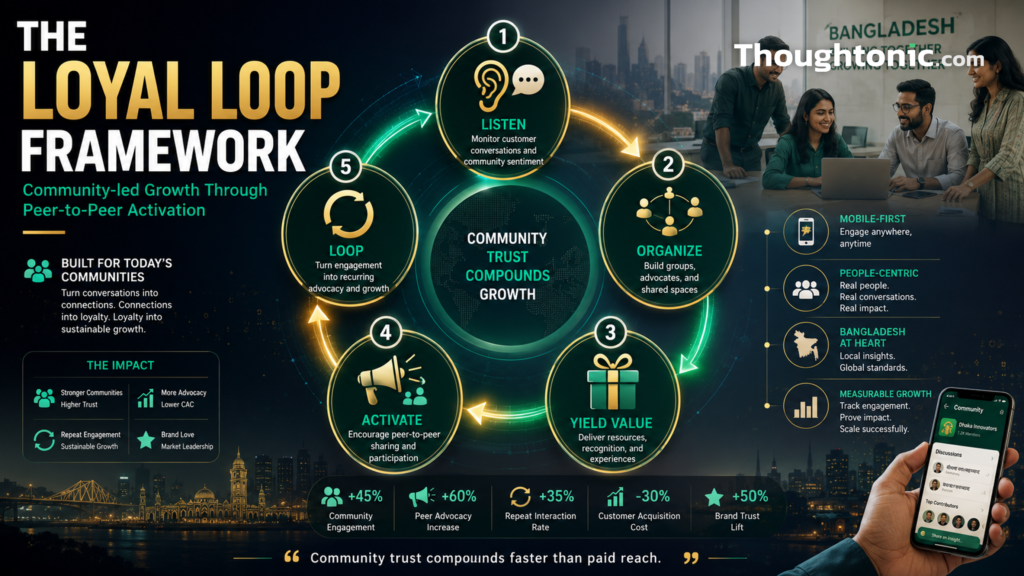
L: Listen Before You Build. Map where your customers are already talking before deciding where to host your community. For Bangladesh-based brands, this means niche Facebook groups, neighborhood-level community pages, and category-specific WhatsApp networks. What problems are they solving together? The leadership decision here is resisting the pressure to launch before you’ve listened. Most brands can’t do this. The political incentive always favors visible activity.
O: Orient Around Identity, Not Product. Build around who your customer is, not what they bought. “Fans of our skincare brand” is not a community premise. “Working women in Dhaka navigating beauty choices on a mid-range budget” is. When the identity is named clearly and honestly, the right people recognize themselves in it. That recognition is the first moment of belonging.
Y: Yield Value Before Asking. Exclusive peer access, direct team introductions, early product input. These are mechanisms that earn a member’s first real engagement. The trade-off is resource intensity without immediate return. Most Bangladeshi brands consciously skip this because it doesn’t appear in quarterly reports. Skip it anyway and the community never activates.
A: Activate Peer-to-Peer Rituals. Weekly threads where customers answer each other’s questions. Monthly challenges with peer voting. Cohorts of new members onboarded together with structured introductions. These rituals create recurring reasons for members to talk to each other without the brand orchestrating every interaction. When that happens consistently, you’ve built something real.
L: Loop Brand as Enabler, Not Hero. The brand that positions itself as the infrastructure of the community, not the performer, earns a form of loyalty that advertising can’t replicate. Members begin to feel the community belongs to them. That shift in ownership is exactly what creates the loyalty loop. They protect it. They recruit for it. They advocate for it without being asked.
Here’s a simple field test. Open your brand’s Facebook group or Slack workspace right now. Scroll back 30 days. Count the conversations that happened between two customers without the brand initiating either side. If that number is zero, or close to zero, you don’t have a community. You have an audience. Audiences are passive. Communities compound.
How to Build Loyalty Loops That Don’t Feel Like a Sales Pitch
Building this kind of community isn’t a six-week sprint. But the first steps are deceptively accessible.
Step 1: Listen for 30 days before building anything. Catalogue where your customers are already having the conversations you want to enable. In Dhaka specifically, sector-specific Facebook groups and alumni WhatsApp networks are often richer with insight than any formal research. The mistake: skipping this because you already think you know.
Step 2: Name the identity, not the product. Define the shared identity the community serves. “Young entrepreneurs building their first business from Chittagong.” “Professionals managing personal finance without access to a trusted advisor.” When the identity is specific, the right members self-select. When it’s generic, no one feels it.
Step 3: Launch with founding members, not a campaign. Personally invite your top 1% of customers. Give them something exclusive: direct team access, early product input, peer introductions. Founding members set the cultural tone for everyone who joins afterward. Rush this step and you’ve built a mediocre culture at scale.
Step 4: Install one recurring ritual. A monthly peer Q&A thread. A seasonal challenge with community voting. A cohort of 20 new members onboarded together every quarter. One ritual done consistently outperforms ten ideas done once.
Step 5: Measure depth, not size. Track conversation-to-member ratio, peer reply rate, and organic referral volume alongside, or instead of, follower counts. For mid-sized Bangladeshi brands starting out, budget reality looks like this: a dedicated community manager at BDT 50,000-80,000 per month, basic community tooling at BDT 5,000-15,000 per month, and a minimum of six months before results become attributable.
Two Brands That Built Real Loyalty Loops
Duolingo: Social Architecture at Scale
Between 2022 and 2024, Duolingo turned individual habit into social accountability. Streaks created visible commitment. Leaderboards generated friendly competition. Community forums accumulated over 5 million posts organically. By 2023, 40% of new users were arriving through word-of-mouth, not paid acquisition, and monthly active users had reached 88 million (Duolingo Annual Report, 2023).
The limitation worth naming: Duolingo benefits from a daily-use product with built-in goal urgency. Language learning is inherently identity-adjacent. Not every brand has this natural alignment. But the mechanism, using streaks, rituals, and social accountability, can be adapted to any context where customers face a recurring challenge better tackled with peers than alone.
Shajgoj: Community-Commerce From Dhaka
Between 2021 and 2024, Shajgoj did something quietly significant. It stopped being just a beauty e-commerce platform and became the reference point for beauty conversations in Bangladesh. User reviews became community currency. Women didn’t just buy; they advised each other, flagged misleading claims, and built reputations through genuine helpfulness.
By 2024, the platform had grown to over 2 million registered users, with user-generated content driving a substantial share of purchase decisions and repeat purchase rates sitting above the national e-commerce average (LightCastle Partners, Bangladesh Consumer Report 2024). The cultural insight: Bangladesh’s beauty market was already peer-driven informally, within family and friendship circles. Shajgoj digitized that dynamic and gave it reach. The brand didn’t replace peer trust. It became the infrastructure for it.
What both cases share: the brand is never the hero. Duolingo is the leaderboard infrastructure. Shajgoj is the credibility infrastructure. The customers are the main characters. That’s not an accident. It’s the design principle.
What Organizations and Professionals Should Do Differently
For Organizations:
Run a conversation audit before making any platform decision. Spend 30 days listening to where your customers already talk. No platform decisions until this is complete. Effort: low. Internal resistance: high.
Create a dedicated community role with metrics that reflect depth, not size. Conversation-to-member ratio and peer reply rate, not follower growth. This conversation with leadership will be uncomfortable. Have it anyway.
Kill one vanity metric publicly and replace it with an engagement depth measure. Signal internally that community quality matters more than community size.
Design one peer-to-peer ritual in the next 90 days. Something that gives two customers a reason to interact with each other, not just with your content.
Spend five unstructured hours listening to your best customers talk to each other, with no agenda and no product pitch. The intelligence you’ll gather is worth more than most paid research projects.
For Marketing Professionals:
Learn facilitation, not just content creation. The ability to hold space for other people’s conversations to develop without inserting yourself is the skill most community builders are missing. It’s uncomfortable because our instinct is to add value by talking.
Develop qualitative research habits. Spend time in your customers’ natural environments, whether Facebook groups, WhatsApp communities, or in-person gatherings. The insight won’t be scalable. That’s the point.
Build a network of community practitioners in Dhaka. The CMX community, local marketing associations, and BASIS peer groups are underused resources. People doing this well tend to be generous with what they’ve learned.
Before You Start: The Risks Nobody Mentions in the Case Studies
Community-led growth is genuinely powerful. But the failure rate in Bangladesh is high, and most postmortems point to two consistent causes.
The first is operational abandonment. Brands launch with real enthusiasm, then quietly stop investing when the six-month review shows no direct revenue attribution. A dead community is measurably worse than no community at all. It signals to your most loyal customers that the brand doesn’t follow through.
The second is extraction without reciprocity. Using community members as unpaid content creators, sentiment sources, or brand advocates without genuine value exchange is an ethical problem that most Bangladeshi brands haven’t begun to address. Customers are increasingly aware of this pattern, and the reputational consequences, when they arrive, tend to be disproportionate to the short-term gain.
And the contrarian scenario worth taking seriously: a brand with 5,000 deeply engaged email subscribers will outperform a brand with a 50,000-member Facebook group at 0.5% engagement on almost every meaningful business metric. Sometimes the right community is smaller and quieter than the one that looks impressive in a monthly report.
Community-led growth doesn’t ask you to be everywhere. It asks you to be genuinely useful somewhere.
Key Takeaways
- A Slack group or Facebook community with no peer conversations isn’t community-led growth. It’s a broadcast channel with extra steps.
- Only 23% of urban Bangladeshi consumers feel emotionally connected to any brand they regularly purchase from (Nielsen Bangladesh, 2024). That’s the problem community solves.
- The LOYAL Loop (Listen, Orient, Yield, Activate, Loop) is a five-step operational model for building loyalty loops that don’t require constant brand orchestration.
- 40% of Duolingo’s new users arrived through word-of-mouth in 2023, after the brand invested consistently in peer ritual architecture rather than paid acquisition.
- The founding member experience sets the cultural DNA of your community. Don’t automate it. Don’t rush it.
- Measure conversation depth, not community size. Peer reply rate and organic referral volume are more useful than follower counts.
- Operational abandonment at the six-month mark is the most common failure mode for brand communities in Bangladesh.
- The brand that positions itself as the community’s infrastructure, not its main character, earns compounding loyalty that advertising cannot replicate or take away.
Read More Articles:
- The Costly AI Strategy Gap: Why Your Team Is Playing, Not Executing
- The Costly Truth About Minimalist Bangladesh Design Strategy
- The Costly Visual Search Blind Spot That Is Making Bangladesh Brands Invisible
- Quantum Marketing: How 2030’s Technologies Will Shatter Bangladesh’s Status Quo
- Digital Literacy & Brand Purpose: How Education Drives Loyalty in Emerging Markets
Bibliography
- Digital 2024: Bangladesh — DataReportal, January 2024
- Sprout Social Index 2024 — Sprout Social, 2024
- State of Community Management 2024 — Community Roundtable, 2024
- Nielsen Bangladesh Consumer Insights 2024 — Nielsen, 2024
- The Value of Getting Personalization Right — McKinsey & Company, 2023
- The New Science of Customer Emotions — Harvard Business Review, 2015
- Duolingo Annual Report 2023 — Duolingo, 2023
- Bangladesh Consumer Report 2024 — LightCastle Partners, 2024
- Community-Led Growth Report 2024 — Forrester Research, 2024
- Community Industry Report 2024 — CMX Hub, 2024
- The Orbit Model: A Framework for Community Building — David Spinks & Patrick Woods, 2023
- Bangladesh Tech Community Landscape — BASIS, 2024
- Bangladesh Cultural Dimensions — Hofstede Insights, 2024
- Mobile Internet Report Bangladesh 2024 — GSMA, 2024
- Bangladesh Social Commerce Report — Meta Business Insights, 2024
- Competing on Customer Journeys — Harvard Business Review, 2015
- Community ROI Research 2023 — The Community Roundtable, 2023