The Brutal Truth About Retention Marketing: Your Funnel Is Bleeding You Dry
It costs 7x more to acquire a new customer than to keep an existing one. You’ve probably heard this stat. Nodded at it in a strategy meeting. And then walked right back to allocating 85% of your marketing budget to Meta ads, influencer campaigns, and lead generation. That contradiction sits at the heart of why most marketing teams in Bangladesh are working harder and earning less. Retention marketing is not a loyalty program you bolt on after the “real” marketing is done. It is the real marketing. And in 2026, as customer acquisition costs across South Asia climb 28-30% year-on-year, the brands that are surviving are the ones that stopped obsessing over filling the funnel and started building the loop.
The Funnel Had a Good Run. Now It’s Broken.
The marketing funnel made sense in a world with low digital competition, expensive switching costs, and cheap paid media. That world no longer exists. Bangladesh now has over 130 million internet users navigating an increasingly crowded marketplace where the average consumer sees dozens of competing offers before making a single purchase decision.
The numbers are alarming. Facebook CPM rates in South Asia rose approximately 28-30% year-on-year through 2024, according to industry benchmarks tracked by WordStream and Meta’s Business Manager data. What that means practically: the same ad budget that generated 1,000 new leads in 2022 now generates roughly 700. And those 700 are less loyal, more price-sensitive, and more distracted than they’ve ever been.
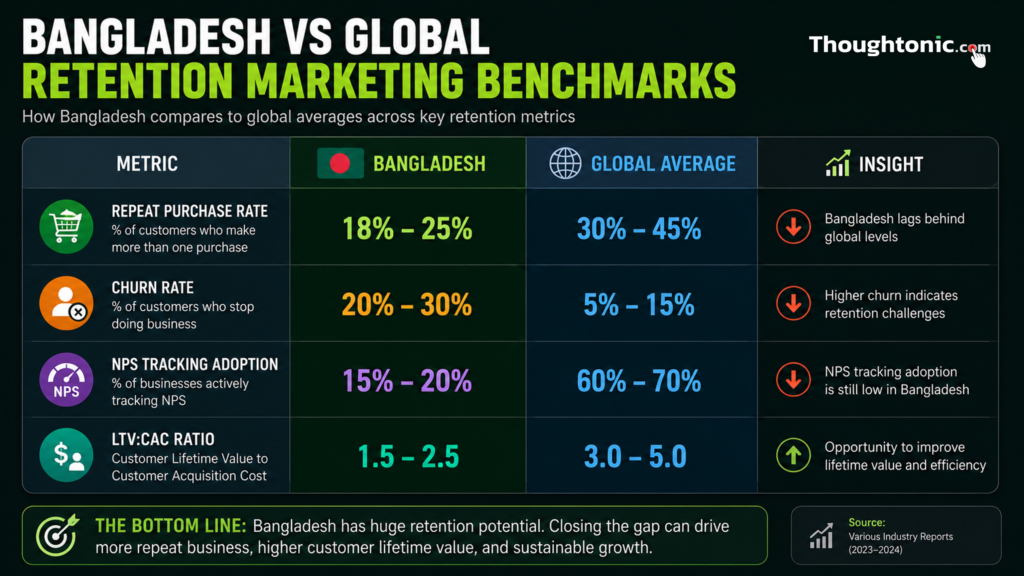
Here’s what makes this particularly painful in the local context. E-commerce repeat purchase rates in Bangladesh sit at roughly 15-20%, compared to 35-45% in mature markets like South Korea and the UK (LightCastle Partners, 2024). That gap isn’t just a benchmark difference. It represents hundreds of crore taka in lost lifetime value across the sector every single year.
Global research confirms the same pattern. Bain and Company’s foundational work by Frederick Reichheld found that a 5% increase in customer retention produces profit growth of 25-95%. That’s not a rounding error. That’s the difference between a brand that compounds and one that cannibalizes itself through endless acquisition spend. The funnel’s fatal flaw is that it ends at the sale. The loop doesn’t. Retention marketing assumes the relationship starts at purchase. And for brands competing seriously in 2026, that distinction is not a nice-to-have. It’s survival.
The Science Behind Retention Marketing: Why Customers Stay (Or Don’t)
Why do customers leave? Most brand managers will tell you it’s price. They’re mostly wrong.
Research from Salesforce’s State of the Connected Customer (2024) found that 66% of customers expect companies to understand their unique needs and expectations. Yet only 34% say brands typically treat them as individuals. In Bangladesh, where relationship-based commerce has deep cultural roots and trust is earned slowly, this gap has real consequences. When a neighborhood shop knows your name and your usual order, you don’t switch even if the competitor is 15 taka cheaper. Digital brands have collectively forgotten this instinct, and it shows in their retention numbers.
This is where the behavioral science gets interesting. Nobel laureate Daniel Kahneman’s work on loss aversion tells us that people feel losses roughly twice as intensely as equivalent gains. A customer who feels ignored after a purchase doesn’t just stop buying. They develop active negative associations with your brand. Every unreturned message, every generic push notification, every failed delivery without follow-up is, psychologically speaking, a small loss you’ve inflicted on that customer. Enough small losses and they’re gone.
How the Retention Marketing Loop Works at a Mechanical Level
Retention marketing operationalizes this psychology in reverse. It converts transactional relationships into emotional ones through four interlocking mechanisms:
Habit Formation. Products that embed themselves into daily routines generate the highest retention. Pathao achieved strong repeat usage at its peak not through discounts but because it became a daily commute habit for urban Dhaka professionals. Habit reduces the cognitive energy required to stay and increases the energy required to leave.
Progressive Value Delivery. The longer a customer stays, the more value they should receive. Not the same value. More. This is the engine behind tiered loyalty programs, CRM-driven personalization, and account-based engagement models. Brands that fail to deliver progressive value teach customers that loyalty has no material benefit.
Community and Social Identity. This mechanism is chronically underused in Bangladesh. Nielsen’s 2024 research shows customers who feel part of a brand community have retention rates roughly 3x higher than those who don’t. Brands that build spaces for their customers to connect, whether through Facebook groups, WhatsApp communities, or offline events, are constructing a form of social switching cost that price competition cannot easily erode.
Friction Reduction. Every unnecessary step between a customer and their next purchase is a dropout risk. Retention marketing includes obsessing over the re-purchase journey: are payment details saved? Is the delivery experience consistent? Does the returns process feel respectful or punishing?
The Gap Between Where Bangladesh Stands and Where It Should Be on Retention Marketing
| Retention Metric | Global Benchmark | Bangladesh Average |
| Repeat Purchase Rate | 35-45% | 15-20% |
| Monthly Churn (SaaS/Apps) | 3-5% | 8-12% |
| Net Promoter Score Tracking | Industry standard | Rarely measured |
| LTV:CAC Ratio Reporting | 3:1 target | Under-measured |
| Post-Purchase Email Engagement | 10-15% reactivation | Below 5% (estimated) |
Sources: LightCastle Partners 2024, BASIS 2024, Salesforce 2024, Bain and Company
The gap between these numbers isn’t a cultural problem. It’s an investment problem. Brands that don’t measure retention cannot improve it, and in my analysis of local marketing teams, fewer than 10% have a dedicated retention function with its own KPIs and budget ownership.
A Practical Retention Marketing Framework for Building the Loop
I’ve seen brands throw CRM software at a retention problem and call it a strategy. It isn’t. Effective retention marketing requires a deliberate, sequenced approach that treats customer success as a revenue function, not a support function.
Step 1: Audit the Leak Before You Build Anything
Map where customers are actually leaving using cohort analysis. Group customers by acquisition month, then track purchase behavior across 3, 6, and 12-month windows. Most brands that do this discover their biggest churn problem is in the first 30 days, which means onboarding and the post-purchase experience are the real enemies, not price.
Common mistake: Confusing low purchase frequency with churn. A customer who buys every six months is seasonal, not lost. Treating them like lapsed customers with aggressive win-back campaigns will push them out permanently.
Step 2: Segment by Value, Not Volume
Your top 20% of customers by lifetime value almost certainly behave differently from your median customer. Build retention strategies for each segment separately. One-size-fits-all loyalty programs are expensive, easy to ignore, and primarily reward your least-profitable customers.
Step 3: Design a 90-Day Post-Purchase Communication Plan
Map every customer touchpoint from Day 1 to Day 90. Day 3 should deliver a relevant tip or usage insight. Day 14 should ask for feedback and make it easy to give. Day 30 should offer something exclusive to existing customers. Day 60 should surface a complementary product based on actual purchase history. None of these should lead with a discount.
Step 4: Align Internal Incentives Around Retention
This is the step most organizations skip entirely. If your sales team is rewarded on new customer acquisition and your retention function (if one exists) has no budget ownership or C-suite champion, your retention marketing strategy will always lose the budget war. Retention requires a leader whose compensation is tied to LTV and repeat purchase rate, not just leads closed.
Step 5: Measure LTV:CAC Weekly, Not Quarterly
Stop reporting on cost per acquisition in isolation. A healthy LTV:CAC ratio sits at 3:1 or above. If yours is below 2:1, you have a retention problem whether you’ve admitted it or not. Make this ratio mandatory in every marketing performance review. The act of measuring it forces the right conversations.
What Retention Marketing Success Actually Looks Like: Two Cases
Global: Amazon Prime – Retention as a Revenue Engine
Amazon Prime is, in my analysis, the most effective retention vehicle ever built at scale. It launched in 2005 as a shipping perk. By 2024, Prime members spend more than double what non-members spend annually, Prime renewal rates globally exceed 90%, and the program now has over 200 million active subscribers worldwide (Amazon Annual Report, 2024).
What makes Prime instructive isn’t the free shipping. It’s the progressive value architecture. Prime didn’t stay as a delivery product. It became music, video, pharmacy, reading, and cloud storage. Each new benefit increased the perceived cost of leaving. The customer using Prime Video, Prime Music, and Prime Grocery isn’t just a subscriber. They’re embedded. Switching costs become prohibitive not through contracts but through accumulated convenience.
The limitation: This model required billions in infrastructure investment and a decade of patience. No brand in Bangladesh should try to copy Prime directly. The principle, however, is universal: retention is built by increasing value over time, not by discounting.
Bangladesh: Chaldal – Retention Through Operational Trust
Chaldal, Bangladesh’s largest online grocery platform, has built something rare in local e-commerce: genuine repeat purchase behavior at scale. Between 2020 and 2024, Chaldal maintained repeat purchase rates significantly above the national e-commerce average, driven primarily by consistent 2-3 hour delivery windows and an intuitive re-order experience (Chaldal company coverage, 2020-2024).
Their retention marketing approach wasn’t sophisticated CRM automation. It was operational reliability translated into brand trust. When your groceries arrive fresh three times in a row, you don’t need a discount to return. You’ve already made the mental decision to stay. Chaldal understood that in a necessity-driven category, certainty outperforms cheapness.
The limitation: This model works most effectively in high-frequency, necessity-driven categories. Brands in lower-frequency or aspirational categories face different challenges and cannot rely on operational consistency alone. Cultural context matters: Bangladeshi consumers in secondary cities have different behavioral patterns than Dhaka-based users, and what works at scale in Gulshan may need significant adaptation in Sylhet or Rajshahi.
Both cases confirm the same insight. Retention marketing works best when it’s built into the product experience, not applied as a promotional layer on top.
What Your Team Should Do Next With Retention Marketing
The most common mistake organizations make is reading about retention marketing and then treating it as a campaign rather than a capability. Here’s what actual implementation looks like.
For Marketing Leaders and CMOs
Reallocate 20-30% of acquisition budget toward retention within two quarters. This requires CFO alignment and a clear LTV model to justify the shift. Budget reallocation is a political act, not just a financial one. Come with data on your current LTV:CAC ratio. Effort: High. Timeline: 60 days to build the case, 6 months to see measurable results.
Launch a post-purchase email or SMS sequence within 30 days. Three emails, three touchpoints, zero discount offers in the first sequence. Deliver value first. Tools like Mailchimp, Klaviyo, or even well-structured WhatsApp broadcasts can execute this with minimal budget. Effort: Medium.
Hire or designate a Customer Success owner. This role should own retention rate, NPS, and repeat purchase rate as primary KPIs. Not lead volume. Not CPA. Many brands already have this person. They’re just calling them something else and measuring the wrong things. Effort: Medium.
Stop measuring CAC in isolation. Every marketing report that shows cost per acquisition without LTV:CAC context is an incomplete picture. Change the template. This costs nothing and forces smarter conversations. Effort: Low.
For Individual Marketers and Brand Strategists
Learn cohort analysis. This is uncomfortable because it requires basic data skills most marketers actively avoid. But if you can’t read a cohort retention chart, you cannot diagnose a retention problem or make a credible case for budget.
Build and present LTV models. Finance literacy is no longer optional for senior marketers. If you’re presenting a campaign without LTV projections, you’re presenting half a business case.
Push back on acquisition-only KPIs. This is a career risk. But teams that never challenge the metrics they’re given will keep doing the wrong things efficiently.
Run win-back campaigns and report the failure rate honestly. Win-back conversion rates are often below 10%. That’s not failure. That’s useful data about permanently lost customers. Report it clearly and use it to invest earlier in preventing churn in the first place.
The Honest Limits of This Approach
I want to be direct about what retention marketing cannot do.
If your product is genuinely inconsistent, no re-engagement sequence will save you. Retention strategies amplify product quality. They don’t replace it. Brands in Bangladesh with delivery failures, quality inconsistencies, or weak customer service will find that retention marketing exposes those problems faster, not slower.
There’s also an ethical dimension that practitioners rarely discuss. Aggressive re-engagement campaigns, daily push notifications, repeated SMS blasts, and countdown email urgency are crossing a line with Bangladeshi consumers who are increasingly opting out of brand communications entirely. BTRC data shows app uninstall rates rising as notification fatigue grows. More communication is not always better communication.
And for early-stage startups with fewer than 500 customers: a full retention marketing stack may genuinely be premature. A well-crafted WhatsApp broadcast from a founder personally checking in on their top 50 customers may outperform any automated sequence. Match the sophistication to the stage.
Key Takeaways
- It costs 7x more to acquire a new customer than to retain one. Yet most Bangladeshi brands allocate under 10% of their marketing budget to retention.
- Bangladesh’s e-commerce repeat purchase rate (15-20%) is roughly half the global average (35-45%), representing an enormous unrealized revenue opportunity across the sector.
- Retention marketing works through four core mechanisms: habit formation, progressive value delivery, community building, and friction reduction.
- A 5% increase in customer retention can produce 25-95% profit growth (Bain and Company). That’s not incremental. That’s structural.
- The LTV:CAC ratio, not cost per acquisition, is the metric that determines whether a marketing strategy is genuinely profitable.
- Both Amazon Prime and Chaldal demonstrate that retention is built into product experience first, then supported by communication strategy.
- Aggressive re-engagement can damage brands. Retention marketing requires restraint and relevance, not just frequency.
- Early-stage startups should start with human-led retention before investing in automation infrastructure.
Read More Articles:
- The Costly AI Strategy Gap: Why Your Team Is Playing, Not Executing
- The Costly Truth About Minimalist Bangladesh Design Strategy
- The Costly Visual Search Blind Spot That Is Making Bangladesh Brands Invisible
- Quantum Marketing: How 2030’s Technologies Will Shatter Bangladesh’s Status Quo
- Digital Literacy & Brand Purpose: How Education Drives Loyalty in Emerging Markets
Bibliography
- Bain and Company – “Prescription for Cutting Costs” (Frederick Reichheld) – Bain and Company, 2001 (foundational, widely cited through 2024)
- Harvard Business Review – “The Value of Keeping the Right Customers” – HBR, October 2014
- Salesforce – State of the Connected Customer, 6th Edition – Salesforce, 2024
- WordStream – Facebook Advertising Benchmarks 2024 – WordStream, 2024
- LightCastle Partners – Bangladesh E-Commerce Landscape Report 2024 – LightCastle Partners, 2024
- e-CAB – e-Commerce Consumer Behavior Survey 2023-24 – e-Commerce Association of Bangladesh, 2024
- BASIS – Bangladesh IT/ITES Industry Report 2024 – Bangladesh Association of Software and Information Services, 2024
- BTRC – Digital Bangladesh Progress Report 2024 – Bangladesh Telecommunication Regulatory Commission, 2024
- McKinsey and Company – “The Value of Getting Personalization Right” – McKinsey, 2024
- Forrester Research – Customer Experience Index 2024 – Forrester, 2024
- Nielsen – Consumer Loyalty and Trust in the Digital Age – Nielsen, 2024
- Kahneman, Daniel – Thinking, Fast and Slow – Farrar, Straus and Giroux, 2011
- Amazon – Annual Report 2023 – Amazon Inc., 2024
- HubSpot – The Ultimate List of Marketing Statistics for 2024 – HubSpot, 2024
- Statista – Global E-Commerce Repeat Purchase Rate Benchmarks – Statista, 2024
- Chaldal – Company Profile and Press Coverage – Various sources including The Daily Star, TechCrunch coverage, 2020-2024