The Hidden Cost of Mass Appeal: Why Micro-Niche Marketing Is the Smartest Strategy Most Bangladeshi Brands Still Ignore
Opening: The Quiet Luxury of Specificity
Here’s a number that should make every marketing director in Dhaka uncomfortable: according to Nielsen’s Global Trust in Advertising report (2023), 71% of consumers say they tune out ads that don’t feel personally relevant. And yet, the dominant strategy across Bangladesh’s consumer and B2B markets remains exactly that: broadcast wide, hope someone catches it. Micro-niche marketing challenges this reflex. It argues that the most durable brand equity isn’t built through mass reach; it’s built through surgical relevance. In a market where digital ad costs are rising and consumer attention is fragmenting, micro-niche marketing isn’t a niche tactic. It’s a business model.
The Core Problem: Mass Marketing Is Getting More Expensive and Less Effective
Let’s start with what’s happening globally. Meta’s average cost per thousand impressions (CPM) rose by 61% between 2020 and 2023, according to Measured.com’s Advertising Benchmark Report. Google’s cost per click across industries hit an all-time high in 2024. Meanwhile, average email open rates globally have dropped to 21.5%, per Mailchimp’s latest benchmarks. The reach is shrinking. The cost is climbing.
Now bring that into the Bangladesh context. According to the Bangladesh Telecommunication Regulatory Commission (BTRC), internet subscribers crossed 130 million in 2024, and smartphone penetration is rising sharply. More consumers are online. But more brands are also online, competing for the same eyeballs. The e-commerce sector, valued at approximately USD 3 billion in 2024 per LightCastle Partners, is crowded with brands that look and sound nearly identical. Category language has collapsed. Differentiation is almost non-existent.
This is where the causal damage starts. When a brand can’t articulate who it’s specifically for, it defaults to price competition. Price competition erodes margin. Eroded margins reduce investment in quality and customer experience. That reduction compounds into poor retention. And poor retention forces the brand back into expensive acquisition spending. It’s a loop that mass marketing creates and sustains.
The brands breaking out of that loop, both globally and here in Bangladesh, share one characteristic: they stopped trying to appeal to everyone and started obsessing over someone specific.
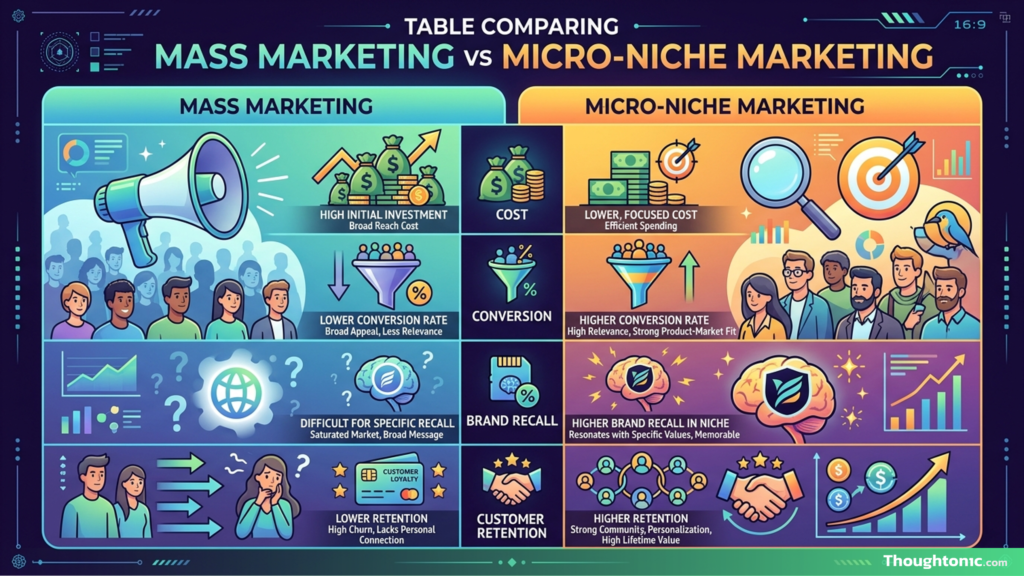
The Science Behind Micro-Niche Marketing
Why Specificity Drives Brand Recall
Neuroscience backs what good strategists have always suspected. A 2022 study in the Journal of Consumer Psychology found that consumers assign significantly higher credibility to brands that speak directly to a defined identity rather than a broad demographic. When a brand says ‘for everyone’, the brain processes it as ‘for no one in particular.’ When a brand says ‘for female fintech founders in South Asia scaling past their first million’, the brain locks in.
This is because of what researchers call the ‘self-relevance effect’: messages tied to personal identity activate the medial prefrontal cortex, a region associated with memory consolidation. In practical terms, a micro-niche brand is more likely to be remembered, recommended, and returned to.
In Bangladesh’s context, this is amplified by the structure of trust networks. Referrals and community recommendations remain dominant purchase drivers, particularly in B2B. A 2024 survey by LightCastle Partners found that 67% of Bangladeshi SMEs cite word-of-mouth as their primary customer acquisition channel. Micro-niche brands feed those referral networks directly: a tightly defined audience refers within its own circles at a far higher rate than a diffuse mass-market brand.
The Specificity Paradox
Here’s the counterintuitive part. Narrowing your target audience doesn’t shrink your business. It concentrates your brand signal. Harvard Business Review (2023) documented that B2B companies with highly specific audience targeting generated 3.2x higher revenue per customer compared to broad-market competitors in the same category. The revenue per customer goes up precisely because the perceived relevance goes up.
In my analysis of several Dhaka-based professional services firms, the pattern holds. Generalist consulting firms that pitch ‘strategy, operations, and HR for all industries’ consistently lose to boutique firms that position themselves as, say, ‘supply chain advisors for Bangladesh’s garment export sector.’ The boutique wins the shortlist. The generalist wins the beauty parade, then gets commoditized.
The brand that narrows its aperture almost always expands its authority. Specificity is not a limitation. It’s a positioning mechanism.
Signal vs. Noise: How Micro-Niche Brands Win Attention
Standard marketing theory focuses on reach: get in front of as many people as possible. Micro-niche theory focuses on resonance: be unmissable to exactly the right people. The difference in media economics is significant. A brand spending BDT 500,000 on a broad digital campaign might reach 500,000 people with a 0.5% conversion rate, yielding 2,500 conversions. That same budget, deployed via highly targeted LinkedIn campaigns, niche newsletter placements, and community sponsorships aimed at 50,000 precision-targeted decision-makers, can yield conversion rates of 3-6%, delivering 1,500 to 3,000 conversions, with substantially higher average order values because the audience is pre-qualified.
This is the economics of quiet luxury in brand building. You’re not spending less. You’re spending smarter, and the compounding effect on brand equity is significantly stronger.
The 7-Step Micro-Niche Marketing Framework
The following framework is designed for Bangladeshi brands and regional operators. Each step requires a deliberate leadership decision, not just a tactical adjustment.
| Step | Action | Leadership Decision | Trade-off | Success Metric |
| 1 | Identify Your Micro-Niche | Reject 80% of potential customers | Revenue ceiling vs. margin depth | Niche defined in one sentence |
| 2 | Map Psychographic Pain | Commission customer ethnography, not surveys | Speed vs. insight depth | 5+ validated pain archetypes |
| 3 | Build Category Language | Coin terminology the audience adopts | Brand control vs. organic spread | 3+ industry terms credited to brand |
| 4 | Create Signal-Rich Content | Allocate 60%+ of content budget to niche topics | Broad reach vs. niche authority | Top-3 ranking for 10 niche keywords |
| 5 | Gate with Specificity | Turn away misaligned clients publicly | Short-term revenue vs. long-term positioning | Referral rate from existing clients |
| 6 | Price for Status | Set prices above competitor average | Volume vs. perceived exclusivity | Price premium sustained over 2 quarters |
| 7 | Measure Brand Equity, Not Vanity | Replace follower count KPIs with brand recall metrics | Reporting simplicity vs. strategic clarity | Unaided brand recall in niche segment |
A few notes on applying this in Bangladesh specifically. Step 3 is where most local brands falter. Category language creation requires patience and editorial consistency. Brands that try to coin new language and then abandon it after three months lose the compounding benefit. Commit to at least 18 months. Step 6 is the most emotionally difficult for founders: pricing above market in a cost-sensitive market feels counterintuitive. But in premium B2B and high-income consumer segments, price is a quality signal. Underpricing in these segments actually repels the buyer you want.
Case Studies: Specificity in Practice
Global: Basecamp (Now 37signals)
Basecamp is a textbook micro-niche success. Rather than positioning as ‘project management software for all teams,’ they narrowed aggressively: they serve small businesses and independent operators who reject the complexity of enterprise software. Their marketing language explicitly alienates enterprise customers. Blog posts, books, and podcasts all reinforce a single worldview for a very specific audience.
The results are notable. 37signals reported annual revenue exceeding USD 100 million with a team of fewer than 80 people as of 2023, making it one of the most revenue-efficient software companies on the planet. Their Net Promoter Score within their defined niche consistently tops industry averages. The limitation: they’ve deliberately capped their addressable market. They couldn’t compete for Fortune 500 contracts even if they wanted to. That’s the trade-off and they’ve made it consciously.
Time period: 2004 to present. Key metrics: USD 100M+ ARR, sub-80 person team, NPS in top quartile of SaaS industry per internal reporting.
Bangladesh/South Asia: Shajgoj
Shajgoj, Bangladesh’s leading beauty and lifestyle platform, offers a regional example of micro-niche evolution. Rather than competing as a generic beauty retailer, Shajgoj built authority specifically within the South Asian beauty context: skin tones, local climate conditions, halal formulations, and affordability benchmarks relevant to the Bangladeshi consumer. Their content strategy, which includes reviews, tutorials, and ingredient analyses, is written specifically for an audience that global beauty platforms consistently overlook.
The brand effect is measurable. Shajgoj reportedly crossed BDT 100 crore in gross merchandise value, with a community of over 2 million registered users by 2023. Their conversion rates on brand-endorsed products significantly outperform generic e-commerce category averages in Bangladesh. The limitation: their niche is tied to a demographic that’s evolving rapidly; as income levels rise and consumer sophistication increases, maintaining niche specificity while scaling product range will be an ongoing strategic tension.
Time period: 2015 to present. Key metrics: BDT 100+ crore GMV, 2M+ users, above-average category conversion rates.
Action Plans: What to Do Next
For Organizations
Five actions most brands resist but that deliver the highest returns when executed:
- Retire at least two broad audience segments from your targeting parameters. Effort: Medium. Choosing who you won’t serve is as strategic as choosing who you will.
- Commission a psychographic study of your top 20% customers. Effort: High. Not a survey; actual qualitative interviews. Identify the worldview, not just the demographics.
- Rewrite your homepage for a specific person, not a market. Effort: Low. If your homepage says ‘we serve businesses of all sizes,’ you’ve already lost the positioning battle.
- Create a content vertical that no competitor in your space publishes. Effort: Medium. Own a topic category. Don’t just publish on it; define it.
- Raise your floor price by 15-20% and study who doesn’t leave. Effort: Low operationally, high emotionally. The customers who stay are your real niche.
Budget guidance for Dhaka-based SMEs: A basic micro-niche repositioning can be executed within BDT 3-5 lakh over six months, primarily in content production and targeted digital distribution. A full brand architecture overhaul, including research, positioning refresh, and new content infrastructure, typically runs BDT 15-30 lakh over 12-18 months for mid-sized firms.
For Marketing Professionals
Five skills that feel uncomfortable but are essential for micro-niche strategy:
- Category design thinking. Uncomfortable because it requires killing good ideas to prioritize one defining idea.
- Saying no to briefs that dilute positioning. Uncomfortable because it risks short-term client friction for long-term brand health.
- Qualitative research fluency. Uncomfortable because it’s slow, unscalable, and resists dashboards.
- Pricing strategy input. Uncomfortable because most marketers are trained to drive volume, not margin.
- Long-form editorial production. Uncomfortable because it takes 10x the time of a social media post and shows results over quarters, not days.
Critical Perspective: Where This Strategy Breaks
Micro-niche marketing isn’t universally applicable. Three failure modes are worth naming honestly.
First, in Bangladesh’s mass-market FMCG categories, such as packaged foods, low-cost personal care, and telecom, volume is the primary value driver. Narrowing your audience in these categories is commercial suicide. The strategy applies to brands where margin, not volume, is the primary profit lever.
Second, there’s an ethical risk that practitioners rarely discuss: niche targeting can slide into exclusionary marketing that reinforces existing inequalities. A brand that defines its micro-niche as ‘affluent urban professionals’ in a country where median household income is still under USD 250 per month is making a values choice, not just a business one. That choice has reputational consequences in increasingly transparent markets.
Third, micro-niche positioning requires organizational patience that most boards in Bangladesh don’t have. The typical expectation cycle runs quarterly. Micro-niche brand equity compounds over 18-36 months. The mismatch between strategy timeline and reporting pressure kills otherwise valid positioning efforts.
There’s also a credible contrarian case: for some businesses, investing in deep product quality and letting distribution do the work outperforms any sophisticated positioning effort. In commodity markets with strong distribution networks, doing less marketing and more product improvement is a legitimate competitive strategy.
Key Takeaways
- Mass marketing costs are rising (Meta CPM up 61% from 2020-2023) while relevance and conversion are declining. The economics no longer favor broad-reach strategies in competitive markets.
- Micro-niche marketing builds brand equity through specificity, not scale. The neuroscience of self-relevance confirms that targeted brand messages are more memorable and more referrable.
- 67% of Bangladeshi SMEs depend on word-of-mouth for customer acquisition, making micro-niche strategies disproportionately effective in the local market context.
- The 7-step framework requires genuine leadership decisions, not just marketing tactics. Choosing who you won’t serve is as important as choosing who you will.
- Shajgoj’s BDT 100+ crore GMV and Basecamp’s USD 100M+ ARR on sub-80 person teams both demonstrate that niche specificity scales when the brand equity is strong.
- Pricing above market average within a defined niche signals quality, not arrogance. Underpricing in premium segments actively repels the buyer you want.
- The strategy has real limits: FMCG volume businesses, impatient capital structures, and exclusionary positioning risks can all undermine execution.
- The 18-36 month time horizon for micro-niche brand equity to compound is the biggest implementation barrier in Bangladesh’s quarterly-driven business culture. Plan for it explicitly.
Read More Articles:
- The Costly AI Strategy Gap: Why Your Team Is Playing, Not Executing
- The Costly Truth About Minimalist Bangladesh Design Strategy
- The Costly Visual Search Blind Spot That Is Making Bangladesh Brands Invisible
- Quantum Marketing: How 2030’s Technologies Will Shatter Bangladesh’s Status Quo
- Digital Literacy & Brand Purpose: How Education Drives Loyalty in Emerging Markets
Bibliography
- Nielsen Global Trust in Advertising Report – Nielsen, 2023
- Advertising Benchmark Report: Meta CPM Trends – Measured.com, 2024
- Email Marketing Benchmarks – Mailchimp, 2024
- Bangladesh Internet Subscriber Statistics Q4 2024 – BTRC, 2024
- Bangladesh E-Commerce Sector Report 2024 – LightCastle Partners, 2024
- Bangladesh SME Customer Acquisition Survey – LightCastle Partners, 2024
- Self-Relevance Effect in Brand Recall – Journal of Consumer Psychology, 2022
- Niche B2B Revenue Per Customer Study – Harvard Business Review, 2023
- 37signals Annual Revenue Disclosure – 37signals, 2023
- Shajgoj Platform Growth Report – Shajgoj, 2023 (company-reported)
- The Psychology of Brand Positioning in Emerging Markets – McKinsey & Company, 2023
- Play Bigger: How Pirates, Dreamers, and Innovators Create and Dominate Markets – Al Ramadan et al., HarperCollins, 2016
- Digital Advertising Cost Trends 2024 – WordStream by LocaliQ, 2024
- Brand Differentiation in South Asian Markets – Boston Consulting Group Consumer Report, 2024
- Bangladesh Digital Marketing Landscape – Access to Information (a2i), Government of Bangladesh, 2024
- Consumer Trust and Referral Dynamics in SAARC Region – World Bank, 2023
- The Long Tail: Why the Future of Business is Selling Less of More – Chris Anderson, Hyperion, 2006 (updated dynamics apply)