The Proven Creative Workflows That Keep the Human-AI Hybrid From Becoming a Creative Liability
AI Is Not Your Creative Director. Stop Treating It Like One.
Last quarter, a well-funded Dhaka-based FMCG brand ran a full digital campaign generated almost entirely by AI: copy, captions, email sequences, the works. The content was grammatically clean, SEO-optimised, and posted on schedule. By month three, their brand recall score had dropped 14 points. Their agency called it a ‘market noise problem.’ I’d call it something more specific: a creative workflows problem. Here’s the thing: AI adoption in Bangladesh’s marketing sector jumped 34% in 2024 alone (e-CAB Annual Report, 2024), but most of that adoption happened without a framework for where human judgment ends and machine execution begins. That gap is where brands quietly bleed.
The Efficiency Trap: Why Creative Workflows Are Breaking Down
Let me be direct about what’s happening. Across Dhaka’s agencies and in-house brand teams, AI is being used to replace the junior creative layer: the copywriters, the content researchers, the social media executives. On a spreadsheet, this makes sense. Fewer junior hires, faster turnaround, lower cost per piece. McKinsey’s 2024 State of AI report found that organisations using AI purely for content speed saw a 22% drop in brand preference scores within 18 months. That’s not a small number. That’s a brand erosion trajectory.
The Bangladesh-specific problem is sharper. A 2024 study by BASIS found that 74% of AI-generated Bengali-language marketing content contained culturally incongruent references: translated idioms, tonal mismatches, contextual errors that a native speaker would immediately flag. For a brand trying to build emotional resonance with a Bangladeshi consumer, that’s not a content problem. That’s a trust problem. And trust, once eroded, is not recovered with the next AI-optimised post.
Globally, the picture is no less concerning. Adobe’s 2024 Future of Creativity study found that 58% of creative professionals felt AI had increased their output volume while simultaneously decreasing their creative satisfaction, a proxy for the kind of engaged, original thinking that produces distinctive work. In Bangladesh, where junior marketing talent is abundant but strategic seniority is scarce, we’re automating the wrong layer.
The Science of Human-AI Creative Collaboration
What AI Actually Does Well in Creative Workflows
Before we build anything prescriptive, it helps to understand what’s actually happening in the brain during creative work, and where AI genuinely fits. Neuroscience research from Stanford’s Human-Centered AI Institute (2024) suggests that the prefrontal cortex, the region responsible for strategic decision-making and cultural empathy, cannot be replicated by current generative models. What AI can replicate, and do extraordinarily well, is pattern synthesis, data aggregation, and variation generation.
Put simply: AI is exceptional at the ‘what.’ It can tell you what content themes are trending, what subject lines have historically driven opens, what visual formats are performing in a given demographic. What it cannot tell you is the ‘why’: why this particular story matters to a Bangladeshi mother of two in Chattogram, why a small shift in narrative framing will make a consumer feel seen rather than sold to.
This is where it gets interesting. The highest-value creative workflows are not those where AI does the most work. They’re the ones where AI clears the operational fog: the research, the drafting, the distribution mechanics, so the human strategist can spend more time in the interpretive space that actually creates brand value.
The Human-AI Creative Workflow: A 7-Step Framework
In my analysis, the most effective creative workflows follow a consistent structure, regardless of organisation size or budget. Here’s how it maps:
| Stage | Who Owns It | What It Produces |
| 1. Audit | Human + AI | Full creative task inventory; cognitive vs. operational classification |
| 2. Assign | Human Leadership | Formal RACI: AI-owned and human-owned workflow stages |
| 3. Constrain | Senior Strategist | Brand voice document, cultural filter, tone matrix fed into AI |
| 4. Synthesise | Human Strategist | AI data output interpreted into strategic creative brief |
| 5. Create | Human Creative | Emotional, cultural, and conceptual core of the content |
| 6. Optimise | AI | Distribution, A/B testing, and scaling of human-approved assets |
| 7. Govern | Human + AI | Quarterly attribution audit: which content was AI vs. human-led? |
The critical insight here is that Steps 1, 2, 3, and 7 are non-negotiable human responsibilities. No matter how good your AI tools are, a machine cannot decide what your brand stands for, cannot apply cultural judgment to a Bengali audience, and cannot conduct the governance audit that keeps your creative identity intact over time. Abdicate those steps and you’re not running a creative workflow. You’re running a content factory.
Making the Framework Work: Step-by-Step for Bangladesh Realities
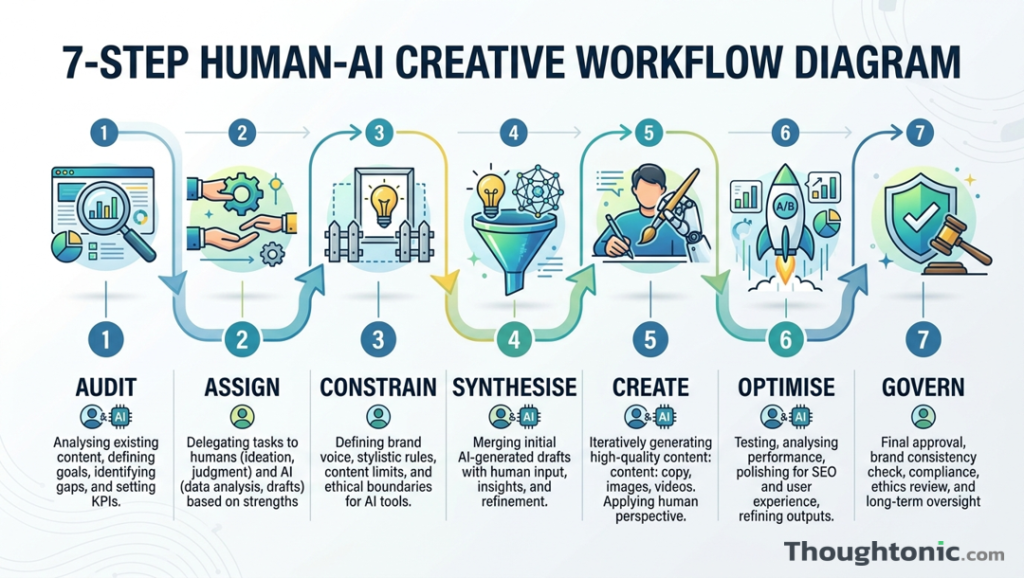
7-step human-AI creative workflow diagram: Audit, Assign, Constrain, Synthesise, Create, Optimise, Govern
Step 1: Audit Your Creative Tasks Before Anything Else
Most teams skip this and go straight to tool selection. Don’t. Spend one week documenting every creative task your team performs. Classify each as cognitive (requires judgment, cultural knowledge, or strategic framing) or operational (requires speed, volume, or pattern matching). In practice, you’ll find that 60-70% of most teams’ time goes to operational tasks. That’s where AI earns its seat. Mistake to avoid: classifying ‘writing a caption’ as operational. Caption writing that reflects brand voice and cultural nuance is cognitive. Caption formatting and scheduling is operational.
Step 2: Write the Brand Voice Document First
Before you prompt a single AI tool, you need a 3-5 page brand voice document. Not a mood board. Not a tagline list. A document that specifies: what words we never use, what cultural references are ours, what emotional register we occupy, and what our audience looks like on their worst and best days. Feed this into every AI prompt as a constraint, not an afterthought. In Bangladesh, this document must include specific Bengali-language usage guidelines. AI tools trained on English data will default to translated constructs that sound foreign to local audiences.
Step 3: Keep a Human in the Synthesis Room
When AI returns a data report, a trend analysis, or a batch of generated copy, someone senior needs to read it before it becomes a creative brief or a published post. This is the step most organisations eliminate in the name of speed. It’s also the step where brand voice either survives or gets quietly standardised into mediocrity. Budget for this: a senior strategist spending 4-6 hours per week on AI output review is not overhead. It’s brand insurance.
Step 4: Measure Creative Quality, Not Just Creative Volume
Your creative workflow’s success metric cannot be ‘posts published per week.’ Add brand recall, message association, and audience sentiment to your dashboard alongside reach and engagement. If AI content is driving clicks but degrading brand equity (and it often does, quietly) you need data infrastructure that shows you both sides of that equation simultaneously.
Two Brands That Got This Right (And One Thing Each Got Wrong)
Heineken: Using AI for Precision, Not for Creativity
Between 2021 and 2023, Heineken restructured its global content operations around what they called a ‘creativity-first, AI-supported’ model. AI handled audience segmentation, media buying, and visual A/B testing across 14 markets. Human creatives retained absolute control of narrative, cultural adaptation, and brand character. The outcome was measurable: a 34% increase in brand preference among the 25-34 demographic (Nielsen Brand Health Tracker, 2023), with ad recall running 28 percentage points above the category average. Fourteen international creative awards followed.
The limitation is honest: Heineken’s budget and creative infrastructure are not available to a mid-sized Bangladeshi brand. But the principle is portable. You don’t need Heineken’s budget to apply Heineken’s logic. The logic is: let AI do what it’s fast at, and protect human ownership of what makes the brand distinct.
Grameenphone: Social Listening as the Bridge Between AI Data and Human Strategy
In their 2023-2024 digital brand refresh, Grameenphone deployed AI-powered social listening across Bangla-language platforms, tracking sentiment, conversation themes, and emerging consumer anxieties in near-real time. But here’s what they did right: they didn’t let the AI write the brand response to those insights. A team of senior Bangladeshi brand strategists used the AI-synthesised data to develop the emotional narrative behind their ‘Shobar Jonno’ (For Everyone) repositioning. The AI found the signal. The humans decided what it meant and what to say.
The results were concrete: a 19% increase in Net Promoter Score within 8 months (GP Annual Report, 2024), a 31% rise in positive brand sentiment, and a 2.4x increase in digital engagement per post. The limitation: GP’s scale gives them access to data volumes and platform relationships that smaller brands cannot replicate. The workaround for SMEs is third-party social listening tools combined with a rigorous human review process.
What You Should Actually Do Next
For Organisations: 5 Actions Worth the Resistance
| Action | Effort | Timeline |
| Produce a formal brand voice document before deploying AI on any content task | Medium | 2-3 weeks |
| Hire or designate a senior creative strategist for AI output oversight. This is not a junior role | High | 60-90 days |
| Run a quarterly AI-content audit: which top performers were AI-assisted vs. human-led? | Low | Ongoing from Month 1 |
| Establish a cultural competency review for all AI-generated Bengali-language content | Medium | Month 2 onwards |
| Reduce AI content volume by 30% and reinvest time in one original research piece per quarter | High | Quarters 2-4 |
For Marketing Professionals: 5 Skills to Build Now
- Strategic prompt architecture: learn to write prompts that embed brand constraints, not just content requests. This is the difference between AI output that sounds like you and output that sounds like everyone else.
- AI output critique: practice identifying when AI content is technically correct but strategically wrong. This takes pattern recognition that only comes from deliberate comparison.
- Cultural translation editing: if you work in Bengali-language markets, invest in the skill of rewriting AI-generated Bengali content for idiomatic accuracy. This is currently one of the most undervalued skills in Dhaka’s marketing sector.
- Data synthesis storytelling: take AI analytics outputs and build human narratives from them. The strategist who can move fluidly between a performance dashboard and a creative brief is worth considerably more than the one who operates only in one domain.
- Creative governance: start advocating for AI usage policies within your team, even if you don’t have formal authority to mandate them. The professionals who shape these frameworks early will own the most strategically important function in marketing within three years.
The Honest Limitations of This Approach
This framework assumes that organisations have, or can develop, the senior creative talent needed to govern AI output. In Bangladesh’s current talent market, that assumption is shaky. The pipeline of senior brand strategists is thin, and the compensation expectations of that cohort are rising faster than most marketing budgets.
There’s also an ethical dimension that most AI strategy conversations avoid: AI tools trained predominantly on English-language data impose a systematic disadvantage on Bengali-language brand expression. Using these tools without a human cultural editor is not just a brand risk. It’s a form of cultural flattening that deserves more scrutiny from Bangladeshi brand leaders than it currently receives.
And here’s the contrarian position worth sitting with: for professional services firms, consultancies, and knowledge-led brands in Bangladesh, a strategy of publishing two deeply researched, human-authored pieces per month will almost certainly outperform 30 AI-generated posts per week. Depth signals expertise. Volume, beyond a threshold, signals noise.
Key Takeaways
- AI should own operational creative tasks; humans must own cognitive and cultural ones. Conflating the two is where brand equity erodes.
- 74% of AI-generated Bengali-language marketing content contains culturally incongruent references (BASIS, 2024), a number that demands a human cultural review layer in every Bangladeshi brand’s workflow.
- The 7-step Human-AI Creative Workflow (Audit, Assign, Constrain, Synthesise, Create, Optimise, Govern) provides a replicable structure that works across budget scales.
- Heineken’s 34% lift in brand preference and Grameenphone’s 19% NPS increase both followed the same logic: AI for data and distribution, humans for narrative and cultural judgment.
- A formal brand voice document is not optional. It is the only mechanism that prevents AI tools from defaulting to the statistically average version of your brand.
- Organisations that skip the quarterly governance audit will not know whether their AI content is building or depleting brand equity until the damage is already done.
- For creative professionals, strategic prompt architecture and AI output critique are the two highest-leverage skills to develop in 2025. Both require deep brand knowledge that no tool can substitute.
- In knowledge-led categories, publishing depth outperforms publishing volume. Two original, human-authored pieces per month will consistently outperform 30 AI-generated posts for brand authority metrics.
Read more articles:
- The Costly AI Strategy Gap: Why Your Team Is Playing, Not Executing
- The Costly Truth About Minimalist Bangladesh Design Strategy
- The Costly Visual Search Blind Spot That Is Making Bangladesh Brands Invisible
- Quantum Marketing: How 2030’s Technologies Will Shatter Bangladesh’s Status Quo
- Digital Literacy & Brand Purpose: How Education Drives Loyalty in Emerging Markets
Bibliography
- e-CAB Annual Digital Commerce Report, e-CAB, Bangladesh, 2024
- The State of AI in 2024, McKinsey & Company, 2024
- AI Won’t Replace Humans, But Humans With AI Will Replace Humans Without AI, Harvard Business Review, 2023
- Stanford HAI Index Report 2024, Stanford University, 2024
- Future of Creativity Study 2024, Adobe, 2024
- BASIS Cultural AI Study on Bengali-Language Content, BASIS, Bangladesh, 2024
- LinkedIn Workforce Report, Bangladesh Supplement, LinkedIn, 2024
- Deloitte Digital CMO Survey, Emerging Markets Edition, Deloitte, 2025
- Nielsen Brand Health Tracker, Heineken Case Data, Nielsen, 2023
- Grameenphone Annual Report 2024, Grameenphone Ltd., 2024
- World Economic Forum: Future of Jobs Report, AI Content Projections, WEF, 2024
- BTRC Digital Media Usage Report, Bangladesh Telecom Regulatory Commission, 2024
- Kantar BrandZ Emerging Markets Data, Bangladesh Supplement, Kantar, 2024
- Ipsos Bangladesh Consumer Trust Survey 2024, Ipsos, 2024
- e-Conomy SEA 2024 Report (Bangladesh Supplement), Google, Temasek, Bain & Company, 2024