The Costly Channel Partner Marketing Blind Spot Bangladeshi Brands Keep Ignoring
You’ve built a beautiful brand book. Has your dealer in Bogura ever seen it? Probably not: he’s improvising your pitch from memory, badly. Here’s the number that should worry you more than any campaign metric: Bangladesh’s internet penetration sits at approximately 44.5 percent, meaning roughly 55 percent of the country can’t be reached by the digital brand story you spent months perfecting. For most B2B2C companies here, channel partner marketing isn’t a nice-to-have layer of strategy. It’s the layer that actually closes the sale, and it’s the one nobody’s funding.
Why Bangladesh Punishes Weak Channel Partner Marketing Harder Than Other Markets
Here’s the thing about consumer-facing ad budgets in Bangladesh: they’re solving for reach in a market where reach was never the real bottleneck. Trust was. Research on Bangladesh’s consumer culture consistently shows that outside Dhaka’s affluent core, purchasing decisions lean heavily on community influence and local, relationship-driven credibility rather than national campaigns. In rural markets particularly, local brands and community-driven choices carry more weight than the polish of a television spot. That means the showroom conversation is doing far more persuasive work than your media plan.
Compare that to how last-mile retail actually operates. A study of Bangladesh’s private drug shops, used here as a proxy for how the country’s retail last mile functions, found that in 76 percent of shops, the owner and the salesperson were the same person, and salespersons routinely worked with little or no formal training. This isn’t a pharmacy-specific problem. It’s a structural description of how thousands of appliance showrooms, motorcycle dealerships, and mobile financial service agent points operate every single day. Your carefully worded brand promise gets filtered through someone who’s never been formally briefed on it, in a market where that person’s word carries more weight than your ad did.
Now layer on the supply-side pressure. Bangladesh’s motorcycle industry alone had production capacity of roughly 800,000 to 1,000,000 units annually by 2024, against domestic demand of only around 380,000 units. That’s a country awash in more supply than demand can absorb, across a category where five or six brands look nearly identical from across the showroom floor. When that’s the competitive reality, the dealer isn’t just a distribution point. He’s the tiebreaker. And most companies are marketing to the consumer while leaving the tiebreaker completely unmanaged.
The Science and the Structure Behind This Blind Spot
Let’s get analytical about why this keeps happening, because it isn’t stupidity, it’s structural incentive design. Marketing departments are measured on reach and engagement. Trade or channel teams, where they exist at all, are measured on sell-in volume and margin. Neither team owns the moment where a brand promise gets delivered, or butchered, at the counter. In my analysis, this is the single biggest reason channel partner marketing gets underfunded in Bangladesh: it falls into a gap between two departments that don’t share a KPI.
This is where it gets interesting globally, because fixing this gap pays off more than companies expect. Foundry’s 2024 State of Partner Marketing research found that 89 percent of partner marketers face real barriers just measuring partner engagement, meaning most organizations are essentially flying blind on how their channel represents them. Separately, partner-enablement research aggregated by Continu found that high-maturity partner organizations captured approximately 28 percent of overall revenue from partnerships, versus roughly 18 percent for low-maturity ones, a gap that traces back to how well partners are trained and supported, not how much co-op money changed hands.
There’s a brand-consistency angle too, worth flagging honestly. Widely cited industry studies, originally from Lucidpress and Demand Metric, have claimed that consistent brand presentation across channels correlates with revenue increases in the 23 to 33 percent range. I’d treat the specific figure with some caution since it originates from vendor-sponsored research, but the directional finding holds up: brands represented consistently at every touchpoint, including the dealer counter, tend to outperform brands that aren’t. Multiple industry surveys put the share of companies struggling to keep messaging consistent across channels well above 60 percent, and that’s before you even get to a dealer improvising in Bogura.
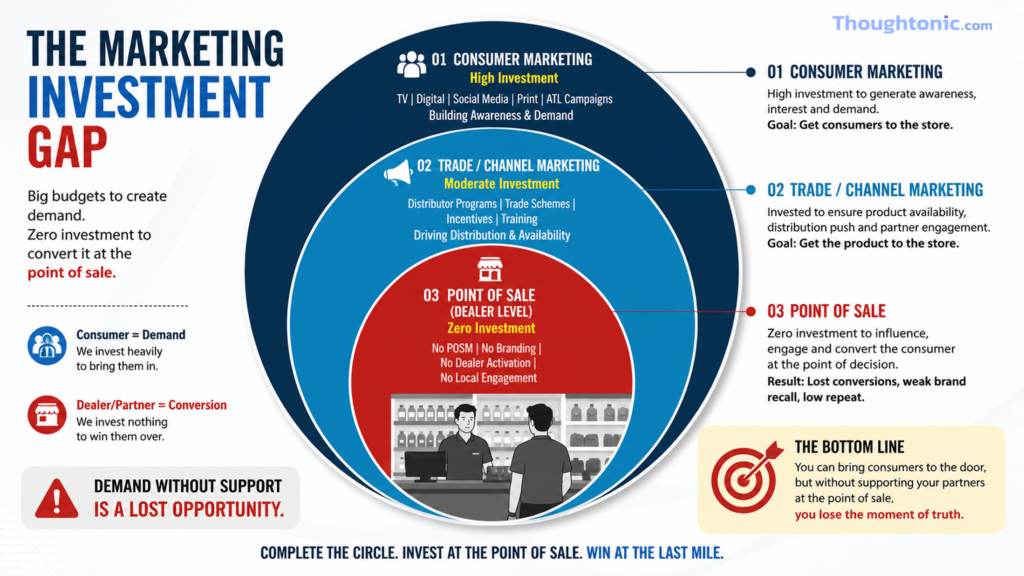
Picture three concentric rings. The outer ring is consumer-facing marketing (ads, social, PR), where almost all budget sits. The middle ring is the distributor layer, usually covered by a WhatsApp group and a price list. The inner ring is the actual point of sale, where zero percent of the marketing budget typically lands despite it being where 100 percent of purchase decisions get made. Every taka spent on the outer ring depends on the inner ring not sabotaging it. Most Bangladeshi B2B2C companies have never mapped their spend this way, and once you do, the imbalance is impossible to unsee.
The consequence compounds. A customer sees your ad, walks into a showroom primed to buy, gets a flat or inaccurate pitch, and either walks out or buys purely on price, meaning your ad spend built awareness that converted into a commodity transaction instead of a premium one. Do that across enough showrooms, and the dealer, not headquarters, becomes the de facto author of your brand’s market position, whether or not it matches the brand book gathering dust in Gulshan.
A Practical Framework for Fixing Channel Partner Marketing
You don’t need a six-month overhaul to start closing this gap. You need a sequence.
Step One: Audit the Counter, Not the Campaign
Send mystery shoppers into a representative sample of your dealer network and score whether staff can accurately describe your product’s actual differentiation. Most companies discover the gap is worse than they assumed, and it usually implicates sales leadership as much as marketing. Run it anyway. Success metric: percentage of dealers who can correctly recite the core positioning without prompting.
Step Two: Build a Pitch Kit People Will Actually Use
Not a 40-page brand guideline PDF nobody opens. Just a single laminated card, in Bangla, with the three things a dealer should say and the two things they shouldn’t. The mistake most brands make here is preserving too much nuance; simplicity is what survives a busy showroom floor. Success metric: field-verified adoption rate.
Step Three: Fund Channel Partner Marketing Training Like a Media Line Item
Reallocate a fixed percentage of trade marketing spend, even five percent to start, toward recurring, in-person dealer training rather than one-time launch events. Success metric: cost per trained dealer measured against cost per consumer impression, so leadership sees it in the same language as the rest of the media plan.
Step Four: Build a Real Feedback Loop, Not Just a WhatsApp Group
Dealers hear customer objections daily that your insight team pays research agencies to discover months later. Give them a structured, low-friction way to report what they’re hearing, and commit to responding. Success metric: number of product or messaging decisions traced back to dealer input.
Step Five: Pay for Fidelity, Not Just Volume
Tie a portion of dealer incentive payouts to accurate brand representation, assessed through periodic scorecards, not only to units moved. Success metric: percentage of total incentive payout linked to qualitative, not purely volume-based, criteria.
Case Studies: What Disciplined Channel Partner Marketing Looks Like
Sherwin-Williams’ long-running partnership with Toyota’s collision center network offers a genuinely useful global reference point, imperfect as the comparison is. Through their jointly run “Estimating Solutions for Profit” training program, offered across roughly 1,200 Toyota dealership partners and accredited by the Automotive Management Institute, participating Gulf States Toyota shops reported averaging more than a 150-dollar increase in repair order value. The lesson isn’t the dollar figure. It’s that a vendor funded structured, skills-based training at the partner level and could point to a specific commercial result. The limitation: this is a mature program between two large, well-capitalized U.S. corporations, in a market where dealer economics look nothing like a family-run showroom in Bangladesh, so the model needs real simplification before it transfers.
Closer to home, Walton Hi-Tech Industries is the more instructive story, even if it proves a slightly different point. Walton has built a distribution footprint of more than 25,000 sales points nationwide, including over 700 company-owned Walton Plaza showrooms, layered on a network reported at roughly 5,100 exclusive distributors and around 19,000 sub-dealers, a scale of last-mile presence that underpins a refrigerator category share widely cited in the 70 to 80 percent range. What Walton demonstrates is the power of owning enough of the showroom experience directly that brand fidelity becomes less dependent on training third parties. One honest limitation: I could not verify public figures on Walton’s dealer-training budget or curriculum, so treat this as evidence for network scale and owned retail, not documented proof of a formal training system.
Action Plans: What to Do Monday Morning
For organizations: Start with the mystery-shopper audit this quarter. It costs the price of a small agency retainer, roughly two to four weeks of fieldwork, and needs no new headcount. In parallel, draft the one-page vernacular pitch card, which a competent trade marketing lead can produce in two weeks. Within two to three months, pilot recurring training in one region before rolling out nationally, since Bangladesh’s regional dialects and buying habits differ enough that a single national script underperforms a localized one. Treat this as a redirection, not new spend: shifting five to ten percent of existing trade marketing budget from giveaways toward training and feedback infrastructure is enough to see measurable change within two quarters.
For professionals: Get comfortable auditing your own channel, even when it means telling a sales colleague their star dealer is misrepresenting the brand. Learn to write in vernacular Bangla for a showroom floor, not just polished English for a boardroom deck. Learn to read a dealer’s basic margin structure, because a pitch that ignores the dealer’s own profit logic won’t survive contact with a real sales floor. Get out from behind the desk and run a training session in person, uncomfortable as that is for digitally native marketers unused to holding a room of skeptical showroom owners. And practice building the internal case to shift budget away from paid media toward channel enablement. It’s harder to defend than a media plan with clean impression numbers, but it’s the pitch that protects your revenue.
The Critical Perspective: Where This Can Backfire
Channel partner marketing programs designed entirely in a Dhaka boardroom often fail the moment they meet a real showroom, because they’re built for a partner who behaves like a corporate franchisee when the actual dealer runs a small family business on relationships and margin logic first. A slick digital training module means little to a shop owner who learns by watching and doing, not clicking through an LMS. There’s a real risk that gets ignored too: over-scripting dealers produces compliance theater, where staff recite the approved pitch for an auditor and revert to old habits the moment a customer starts negotiating price. And it’s worth saying plainly: for small, owner-operated showrooms where the owner already is the trusted brand, a formal corporate training program can dilute the authenticity that made the relationship work. Doing less, in that narrow case, genuinely outperforms doing more.
Key Takeaways
- Bangladesh’s internet penetration was approximately 44.5 percent in early 2025, meaning a majority of the country is reached primarily through offline, relationship-driven channels rather than digital ads.
- In a Bangladesh retail study used here as a proxy for last-mile behavior, 76 percent of small retail outlets had the owner doubling as an untrained salesperson.
- Bangladesh’s motorcycle production capacity of roughly 800,000 to 1,000,000 units against domestic demand of about 380,000 units shows how oversupply pushes the real competitive battle down to the dealer counter.
- Globally, 89 percent of partner marketers report difficulty even measuring channel partner engagement, meaning most brands are managing this layer blind.
- High-maturity partner organizations captured approximately 28 percent of revenue from partnerships versus roughly 18 percent for low-maturity ones, according to partner-enablement research.
- Walton’s network of 25,000-plus sales points and roughly 700 owned showrooms illustrates how controlling more of the last mile directly reduces dependence on training third parties.
- A one-page vernacular pitch card will consistently outperform a comprehensive brand guideline PDF at the actual point of sale.
- Fixing channel partner marketing is an internal budget-reallocation problem before it’s a creative problem, the money is usually already in the building.
Read more articles:
- The Costly AI Strategy Gap: Why Your Team Is Playing, Not Executing
- The Costly Truth About Minimalist Bangladesh Design Strategy
- The Costly Visual Search Blind Spot That Is Making Bangladesh Brands Invisible
- Quantum Marketing: How 2030’s Technologies Will Shatter Bangladesh’s Status Quo
- Digital Literacy & Brand Purpose: How Education Drives Loyalty in Emerging Markets
Bibliography
- DataReportal – “Digital 2025: Bangladesh,” February 2025 – https://datareportal.com/reports/digital-2025-bangladesh
- Bangladesh Bureau of Statistics via BSS News – “Steady rise in internet use in recent years: BBS,” December 21, 2025 – https://www.bssnews.net/news/343905
- Wikipedia, citing BTRC and BBS data – “Internet in Bangladesh,” accessed 2026 – https://en.wikipedia.org/wiki/Internet_in_Bangladesh
- PMC/NCBI – “Exploring the status of retail private drug shops in Bangladesh,” facility-based cross-sectional study – https://www.ncbi.nlm.nih.gov/pmc/articles/PMC5506600/
- Premier Market Research Partner – “Market Research in Bangladesh: Cultural Traits,” April 2026 – https://culturaltraits.com/market-research-in-bangladesh/
- The Daily Star – “The Next 25 Years: Where Bangladesh’s Motorcycle Industry Is Headed,” December 30, 2025 – https://www.thedailystar.net/supplements/the-long-ride/news/the-next-25-years-where-bangladeshs-motorcycle-industry-headed-4068991
- MotorCyclesData – “Bangladesh Motorcycles – Fact & Data 2025,” September 15, 2025 – https://www.motorcyclesdata.com/2025/08/25/bangladesh-motorcycles/
- Foundry (IDG) – “2024 State of Partner Marketing Study,” July 24, 2024 – https://foundryco.com/news/partner-marketing-success-drives-confidence-and-increased-investment/
- Continu – “Partner Enablement Statistics (2026),” citing Paperflite research – https://www.continu.com/research/partner-enablement-statistics
- The Channel Company (IPED) – “The State of Partner Marketing 2025” – https://www.thechannelco.com/article/state-of-partner-marketing-2025
- Apollo.io, citing The CMO Survey – “What Is Channel Partner Marketing Strategy?” – https://www.apollo.io/insights/channel-partner-marketing-strategy
- gitnux.org – “Brand Consistency Statistics,” fact-checked 2026, aggregating Gartner and NielsenIQ references – https://gitnux.org/brand-consistency-statistics/
- Envive.ai – “40 Brand Voice Consistency Statistics in eCommerce in 2026,” citing Lucidpress/Demand Metric studies – https://www.envive.ai/post/brand-voice-consistency-statistics-in-ecommerce
- BodyShop Business – “Sherwin-Williams Automotive Finishes Partners with Toyota,” documenting the Gulf States Toyota repair order value result – https://www.bodyshopbusiness.com/sherwin-williams-automotive-finishes-partners-with-toyota-for-successful-estimator-training-program/
- FenderBender/ABRN – “Toyota, Sherwin-Williams continue estimator training program” – https://www.fenderbender.com/running-a-shop/operations/article/33026346/toyota-sherwin-williams-continue-estimator-training-program
- Future Startup – “Walton: Bangladesh’s E&E Champion With Global Ambitions,” December 2, 2025 – https://futurestartup.com/2025/05/28/walton-bangladeshs-ee-champion-with-global-ambitions/
- Studocu (academic report) – “Final Report on HR Management Strategies at Walton Group,” citing Walton’s 5,000+ outlet and 140+ plaza network figures – https://www.studocu.com/row/document/north-south-university/human-resouce-management/final-report-for-print-mgt351/27334050
- Demand Gen Report – “2024 Channel Partner Marketing Benchmark Survey” – https://www.demandgenreport.com/resources/channel-partner-marketing-benchmark-survey/47183/