The Costly Meeting Culture in Bangladesh That’s Quietly Killing Decisions
Count your meetings this week. Now count how many ended with an actual decision, a name attached to it, and a deadline. Uncomfortable, right? Most Dhaka offices run on a meeting culture in Bangladesh that mistakes attendance for output. Globally, senior managers already know something is broken. A widely cited Harvard Business Review analysis found that 71% of senior managers believe their own meetings are unproductive and inefficient. Bangladesh has its own version of this problem, and it runs deeper than bad scheduling. It is baked into how authority, hierarchy, and face-saving work in our offices, and it is costing CXOs far more than calendar space.
The Problem Isn’t Meetings. It’s What Bangladeshi Offices Use Them For
Here’s the thing most productivity articles miss: meetings in Bangladesh rarely fail because people talk too much. They fail because of what a meeting is culturally allowed to do. According to the Cultural Atlas’ analysis of Bangladeshi business practice, meetings here are generally held to establish who has the authority to decide, not to actually make the final call. That single sentence explains half the calendar bloat in Gulshan, Banani, and Motijheel offices. A meeting becomes a ritual of hierarchy rather than a decision venue, and decisions quietly migrate elsewhere, usually to a senior person’s desk, days later, without the people who did the analysis in the room.
Compare that to the global data. Fellow’s 2025 meeting research found that 92.4% of all meetings don’t have an end date, which means nobody is ever forced to ask whether the recurring sync still earns its slot. Atlassian’s research, cited widely across meeting-productivity studies, found that 77% of employees have sat in a meeting that existed only to schedule another meeting. Add Bangladesh’s high-power-distance office culture, documented in cross-cultural business research on South Asian administration, and you get a specific local failure mode: meetings that are long because ending early looks disrespectful, large because excluding someone looks political, and inconclusive because junior staff rarely challenge a senior view out loud. The Business Standard’s reporting on Dhaka’s private, NGO, and government offices captures this well: each sector has built its own meeting rhythm, and almost none of them are built around speed to decision.
Why This Actually Damages a Business, Not Just a Calendar
This is where it gets interesting. The damage isn’t just lost hours, it compounds.
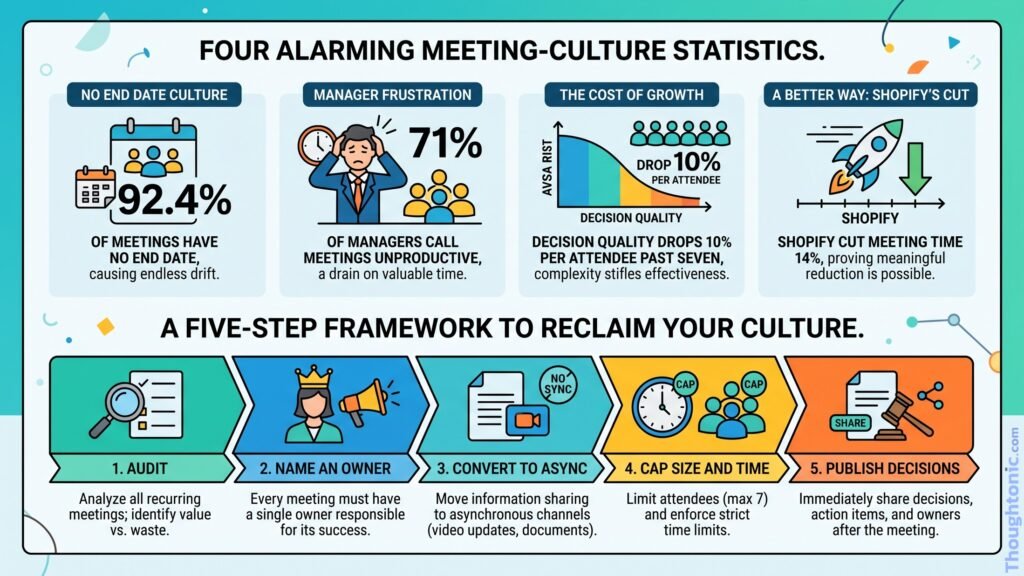
Start with the recurring meeting that has no expiry date, which Fellow’s research pegs at 92.4% of all meetings globally. Because nobody revisits it, the same eight or ten people show up weekly out of habit, not necessity. Bain & Company’s research on group decision-making found that decision quality drops by roughly 10% for every person added beyond seven attendees, so bloated Bangladeshi meetings, often over-invited for hierarchy and face reasons, are structurally worse at deciding before anyone opens their mouth. Because a decision doesn’t get made in the room, someone says “let’s take this offline” or “sir will confirm,” which is the local equivalent of Atlassian’s finding that 77% of meetings simply generate another meeting. That follow-up burns senior time that a Harvard Business Review-cited study says has already exploded, from roughly 10 hours a week for executives in the 1960s to more than 23 hours a week now. With that bandwidth gone, junior staff stop preparing seriously, because prepared and unprepared meetings tend to end the same way: with no decision. Action points, when they do exist, evaporate fast. Workplace productivity research found that nearly half of action items discussed in meetings are never captured or followed up on. Multiply this across a marketing team launching a campaign or a bank approving a partnership, and the real cost shows up: not wasted hours, but a visible drop in how fast the organization can execute against a market that isn’t waiting.
The Meeting Culture in Bangladesh Feedback Loop
Put together, this becomes a loop rather than a one-time inefficiency. Recurring meetings without expiry dates create habit. Habit plus hierarchy creates non-decisions. Non-decisions create follow-up meetings. Follow-up meetings consume senior time. Consumed senior time reduces preparation quality. Reduced preparation quality reduces the odds of a decision happening in the room, which feeds back into more recurring, inconclusive meetings. Every additional loop makes the meeting culture in Bangladesh more expensive to unwind, because by the time leadership notices, the recurring meetings have become part of “how we’ve always worked here.”
There is a genuine, if uncomfortable, counterargument worth stating plainly: in a business culture where trust is built through in-person presence and where indirect communication carries real signal, some of this apparent inefficiency is actually relationship maintenance, not waste. Removing it too fast, without building trust some other way, can break coordination that spreadsheets and Slack threads don’t replace. A reasonable professional could disagree with how far to push toward American-style ruthless meeting-cutting in a market where face-to-face trust still closes deals that a message never could.
A Practical Framework for Fixing Meeting Culture in Bangladesh
None of this requires a consultant deck. It requires leadership willing to make five specific, slightly uncomfortable calls.
1. Audit before you cut. Pull every recurring meeting on the org’s calendar and ask one question per meeting: has this produced a documented decision in the last 90 days? Leadership decision required: mandate the audit even though it exposes pet meetings senior people run. Trade-off: short-term friction and defensiveness. Metric: percentage of recurring meetings with zero documented decisions in 90 days.
2. Name a decision owner for every meeting that survives. One person, not a committee, owns the call. Leadership decision required: accept that this removes collective cover when a decision goes wrong. Trade-off: some staff will resist visible accountability. Metric: percentage of meetings with a named decision owner in the invite.
3. Kill or convert status meetings to a written update. If a meeting exists only to report status, it should be a shared document, not a room full of people. Leadership decision required: senior managers must actually read the document instead of asking for a verbal recap anyway. Trade-off: requires better writing discipline across the team. Metric: number of recurring status meetings converted to async updates.
4. Cap the invite list and the clock. Default to 25 or 45 minutes, not 30 or 60, and cap attendance at seven unless there’s a specific reason to exceed it, in line with the Bain & Company decision-quality data cited above. Leadership decision required: accept that some people will feel excluded. Trade-off: requires trusting delegates to represent their teams’ views accurately. Metric: average attendee count and average duration per meeting.
5. Publish a decision log, not minutes. Every surviving meeting ends with one line: what was decided, who owns it, and by when. Leadership decision required: normalize ending a meeting with “no decision” as a visible, trackable outcome rather than a hidden one. Trade-off: exposes meetings that keep producing nothing. Metric: percentage of meetings that close with a published decision log.
Case Studies: What Happens When You Actually Cut
The clearest global proof point is Shopify. In January 2023, the company canceled roughly 12,000 recurring meetings involving three or more people and reinstated meeting-free Wednesdays. By July 2023, Shopify’s CFO reported average meeting time down 14% versus the same period the previous year, with Wednesday meeting time down about 26%. Shopify then built an internal cost calculator showing a typical 30-minute meeting cost the company between $700 and $1,600, designed to make attendees think twice before accepting an invite. Some secondary write-ups of the same initiative cite a larger 33% reduction and a 25% jump in completed projects; those trace back to internal reporting rather than an audited study, so treat the CFO-confirmed 14% as the defensible number and the rest as directionally supportive, not verified.
Bangladesh doesn’t have an equivalent, publicly documented, metrics-backed case of a company auditing and cutting its meeting load, and that absence is itself telling. What we do have is a documented cultural pattern: The Business Standard describes how private offices, government offices, and NGOs in Dhaka have each built distinct meeting rhythms shaped by institutional incentives rather than decision speed. That pattern, not a named company’s before-and-after numbers, is the honest local evidence available, and it points to the same fix: separate the meeting that exists to show respect for hierarchy from the one that exists to decide something.
Action Plans: Organizations and Professionals
For organizations, five moves face real resistance and are worth doing anyway. Mandating a 90-day meeting audit across departments is low effort and can start this month with a few hours of calendar review. Requiring a named decision owner on every recurring meeting is also low effort and should start immediately. Converting status meetings to written async updates is medium effort, needs a shared tool most companies already own, such as Google Docs or Notion, and can roll out over a quarter. Capping meeting size and default duration company-wide is medium effort and needs manager buy-in. Rebuilding review criteria so managers aren’t implicitly rewarded for calendar density is high effort, touches HR policy, and belongs in a six-to-twelve-month plan tied to the next review cycle.
For professionals, five skills are genuinely uncomfortable in a high-power-distance office. Declining a senior colleague’s invite politely, in writing, can read as insubordination even when the ask is reasonable. Asking “what decision are we making today” in a room full of superiors can expose that a meeting was never going to decide anything. Documenting and circulating decisions in writing, especially disagreements, removes ambiguity some people rely on for cover. Pushing back on being copied into a meeting with no clear role can look like disengagement. Ending a meeting on time when a senior person is still talking directly tests hierarchy norms. None of these are dramatic, but they are the real behavior change a leaner meeting culture in Bangladesh requires.
Where This Approach Has Real Limits
Cutting meetings hard, fast, and without adapting for context is a legitimate risk, not just a hypothetical one. In sectors where regulatory approval chains and relationship-based trust genuinely require in-person conversation, such as banking compliance or government-facing business, an aggressive Silicon Valley-style meeting purge can slow things down rather than speed them up. There’s also an ethical wrinkle worth naming honestly: publishing decision logs and naming decision owners increases individual accountability, which can be used constructively or can turn into a blame mechanism in organizations with weak psychological safety. And in some cases, doing less really is better than doing something: a team drowning in unclear priorities doesn’t need a sharper meeting framework, it needs clearer strategy first, and no amount of meeting discipline fixes a strategy problem dressed up as a scheduling problem.
Key Takeaways
- A meeting culture in Bangladesh built around hierarchy display, not decision-making, is a documented pattern, not an assumption, per Cultural Atlas’ business-culture research.
- Globally, 71% of senior managers already admit their meetings are unproductive, per Harvard Business Review-cited research, so this isn’t a uniquely Bangladeshi failure, just a locally amplified one.
- 92.4% of recurring meetings have no end date, according to Fellow’s 2025 research, meaning almost nothing on most calendars gets re-evaluated.
- Bain & Company’s research shows decision quality drops roughly 10% for every attendee beyond seven, which directly punishes the large, hierarchy-driven invite lists common in Dhaka offices.
- Shopify’s CFO confirmed a 14% reduction in meeting time within six months of a meeting purge, a concrete, verifiable benchmark for what disciplined cutting can achieve.
- Fixing this needs five specific moves: audit, name an owner, convert to async, cap size and time, and publish decisions, not minutes.
- The riskiest failure mode is applying this framework without adjusting for sectors where in-person trust-building is genuinely load-bearing, not just habitual.
- If the real problem is unclear strategy, no meeting framework will fix it, and leaders should diagnose that first.
Read more Articles:
- The Costly AI Strategy Gap: Why Your Team Is Playing, Not Executing
- The Costly Truth About Minimalist Bangladesh Design Strategy
- The Costly Visual Search Blind Spot That Is Making Bangladesh Brands Invisible
- Quantum Marketing: How 2030’s Technologies Will Shatter Bangladesh’s Status Quo
- Digital Literacy & Brand Purpose: How Education Drives Loyalty in Emerging Markets
Sources
- Harvard Business Review-cited meeting statistics – Noota, 2026
- 45 Meeting Statistics and Behavior Trends in 2025 – Fellow.ai, 2025
- Work Meetings in Numbers: Latest Meeting Statistics 2025 – Archie, 2026
- Team Decision-Making Statistics: 50+ Studies & Data – DecTrack, 2026
- Meeting Waste Statistics for 2026 – MeetingToll, 2026
- Shopify’s CFO explains how its new meeting cost calculator works – Fortune via Yahoo Finance, July 2023
- Time is money: Shopify introduces a cost calculator for pointless meetings – The Corporate Governance Institute, 2025
- Meeting fatigue and productivity in the age of AI – Fortune, February 2026
- Asana Anatomy of Work Index 2022 – Asana / Business Wire, 2022
- Meeting Cost Statistics 2026 – SpeakWise, 2026
- Bangladeshi Business Culture – Cultural Atlas, SBS
- Can Bangladesh establish a common workplace culture? – The Business Standard, December 2025
- The corporate sector in Bangladesh needs a cultural reset – The Daily Star
- Bengali Business Culture: Doing Business in Bangladesh – Commisceo Global, 2026
- Cultural Considerations in Bangladesh – Rivermate, 2025
- Administrative Culture and Incidence of Corruption in Bangladesh: A Search for the Potential Linkage – Haque & Mohammad, International Journal of Public Administration, 2013
- Work Culture in Bangladesh: How Employee Engagement Is Transforming Workplaces – PiHR, 2026