AI in Marketing in Bangladesh: Costly Hype vs 7 Real Wins
Every boardroom in Dhaka has the same slide this year: a steep curve and two words, “AI strategy”. Here’s what the slide leaves out. McKinsey’s 2025 global survey found that only 39% of organisations report any enterprise-level profit impact from AI, and most of them say it’s under 5% of EBIT. MIT’s NANDA study went further: 95% of generative AI pilots showed no measurable P&L impact. I’ve sat through enough vendor demos in Gulshan and Banani to believe both numbers. AI in marketing isn’t failing because the tools are weak. It fails because brands buy tools before they choose a decision worth improving. This article shows where AI in marketing is paying off in Bangladesh, where it isn’t, and how to start without burning a quarter’s budget.
The hype gap: why AI in marketing keeps overpromising here
The global picture is clear: AI in marketing is absorbing budget faster than it’s building capability. Gartner’s 2026 CMO Spend Survey shows CMOs putting 15.3% of marketing budgets into AI, yet 70% admit their processes aren’t mature enough to scale it, and total budgets sit flat at 7.8% of revenue.
Bangladesh shows the same gap in sharper form. Telenor Asia found workplace AI use jumped from 44% to 62% in a year, but only half of employees say their company has a formal AI strategy. PwC Bangladesh’s CEO survey says it in boardroom language: culture supports AI, enterprise-wide deployment stays limited. That’s usage without direction. Everyone has a chatbot open, but AI in marketing without a metric is just a faster way to produce average work.
Then there’s the audience these tools learn from. Facebook reached 77.0 million Bangladeshis in June 2026, but 62.6% of them are men. Instagram’s 11.4 million skews 64.3% male. When AI in marketing tools optimise on that data, they learn a male, urban, Facebook-first version of the country. If your buyer is a woman in Rajshahi shopping at a neighbourhood store, the algorithm barely sees her.
But here’s the thing. MIT found about half of enterprise GenAI budgets go to sales and marketing, while the sharpest savings came from back-office operations. In my analysis, Bangladeshi brands make that mistake twice: they overspend on content tools and underspend on trade execution, where our biggest brands actually win or lose. The rules are tightening too. The Personal Data Protection Act 2026 (passed in April, per Securiti’s overview) and the draft National AI Policy 2026-2030 make careless data habits a legal cost, not only a reputational one.
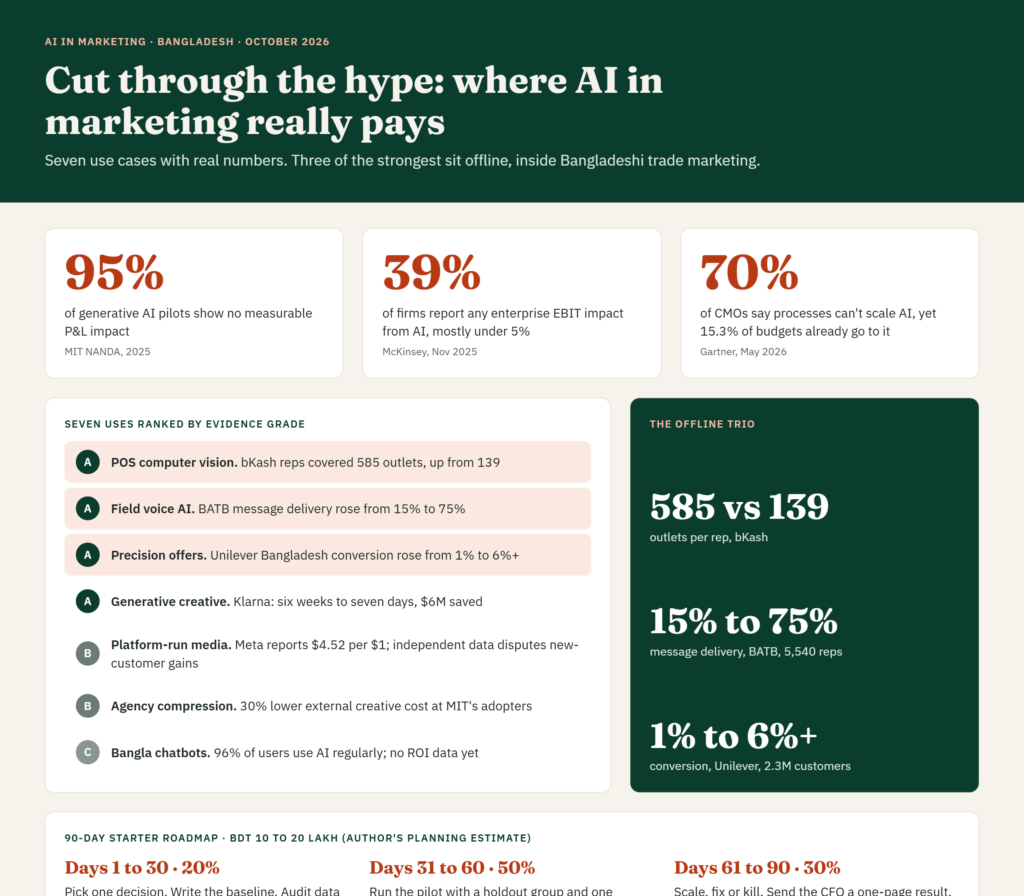
Seven proven uses of AI in marketing, ranked by strength of evidence
I filtered ruthlessly. A use case made the list only if it had a before-and-after number from a named organisation. Four of the seven draw on Bangladeshi data. Grade A means a named before-and-after number, B means partial or contested, C means directional only.
| # | Use case | Result | Source | Grade |
|---|---|---|---|---|
| 1 | Computer vision for point-of-sale checks | bKash reps covered 585 outlets, up from 139 (320% productivity) | Daily Star, Feb 2025 | A |
| 2 | Voice AI for field message delivery | BATB brand message delivery rose from 15% to 75% across 5,540 reps | Daily Star, Feb 2025 | A |
| 3 | Precision offers for small retailers | Unilever Bangladesh conversion rose from 1% to 6%+ (up to 13%) | Daily Star, Feb 2025 | A |
| 4 | Generative creative production | Klarna image cycle fell from six weeks to seven days; $6M saved | Banking Dive, May 2024 | A |
| 5 | Platform-automated media buying | Meta reports $4.52 revenue per $1 on Advantage+ Shopping | Campaign Canada; Wicked Reports, 2025 | B |
| 6 | Agency spend compression | 30% lower external creative costs among MIT’s successful adopters; Klarna saved $4M on suppliers | PPC Land; Banking Dive | B |
| 7 | Bangla conversational support | 96% of internet users use AI regularly; trust in chatbots is high | Telenor Asia, Dec 2025 | C |
Where AI in marketing earns its keep first
This is where it gets interesting. The top three rows aren’t content tools. They fix trade marketing, where bKash alone had roughly eight lakh outlets to monitor. In my analysis, the highest-return AI in marketing in Bangladesh sits offline, because that’s where margin leaks: a poster missing from a shop, a rep who skips the brand message, a discount sent to the wrong retailer. My view, and you can push back on it: most Bangladeshi brands should spend their first AI taka on trade execution, not content.
Rows four to six are real but cost-side. They make you faster and cheaper, not more loved. Row five deserves suspicion: Meta reports $4.52 of revenue per dollar on Advantage+ Shopping, yet an independent analysis of 55,661 campaigns found manual campaigns acquiring new customers more cheaply by May 2025. Row seven is demand without proof. Telenor’s data says Bangladeshis trust AI chatbots, but nobody has published a conversion lift in Bangla.
A six-step framework for putting AI in marketing to work
Here’s the sequence I use to make AI in marketing pay for itself. Each step has the move, a real example and the mistake I see most.
- Pick one decision. Choose a repeated choice with money attached, such as which outlet to visit or which offer to send. bKash’s merchandiser routing is the model. The mistake: starting with “we need a chatbot”.
- Baseline before you buy. Write down today’s number and its cost. Unilever’s 1% starting conversion made a 6% to 13% result provable. The mistake: measuring tool usage instead of outcomes.
- Fix the data join. Link outlet, CRM, mobile-wallet and social IDs, with consent recorded. Personalised discounts for millions of customers only work when purchase records are clean. The mistake: buying a customer data platform before cleaning the spreadsheets.
- Redesign the workflow. Remove the approval step the AI makes redundant. Klarna cut image cycles from six weeks to seven days with brand, quality and legal checks built in. The mistake: bolting AI onto a seven-signature approval chain.
- Protect the brand. Assign native-Bangla human review, a disclosure rule and a no-go list. Coca-Cola’s 2025 AI holiday ad drew heavy online backlash, though System1 data suggested private reactions were kinder. The mistake: letting speed override taste.
- Scale only on proof. Run a four to six week holdout test and scale if lift beats cost. Independent campaign data shows platform dashboards can flatter results. The mistake: trusting the vendor’s own report.
Two case studies: Klarna’s cost engine and Unilever Bangladesh’s precision play
Klarna (global, Q1 2024). Klarna is the clearest global proof that AI in marketing can cut cost without cutting output. The Swedish fintech trimmed sales and marketing spend 11% while running more campaigns. AI drove about 37% of the savings, roughly $10 million annualised. Image development fell from six weeks to seven days, saving $6 million. Culture mattered: 87% of staff used generative AI in daily work, so adoption wasn’t a training project. The limitation: these are company-reported, cost-side figures. They say nothing about whether customers like Klarna more.
Unilever Bangladesh (reported February 2025). Its Fordo tool, built by local firm Intelligent Machines, recommends personalised discounts to 2.3 million customers across about 4,500 kitchen markets. Conversion rose from 1% to 6% and above, often reaching 13%. The cultural fit is worth noting: the AI advises on offers inside relationships Unilever’s reps already own, rather than replacing the human visit. That’s my read, not Unilever’s claim. BATB shows a similar pattern with Shobdo, its Bangla keyword-spotting tool, which lifted brand message delivery from 15% to 75% across 5,540 reps and 200,000 outlets. And bKash’s Biponon let representatives cover 585 outlets instead of 139. The limitation: these figures come from a newspaper feature, with no public control group and no brand-health data.
Both cases show AI in marketing working when it’s pointed at a metric the business already tracked.
Action plans: a 90-day starter roadmap for AI in marketing
Budget first. A focused pilot for AI in marketing at a mid-size brand should run BDT 10 to 20 lakh over 90 days, roughly $8,000 to $16,000. That’s my planning estimate, not a published benchmark. Buy, don’t build: MIT found internally built tools succeed about one-third as often as purchased ones.
Organisations
- Days 1 to 30 (about 20% of budget): pick one decision, write the baseline, audit data and consent records. Effort: low to medium.
- Days 31 to 60 (about 50%): run the pilot with a holdout group and one accountable owner. Effort: medium.
- Days 61 to 90 (about 30%): decide to scale, fix or kill, and send the CFO a one-page result. Effort: low.
The moves leaders resist most are freezing new tool purchases for 30 days, rewriting agency contracts to pay for outcomes, and cleaning data, which is high effort and zero glamour.
Professionals. Five skills feel uncomfortable and pay off: reading a holdout test, editing Bangla copy with a native editor’s ear, joining datasets in a spreadsheet or SQL, writing a baseline memo before touching a tool, and rejecting AI output when it’s off-brand. Gartner found only 32% of marketers believe they need to update their skills. That complacency is your opening.
Where AI in marketing breaks: risks and limits
The honest limit of AI in marketing is evidence quality. Treat every number here as directional, because most come from company statements, vendors or press features. Three risks get ignored. First, audience skew: with 62.6% male Facebook reach, optimisation can quietly narrow who your brand speaks to. Second, ethics: voice AI that scores field reps’ conversations is workplace monitoring, and consent and purpose limits under the new data law will matter, so ask counsel before copying Shobdo-style tools. That’s my inference, not a legal finding. Third, sometimes doing less wins. If your sales close in Bangla Messenger chats and you handle a few hundred a day, a trained team with saved replies can beat a bot you can’t yet measure. Tag 90 days of conversations first.
Key takeaways
- AI in marketing pays when it’s tied to one decision with a baseline. MIT found 95% of pilots show no P&L impact, and McKinsey found only about 6% of firms qualify as AI high performers.
- Budgets are racing ahead of readiness: CMOs put 15.3% of marketing budgets into AI while 70% admit their processes can’t scale it (Gartner, 2026).
- The best-documented Bangladeshi wins are offline: 585 versus 139 outlets per rep, 15% to 75% message delivery, 1% to 6%+ conversion.
- Generative creative cuts cost and cycle time, but brand risk stays with you.
- Treat platform dashboards as claims, not proof. Run holdouts.
- With Facebook 62.6% male, check who your AI in marketing stack can’t see.
- Data consent is now a design requirement under the PDPA 2026.
- Start small: BDT 10 to 20 lakh, 90 days, one owner, one decision.
Read More Articles:
- The Costly AI Strategy Gap: Why Your Team Is Playing, Not Executing
- The Costly Truth About Minimalist Bangladesh Design Strategy
- The Costly Visual Search Blind Spot That Is Making Bangladesh Brands Invisible
- Quantum Marketing: How 2030’s Technologies Will Shatter Bangladesh’s Status Quo
- Digital Literacy & Brand Purpose: How Education Drives Loyalty in Emerging Markets
Bibliography
Where I couldn’t retrieve a primary report, I cite the secondary coverage. Check the primary before quoting in client work.
- Digital 2026: Bangladesh – DataReportal, late 2025 (data as of Oct 2025)
- Facebook users in Bangladesh, June 2026 – NapoleonCat, Jun 2026
- Instagram users in Bangladesh, June 2026 – NapoleonCat, Jun 2026
- 96% of Bangladeshi Internet Users Now Use AI Regularly (Telenor Asia, Digital Lives Decoded 2025) – MEA Tech Watch, 9 Dec 2025
- Feature on AI adoption by Bangladeshi companies (bKash, Unilever, BATB, Robi) – The Daily Star, Business Plus, 22 Feb 2025
- An Overview of Bangladesh’s Personal Data Protection Act, 2026 – Securiti, 29 Jun 2026
- Bangladesh’s Personal Data Protection Ordinance 2025: key takeaways – The Daily Star, Oct 2025
- Draft AI policy tightens state oversight – The Financial Express, 2026
- CEOs optimistic about growth prospects despite tech transition challenges (PwC Bangladesh 29th CEO Survey) – The Financial Express, 2026
- Impact of Artificial Intelligence on Future Marketing – United International University repository, n.d.
- Artificial Intelligence in Digital Marketing: A Bangladeshi Perspective – United International University repository, n.d.
- The state of AI in 2025 – McKinsey & Company, Nov 2025
- MIT report: 95% of corporate generative AI pilots fail to deliver returns – Computing, Aug 2025
- MIT reveals 95% of GenAI initiatives fail as learning gap widens – PPC Land, 2025
- Gartner 2026 CMO Spend Survey press release – Gartner, 11 May 2026
- AI remains a top priority for CMOs, but spending lags – Marketing Dive via Yahoo Finance, 2026
- Klarna generative AI cuts marketing spend – Banking Dive, May 2024
- Klarna says it has cut marketing costs by $10m with GenAI – Verdict, 28 May 2024
- How Meta’s new Generative AI tools can deliver seasonal success – Campaign Canada, n.d. (Meta-reported figures)
- Meta Is Pushing Advantage+ Campaigns Relentlessly: 55,661 Campaigns – Wicked Reports, 2025
- Coca-Cola Gets Into AI-Generated Spirit With Holiday Ads – eWEEK, Nov 2025
- The GenAI Divide: Why 95% of Companies Aren’t Seeing ROI – Atrium, 2025
- Digital Marketing Trends 2026 (citing Salesforce State of Marketing 2026) – Stripo Research, 2026