The Hidden Sonic Branding Gap Costing Bangladeshi Brands Their Voice
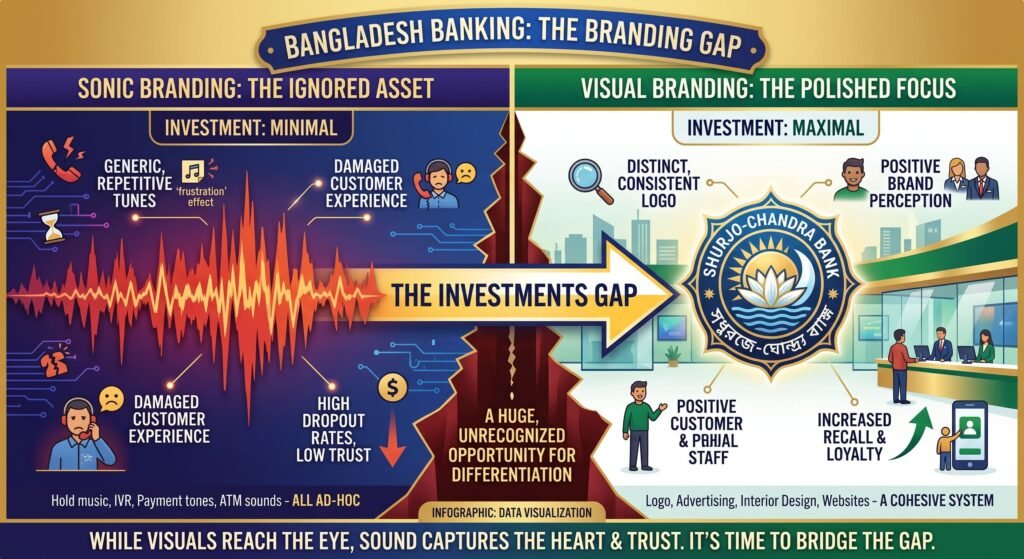
Call three banks in Dhaka back to back and put them on speaker. The first plays a tinny orchestral loop that could be selling insurance in Ohio. The second gives you a distorted MIDI version of a tune nobody can place. The third hums a generic corporate drone that sounds pulled from a royalty-free folder in 2011. None of it says the bank’s name. None of it survives ten seconds after you hang up. This is the state of sonic branding in a country that will argue for an hour over a logo’s exact shade of blue but has never once asked what its brands sound like. Sound is the one identity layer nobody in Bangladeshi marketing is designing on purpose, and that’s a genuinely expensive blind spot.
Why Sonic Branding Keeps Losing to Logos in Bangladesh
Visual identity has a budget line, a design agency, and a brand manual with Pantone codes. Sound gets whatever the IT vendor had installed on the PBX system. That gap matters more here than in most markets, because Bangladesh is quietly audio-heavy. Bangladesh Bank data shows mobile financial services carried 678.63 million transactions worth Tk 1.58 trillion in October 2025 alone, most of them touching a call center, an IVR menu, or a helpline at some point. The country had roughly 187 million mobile phone subscribers as of late 2025, per BTRC figures reported by The Business Standard, with Grameenphone alone holding 45.7 percent of that base. Every one of those subscribers has heard a hold tune, a low-balance alert, or an app notification more times than they’ve consciously looked at a logo that week.
Globally, the market has already priced this in. The sonic branding market hit roughly $1.12 billion in 2024 with a projected annual growth near 14 percent through 2033, according to one industry estimate, though a competing report puts 2024 value closer to $2.12 billion, a spread wide enough that I’d treat either figure as directional rather than precise. Either way, global brands are moving. Bangladeshi ones, largely, are not.
What a Sonic Branding System Actually Contains
Here’s where it gets interesting: most marketers in Dhaka think sonic branding means a jingle, and a jingle is the smallest, least strategic piece of it. A real sonic identity is a system: a sonic logo (two to four seconds, the audio equivalent of a wordmark), a hold and IVR loop, notification and UI sounds, and a voice register for anything read aloud. Intel’s five-note chime, Netflix’s “ta-dum,” and McDonald’s sung tagline are the textbook sonic logos, but the system behind them is what actually compounds recall over years, not the single asset everyone remembers.
The psychological case for building this is fairly direct. Veritonic’s research (drawing on Edison Research’s Infinite Dial study) found that 77 percent of consumers recall a brand more easily when it’s tied to a specific sound, and consistent sonic branding has been linked to ad recall gains of up to 17 percent on radio and 14 percent on podcasts. Some industry sources also cite sound being processed by the brain in roughly 0.146 seconds, nearly three times faster than a visual logo. I haven’t been able to trace that figure to an original peer-reviewed study, so treat it as a widely repeated claim rather than a confirmed one.
The bigger, harder-nosed data point comes from SoundOut’s 2025 Index, the largest sonic-logo tracking study run to date: 174 brands, over 70,000 consumers. It found something uncomfortable for anyone assuming a nice tune is enough. While 36 percent of consumers claim to recognize a sonic logo, only 43 percent of those claims are actually accurate, and accuracy collapses to 18 percent when the brand name isn’t woven into the sound itself. Sonic logos that include the brand name are roughly nine times more effective at driving real attribution than pure musical stings. That single finding should reframe how any Bangladeshi brand thinks about commissioning sound: a beautiful melody with no name embedded in it is closer to ambient music than to a brand asset.
How Poor Sonic Branding Loses You Customers on Hold
This is the part that should worry finance departments, not just brand teams. Call abandonment research consistently shows long hold times as the number-one driver of hang-ups across every industry studied, and one widely cited benchmark says 60 percent of callers won’t wait past one minute. Repetition in hold music has been shown to make the wait feel longer, and dead air makes callers assume they’ve been disconnected, so they hang up even faster than with mediocre music. In my analysis, this is where brand and operations quietly collide in Bangladeshi call centers: the same generic loop plays across banks, MFS providers, and telecom helplines handling tens of millions of calls a month, actively working against both customer experience and brand recall at the same time.
A Five-Step Framework for Building an Audio Identity
1. Audit. List every place your brand currently makes sound: hold queue, app, notifications, retail counters, ads. Leadership decision: assign one owner for audio the way there’s already an owner for the logo. Trade-off: this exposes how fragmented and cheap the current sound actually is, which is uncomfortable in a review meeting. Metric: number of touchpoints inventoried and rated for consistency.
2. Define. Translate brand personality into sound parameters (tempo, instrumentation, mood) the same way a brand book defines typography. Decision: commit real budget instead of treating this as a design freebie. Trade-off: this takes weeks a busy marketing calendar doesn’t want to give up. Metric: a written sonic brief, signed off like a visual brand guideline.
3. Compose. Commission a sonic logo and hold-loop as one connected system, not two separate purchases. Decision: pick a composer or studio based on strategic fit, not lowest quote. Trade-off: costs more upfront than a stock hold-music subscription. Metric: recognition testing on a sample audience before launch.
4. Deploy. Replace every default sound (IVR, hold queue, app notification) in one coordinated rollout rather than piecemeal. Decision: push vendors (telecom, call center software, app developers) to actually implement it, which requires cross-department muscle marketing teams rarely flex. Trade-off: short-term friction with IT and outsourced call center partners. Metric: percentage of touchpoints live with the new sound within 90 days.
5. Govern. Protect the asset in the brand guideline, monitor for drift, and re-test recall periodically. Decision: treat sound with the same governance as the logo, including legal protection where possible. Trade-off: ongoing cost with delayed payoff. Metric: unaided recall in periodic brand tracking.
Case Studies: A Global Bet and a South Asian Signature
Mastercard remains the reference case, not because it’s exotic but because it’s measured. Its “Sonic DNA,” built with agency amp over roughly two years starting around 2019, was adapted into 148 localized melody versions and deployed across an estimated 500 million audio touchpoints worldwide, including point-of-sale acceptance sounds in 210-plus countries. Mastercard’s own commissioned GFK research (2019–2020) found 65 percent of consumers felt a store felt more trustworthy with the sound present, and the brand states shoppers exposed to it were 2.5 to 4 times more likely to return. The limitation is straightforward: this is Mastercard-funded research measuring a Mastercard-funded asset, so the numbers should be read as directionally positive rather than independently audited.
Closer to home, Mahindra worked with composer A.R. Rahman to build a full sonic identity spanning more than 75 designed sounds, from electric-vehicle hums to engine notes, launched as part of its automotive rebrand in the early 2020s. It’s a genuinely useful South Asian reference point for scale and ambition. But here’s the thing: I found no verified case of any Bangladeshi brand commissioning a comparable proprietary sonic identity system. That absence isn’t a footnote; it’s the actual finding. The territory is empty, which is precisely why claiming it now is cheap relative to claiming it in five years once competitors move first.
What to Do Monday Morning
For organizations, in order of increasing effort: audit existing sounds across touchpoints (low effort, roughly a week, no budget); rewrite the call center hold-music brief before the next vendor renewal instead of auto-renewing (low effort, near-zero incremental cost); commission a proprietary sonic logo from a composer, budgeting comparably to a mid-tier logo redesign, realistically several lakh taka depending on scope, which you should verify against current agency quotes rather than treat as fixed (medium effort, 6–10 weeks); add an audio section to the brand guideline document (medium effort); and pursue legal registration of the sound mark where Bangladesh’s IP framework allows it (high effort, uncertain timeline given how nascent this area of local IP practice is).
For professionals, the uncomfortable skills are less technical than they sound. Learning to brief a composer is uncomfortable because most marketers have never had to translate strategy into tempo and timbre. Giving structured feedback on a sound draft is uncomfortable because taste feels more personal and less defensible than feedback on a headline. Negotiating with call center and telecom vendors to swap out default hold music is uncomfortable because it’s a cross-department fight nobody wants to start. Measuring an intangible outcome like sound recall is uncomfortable given how little local research infrastructure exists for it. And asking finance for a budget line that’s never existed before is uncomfortable no matter how good the pitch is.
Where This Can Go Wrong
Sonic branding fails in Bangladesh for boring reasons: agencies push cheap stock tracks because clients don’t know to ask for better, and CMOs treat sound as a production detail rather than a strategic asset until it’s already live everywhere and hard to change. There’s also a genuinely under-discussed risk: notification and UI sound overload in a market where phones are shared, data is metered, and silent mode is often the default; a brand chasing sonic presence can easily become the brand associated with an annoying buzz rather than a pleasant one. And doing less can be the smarter call: an early-stage startup with two customer touchpoints doesn’t need a 75-asset system: one clean, well-tested notification chime might outperform an expensive full identity that nobody hears often enough to remember.
Key Takeaways
- Sonic branding in Bangladesh is largely unclaimed territory. I found no verified case of a Bangladeshi brand building a proprietary sonic identity system.
- Roughly 187 million mobile subscribers and 678.63 million monthly MFS transactions mean sound touches Bangladeshi consumers constantly, more often than most visual brand assets.
- Sonic logos that embed the brand name are about nine times more effective at driving real attribution than pure musical stings, per SoundOut’s 2025 Index.
- Long hold times remain the top driver of call abandonment industry-wide, and repetitive or generic hold music makes the wait feel longer, not shorter.
- Mastercard’s Sonic DNA system spans an estimated 500 million audio touchpoints across 210-plus countries, though its recall statistics come from brand-commissioned research.
- Start with an audit and a hold-music rewrite before committing to a full sonic identity system. The cheapest fixes are also the most neglected.
Read More Articles:
- The Costly AI Strategy Gap: Why Your Team Is Playing, Not Executing
- The Costly Truth About Minimalist Bangladesh Design Strategy
- The Costly Visual Search Blind Spot That Is Making Bangladesh Brands Invisible
- Quantum Marketing: How 2030’s Technologies Will Shatter Bangladesh’s Status Quo
- Digital Literacy & Brand Purpose: How Education Drives Loyalty in Emerging Markets
Sources
Bangladesh-specific:
- MFS transactions maintain rising trend in Oct ’25 – The Financial Express, January 2026
- Bangladesh MFS accounts surge by 20 million in a year, transactions up 32pc – The Financial Express, 2025
- Transforming the Banking Landscape through MFS – The Daily Star, 2025
- The State of Mobile Financial Services (MFS) Industry in Bangladesh at the Beginning of 2025 – Future Startup, May 2025
- Mobile, internet subscribers dip for 3rd straight month amid SIM verification drive – The Business Standard, November 2025
- Internet in Bangladesh – Wikipedia, citing BTRC and Bangladesh Bureau of Statistics data, 2025
- Mobile Phone Subscribers in Bangladesh – Industry Statistics – Association of Mobile Telecom Operators of Bangladesh, April 2026
Global benchmarks:
- Largest Ever Sonic Brand Tracking Study Reveals the Best Performing Sonic Logos of 2025 (SoundOut Index 2025) – Yahoo Finance / ACCESS Newswire, October 2025
- The Power of Sonic Branding in the 2025 Omnichannel Marketing Landscape – Veritonic, 2024
- What Is Sonic Branding? Definition, Examples & Audio Branding Guide – Sixième Son, November 2025
- Sonic Branding Market Research Report 2033 – Dataintelo, September 2025
- What is Sonic Branding? Latest insights (2026) – Human Sound Studio, August 2026
- Inside Mastercard’s ’10-layer’ sonic branding plan – Marketing Brew, October 2022
- Mastercard Sonic Branding Case Study – The Sound of Mastercard – amp sound branding, 2025
- Mastercard Multisensory Branding – Trust, Innovation & Sonic Identity – Mastercard, undated
- Mastercard Launches Sonic Brand In Vietnam – Vietcetera, August 2022
- Mastercard: Creators of the original sound of ‘PRICELESS’ – BrandMusiq, undated
- From catchy jingles to sonic identities – afaqs!, August 2023
- 47 call abandonment rate statistics you need to know in 2026 – Ringly, June 2026
- STUDY: Most Customers Hang Up After 8 Minutes – Nextiva, May 2026
- Call Centre Hold Music: What Keeps Callers on the Line – ACXPA, July 2026
- Call Abandonment Rate & Hold Time Statistics (2026) – AInora, 2026
A note on sourcing: two industry reports cited above (Sixième Son and Dataintelo) give conflicting 2024 market-size figures for global sonic branding ($1.12 billion vs. $2.12 billion). Both are commercial market-research estimates rather than government or audited data, so treat the exact figure as directional. The Mastercard performance statistics come from Mastercard-commissioned research (GFK, 2019–2020) and Mastercard’s own case study pages, not independent third-party audits; they are included because they are the most detailed public data available on a sonic branding system at scale, with that caveat stated plainly.