The Vanity Metrics Con: The Costly Lie Behind Bangladesh’s Follower Obsession
A Dhaka based skincare brand walked into an agency review last year with a Facebook page carrying 50,000 followers and a monthly ad spend of nearly four lakh taka. Total sales attributed to that page in ninety days: two. Not two hundred. Two. This is close to the median story in Bangladesh’s marketing rooms right now, not the exception. Vanity metrics, the follower counts, like totals, and “engagement rate” screenshots dominating monthly reports, have become the country’s most profitable fiction: profitable for agencies selling growth theatre, and for gray market sellers filling pages with accounts that never buy anything. Bangladesh is named repeatedly among the world’s top sources of bought followers, and most CMOs still don’t check. Here is the math nobody wants to run.
Why Vanity Metrics Became Bangladesh’s Most Profitable Fiction
Bangladesh now counts between 69 and 74 million monthly Facebook users depending on which month’s Meta snapshot you trust, roughly 38 to 40 percent of the population (NapoleonCat, 2025; DataReportal, 2025/2026). That scale is real. What is not real, in large parts of it, is the audience behind many business pages. Researchers at HypeAuditor and the Swedish firm A Good Company have flagged Bangladesh, alongside Brazil and India, as one of the world’s “bot farm hotbeds,” where a page’s follower base concentrating there is treated by international brand safety teams as a fraud signal, not a growth signal (CreatorIQ, citing A Good Company CEO Anders Ankarlid). Globally, a widely cited 2019 Cheq and University of Baltimore analysis put the cost of influencer fraud at roughly 1.3 billion US dollars, about 15 percent of that year’s spend. I have not found an equally rigorous updated figure, so treat 15 percent as a dated floor, not today’s number.
Trust in the transactions these vanity metrics support is thin, too. A 2025 e-Commerce Association of Bangladesh survey found 62 percent of first time online buyers hesitated because they did not trust the seller (cited in Kanok Miah, 2026). Bangladesh’s digital ad market is not small either, estimated at roughly 3.80 billion US dollars a year, growing above 10 percent annually (Ngital, citing ResearchAndMarkets, 2026). The money riding on inflated numbers is board level spend, not marginal budget.
The Anatomy of a Vanity Metrics Economy
How a Fake Follower Turns Into a Real Loss
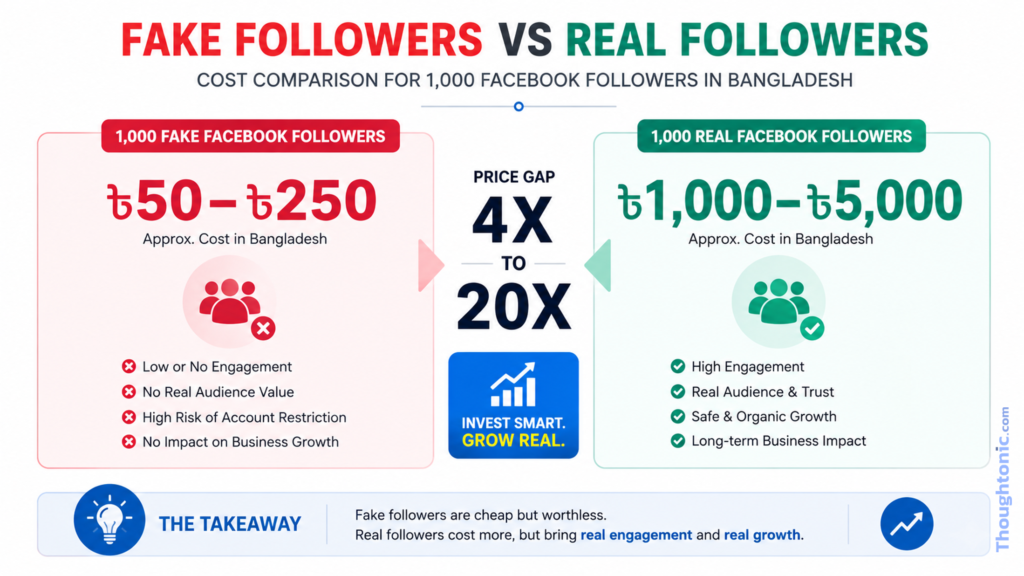
The mechanism is simple, which is exactly why it survives. A brand sets “grow the page” as its visible KPI because it is easier to report upward than admitting a channel needs months before any honest conversion signal appears. The agency being measured against that KPI responds rationally: buy the followers, or run “engagement pods,” closed groups that like and comment on each other’s posts on schedule, simulating interest without producing any. Bangladeshi resellers advertise this openly. One local vendor’s own site distinguishes its shortcut follower packages, priced from 0.78 US dollars for fifty followers, under 16 dollars per thousand, from “real” audience building through paid marketing, priced at 4,000 to 8,000 taka, roughly 33 to 66 US dollars, per thousand genuine followers (GameBuyBD, 2024). That four to twenty fold gap between an audience’s appearance and reality is the entire business model behind Bangladesh’s vanity metrics economy.
Once a page’s audience turns majority bot or majority disengaged, the damage compounds. Reach stops overlapping with anyone who could plausibly buy anything, since bots and pod participants are farming engagement credits, not shopping. Paid campaigns built on that base, retargeting, lookalikes, “engaged shoppers” segments, inherit the contamination, because the platform’s algorithm optimizes toward whoever is already interacting, meaning more bots. Spend then rises just to hold flat sales, and when someone finally asks why ninety days produced two transactions, the easiest response is firing the agency and restarting the cycle elsewhere, losing whatever brand history existed. Nobody in that loop was necessarily lying. Everyone was optimizing for the number they were told mattered.
The Real Math Behind Vanity Metrics
Run the unit economics once, honestly, and vanity metrics lose their appeal fast. Fifty thousand followers and two sales in ninety days, against roughly 3,650 US dollars of quarterly spend, works out to a customer acquisition cost near 1,825 US dollars, on a product that likely sells for under ten dollars. That campaign cannot mathematically justify itself, whatever the follower chart shows.
Compare that with what actually converts. Content built from real users, not bought reach, achieves two to four times the click through rate and 30 to 60 percent lower cost per result than studio produced ads in Bangladeshi campaigns using licensed user content (AgentWiseX, 2026). Micro and nano creators, the ones without the eye catching follower count, consistently outperform larger accounts per dollar. Research cited by SideShift found influencers under 10,000 followers frequently deliver better returns than accounts many times their size, echoing Gartner’s finding that engagement lift peaks at the smallest and largest tiers, not the vanity friendly middle where bought followers cluster (Forbes Councils, 2019). Kantar’s review of over 15,000 branded creator assets found only 6 percent achieved both strong engagement and durable brand value at once (Aaranya Advertising, 2026). The pattern holds everywhere: the easiest metric to fake has the weakest link to revenue.
A Five Step Framework to Kill the Vanity Metrics Habit
1. Audit the asset. Before renewing any contract, run a basic audience quality check: comment to follower ratio, geographic skew, sudden spikes. Trade off: leadership accepts a “success story” channel might not be one. Metric: percentage of followers flagged inauthentic. Mistake: auditing only new partners while legacy pages, usually carrying the oldest bought batches, go unchecked.
2. Anchor KPIs to revenue. Replace follower growth and engagement rate with CAC, conversion rate, and repeat purchase rate as headline metrics. Trade off: the growth story looks less dramatic short term. Metric: the CAC trend line, not the follower trend line. Mistake: running both side by side indefinitely, letting teams retreat to the flattering one.
3. Attribute every taka. Put UTM tags or platform native attribution on every channel, including influencer posts. Highest effort step, most often skipped, since it needs creator cooperation and technical setup. Metric: percentage of orders with a traceable source. Mistake: defaulting unattributed sales to “organic,” hiding the exact leakage this exercise exists to find.
4. Allocate toward micro over macro. Shift budget from one large follower deal toward multiple vetted micro and nano creators with checkable engagement. Trade off: more relationships to manage instead of one signature name. Metric: cost per acquisition, tracked by creator tier.
5. Report the real number, even ugly. Leadership puts CAC and conversion rate in the board deck instead of a rising follower chart. Metric: whether the template actually changed.
Two Brands, Two Different Bets Against Hype
Fyre Festival: When Borrowed Followers Met Real Consequences
Fyre Festival is the clearest global case of hype metrics substituting for operational reality. In December 2016, organizers paid 63 influencers to post an identical orange image, then paid supermodels, including a reported 250,000 US dollars to Kendall Jenner for one post, to promote a Bahamas luxury festival that had no secured venue, food supplier, or lineup (Entrepreneur, 2025; ION, 2017). Ticket demand outran real capacity, driven by borrowed audience trust rather than verified value. When guests arrived in April 2017 to disaster relief tents and cheese sandwiches, the collapse was near instant, and several influencers later faced regulatory scrutiny over undisclosed paid promotion. Fyre was deliberate fraud from the start, not a company that drifted into vanity metrics self-deception, so the lesson here is narrower than it looks: it proves what happens when borrowed reach outruns real capacity, not the slower Bangladeshi pattern of honest teams mistaking rented audience for real audience.
Evaly and the Bangladeshi Growth Illusion
Closer to home, Evaly and the platforms that copied its model (Qcoom, Dhamaka, E-orange, among others) built rapid acquisition on discount and growth optics rather than fulfillment capacity, taking advance payment at unsustainable discounts and using order volume as proof of momentum to attract more capital (bdnews24, 2021). When the models could not support those promises, customers who paid in advance were left without goods or recourse, some reportedly still chasing refunds four years later (Asia News Network, 2025). Bangladesh’s wider scam economy, spanning e-commerce, MLM, and fraudulent investment schemes, cost citizens an estimated Tk 21,000 crore between 2006 and 2021 (The Daily Star), a figure spanning many scheme types, not Evaly alone, so read it as context, not a direct Evaly loss figure. Evaly’s failure was financial fraud, not a marketing measurement mistake, but the underlying instinct, using growth shaped numbers to paper over a gap between promise and delivery, is the same instinct behind smaller vanity metrics decisions across Bangladeshi marketing teams today.
What to Do Monday Morning
For organizations. Budget a modest audience audit within 30 days, before any renewal. A manual sample of 200 followers, checked for profile completeness, costs a junior analyst a day, not an agency retainer. Within 90 days, rebuild attribution on your top three paid channels, budgeting 15,000 to 40,000 taka for a freelance build if nobody in-house can. Within two quarters, renegotiate influencer contracts to include a performance clause, a minimum conversion benchmark tied to partial payment, instead of a flat fee based on follower count alone.
For professionals. Learn to pull and read a raw ads manager export yourself instead of relying on an agency’s summary slide, uncomfortable since it exposes gaps colleagues have been smoothing over, but it takes a weekend, not a course. Practice presenting a flat or declining follower count as a positive when it reflects a cleaner audience, uncomfortable since stakeholders read growth charts literally. Get comfortable saying no to a follower count KPI when your boss wants a growth chart for their own boss, the most uncomfortable skill here, since it can look like underperformance short term. None of this needs a large budget, it needs someone willing to ask where the two sales came from.
Where This Framework Breaks Down
This framework is not free, and pretending otherwise would be its own vanity metric. An honest audit costs time a very small business genuinely does not have, and for a tiny seller running one page with no real ad budget, the correct move may be to do nothing, no audit, no attribution overhaul, just direct WhatsApp service and word of mouth, since the audit would consume more resource than the fraud it uncovers. There is an ethical risk in swinging hard toward micro and nano influencers too: smaller creators disclose paid partnerships inconsistently, since enforcement is weak in Bangladesh, so this strategy can quietly recreate the same trust problem at a smaller, harder to audit scale. Organizationally, this fails most often not because the tactics are wrong but because the people asked to report honest numbers are the same people whose reviews depend on growth optics. The resistance is rarely about method, it’s about who gets blamed once the real number is visible.
Key Takeaways
- Bangladesh is repeatedly named among the world’s top sources of bought followers and bot engagement; treat any high follower page with low comments as suspect by default.
- Buying 1,000 fake Bangladeshi Facebook followers costs under 16 US dollars, versus roughly 33 to 66 US dollars per thousand for real, ad-driven followers, a gap that funds the entire con.
- 50,000 followers and two sales in a quarter is not underperformance, it reveals a customer acquisition cost north of 1,800 US dollars on a product that cannot support it.
- Only 6 percent of over 15,000 branded creator assets studied by Kantar achieved both strong engagement and durable brand value.
- Replace follower growth and engagement rate with CAC, conversion rate, and repeat purchase rate as primary dashboard metrics now, not next quarter.
- Fyre Festival and Evaly are different failures, deliberate fraud versus broken fulfillment, but both show hyped numbers eventually meet a reality they cannot survive.
- Micro and nano creators without eye-catching follower counts return more per dollar, but only if attribution is in place to prove it.
- The hardest part of fixing this is organizational, not technical: someone has to report a falling follower count as good news.
Read More Articles:
- The Costly AI Strategy Gap: Why Your Team Is Playing, Not Executing
- The Costly Truth About Minimalist Bangladesh Design Strategy
- The Costly Visual Search Blind Spot That Is Making Bangladesh Brands Invisible
- Quantum Marketing: How 2030’s Technologies Will Shatter Bangladesh’s Status Quo
- Quantum Marketing: How 2030’s Technologies Will Shatter Bangladesh’s Status Quo
- Digital Literacy & Brand Purpose: How Education Drives Loyalty in Emerging Markets
Sources
- NapoleonCat. “Social Media Users in Bangladesh, 2025.” NapoleonCat, 2025. napoleoncat.com/stats/social-media-users-in-bangladesh/2025
- DataReportal. “Digital 2026: Bangladesh.” DataReportal, November 8, 2025. datareportal.com/reports/digital-2026-bangladesh
- Ngital. “The State of Digital Marketing in Bangladesh 2026: A Founder’s Perspective.” Ngital, April 24, 2026. ngital.com/state-of-digital-marketing-bangladesh-2026
- Kanok Miah. “Content Marketing Strategy for Bangladesh Businesses: Complete Guide 2026.” Kanok Miah, July 14, 2026. kanokmiah.com/content-marketing-strategy-bangladesh
- The Daily Star. “Why Scams Thrive in Bangladesh.” The Daily Star. thedailystar.net/opinion/views/news/why-scams-thrive-bangladesh-3407316
- bdnews24. “Bangladesh’s E-commerce Players Reel From Scams. Can They Win Back Trust?” bdnews24, October 5, 2021. bdnews24.com/business/bangladeshs-e-commerce-players-reel-from-scams
- Asia News Network. “Four Years On, Customers Still Chasing Refunds After E-commerce Scams in Bangladesh.” Asia News Network, October 2, 2025. asianews.network/four-years-on-customers-still-chasing-refunds
- GameBuyBD. “Facebook Bangladeshi Services (Like, Follower, Group Member, Page Review).” GameBuyBD, 2024. gamebuybd.com/facebook-bangladeshi-services
- PlugViews. “Buy Facebook Profile Followers Bangladesh.” PlugViews, September 14, 2024. plugviews.com/product/buy-facebook-profile-followers-bangladesh
- AgentWiseX. “Influencer Marketing in Bangladesh: Complete Guide for Businesses 2025.” AgentWiseX, March 30, 2026. agentwisex.com/influencer-marketing-bangladesh
- CreatorIQ. “The Complete Influencer Marketer’s Guide to Spotting Audience Fraud.” CreatorIQ. creatoriq.com/blog/spotting-follower-fraud
- Gulf News. “16 Million Accounts of Indian Instagram Influencers Fake: Study.” Gulf News. gulfnews.com/world/asia/india/16-million-accounts-of-indian-instagram-influencers-fake-study-1.65208654
- CNBC. “Fake Followers in Influencer Marketing Will Cost Brands 1.3 Billion Dollars This Year, Report Says.” CNBC, July 24, 2019. cnbc.com/2019/07/24/fake-followers-in-influencer-marketing-will-cost-1point3-billion-in-2019
- Forbes Councils. “What Marketers Can Learn From The Fyre Festival’s Influencer Marketing Fiasco.” Forbes. forbes.com/councils/forbescommunicationscouncil/2019/04/16/what-marketers-can-learn-from-the-fyre-festivals-influencer-marketing-fiasco
- SideShift. “Moving Beyond Vanity Metrics in Influencer Marketing.” SideShift. sideshift.app/blog/vanity-metrics
- Aaranya Advertising. “Why High Engagement Is Killing Brand Conversions.” Aaranya Advertising. aaranyaadvertising.com/high-engagement-vs-brand-conversions
- Entrepreneur. “4 Influencer Marketing Lessons Learned From the Calamitous Fyre Festival.” Entrepreneur, September 3, 2025. entrepreneur.com/business-news/4-influencer-marketing-lessons-learned-from-the-calamitous/327185
- ION. “Fyre Festival: 3 Major Lessons For Influencers And Brands.” ION, June 5, 2017. ion.co/fyre-festival-3-major-lessons-influencers-brands