Middle Manager Burnout Is Bangladesh’s Costly Blind Spot
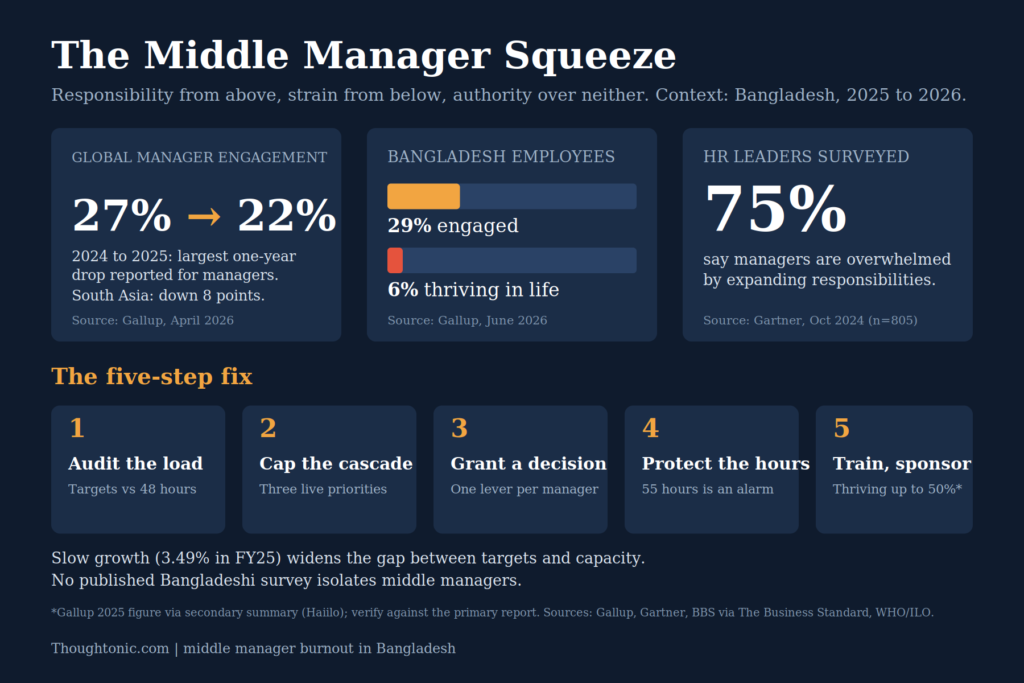
Gallup put global manager engagement at 22% in 2025, down from 27% a year earlier. That’s the largest one-year drop it reports for managers, and South Asia fell eight points, the steepest of any region. Now set that beside a Bangladesh figure that should bother you more. Here, 29% of employees are engaged, yet only 6% say they’re thriving in life. That gap is where middle manager burnout hides.
I’ve spent over a decade around Dhaka boardrooms and marketing floors, and I think leadership keeps missing the pattern. Leadership sets the target. Teams bring their fatigue. The person in the middle holds both, with authority over neither. This piece is for the people who set those targets, and for the people who carry them.
Why Middle Manager Burnout Hits Harder in Bangladesh
Start with the global picture. Gallup reports global engagement at 20% in 2025, its lowest level since 2020, and India, the region’s largest workforce, hit a four-year low. In July 2024, Gartner surveyed 805 HR leaders, and three-quarters said their managers were overwhelmed by the growth of their responsibilities. Gallup adds that managers account for roughly 70% of the variance in team engagement. Yet summaries of Gallup’s 2025 report say only 44% of managers have received any training. (I’m citing that last figure secondhand, so check it against the primary report.) The layer carrying the most weight gets the least preparation.
Now bring it home. Final BBS estimates put FY25 GDP growth at 3.49%, down from 7.10% in FY22. The World Bank projects 3.9% for FY26, with inflation averaging 8.5% from July to February and private investment growth falling for the first time in 35 years. Here’s what that does to a target. Revenue goals set in a seven-percent world get carried into a three-percent one, while costs climb with inflation. The gap lands on whoever owns the number, and that’s usually the middle.
Then add the hours. The Labour Act sets a 48-hour week, but a Business Standard commentary argues that most private firms have no standard hours or KPI framework, and the Daily Star describes staff expected to stay reachable long after closing time. The WHO and ILO found that working 55 hours or more is linked to a 35% higher stroke risk and a 17% higher risk of dying from ischaemic heart disease, compared with 35 to 40 hours.
One honest caveat. I couldn’t find a published Bangladeshi survey that isolates middle managers. That absence is a finding. Nobody is counting the people we depend on most.
The Squeeze Has a Mechanism, and It Compounds
Middle manager burnout isn’t a mood. It’s an output of a system, and the system runs in a sequence. In my analysis, it looks like this.
The Middle Manager Burnout Loop
- Leadership sets targets from last year’s growth assumptions.
- Targets cascade unchanged, because strict hierarchy discourages pushback, something the Daily Star flags in many Bangladeshi workplaces.
- Managers absorb the gap as personal hours. They can’t change the target, the headcount or the budget.
- Team strain arrives as emotional workload, with no time allocated to handle it.
- Recovery collapses. Hours drift past 55, training is thin, and Gallup’s 2025 data show manager wellbeing falling.
- Manager engagement drops, team engagement follows, and customers feel it in service quality and staff turnover.
- Leadership reads the results as a manager weakness and adds pressure, or removes a layer. The loop restarts.
The same World Bank event heard that senior managers spend an average of 13% of their time on regulatory compliance, so the layer above the middle is stretched too. Overload runs in both directions. Steps one to five are well supported by the sources above. Steps six and seven are my causal reading, and nobody has tested them on Bangladeshi firms.
Here’s the table I’d put on a boardroom slide.
| Pressure source | What arrives | Manager’s authority |
|---|---|---|
| Leadership above | Targets, deadlines, cost caps | Can’t renegotiate |
| Team below | Fatigue, resignations, expectations | Can’t fund fixes |
| Market around | Inflation, weak demand | None |
Gallup’s numbers show what that table does to a person. In 2022, managers were 11 points more engaged than individual contributors. By 2025, the gap was 3, according to a People Results analysis of the report. Managers have lost their engagement premium.
But here’s the thing. Your brand lives at the point of contact. When the layer that steadies your frontline wobbles, customers notice before your dashboard does. A late delivery, a curt reply, a promise nobody owns: those are brand events, and they start with an exhausted person one level up.
This is where it gets interesting for Bangladesh. We score 29% engaged against a South Asian average of 21%, yet only 6% thriving, and just 37% say it’s a good time to find a job locally. My interpretation, and it’s only that, is that some engagement here is people holding on to scarce jobs. Engagement can be genuine and still be fragile.
Five Moves That Cost Less Than a Wellness Retreat
Each move has an action, an example and the mistake I see most. Track each with one number: the share of managers whose targets exceed their capacity, live priorities per manager, escalations resolved at manager level, average weekly hours, and manager pulse scores.
1. Audit the load. List every target a manager owns and estimate the hours each needs against a 48-hour week. Picture a sales manager with six targets and eight reports, all on one page. The mistake: auditing the team’s workload and skipping the manager’s.
2. Cap the cascade. Limit each manager to three live priorities, and make leadership name what stops whenever something starts. The mistake: letting everything become “top priority”.
3. Grant one decision right. Give every manager control of one lever, such as overtime approval, a small discretionary budget, or one target renegotiation per quarter. The mistake: delegating responsibility while keeping the signature.
4. Protect the hours. Set an after-hours norm, and backfill a departure within a fixed window or shrink the target to match. Treat 55 hours a week as an alarm, not a badge. The mistake: tracking hours for juniors only.
5. Train and sponsor. Gallup’s 2025 findings, as summarised by Haiilo, put manager thriving at 28%, rising to 34% with training and 50% when someone at work actively backs their development. The mistake: a single workshop with no follow-up.
Two Cases: Google Fixed Manager Quality, HCLTech Made Managers Accountable
In 2008, Google’s people analytics team set out to test whether managers mattered. They did. The team named eight behaviours, trained managers on them and gave each manager a feedback report. From 2010 to 2012, median favourability scores rose from 83% to 88%, and the lowest-scoring managers improved most, per Harvard Business Review. The limitations are real. These are upward-feedback scores, not burnout measures, the data comes from Google itself, and few Bangladeshi firms have its analytics budget.
The South Asian case runs the other way. Between 2005 and 2010, HCLTech’s revenue grew from $762 million to $2.7 billion, according to CIO.com, while CEO Vineet Nayar made managers answerable to employees through open 360-degree reviews. One secondary summary says attrition fell by nearly half in four years. Treat that with care. The figures come largely from the company and its CEO’s own account, and growth also rode a booming IT services market, which is my inference. Public reviews can also add pressure on managers when authority and support don’t come with them.
What I take from both is that the fix was structural, not motivational. Culture matters here too. Both cases assume a manager can act on feedback. In hierarchical Dhaka workplaces, feedback without authority is just another burden. And I couldn’t find a verified Bangladeshi case on manager burnout, so I won’t invent one. If your firm has run something measurable, publish it. It would be the first.
What to Do on Monday: Plans for Organizations and Professionals
For organizations. Run the load audit in the first 30 days. It costs staff time, not cash. By day 60, cap priorities and publish the list of what stops. By day 90, grant one decision right per manager and start a short quarterly manager pulse. Then the hard one: backfill departures within 60 days or cut the target in proportion. For budget, plan roughly 1% to 2% of managerial payroll in year one for training and sponsorship. That’s my planning heuristic, not a benchmark. Set success metrics before you start. Mine would be the share of managers whose targets exceed their capacity, average weekly hours against the 55-hour line, and regretted manager resignations, measured at day 0, day 90 and month six.
On effort, the audit and the cap are low effort but draw high resistance. The decision right and the pulse are medium. Backfill discipline is high, because it forces a finance conversation. Ignore all of it and you’re paying for middle manager burnout anyway, just in resignations instead of budget lines.
For professionals. These five skills are uncomfortable, and that’s why they work. Negotiate a target upward with data, which feels disloyal. Say no with a trade-off attached, which feels risky. Write a one-page capacity memo, which feels like complaining. Delegate real authority to someone junior, which feels like losing control. And ask a senior leader to sponsor you, which feels like admitting weakness. Pick one this month and put it in your calendar as a fixed appointment.
Where This Argument Is Weak
Three limits. First, Gallup’s manager figures are global and regional, and the South Asia drop is driven largely by India. Bangladesh has its own engagement number, but not a manager-specific one. Second, engagement isn’t burnout. They’re different constructs, and I’m using one to argue about the other. Third, surveying managers about wellbeing carries an ethical risk. In a market where exit options are thin, that data can be used against the people who give it. Collect it anonymously, and never tie it to appraisals.
Now the contrarian part. In a year of contracting private investment, launching a wellness program might do less than cancelling two initiatives. And flattening another management layer right now could cost more than it saves. A reasonable colleague might also say a target veto invites sandbagging. They’re right to worry, so cap it at one renegotiation per quarter.
Key Takeaways
- Global manager engagement fell from 27% to 22% in 2025, Gallup’s largest one-year drop for managers.
- Bangladesh shows 29% engaged but 6% thriving. Engagement isn’t wellbeing.
- Middle manager burnout is a design flaw, not a character flaw: responsibility without decision rights.
- Slow growth (3.49% in FY25) and persistent inflation widen the gap between targets and capacity.
- Weeks of 55 hours or more are linked to a 35% higher stroke risk, per the WHO and ILO.
- Fund managers before you fund wellness events: audit load, cap priorities, grant one decision right.
- Nobody publishes Bangladeshi data on this group. Start counting inside your own firm.
More Articles:
- The Costly AI Strategy Gap: Why Your Team Is Playing, Not Executing
- The Costly Truth About Minimalist Bangladesh Design Strategy
- The Costly Visual Search Blind Spot That Is Making Bangladesh Brands Invisible
- Quantum Marketing: How 2030’s Technologies Will Shatter Bangladesh’s Status Quo
- Digital Literacy & Brand Purpose: How Education Drives Loyalty in Emerging Markets
Sources
- State of the Global Workplace 2026 – Gallup, April 2026
- State of the Global Workplace: Bangladesh Country-Level Data – Gallup, June 2026
- Gallup 2026 Workplace Report: HR, IT & Ops Insights – MangoApps, 17 April 2026 (secondary summary of Gallup; source of the 70% team-engagement variance figure)
- Gallup State of the Global Workplace 2026: What It Tells Us and Why It Matters – People Results, 28 April 2026 (secondary summary; source of the 11-point to 3-point manager gap)
- The State of the Global Workplace – Institute for Public Relations, 10 June 2026 (sample-size and trend cross-check)
- Gartner Survey Finds Leader and Manager Development Tops HR Leaders’ List of 2025 Priorities – Gartner, 15 October 2024
- 2025 Gallup State of the Global Workforce Report: key insights and next steps – Haiilo, 23 April 2025 (secondary summary of Gallup 2025; source of the 44% training and 28% to 34% to 50% thriving figures)
- Global Employee Engagement Falls Again: What Can Help Reverse This Trend? – Inspiring Workplaces, republishing Gallup (Harter and Pendell), 22 May 2025
- GDP growth for FY25 slips to 3.49% as investment and demand weaken – The Business Standard, 26 February 2026
- Bangladesh’s economic growth set to slow to 3.9% as inflation, banking risks, investment crisis deepen – The Business Standard, 18 May 2026 (reporting a PRI and World Bank event)
- Bangladesh Economy to Slow to 3.9% Growth in FY2025 Before Rebounding in FY2026 – Asian Development Bank, 9 April 2025
- The price of overwork: How Bangladesh’s six-day workweek is failing its workforce – The Business Standard, 21 October 2025
- Time to do something about long hours and extra workloads – The Business Standard (opinion), 7 April 2023
- The corporate sector in Bangladesh needs a cultural reset – The Daily Star (opinion), date not shown in retrieved copy
- Why the culture of glorifying overwork needs to stop – The Daily Star, date not shown in retrieved copy
- Long working hours increasing deaths from heart disease and stroke: WHO, ILO – World Health Organization, 17 May 2021
- Global, regional, and national burdens of ischemic heart disease and stroke attributable to exposure to long working hours – Environment International (WHO/ILO Joint Estimates), 17 May 2021
- Working hours and cardiovascular disease – PubMed Central, date not shown in retrieved copy (South-East Asia carries the largest burden)
- How Google Sold Its Engineers on Management – Harvard Business Review, December 2013
- Why Indian Outsourcer HCL Technologies Puts Employees First – CIO.com, page dated May 2023 in retrieved copy (interview originally tied to 2010 book)
- Employees First, Customers Second – Corporate Rebels, 17 November 2023 (secondary source for the attrition figure)