The Hidden Cost of Martech Stack Bloat: Why Bangladeshi Marketing Teams Are Paying for Tools That Do Nothing
Your marketing team is probably running twelve to fifteen tools right now. If you asked the head of marketing to name them all without checking the finance sheet, I’d bet money they stop at seven. That gap between what leadership thinks it’s paying for and what’s actually installed is martech stack bloat, and it’s quietly draining budgets across Dhaka’s corporate marketing departments. Globally, the average enterprise now runs close to 300 SaaS applications, up from around 110 just five years ago, and organizations waste an average of nineteen to twenty one million dollars a year on licenses nobody uses, according to Zylo’s SaaS Management Index. Bangladesh doesn’t have its own published audit of this yet. That absence is a warning sign, not proof the problem doesn’t exist here.
What Causes Martech Stack Bloat in Bangladeshi Marketing Teams
Here’s the thing about tool sprawl. Nobody sets out to build a bloated stack. It happens one subscription at a time. A campaign manager needs a scheduling tool for a three month push. A new hire prefers the CRM she used at her last agency. The CMO sits through a vendor demo and signs off on an “AI-powered” platform because the board is asking what marketing is doing about AI. None of these decisions look reckless alone. Stacked together over three years, they produce a mess nobody has the appetite to untangle.
This is where it gets interesting for Bangladesh specifically. Most corporate marketing teams here still run lean, often five to twelve people covering brand, performance, and content for the whole organization. Lean teams should mean lean stacks, since fewer people means less room for tool fragmentation. But the opposite tends to happen. Small teams rarely have a dedicated marketing operations function, which in more mature markets is exactly the role that audits tool usage and kills overlap. Without that function, nobody owns the question of whether the dashboard bought in 2023 still gets opened. In my analysis of how procurement actually works inside Dhaka corporates, subscriptions get approved by whoever controls the card, not by whoever uses the tool six months later. That single structural gap explains most of the martech stack bloat I see when I sit down with a client’s finance sheet.
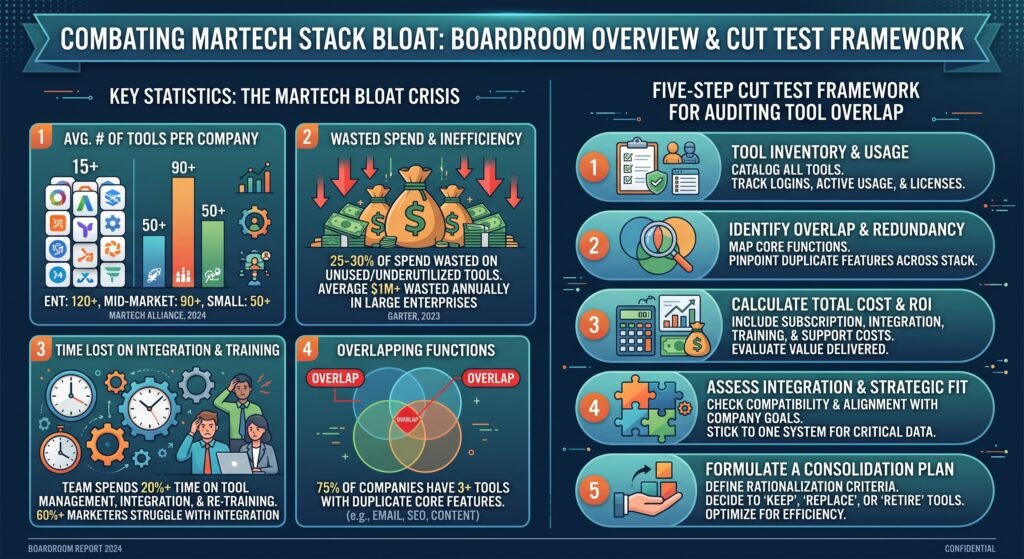
The Problem, By the Numbers
- Marketing technology utilization sat at just 49% globally in 2025, meaning marketers actively use less than half of what they’ve already paid for, per Gartner’s 2025 Marketing Technology Survey. The brand impact: half the “capability” a CMO reports to the board doesn’t exist in practice.
- 62.1% of marketing teams say they’re using more tools than two years ago, per the 2025 State of Your Stack Survey from MarTech, Chiefmartec.com, and MarketingOps.com. More tools usually means more fragmented customer data, which shows up as inconsistent messaging across channels.
- Only 15% of organizations qualify as martech “high performers,” meaning they actually meet strategic goals and show positive ROI from their stack, per Gartner’s 2025 survey. Most organizations run stacks that don’t demonstrably help the brand.
- 45% of martech leaders already piloting AI agents say the vendor-promised performance never showed up, per a Gartner survey of 413 leaders fielded June through August 2025. Brands that bought into the AI hype cycle are now carrying tools that added cost without adding capability.
- AI-native application spending grew 75.2% in a single year, the fastest growing line item in the SaaS budget, per Zylo’s most recent index. AI hype isn’t replacing old tools, it’s stacking on top of them, and brand teams manage more surface area with the same headcount.
The Bangladesh Data Gap on Martech Stack Bloat
I want to be honest here: I could not locate a published, Bangladesh-specific audit of marketing stack utilization, and I’m not going to invent one to make this section feel local. What exists instead is context. Smartphone adoption climbed from 63.3% in 2023 to 72.8% in 2025, per the Bangladesh Bureau of Statistics ICT Access and Use Survey 2024-25, and the local digital ad market keeps expanding fast. Growth like that pulls more vendor pitches into every marketing inbox in the country. The pressure that produces bloat elsewhere is present here too, unaudited so far.
How Stack Bloat Quietly Damages a Brand
A tool gets bought to solve a narrow problem under time pressure. The champion leaves or changes teams, and the reason it exists leaves too. Nobody cancels it, since cancellation means proving a negative, that removing it won’t break anything, and that’s unrewarding work nobody owns. The tool keeps collecting its own slice of customer data in a silo, disconnected from what everyone else relies on. That fragmentation means the brand team makes creative and targeting calls off incomplete pictures, since three tools each hold a third of the truth. Reporting becomes manual reconciliation between spreadsheets, which slows decisions and raises the odds someone reports a wrong number to leadership. The brand ends up making slower, less confident calls exactly when competitors with cleaner data move faster. Bloat doesn’t just cost subscription fees. It costs decision speed, and speed is a competitive variable in a market where attention shifts fast across Facebook, YouTube, and TikTok.
| Dimension | Bloated Stack (12+ tools) | Lean Stack (3 to 5 tools) |
|---|---|---|
| Customer data | Fragmented across silos | Consolidated in one or two sources |
| Reporting | Manual reconciliation, delayed | Near real time, single dashboard |
| Onboarding | Weeks learning 10+ interfaces | Days learning a core set |
| Renewal visibility | Nobody tracks what auto-renews | Finance and marketing jointly review |
| Decision speed | Slow, contested numbers | Fast, single source |
The Cut Test: A Practical Framework Against Martech Stack Bloat
I use a version of this with clients because it forces a decision instead of a discussion.
List every tool with a login, not every tool with a contract. Someone senior has to demand the actual list from bookmarks and inboxes, not just the procurement record, since shadow subscriptions on personal cards rarely show up on finance’s sheet. This takes an uncomfortable afternoon and exposes purchases nobody wants to explain. Success looks like a single signed-off list, no exceptions.
Ask “if we removed this today, what would actually break?” Not what would be inconvenient. What would stop functioning. The person answering has to be someone who uses the tool, not whoever bought it, since buyers overstate value to justify their own decision. Success looks like a one-line answer per tool, no vague justifications like “it’s good to have.”
Rank surviving tools by overlap, not feature lists. Two tools that both do email automation are overlap, even if one has better features. Pick a primary and commit, even if the losing tool has a feature the team liked. Success looks like zero function categories with more than one active tool.
Set a mandatory renewal review sixty days before every contract date. Assign explicit ownership to one person, not to “marketing ops” as an abstract function that doesn’t exist on a five-person team. This adds administrative work to someone already busy. Success looks like zero auto-renewals that weren’t reviewed.
Reinvest savings into the tools that survived, not into new categories. Resist the instinct to spend freed budget on the next AI pitch in the inbox. Success looks like total tool count trending down year over year while spend per surviving tool trends up as usage deepens.
The mistake I see most at step three is teams keeping both overlapping tools “just in case,” which defeats the whole exercise. The cut test only works if someone actually cancels something.
Case Studies in Cutting, and Their Limits
Procter & Gamble is the most documented example of large-scale marketing waste reduction, and it’s worth separating what it proves from what people assume it proves. In 2017, chief brand officer Marc Pritchard pushed a transparency audit across P&G’s digital media and agency relationships, which had ballooned to roughly 6,000 agency relationships worldwide. The company cut that roster toward 2,500, trimmed its programmatic site list from thousands of domains to hundreds, and cut around 200 million dollars in digital ad waste, without a measurable drop in sales. The limitation: this was a media and agency audit, not a SaaS subscription audit. The discipline transfers, ask what’s actually producing results versus what’s just present, but the scale isn’t comparable to cutting a marketing tool stack.
Unilever ran a parallel exercise from 2016 through zero-based budgeting, cutting its creative agency roster in half and total ad output by 30%, targeting two billion euros in brand and marketing efficiency savings by 2019. More than half the savings in a typical zero-based effort show up within the first twelve months, per Bain’s analysis cited by Smart Insights. Again, this is a budgeting discipline applied to media and agencies, not a documented software audit. I have not found a published Bangladeshi or South Asian equivalent for marketing technology specifically. That’s a genuine gap in the public record, not proof no local company has done this internally. If yours has, publish it, since the only evidence available right now is private client conversation, which I can’t cite as a verified case study.
Action Plans
For organizations: Week 1-2, compile the full tool list including shadow subscriptions, staff time only. Week 3, run the cut test on every tool, roughly two half days for a five person team. Week 4, cancel overlapping tools before the next renewal date, budgeting 5-10% of contract value for possible early termination fees. Month 2 onward, reinvest 30-50% of realized savings into training on surviving tools, not new purchases.
For professionals: Say no to a vendor demo without escalating to leadership first, uncomfortable because vendors are persistent. Admit a tool you championed isn’t delivering, uncomfortable because it feels personal. Read cancellation terms before signing, not after the invoice arrives, uncomfortable because it’s tedious. Ask a peer directly whether they actually log into a shared tool, uncomfortable because it can read as questioning their competence. Present a leaner stack to leadership as a win, uncomfortable because fewer tools can feel like falling behind competitors.
Critical Perspective: Where the Cut Test Can Backfire
Cutting isn’t automatically right. If a tool holds historical customer data that takes months to migrate cleanly, an aggressive cut before proper export can destroy institutional knowledge worth more than the subscription cost. There’s also a real risk where procurement power sits with one senior person: a top-down cut can become a way to eliminate a junior employee’s preferred tool for political reasons rather than genuine redundancy, damaging morale without saving money. And doing less can beat doing more in one specific case: early-stage teams still discovering their actual workflow. Cutting to three tools too early can lock a growing team into infrastructure it outgrows within two quarters, forcing a second costly migration.
Key Takeaways
- Global martech utilization sits at 49% of purchased capability, meaning organizations pay for capability they never activate.
- 62.1% of marketing teams report using more tools than two years ago, even as budget discipline tightens elsewhere.
- Martech stack bloat compounds through several stages, from an unowned purchase to slower, less confident brand decisions.
- The cut test asks one question per tool: if we removed this today, what would actually break.
- Overlap, not feature richness, is the real enemy. Two tools doing one job is waste even if both are good.
- P&G and Unilever prove aggressive cutting works at the media and agency level, but no verified Bangladeshi case study exists yet for software stack audits specifically.
- Renewal dates, not annual planning cycles, are the right trigger point for reviewing every subscription.
- Reinvest savings into deeper usage of surviving tools, not into the next AI pitch in your inbox.
Read More Articles:
- The Costly AI Strategy Gap: Why Your Team Is Playing, Not Executing
- The Costly Truth About Minimalist Bangladesh Design Strategy
- The Costly Visual Search Blind Spot That Is Making Bangladesh Brands Invisible
- Quantum Marketing: How 2030’s Technologies Will Shatter Bangladesh’s Status Quo
- Digital Literacy & Brand Purpose: How Education Drives Loyalty in Emerging Markets
Sources
- Why martech stacks are getting messier – MarTech, 2025 MarTech Replacement Survey
- Optimizing Your B2B Martech Stack – Medialogic, citing Gartner 2025 Marketing Technology Survey
- Boost Martech Performance and Prepare for AI – Gartner, 2025 Marketing Technology Survey
- 2025 State of Your Stack Survey – MarTech, Chiefmartec.com, MarketingOps.com
- State of the Stack 2025: Homegrown martech surges as AI accelerates development – MarTech, April 2025
- 2025 SaaS Management Index Reveals First Increase in Average SaaS Spend in Three Years – Zylo, January 2025
- Still breeding like rabbits: SaaS remains a multimillion dollar wasteland – Mi3, January 2025, citing Zylo, Productiv, and Vertice
- SaaS license waste tops IT spend challenges – CFO Dive, February 2024, citing Zylo
- How Much Is Wasted on SaaS Spend? – Zylo, 2026 SaaS Management Index
- SaaS Overload Statistics 2026 – SpeakWise, citing Zylo’s SaaS statistics for 2026
- Gartner Survey Finds 45% of Martech Leaders Say Existing Vendor-Offered AI Agents Fail to Meet Their Expectations – Gartner press release, October 2025
- Most AI agents fail without data and governance maturity – MarTech, November 2025
- Top 10 Digital Marketing Agencies in Bangladesh in 2025 – Marketorr, citing Bangladesh Bureau of Statistics ICT Access and Use Survey 2024-25
- Top 10 Digital Marketing Companies in Bangladesh (2026) – ViserX, citing Research & Markets Q1 report on Bangladesh digital ad spend
- P&G’s Pritchard Tells Agencies To Step Up And Simplify – AdExchanger, 2017
- P&G slashes digital ad ‘waste’ by $200m in marketing pivot – The Drum, March 2018
- After Transparency, P&G’s Pritchard Has A New Mission – AdExchanger, citing P&G’s agency roster reduction
- Unilever to halve its creative agencies as it doubles down on efficiency savings – Campaign, 2017
- Unilever credits in-house content agency U-Studios as marketing savings ‘bear fruit’ – Marketing Week, July 2017
- What is zero-based budgeting and how can it help you? – Smart Insights, citing Bain analysis
- LightCastle Partners has officially invested in SubscriptionPro – LightCastle Partners, May 2025
statistics on martech utilization, SaaS waste, and AI agent performance come from Gartner, Zylo, and MarTech/Chiefmartec surveys, which primarily reflect North American and European enterprises, since no equivalent Bangladesh-specific stack utilization study was located at the time of writing. Bangladesh figures are limited to internet, smartphone, and digital ad market context, not marketing stack audits. Treat the global figures as directional benchmarks for Bangladesh, not locally verified numbers, and verify any statistic here against the primary source before publishing or presenting it to a board.