AI Ad Creative Testing Without a Framework Is a Costly Bangladesh Marketing Trap
Generating 500 ads before lunch isn’t a strategy. It’s a slot machine with a marketing budget, and in Bangladesh, where the real addressable digital audience is smaller than the headline numbers suggest, that machine pays out slower than most CMOs think. Generative tools have made creative production nearly free, and teams across Dhaka’s marketing departments are producing more than ever. But volume was never the hard part of advertising. Knowing why something worked always was. Without disciplined AI ad creative testing, all that output does is spray noise at an audience that’s already shrinking, pricier to reach, and more fatigued by the month.
The Core Problem: Bangladesh Has Less Room for Noise
Global martech blogs treat generative AI as an unlimited creative tap. What they miss is that Bangladesh’s digital ad economy is thin. Statista’s market forecast puts total digital ad spend here at only around $556 million by 2028, growing near 7.46% a year, a rounding error next to the markets where “test 500 variants” case studies come from. Every taka spent on untested creative is a taka not spent building a real testing program.
The audience problem compounds it. BTRC reports over 132 million internet users, and DataReportal shows Facebook’s advertiser-reachable audience growing by more than 7 million between January 2024 and January 2025. That looks like room to run. But independent research from Dhaka-based venture analysts at ExitStack argues BTRC’s definition of an “internet user,” anyone who used 125kb of data in 90 days, wildly overstates the population that’s an actual ad-reachable, purchase-capable consumer. Their back-calculated estimate lands closer to 25 to 30 million truly active digital consumers. That’s the real pool most AI-generated batches get tested against, not 130 million, and it isn’t even stable. BTRC data reported by The Daily Star shows total internet subscribers fell by nearly 7 million between July 2025 and January 2026. Add a mobile data tax burden over 54%, among the highest in the world per the same paper, and you get a consumer base that resents data-heavy, poorly targeted creative far more than audiences in bigger markets do.
There’s a data-maturity gap sitting underneath all of this too. DataReportal’s Digital 2025 Bangladesh figures show only 17.6% of adults have ever sent money online and just 3.1% have made an online purchase. Most of the AI personalization playbooks brands are copying from global case studies assume rich, first-party purchase and behavioral data feeding the generation engine. Without that foundation, “personalized” AI variants in Bangladesh often aren’t personalized at all. They’re just more variety layered on top of the same guesswork, dressed up to look like data-driven output when the underlying signal was never there.
Why Volume Without a Framework Fails: The Mechanics
To see why 500 variants can teach you less than five, separate what creative does from what targeting does. Nielsen-linked research, cited across effectiveness studies including NCSolutions’ analysis of roughly 450 CPG campaigns, attributes 47% to 56% of incremental sales lift to creative quality, not targeting or reach. That’s the opposite of how most Bangladeshi performance teams spend their attention. Budget conversations obsess over segments and bids while creative gets briefed once and iterated on gut feel.
Generative AI didn’t fix that imbalance. It made it faster to be wrong at scale. Here’s the chain that plays out inside most ungoverned “generate hundreds” programs:
The AI Ad Creative Testing Failure Loop
One. AI tools drop the marginal cost of a variant to almost nothing. A junior designer can output dozens of concepts in an afternoon.
Two. Without a written, falsifiable hypothesis, those variants differ across several variables at once, headline, visual, CTA, and format all changing together.
Three. Platform delivery engines, Meta’s Advantage+ and Google’s Performance Max among them, auto-allocate spend using their own opaque internal scoring.
Four. A “winner” emerges, but because nothing was isolated, nobody can say why it won. The platform doesn’t explain itself, and the batch wasn’t built to find out.
Five. The reason stays unknown, so the win can’t be codified into a repeatable insight. The next cycle starts from zero again.
Six. In Bangladesh’s smaller, high-consumption pool, this repeats across dozens of advertisers at once. Meta’s own research team has documented that conversion rates fall and cost per action rises as users see the same creative elements repeatedly, and that fatigue curve compresses fast in a small market.
Seven. Over twelve to eighteen months, short-run numbers like CTR and CPA can look fine because the algorithm is genuinely good at finding what converts today. But brand recall and distinct visual assets, never tested for in an undisciplined pipeline, erode quietly until spend stops working and nobody can explain why.
This is where it gets interesting: platforms have gotten so good at short-term optimization that it’s easy to mistake “the algorithm found a winner” for “we learned something.” Only one of those compounds.
A Governed AI Ad Creative Testing Framework
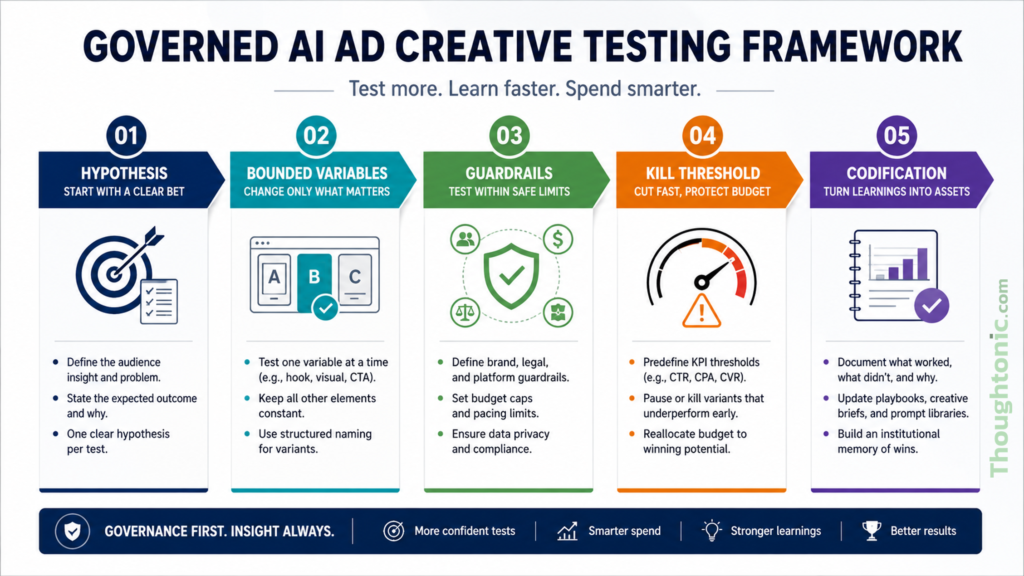
If creative drives roughly half of sales lift and AI has made production nearly free, the discipline has to move upstream. Here’s a five-step framework that treats AI as an execution engine inside a learning system, not a replacement for one.
1. Define the hypothesis first. Every batch starts with one written, falsifiable statement, such as “a founder-testimonial hook outperforms a product-benefit hook for our 25-35 urban segment.” Trade-off: it slows the team down at the start. Metric: percentage of batches with a logged hypothesis before production, targeted at 100%.
2. Bound the variable set. Cap each test to one variable, hook, visual style, or CTA, never all three. Trade-off: fewer total variants per cycle, which feels like giving up AI’s biggest edge. Metric: variables changed per batch, targeted at one.
3. Generate within guardrails. Set brand and quality rules AI output must clear before it goes live, typically 10 to 30 variants per hypothesis. A common mistake is a junior team member pushing 200 ungoverned assets live simply because the tool made it easy. Trade-off: someone has to own review. Metric: rejection rate at the guardrail stage.
4. Set a kill threshold before launch. Agree on the minimum spend or sample size needed before anyone calls a winner. Trade-off: patience from stakeholders wanting an answer in 48 hours. Metric: percentage of winners declared only after the threshold was met.
5. Codify the result, win or lose. Log every test into a shared repository tied to its original hypothesis. Trade-off: documentation discipline creative teams often resist. Metric: number of prior learnings referenced in each new brief.
Case Studies: Discipline Beats Volume
Global: Unilever’s Beauty AI Studio. Per Unilever’s own corporate newsroom disclosure in September 2025, its AI-supported production system cut asset creation time by up to 30%, while video completion rate and click-through rate reportedly more than doubled across brands using it in Beauty & Wellbeing. What matters isn’t the speed. Unilever built modular source assets and usage rules first, then let generation scale inside that structure. Limitation: these are company-disclosed figures, not an independently audited study, and there’s no public data on how many losing variants got discarded along the way.
South Asian: Cadbury Celebrations, “Shah Rukh Khan My Ad.” Mondelez India, with Ogilvy, Wavemaker, and AI video company Rephrase.ai, generated personalized versions of a Shah Rukh Khan ad naming thousands of individual local retailers by store name, geo-targeted by pincode. WARC’s Effective 100 named it the most effective campaign of 2023, crediting it with a 35% lift in Celebrations sales during Diwali. This wasn’t a spray of undirected variants. It was one scoped hypothesis, personalized celebrity endorsement drives footfall to small retailers, executed at personalization scale. Limitation: it was a flagship annual campaign with heavy agency oversight behind the AI layer, not the always-on testing muscle most performance teams need daily.
In both cases, AI executed a decision that had already been made. It didn’t replace the decision.
Action Plans: Organizations and Professionals
Five resisted org actions. Mandate a written hypothesis before generation (low effort). Cap variable changes to one per batch (low effort). Set a minimum spend threshold before declaring a winner, even under pressure (medium effort). Build a documented “creative graveyard” logging killed variants and why (medium effort). Tie agency or freelancer pay to codified learnings, not asset volume (high effort). A mid-size brand running BDT 5-10 lakh monthly in paid social can fund this by redirecting 15-20% of production budget toward a shared testing log and one team member’s review time, with the first governed cycle running two to three weeks.
Five uncomfortable skills. Basic statistical literacy, uncomfortable because most careers here are built on creative or media buying, not stats. Saying no to “more variants, faster,” uncomfortable because it means pushing back on hierarchy. Reading platform “winner” signals skeptically, uncomfortable because it questions a system everyone defers to. Writing a precise, falsifiable hypothesis instead of a vague brief, uncomfortable because it demands structured thinking. Killing a creative the team loves when data disagrees, uncomfortable because it’s personal.
Where This Argument Breaks Down
In my analysis, this framework has real limits. Most agencies in Bangladesh are paid by output volume, not learning velocity, so the incentive structure rewards spray-and-pray, and renegotiating that mid-relationship is hard. There’s an ethical risk too: AI-driven hyper-personalization depends on consent-based data use, and with only 17.6% of Bangladeshi adults having sent money online per DataReportal, aggressive personalization can trigger a trust backlash before it delivers any benefit. AI avatars and cloned voices raise disclosure questions most local brands haven’t built governance for. And sometimes doing less genuinely outperforms doing more. If the real problem is a weak market position, no amount of AI ad creative testing fixes that. It just tests the same weak idea faster and more expensively.
Key Takeaways
- Bangladesh’s digital ad market is projected at only around $556 million by 2028, so untested volume burns a bigger share of a smaller budget.
- Nielsen-linked research attributes 47-56% of sales lift to creative quality, not targeting, meaning most local teams optimize the wrong lever.
- BTRC’s 132 million-plus user figure overstates the real ad-reachable audience, independently estimated closer to 25-30 million active consumers.
- Meta’s own research confirms conversion rates decline as audiences see repeated creative, and that decay is compressing under algorithm-driven delivery.
- A governed framework, one hypothesis, one variable, a pre-set kill threshold, mandatory codification, turns AI output into compounding knowledge instead of disposable noise.
- Cadbury’s “Shah Rukh Khan My Ad” proved AI creative scale works when it executes one sharp hypothesis, not when it replaces the hypothesis.
- The biggest resistance to disciplined AI ad creative testing is incentive structure, not technology: agencies paid for volume have no reason to slow down.
- Infinite variants cannot fix a weak market position or an undifferentiated offer. Sometimes fewer, better-tested creatives win.
Read More articles:
- The Costly AI Strategy Gap: Why Your Team Is Playing, Not Executing
- The Costly Truth About Minimalist Bangladesh Design Strategy
- The Costly Visual Search Blind Spot That Is Making Bangladesh Brands Invisible
- Quantum Marketing: How 2030’s Technologies Will Shatter Bangladesh’s Status Quo
- Digital Literacy & Brand Purpose: How Education Drives Loyalty in Emerging Markets
Sources
- Statista Market Forecast, “Digital Advertising – Bangladesh” – Statista, accessed 2026, https://www.statista.com/outlook/dmo/digital-advertising/bangladesh
- “The digital evolution: Challenges and opportunities” – The Daily Star, 2025, https://www.thedailystar.net/supplements/anniversary-supplement-2025/towards-equality/news/the-digital-evolution-challenges-and-opportunities-3832886
- “Internet subscriber base shrinks by 70 lakh in 6 months” – The Daily Star, 2026, https://www.thedailystar.net/business/economy/news/internet-subscriber-base-shrinks-70-lakh-6-months-4128611
- “Digital 2025: Bangladesh” – DataReportal, March 3, 2025, https://datareportal.com/reports/digital-2025-bangladesh
- “Where Are Bangladesh’s Digital Consumers?” – ExitStack, January 8, 2024, https://www.exitstack.co/posts/where-are-bangladeshs-digital-consumers
- “Internet in Bangladesh” – Wikipedia, compiling BTRC and BBS data, accessed 2026, https://en.wikipedia.org/wiki/Internet_in_Bangladesh
- “Creative Fatigue: How advertisers can improve performance by managing repeated exposures” – Analytics at Meta, Medium, May 10, 2023, https://medium.com/@AnalyticsAtMeta/creative-fatigue-how-advertisers-can-improve-performance-by-managing-repeated-exposures-e76a0ea1084d
- “Facebook Creative Fatigue: What Is It and How to Avoid It?” (Nielsen sales-lift citation) – inBeat Agency, November 24, 2025, https://inbeat.agency/blog/facebook-creative-fatigue
- “Creative Fatigue Testing Framework for Paid Media 2026” (Nielsen 47-56% citation) – Darkroom Agency, https://www.darkroomagency.com/observatory/creative-fatigue-performance-testing-framework
- “Why Your Best-Performing Ad Is Your Biggest Risk in 2026” (Nielsen 2025 Digital Ad Effectiveness report) – Pixel Panda Creative, February 9, 2026, https://www.pixelpandacreative.com/blog/why-your-best-performing-ad-is-your-biggest-risk-in-2026
- “How generative AI is transforming performance marketing in 2025” – Funnel.io, November 4, 2025, https://funnel.io/blog/generative-ai-in-marketing
- “Cadbury and Ogilvy Mumbai win WARC effectiveness top spot” – More About Advertising, March 25, 2024, https://www.moreaboutadvertising.com/2024/03/cadbury-and-ogilvy-mumbai-win-warc-effectiveness-top-spot/
- “Ogilvy and Wavemaker: #NotJustACadburyAd and Shah Rukh Khan-My-Ad” – WPP, March 23, 2022, https://www.wpp.com/en-us/featured/work/2022/03/ogilvy-and-wavemaker-notjustacadburyad
- “Cadbury Celebrations gifts celebrity ads to hundreds of local businesses this Diwali” – Campaign Asia, October 28, 2021, https://www.campaignasia.com/article/cadbury-celebrations-gifts-celebrity-ads-to-hundreds-of-local-businesses-this-diw/uh09922zyvqvxv5v4zf2jvi2ht
- “AI in Ad Creatives: Automating Performance Without Losing Creativity” (Unilever Beauty AI Studio, citing Unilever corporate newsroom, September 2025) – Markhub24, June 17, 2026, https://www.markhub24.com/post/ai-in-ad-creatives-automating-performance-without-losing-creativity
- “AI Ads Case Studies: Real Results & Examples” – GetHookd, May 13, 2026, https://www.gethookd.ai/learn/ai-ads-case-studies-real-results-examples/
- “Generative AI Ad Creative 2025” (10-30 variant testing convention) – Influencers Time, March 16, 2026, https://www.influencers-time.com/generative-ai-drives-ad-creativity-to-new-heights-in-2025/