Brand vs Performance Marketing: The Costly 60/40 Mistake Bangladeshi CMOs Keep Making in 2026
Bangladesh’s digital ad market crossed US$3.45 billion in 2025 and is set to hit US$3.80 billion this year, growing nearly 12% annually through 2029. Almost every taka of that growth is chasing the same auction-based channels, which is exactly why the brand vs performance marketing debate is no longer academic. Search CPCs in real estate, healthcare, and professional services have jumped 30 to 60% in three years, inflation sits above 9%, and the policy rate has been frozen at 10% since October 2024. Marketers are being asked to do more with tighter capital, and the instinctive response, chase every rupee of short-term ROAS, is the exact strategy making the problem worse. Here’s the uncomfortable math nobody in the Monday budget meeting wants to run.
The Real Problem: Why Brand vs Performance Marketing Got So Lopsided in Bangladesh
If you only do performance marketing, you’re a drug addict waiting for the next hit of ad spend. Every campaign has to outperform the last just to hold flat, because you’ve built no memory structure, no reason anyone thinks of you before opening the app and searching. If you only do brand marketing, you’re a dreamer with no cash, running out the clock while competitors eat your share with better-targeted offers. Bangladesh’s marketing culture has drifted toward the first failure mode, and the data backs this up.
Globally, Les Binet and Peter Field’s analysis of nearly 1,000 IPA effectiveness case studies found that brands allocating roughly 60% of budget to long-term brand building and 40% to short-term activation produced the strongest combined result on market share, pricing power, and profit. WARC data shows the market did the opposite: allocations flipped to nearly 69% performance and 31% brand by 2024, with measurable declines in long-term effectiveness. Bangladesh is repeating this brand vs performance marketing mistake faster than markets that got there first. FMCG alone accounts for roughly a third of the country’s digital ad spend, deployed almost entirely as boosted posts, retargeting, and conversion campaigns with nothing built for long-term memory. Meanwhile, Bangladeshi consumers are getting more price-sensitive, not less, with inflation running above 9% for over a year. That combination, rising acquisition costs plus a more discount-driven buyer, is precisely the environment where brand equity should matter more. Instead, most local budgets are moving the other way.
Why This Happens: The Causal Chain Nobody Draws Out Loud
This is where it gets interesting. Nobody wakes up and decides to sabotage their own brand. It happens through a chain of individually rational decisions that compound into a structurally bad outcome.
Start with rising ad auction costs. As more Bangladeshi advertisers pile into Meta, Google, and TikTok, CPCs for anyone competing on the same keywords climb. A marketer under quarterly pressure does the sensible-looking thing: reallocates budget toward campaigns with the fastest attribution. Performance gets funded, brand gets cut, because brand’s payoff doesn’t show up in this week’s dashboard.
But brand-building isn’t a nice-to-have next to performance, it’s the thing that makes performance cheap. Brand advertising builds what researchers call mental availability, the likelihood a category buyer thinks of your brand first when a need arises. When that investment dries up, performance campaigns have to manufacture demand instead of harvesting demand brand advertising already created. That’s a more expensive job, so cost-per-acquisition climbs.
Faced with rising CPA and a revenue target that hasn’t moved, most teams reach for the one lever left: price. Discounts, cashback, flash-sale mechanics. This works short term and destroys pricing power long term, because the customer base learns to wait for the next offer instead of buying at full price out of preference. The brand becomes a commodity competing on price, and a commodity brand needs even more performance spend to move the same volume next quarter. The cycle repeats from a worse starting position each time.
The Bangladesh-Specific Accelerant Tilting Brand vs Performance Marketing Decisions
What makes this sharp in Bangladesh right now is finance-side pressure stacked on top. With the central bank holding the policy rate at 10% since October 2024, capital is expensive, and CFOs demand faster payback from every function, marketing included. A brand campaign with a 12-to-18-month payoff horizon looks indefensible next to a performance campaign with a same-week ROAS number, even when the brand campaign is protecting the business from the CPA spiral above. The accounting logic that looks most rigorous in the boardroom is the same logic quietly eroding the asset, brand equity, that keeps acquisition costs sane in the first place.
There’s a useful diagnostic here, borrowed from how Airbnb evaluated its paid media dependency. Pull your direct-plus-branded-organic traffic as a share of total traffic. Below 40%, your business genuinely depends on performance media. Above 70%, you likely have brand-cannibalization hiding inside your paid budget, paying to “win” traffic that would have found you anyway. Most Bangladeshi D2C businesses I’ve reviewed sit closer to the low end, not because performance is brilliant, but because there’s no brand pull to measure against. That’s the real diagnosis in most brand vs performance marketing audits: it isn’t too much performance spend, it’s no brand floor underneath it.
The Practical Framework: A 60/40 Allocation Model for Bangladesh
In my analysis, applying the 60/40 principle to the brand vs performance marketing split in Bangladesh takes more discipline than the original IPA research assumed, because institutional pressure runs almost entirely one direction. Here’s the seven-step version I’d run.
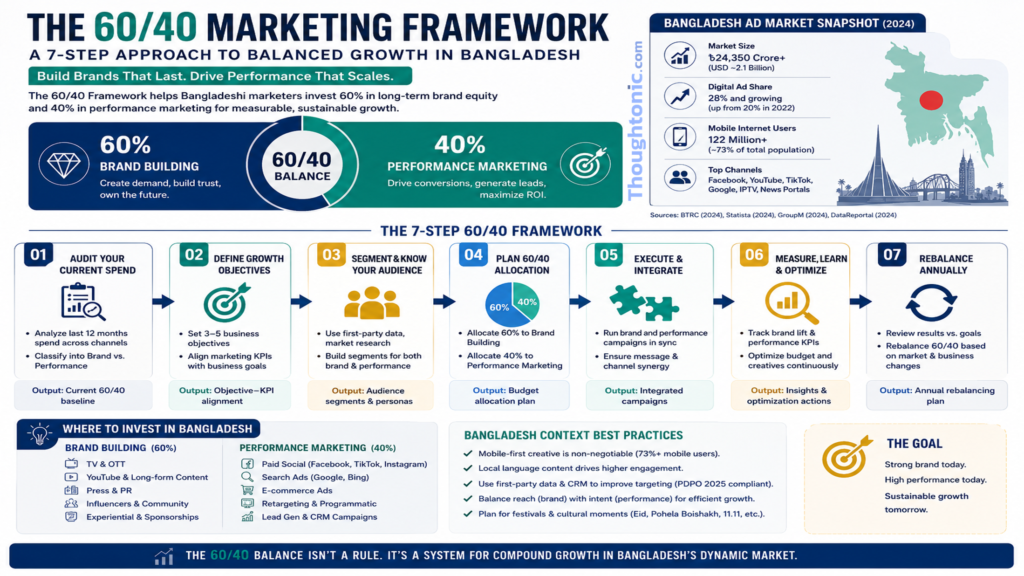
Diagram of the 60/40 marketing framework showing seven steps from budget audit to annual rebalancing, applied to Bangladesh’s ad market
1. Audit the real split, not the aspirational one. Pull twelve months of spend and categorize honestly: anything with a direct-response call to action is activation, everything else is brand. Leadership decision: agreeing to look at the real number. Common mistake: counting “brand awareness” objectives on Meta as brand spend when the creative and targeting are pure conversion logic.
2. Ringfence 60% as a floor the CFO signs off on. This has to survive a bad quarter, or it isn’t a floor. Trade-off: slower short-term revenue response when targets tighten. Mistake: cutting brand budget first when numbers come in soft, defeating the purpose of the floor.
3. Run the direct/branded-traffic diagnostic. Use the Airbnb benchmark above. This takes six to eight weeks and analytics maturity most Bangladeshi teams underinvest in. Metric: percentage of sessions that are direct or branded-organic, tracked quarterly.
4. Sequence channels by function, not habit. Assign every channel a job, reach and memory, or conversion, and stop asking conversion channels to do brand’s job. A boosted video with no frequency plan is not a brand campaign, whatever the objective is labeled. This is uncomfortable because agencies are often paid on channels they’ve always run, not the ones the funnel needs.
5. Fund real brand creative twice a year, minimum. Templated UGC ads are activation tools wearing brand clothing. Real brand work needs proper production budget and a longer approval cycle. Mistake: briefing the same creative team for both jobs on a one-week turnaround, guaranteeing brand work that performs like performance work.
6. Report both timelines in the same deck. A 90-day performance dashboard next to a 12-month brand equity trend, branded search volume works as a proxy where survey tracking isn’t affordable. This forces the CFO and CMO onto the same page.
7. Rebalance annually, not on panic. Pre-commit to one review cycle a year. Off-cycle raids on brand budget during a rough month are the single most common way teams quietly revert to 90/10 performance-heavy allocations without deciding to.
Case Studies: What Brand Resilience Actually Looks Like
Global: Airbnb, 2019 to 2022. Airbnb cut total marketing spend from roughly $1.62 billion in 2019 to $545 million in 2020, close to a two-thirds reduction, as the pandemic collapsed travel demand. By Q4 2020, more than 90% of Airbnb’s traffic was direct or unpaid, and revenue that quarter was up 22% year-over-year despite the reduced spend. CFO Dave Stephenson later confirmed the shift toward brand-centricity “proved to have been the right shift.” The limitation: Airbnb entered this test as a globally recognized brand that had already become a verb in everyday language, a base almost no Bangladeshi brand starts from.
Bangladesh: bKash, 2010 to present. bKash entered mobile financial services in 2010 backed by BRAC Bank and built enough category-defining trust that “bKash” functionally became the generic term Bangladeshis use for sending mobile money, regardless of which app they’re actually using. That mental availability let bKash sustain dominant transaction share even as telco-backed and bank-backed competitors like Rocket and Nagad entered with aggressive cashback promotions. bKash didn’t win by out-discounting competitors; it won by being the default brand people reached for. The limitation: bKash also had first-mover regulatory clearance and an agent network advantage most challengers can’t replicate through marketing spend alone, so the case proves brand resilience but not that brand spend alone guarantees the same outcome.
Action Plans: What to Actually Do This Quarter
For organizations. Start with the audit (Step 1) this month; it costs a few days of a media planner’s time. Within one budget cycle, get CFO sign-off on a brand floor, even a modest 40% if 60% feels politically impossible in year one. Budget BDT 300,000 to 800,000 for one well-produced brand film per half-year cycle for a mid-size challenger, one piece of real creative instead of ten templated variants. Put brand equity and performance metrics on the same quarterly page, and set an annual, not monthly, rebalancing cadence in writing before the next budget fight starts.
For professionals. Learn to read, or at least interrogate, a marketing mix model; it’s the tool that eventually exposes which of your favorite channels were never incremental. Practice defending a budget line with no 30-day payback in front of a skeptical CFO, a rehearsable skill, not an innate one. Build functional literacy in briefing and evaluating brand creative, a different craft than performance ad iteration. Practice saying no to the “quick win” request that cannibalizes brand budget, it’s politically costly but it’s the job. And learn to speak in payback-period and lifetime-value language with finance, because reach and impressions won’t win that argument alone.
Critical Perspective: Where This Framework Breaks
The 60/40 rule is a guideline built from an average across roughly 1,000 case studies, not a law, and Les Binet himself has said as much. It fails fastest in Bangladesh when brand budget gets spent on a single boosted video with no reach plan, which produces neither short-term leads nor long-term memory and gets defunded before it can compound. There’s also a genuine scenario where doing less brand work is correct: a small, cash-constrained challenger in a fully commoditized category may need lean, performance-only campaigns just to survive its first eighteen months, before there’s any revenue base to fund real brand production. Forcing a 60/40 split too early there isn’t discipline, it’s a good way to run out of cash before you get to prove the model works.
Key Takeaways
- Bangladesh’s digital ad market is projected to hit US$3.80 billion in 2026, growing nearly 12% annually, almost entirely into auction-based channels.
- Search CPCs in competitive Bangladeshi sectors have risen 30 to 60% in three years, a direct tax on brands with no branded-search demand to fall back on.
- The 60/40 rule is drawn from nearly 1,000 IPA effectiveness case studies and remains the strongest benchmark for long-run share and margin.
- Global ad markets drifted to roughly 69% performance and 31% brand since 2019, and Bangladesh is repeating that drift faster, not slower.
- Direct-plus-branded traffic below 40% signals genuine performance dependency; above 70% signals hidden brand cannibalization inside the paid budget.
- Airbnb cut marketing spend by roughly two-thirds in 2020 and held over 90% of prior-year traffic, proving brand strength sets a real ceiling on performance spend.
- bKash’s decade-long brand-building effort made it the generic verb for mobile money in Bangladesh, a position aggressive discounting never displaced.
- Brand budgets need a CFO-approved floor that survives a bad quarter, or the floor was never real.
Read more articles:
- The Costly AI Strategy Gap: Why Your Team Is Playing, Not Executing
- The Costly Truth About Minimalist Bangladesh Design Strategy
- The Costly Visual Search Blind Spot That Is Making Bangladesh Brands Invisible
- Quantum Marketing: How 2030’s Technologies Will Shatter Bangladesh’s Status Quo
- Digital Literacy & Brand Purpose: How Education Drives Loyalty in Emerging Markets
Bibliography
- Bangladesh Digital Ad Spend Business Report 2026 – GlobeNewswire/ResearchAndMarkets, February 10, 2026
- The State of Digital Marketing in Bangladesh 2026: A Founder’s Perspective – Ngital, April 2026
- How Much Digital Marketing Cost in Bangladesh? – Ngital, October 2025
- Local ad market shifting to digital media – The Financial Express
- Digital Marketing Landscape in Bangladesh – BenWil Marketing Agency, November 2024
- The Long and the Short of It: Binet & Field’s Framework Explained – Growth Method
- The Brand-Performance Balance: Applying Binet & Field’s 60/40 Rule to 2026 – Leadgen Economy, May 2026
- The 60/40 Rule: Binet & Field on Brand Building vs Activation – Subverse, May 2026
- 60/40 Rule 2026: Brand vs Performance Budget Split – Deep Marketing, April 2026
- INTERVIEW: Les Binet on brand building – PHD Intelligence, May 2022
- Why Airbnb Cut $1B in Performance Marketing and Kept the Traffic – Marketing Case Bootcamp, April 2026
- Airbnb slashes spend in permanent shift from performance marketing to brand – Campaign, June 2021
- How Airbnb proves the power of brand – Tracksuit, March 2025
- Two bKash case studies featured in Dr Philip Kotler’s ‘Essentials of Modern Marketing’ – The Business Standard, May 2023
- Bangladesh: Local brands shine in a market that’s rapidly going digital – Campaign Asia, May 2021
- Bangladesh Inflation Rate Hits Over 1-Year High – Trading Economics/BBS, June 2026
- Bangladesh Bank holds key rate at 10% but cuts deposit rate to spur lending – The Daily Star
- Bangladesh Inflation 9.16% June 2026 – The Daily Star, July 2026