The Brutal Truth About Value-Based Pricing: How to Stop the Race to the Bottom
Most Bangladeshi businesses are pricing themselves into irrelevance while believing they’re staying competitive. A 2024 LightCastle Partners survey found that over 71% of local SMEs set prices using competitor benchmarking or cost-plus formulas. Fewer than 12% conduct any willingness-to-pay analysis. That isn’t a pricing strategy. That’s organized guessing with a spreadsheet attached.
Value-based pricing isn’t a concept reserved for multinationals or consulting firms. It’s a communication discipline. The price tag is the last step in the process, not the first. If your customers are negotiating down on every invoice, they haven’t seen the transformation your product delivers. They’ve only seen a number. And a number without a story is just a cost.
This article is for the founder, the CMO, and the senior marketer who’s tired of discounting and still losing.
The Commodity Trap: Why Price Wars Have No Winners
Bangladesh’s urban middle class grew from roughly 5% to nearly 20% of the population between 2000 and 2023 (World Bank, 2024). That’s a structural shift in consumer sophistication. People aren’t making purely price-driven decisions anymore. They’re evaluating outcomes, experience, and brand credibility. But most brands in this market are still leading with flash sales, discount banners, and “lowest price guaranteed” messaging, as if it’s still 1998.
The math is unambiguous. McKinsey’s 2024 B2B Pulse Survey found that companies with value-based pricing models report 15-20% higher EBITDA margins than cost-plus competitors. Meanwhile, Bangladesh’s RMG sector, which accounts for 84.58% of total export earnings (BGMEA, 2024), remains locked in buyer-dictated cost-plus pricing. Entire industries repeat the same low-margin cycle every decade.
But this isn’t only an export sector story. Walk into any Dhaka retail environment or open any local e-commerce app. Brands are discounting to acquire, discounting again to retain, and wondering why loyalty is so thin.
Here’s what the data actually tells us. The 2024 Bangladesh Brand Forum study found that 62% of customers who switched brands cited “not feeling the value” as their primary reason, not absolute price. They didn’t leave because it was too expensive. They left because no one made it worth it.
When a brand discounts reflexively, it trains its customers to wait for the sale. It signals that the original price was always fictional. Once that perception sets in, no promotion reverses it. You’re not running a campaign anymore. You’re managing a trust deficit. And in Dhaka’s increasingly crowded urban market, trust is the only competitive moat that actually holds.
The Psychology Behind Value-Based Pricing
Value-Based Pricing Starts With a Question Most Brands Never Ask
The question is this: what does your customer believe your product is worth before you name the price? That belief is shaped entirely by perception, not by your cost sheet. And perception is built through communication.
Two decades of behavioral economics research are consistent on this. Daniel Kahneman’s work on loss aversion shows that people feel the pain of paying roughly twice as intensely as they feel the pleasure of receiving (Kahneman, 2011). This means price is psychologically loaded in ways that pure logic doesn’t resolve. Every time a customer sees your price, they’re running a mental calculation: “Is what I’m getting worth more than what I’m giving up?” If your messaging hasn’t already answered that question in your favor, no price point is safe.
Anchoring Changes Everything
The anchoring effect, extensively documented in pricing research (Simon-Kucher & Partners, 2024), shows that the first number a customer encounters shapes how they evaluate every number after it. Brands that introduce a premium tier, even one most customers won’t buy, reset the reference frame for the entire range. A BDT 4,500/month software subscription looks aggressive on its own. It looks reasonable sitting next to a BDT 12,000/month enterprise option. This isn’t manipulation. It’s architecture.
Bain & Company’s Elements of Value framework, updated in 2023, identifies 30 distinct factors consumers weigh when assessing worth, organized across four levels: functional (does it work?), emotional (does it feel right?), life-changing (does it improve my situation?), and social impact (does it align with my values?). Most Bangladeshi brands operate exclusively at the functional tier. They demonstrate that the product works, and stop there. The upper three levels, where premium pricing genuinely lives, go unaddressed.
What Consumer Research Reveals in South Asian Markets
PwC’s 2024 Global Consumer Insights Survey found that 46% of consumers in emerging markets, including South Asia, say they’re willing to pay a premium for products that clearly communicate quality, origin, or ethical sourcing. In Bangladesh, this plays out in ways that would surprise most brand managers. Consumers in Dhaka’s Gulshan and Banani corridors routinely pay 2-4x more for brands that tell a coherent value story. The price isn’t the barrier. The story is.
In my analysis of brands that have successfully maintained premium pricing in Bangladesh, there’s a consistent pattern. They articulate outcomes, not features. They document proof, not promises. They invest in customer relationships before the sale closes.
| Value Communication Lever | What It Does | Example Application |
| Outcome Language | Shifts conversation from cost to result | “Saves your team 8 hours per week” vs. “Has automation feature” |
| Social Proof | Reduces perceived risk of paying more | Documented client ROI, case studies, peer testimonials |
| Price Anchoring | Resets the reference frame for “expensive” | Premium tier, cost-of-inaction framing, industry comparison |
These three levers work in sequence. Outcome language creates desire. Social proof creates confidence. Anchoring creates permission. Without all three working together, the customer defaults to comparing you against the cheapest available substitute.
The Journal of Marketing’s 2023 meta-analysis of value-based pricing studies found that businesses aligning pricing with customer-perceived value report 23% higher customer retention rates than cost-plus competitors. Retention, not acquisition, is where margin compounds. And in a market where acquisition costs rise every quarter, that retention differential is where brand economics are actually built.
The VALUE-COMM Framework: Five Steps to Price With Confidence
Most pricing frameworks fail because they’re built around finance departments, not customer communication. This one isn’t.
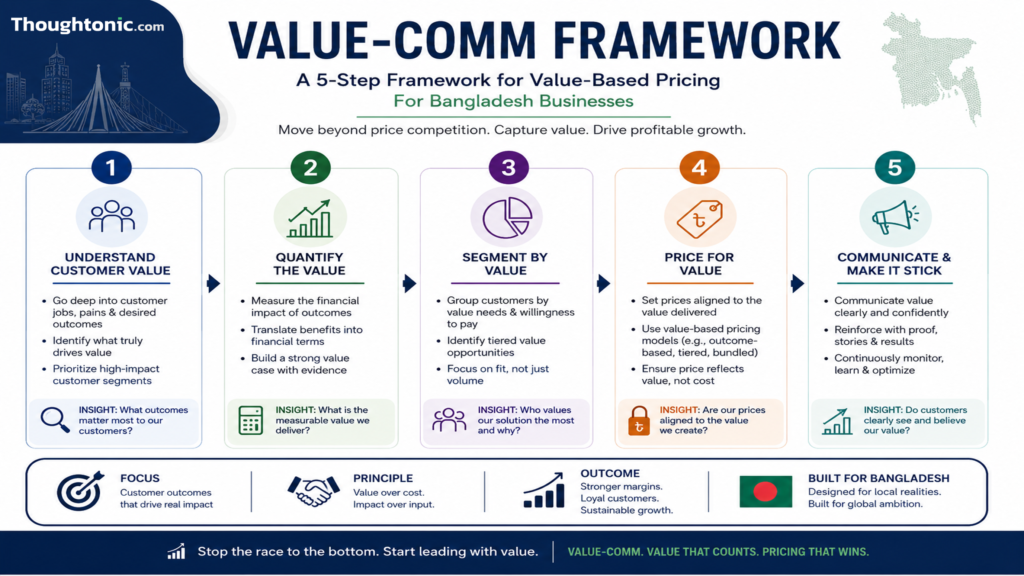
Step 1: Audit the Value Gap
Before touching your price list, understand the distance between what customers receive and what they perceive they’re receiving. Interview your top 20% of customers. Ask them to describe the outcome they actually experience from your product. You’ll almost certainly find they’re undervaluing what they get. That gap is your pricing opportunity, and it’s free to close with better communication.
Step 2: Reframe in Outcome Language
Replace feature language with outcome language across every customer touchpoint: your website, your proposals, your sales scripts, your onboarding materials. “Our software integrates with your CRM” becomes “Your sales team gets back 7 hours per week.” Specific numbers beat vague promises every time. This isn’t copywriting polish. It’s the foundation of your price defense.
Step 3: Anchor High, Then Justify
Introduce a premium tier. Even if the majority of customers choose mid-tier, the anchor changes the psychological reference point. The common mistake is launching a premium option without a corresponding value narrative. An expensive tier with no story reads as arrogance. An expensive tier with a clear outcome story reads as confidence. The difference is entirely in the communication.
Step 4: Build Social Proof Infrastructure
Case studies and client ROI documentation aren’t marketing collateral. In value-based pricing, they’re load-bearing walls. A single well-documented case study demonstrating 3x client return is worth more than three months of promotional campaigns. Make post-sale relationship investment a business process, not an afterthought, specifically to generate this material.
Step 5: Train the Sales Layer to Defend Value
This is the hardest step and the most commonly skipped. In Bangladesh’s relationship-driven business culture, sales professionals offer discounts as courtesy, to smooth relationships, to close faster. Every informal price concession undermines the value story the brand spent months building. Sales teams need to enter every negotiation with one question already answered: “What ROI does this customer expect?” Measure success here by price realization rate, the percentage of listed price actually collected, and target above 90%.
What Global and Local Brands Prove About Premium Positioning
Salesforce: Selling Transformation, Not Software
When Salesforce entered the CRM market in the early 2000s, enterprise software was dominated by on-premise giants with opaque, high-cost structures. Salesforce didn’t compete on price. It competed on three words: “No software.” The promise was clarity, speed-to-value, and business outcome visibility that the alternatives couldn’t match.
The result is documented. Revenue grew from $96 million in 2004 to $34.9 billion in fiscal year 2024 (Salesforce Annual Report, 2024). Salesforce consistently commands price premiums of 30-50% over comparable CRM alternatives. Not because of feature superiority, but because of value narrative superiority. Every case study on its website, every ROI calculator, every customer success story is a piece of value communication infrastructure actively defending the price.
The honest limitation: this model performs most powerfully in enterprise B2B environments where ROI calculation is normalized in procurement workflows. It requires thoughtful adaptation for consumer markets or SME-dominant economies.
Aarong: Building a Price Premium on Heritage and Proof
Aarong, BRAC’s lifestyle brand, has built one of the most instructive premium positioning stories in Bangladesh’s commercial history. Its products, textiles, clothing, and home goods, are priced 2-4x higher than unbranded alternatives in the same category. A hand-embroidered kameez from Aarong isn’t a garment. It’s a documented piece of Bangladeshi artisan heritage with a traceable production story and a social impact warranty.
That story carries measurable weight. Aarong’s revenue crossed BDT 1,000 crore, approximately USD 91 million, by 2023, while supporting over 65,000 artisans across the country (BRAC Enterprise Impact Report, 2023). It competes not against budget garment shops, but against aspirational lifestyle brands regionally.
This is where it gets interesting. Aarong doesn’t sell products. It sells participation in a social narrative. Buyers feel they’re investing in heritage, craftsmanship, and economic inclusion. That feeling, carefully constructed and consistently communicated over decades, is what justifies the premium every single transaction.
The limitation worth naming: Aarong carries BRAC’s institutional credibility as structural support. Smaller brands cannot replicate this overnight. But the underlying mechanism, that value must land emotionally before it’s accepted rationally, is fully applicable at any scale. You don’t need BRAC’s history. You need a coherent story and the discipline to keep telling it.
From Theory to Practice: What You Should Do This Quarter
For Organizations
These aren’t suggestions. They’re decisions that need owners and deadlines.
Stop discounting on first objection. Train every customer-facing person to ask “what outcome are you expecting from this investment?” before considering any price concession. Low effort. High organizational resistance. The resistance itself is the signal.
Conduct willingness-to-pay interviews with your top 20% of customers. Ask directly: “At what price would this become too expensive? At what price would you question the quality?” This takes two weeks and costs nothing beyond time. It will permanently change how your leadership team thinks about pricing.
Redesign your proposal or pricing page. Lead with the client’s problem. Follow with the outcome they’ll achieve. Back it with proof. Then present the price. Most Bangladeshi proposals do the opposite. Price first, justification buried. That order is a self-inflicted wound.
Create a single “price story” document. One internal reference that every salesperson, account manager, and customer-facing employee can access. It answers three questions: What value do we deliver? What does inaction cost the customer? What proof do we have that we deliver?
Launch a premium tier within 90 days. Even if conversion to that tier is low initially. The anchor effect alone will shift purchasing behavior toward your mid-tier option, increasing realized revenue without a single additional sale.
For Marketing and Business Professionals
Learn to calculate and present customer ROI. This requires financial literacy that most marketing professionals haven’t developed. It’s uncomfortable precisely because it attaches a measurable number to your work. That accountability is why it builds credibility faster than any other skill.
Practice holding price under negotiation pressure. In Bangladesh’s high-relationship business culture, saying no to a discount feels like risking the relationship. But consistent discounting signals weakness, not generosity. It tells the client that your confidence in your own value is negotiable.
Build a personal case study portfolio. Document every significant client outcome in a structured format: the problem, the approach, the measurable result. This is uncomfortable because it requires follow-up discipline after the project ends. Most professionals skip it. The ones who don’t open significantly more doors.
For organizations ready to invest, a professional willingness-to-pay research project typically runs between BDT 1.5-4 lakh depending on scope. The full pricing architecture initiative, covering tier redesign, communication overhaul, and sales enablement, typically spans 90-120 days as a serious internal initiative. The ROI on that investment is measurable within two quarters.
Where Value-Based Pricing Gets Complicated
In my experience, this strategy fails most often at the sales layer, not the strategy layer. The framework can be perfectly designed and still collapse when a sales rep offers a 15% discount in a WhatsApp message to close a Friday deal. Organizational culture and pricing strategy must be aligned. One without the other is expensive theater.
There’s also an ethical boundary that deserves direct acknowledgment. Pricing at maximum willingness-to-pay in healthcare, essential goods, or crisis situations is not smart strategy. It’s extraction. The value-based pricing principle applies in markets where genuine alternatives exist and where the buyer has real choice. It is not a license to price out customers who have nowhere else to go.
And there are categories where this approach genuinely doesn’t belong. Budget mobile data, bulk agricultural inputs, basic FMCG staples. In these markets, operational cost efficiency often outperforms value communication investment by a significant margin. Not every product is a premium positioning candidate. Knowing the difference is its own strategic skill.
Value-based pricing is powerful because it’s disciplined. It requires knowing your customer’s real alternatives, their perception of risk, and your own actual delivery. Without that discipline, it’s just charging more and hoping.
Key Takeaways
- Value-based pricing is a communication strategy first. The price is the output. The story is the input.
- 71% of Bangladeshi SMEs price using competitor benchmarking or cost-plus models; fewer than 12% use willingness-to-pay analysis (LightCastle Partners, 2024).
- Companies with value-based pricing models report 15-20% higher EBITDA margins than cost-plus competitors (McKinsey, 2024).
- 62% of brand-switching customers in Bangladesh cited “not feeling the value,” not price level, as the primary reason for leaving (Bangladesh Brand Forum, 2024).
- The three levers of value communication are outcome language, social proof, and price anchoring. All three must work together or none of them fully work.
- Discounting trains customers to wait for sales and signals permanently that the original price was fictional.
- Aarong’s success proves that premium pricing is achievable in Bangladesh’s price-sensitive market when the value story is coherent, consistent, and emotionally resonant.
- Value-based pricing collapses when sales teams discount under relationship pressure. The pricing architecture and the sales behavior must be aligned, not just adjacent.
Read More Articles:
- The Costly AI Strategy Gap: Why Your Team Is Playing, Not Executing
- The Costly Truth About Minimalist Bangladesh Design Strategy
- The Costly Visual Search Blind Spot That Is Making Bangladesh Brands Invisible
- Quantum Marketing: How 2030’s Technologies Will Shatter Bangladesh’s Status Quo
- Digital Literacy & Brand Purpose: How Education Drives Loyalty in Emerging Markets
Bibliography
- LightCastle Partners — Bangladesh SME Pricing Survey, 2024
- McKinsey & Company — B2B Pulse Survey, 2024
- BGMEA — Annual Report, 2024
- World Bank — Bangladesh Economic Update, 2024
- Bangladesh Brand Forum — Consumer Switching Study, 2024
- Bangladesh Bureau of Statistics — Enterprise Survey, 2023-24
- Kahneman, Daniel — Thinking, Fast and Slow, Farrar, Straus and Giroux, 2011
- Simon-Kucher & Partners — Global Pricing Study, 2024
- Bain & Company — Elements of Value Framework, 2023
- PwC — Global Consumer Insights Survey, 2024
- Salesforce — Annual Report FY2024
- BRAC Enterprise — Aarong Impact Report, 2023
- Journal of Marketing — Value-Based Pricing Meta-Analysis, 2023
- Harvard Business Review — “Rethinking Pricing in Emerging Markets,” 2023
- Nielsen IQ Bangladesh — Consumer Confidence Survey, 2024
- Bangladesh Bank — SME Credit and Margin Report, 2024