Approval Layers: The Hidden Speed Tax Bangladesh Must Cut
Only 20 percent of respondents in McKinsey’s global decision-making survey say their organizations excel at it. That should bother anyone who runs a team in Dhaka. Why? Because Bangladesh scores 80 on Hofstede’s power distance index, a culture where people accept hierarchy as the natural order and rarely ask it to justify itself. Put those two facts together and you get a quiet tax on speed. It never shows up on a P&L. It shows up in a calendar. A Tk 50,000 marketing decision can wait eight working days for five signatures, and nobody in the chain is lazy. Everyone is doing the job the structure gave them. In this piece I’ll trace one such decision step by step, show what the research says about approval layers, and give you a plan to cut them without losing control.
Why Approval Layers Cost Bangladeshi Firms More Than They Admit
Start with the culture underneath. Hofstede’s model scores Bangladesh at 80 on power distance, which means people accept a hierarchical order in which everybody has a place and needs no further justification (Prothom Alo, May 2018, citing Hofstede, 2010). The same dataset puts uncertainty avoidance at 60, so rules feel safer than ambiguity. Combine the two and adding approval layers stops looking like delay. It looks like prudence. Academic work on Bangladesh’s administrative culture lands in the same place, linking high uncertainty avoidance to mechanical adherence to hierarchy and centralization (Haque and Mohammad, 2013).
The state shows the same reflex at scale. In the World Bank’s Doing Business 2020 report, Bangladesh ranked 168 out of 190 economies, and transferring a property title took 271 days against a global average of 47 (The Daily Star, October 2019). A private company isn’t a land registry. But in my analysis, habits travel between institutions, and a manager who has spent a career waiting on approvals will often run a department the same way.
Globally the picture isn’t kind either, which is the uncomfortable part. Bain’s research program, covering more than 1,000 companies over ten years, found a clear correlation, at a minimum 95 percent confidence level, between decision effectiveness and business performance (Bain, 2013). Hamel and Zanini estimated that excess bureaucracy costs the US economy more than $3 trillion in lost output, about 17 percent of GDP (Harvard Business Review, September 2016). That’s a deliberately provocative American estimate, so treat the number with care. The direction is harder to dismiss.
But here’s the thing. Approval layers stay hidden because each signature is cheap. One manager’s 15 minutes never looks expensive. Nobody invoices the eight days of waiting, and nobody counts the idea that died in the queue.
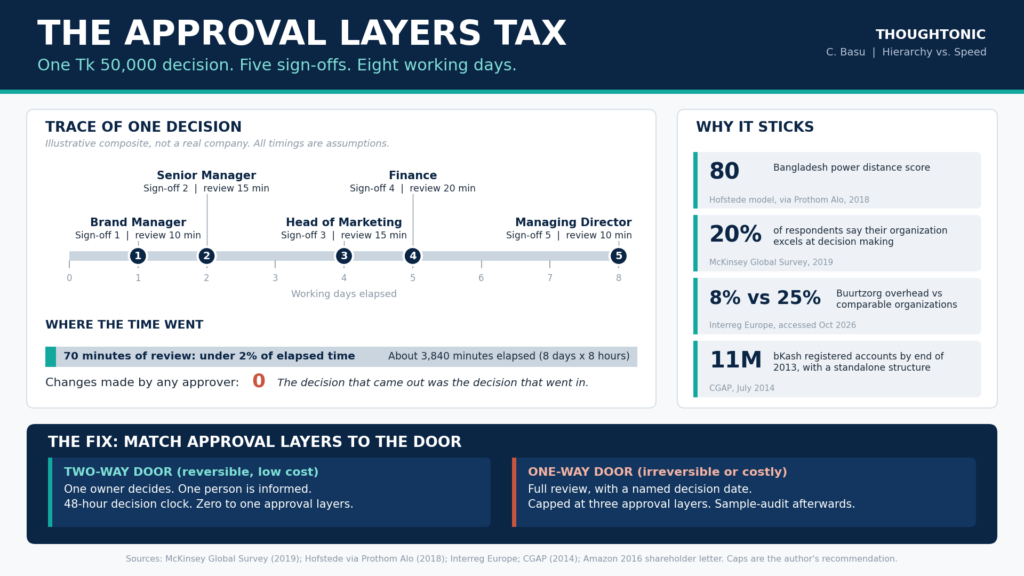
Nobody invoices the eight days of waiting, and nobody counts the idea that died in the queue.
The Science of Slow: How Approval Layers Turn Decisions Into Queues
Approval Layers vs Decision Quality: What the Evidence Says
The instinct behind every extra signature is quality control. More eyes, fewer mistakes. The data says that instinct is shakier than it feels. McKinsey’s 2019 global survey found that, according to respondents, organizations deciding quickly are twice as likely to decide well, and its authors concluded that good practices yield decisions that are both fast and high quality. Speed and quality travel together. The same work warns that giving everyone a vote, or demanding unanimity, slows decisions down.
Bain adds a useful lens. It scores decision effectiveness on four dimensions: quality, speed, yield (how well the decision gets executed), and effort. Effort is the one most Bangladeshi teams never count. A decision that burns five calendars is expensive even when it’s correct.
Jeff Bezos put the mechanism plainly in Amazon’s 2016 shareholder letter. Day 2 companies, he wrote, make high-quality decisions slowly. He also flagged process as proxy, where a leader defends a bad outcome by saying the process was followed, and asked whether you own the process or it owns you. This is where it gets interesting for sign-off cultures. When five approval layers sit on one request, the signature becomes proof of diligence and the outcome becomes secondary.
Culture amplifies the effect. In a low power distance workplace, a junior can say “I’ll decide” and be heard. In a high power distance one, the same person reads a missing signature as a career risk, which is perfectly rational. A June 2026 Daily Star opinion piece notes that strict hierarchy can discourage people from sharing ideas, asking questions or giving feedback, and links weak leadership to delayed approvals (The Daily Star, 1 June 2026). Nobody is being difficult. The incentives simply point toward more signatures.
Matching Approval Layers to Reversibility
The fix isn’t zero approvals. It’s the right number for the type of decision. Bezos separates reversible two-way doors, which can use a light process, from irreversible ones that deserve care. He adds that most decisions should be made with roughly 70 percent of the information you wish you had, because waiting for 90 percent is usually slow. And he recommends disagree and commit, which saves the time spent convincing the boss.
In my analysis, a two-by-two makes this practical. Cross reversibility with cost, then cap the approval layers in each box. The caps below are my recommendation, not a research finding, so calibrate them to your own risk appetite.
Table 1. The Decision Speed Matrix (author’s framework)
| Low cost | High cost | |
| Reversible (two-way door) | Owner decides, one person informed. Zero to one approval layers. | Owner decides, one reviewer, 48-hour clock. One approval layer. |
| Irreversible (one-way door) | Owner plus one reviewer. One to two approval layers. | Full review with a named decision date. Capped at three approval layers. |
One Tk 50,000 Decision Through Five Approval Layers
Now let’s make it concrete. What follows is a composite built from the pattern in sign-off-heavy firms, not a named company’s file, and every timing is an illustrative assumption. A marketing executive at a Dhaka consumer brand spots a post catching a news moment and wants to put Tk 50,000 behind it. The brand manager signs on day one. The senior manager signs on day two and forwards it up. The head of marketing asks whether finance has seen it. Finance confirms the budget code exists. The managing director signs on day eight, after a trip. Total hands-on review: about 70 minutes. Elapsed time: eight working days. Changes made by any approver: zero.
Table 2. The five-sign-off trace (illustrative composite)
| Sign-off | Role | What they actually did | Review time | Signed on |
| 1 | Brand manager | Checked creative and budget line | 10 min | Day 1 |
| 2 | Senior manager | Approved and forwarded upward | 15 min | Day 2 |
| 3 | Head of marketing | Asked if finance had seen it | 15 min | Day 4 |
| 4 | Finance | Confirmed the budget code exists | 20 min | Day 5 |
| 5 | Managing director | Signed after travel | 10 min | Day 8 |
| Total | Changes made by approvers: 0 | 70 min | 8 working days |
That’s under 2 percent of the elapsed time spent actually reviewing. The other 98 percent was queueing. The decision that came out was the decision that went in, and the moment it was meant to catch had passed.
Why does this happen? In my analysis three mechanisms compound. First, queue time: every approver has their own backlog. Second, context loss: each handoff summarizes the one before it. Third, diluted ownership: the more signatures on a decision, the less any one person feels it’s theirs. None of that needs bad intent. It only needs a structure that rewards signing over deciding.
A Six-Step Audit to Cut Approval Layers Without Losing Control
Here’s the sequence I’d run in any firm that wants speed back. Each step has an action, an example, and the mistake that usually kills it. Run steps one to three in the first month. They cost almost nothing, and they give you the evidence you need to win the argument with your leadership team. Skip a step and the others won’t hold.
Step 1. Trace five real decisions
Action: Pull the last five decisions under a set spend limit. Log every signature date and the minutes each approver spent.
Example: The Tk 50,000 boost above: 70 minutes of review, eight days elapsed.
Mistake: Auditing the policy manual instead of the actual email and WhatsApp trail, where the real delays live.
Step 2. Sort by reversibility
Action: Tag each decision reversible or irreversible. Ask one question: could we undo this within a month at low cost?
Example: An ad boost is reversible. A three-year agency contract isn’t.
Mistake: Treating everything as irreversible because one decision once went wrong.
Step 3. Cap approval layers by tier
Action: Set a maximum for each box in the matrix.
Example: Reversible and under Tk 100,000: owner decides, one person informed. Irreversible and over Tk 1 million: up to three layers.
Mistake: Setting caps but leaving the old signature boxes on the form, so people keep signing out of habit.
Step 4. Name one owner with a budget
Action: Give a named person authority, a spend limit, and a written list of what they can decide without asking.
Example: Netflix names an informed captain for each significant decision.
Mistake: Granting the title without the budget, which rebuilds the approval layers you just cut.
Step 5. Review in parallel
Action: Send one page to all reviewers at once with a 24-hour comment window. Reviewers reply with approve, change or block, plus a reason.
Example: A shared document instead of a file moving desk to desk.
Mistake: Applying silence-as-consent to irreversible decisions.
Step 6. Start a decision clock
Action: Publish response times, such as 48 hours for reversible items, with automatic escalation. Report the median cycle time to leadership every month.
Example: Day-two escalation to the next level up.
Mistake: Measuring approval rates instead of cycle time.
Case Studies: Who Has Cut Approval Layers and What Happened
Global: Buurtzorg and Netflix
Buurtzorg is the cleanest proof I know. This Dutch home-care provider runs self-managing teams of up to 12 nurses who manage their own work, backed by a back office of 45 staff. Its overhead runs at 8 percent against about 25 percent in comparable organizations, and Ernst & Young documented savings of around 40 percent to the Dutch health system (Interreg Europe, accessed October 2026). Culture helps. Hofstede scores the Netherlands at 38 on power distance, less than half of Bangladesh’s 80. The point is that trust moved from the org chart to the team.
Netflix attacks the same problem from the corporate side. Its culture memo asks managers to give teams context instead of control, names an informed captain for each significant decision, and reduces the expenses policy, a classic stack of approval layers, to five words (Netflix, accessed October 2026). The memo adds a condition worth copying. Managers still step in during a crisis or when a decision could materially harm the company. Speed with a safety valve. The lesson isn’t to copy Netflix’s words. Its policy works because few rules are paired with high context and clear owners. In a high power distance workplace, you’ll need to build the context first.
Bangladesh: bKash and the Case for Separate Structures
bKash is the local proof, and its lesson is structural. CGAP’s 2014 brief found that BRAC Bank built bKash as a standalone company, not a department. It had its own CEO from outside banking, minority investors with real influence, and staff drawn from other industries. Bank-run mobile money units, CGAP noted, often rotate staff and serve the needs of other parts of the bank. bKash also skipped a formal pilot and took a learn as you do approach, adjusting its agent model on the fly while it kept growing.
The results: about 2 million accounts by the end of 2012, 11 million registered accounts by the end of 2013, and more than 80 percent of mobile financial services transactions despite over 20 licensed providers (CGAP, July 2014). GSMA’s case study reported 30,000 agents after 17 months of operation, in almost one in every two villages.
Here’s the cultural point. bKash operated in the same power-distance-80 country as everyone else, and a conventional bank owned 51 percent of it. It didn’t beat the culture. It sidestepped the approval layers by giving a small team its own owner, its own budget and its own scorecard. Favorable regulation and sizable risk capital helped too, so don’t read this as structure alone. Copy the structure, not the logo.
It didn’t beat the culture. It sidestepped the approval layers.
Action Plans: A 90-Day Path to Fewer Approval Layers
Both plans assume a typical sign-off-heavy structure. Budgets are my estimates, not benchmarks.
For organizations
Days 1 to 30: run the audit. Trace five recent decisions and sort them by reversibility. Budget: no cash, roughly two analyst days plus one 90-minute leadership review. Output: a one-page map of where decisions actually wait, shared with every approver. Keep it factual and blame-free.
Days 31 to 60: publish the matrix and delegation limits, then pilot in marketing and one other function. Budget: one half-day working session, facilitated internally, plus a configuration change in whatever approval workflow you already run. Name a decision owner for every tier and give each a spend limit.
Days 61 to 90: start the decision clock. Publish response times, measure cycle time weekly, and review the first 30 days of results with the leadership team. Budget: a one-page dashboard in a spreadsheet.
Add one control before you remove any signature: a monthly sample of decisions made under the new limits, reviewed after the fact. That’s how you cut approval layers and keep finance comfortable. Budget: about half a day per month from internal audit. Give the program to the COO or head of strategy, not HR, because the owner needs standing to tell a managing director which approvals are theirs to give up.
For professionals
Weeks 1 and 2: log your own sign-off times, because nobody argues with a calendar. Week 3: change how you ask. Send one page with the decision, two options, your recommendation, a deadline, and a default if nobody replies. Week 4: ask for a spend limit you personally own, even a small one, and propose a 48-hour silence-is-yes rule for reversible items. Budget: none, only a conversation with your manager.
One framing tip for high power distance workplaces. Don’t pitch this as challenging authority. Pitch it as protecting your boss’s time. A senior leader who sees 70 minutes of review stretched across eight days may well hear that as a favor. In months two and three, take your log to your manager as evidence, not complaint: here are the last five decisions, here is how long each waited, here is what I propose.
The Critical View: When More Approval Layers Are the Right Call
Let me argue against myself, because the contrarian case is real. First, some signatures are genuine controls. A June 2026 Daily Star opinion piece describes a widespread belief among professionals that decisions are sometimes shaped by informal networks rather than merit. Remove layers carelessly and you may hand more power to the best-connected person in the room. Second, the problem isn’t universal. One practitioner’s account argues that owner-led Bangladeshi businesses decide fast, entering and exiting ventures quickly (Future Startup, January 2025). The tax is heaviest in professionally managed firms with deep reporting lines. Third, the evidence has limits. McKinsey and Bain report correlations from surveys, not controlled experiments, and Hamel and Zanini’s figure is a US estimate. Hofstede’s scores describe national averages, not your office. So cut approval layers where decisions are reversible and cheap. Keep them where mistakes are permanent. And keep the after-the-fact review, because speed without feedback just repeats mistakes faster.
Key Takeaways
- Each extra approval layer feels like prudence. The real cost is the queue behind it, not the signature itself.
- Only 20 percent of respondents in McKinsey’s 2019 global survey say their organization excels at decision making, and fast deciders were twice as likely to decide well.
- Bangladesh scores 80 on Hofstede’s power distance index, so the sign-off reflex is cultural, not accidental.
- Cap approval layers by reversibility. For reversible, low-cost calls, use one owner and inform one person.
- In the illustrative trace, 70 minutes of review took eight working days and changed nothing.
- Buurtzorg runs overhead of 8 percent against about 25 percent in comparable organizations by trusting small self-managing teams.
- bKash reached 11 million registered accounts by the end of 2013 as a standalone company with its own owner and scorecard.
- Start with a 30-day audit, and add a monthly after-the-fact sample so finance keeps its control.
Methodology: every figure was checked against the retrieved text of the linked source as of 6 October 2026. The five-sign-off case is an illustrative composite, and the decision matrix and budgets are the author’s own recommendations, not research findings.
More Articles:
- The Costly AI Strategy Gap: Why Your Team Is Playing, Not Executing
- The Costly Truth About Minimalist Bangladesh Design Strategy
- The Costly Visual Search Blind Spot That Is Making Bangladesh Brands Invisible
- Quantum Marketing: How 2030’s Technologies Will Shatter Bangladesh’s Status Quo
- Digital Literacy & Brand Purpose: How Education Drives Loyalty in Emerging Markets
Bibliography
- McKinsey & Company – Decision making in the age of urgency, McKinsey Global Survey, 2019
- Bain & Company – Decision Insights: The five steps to better decisions, Bain brief, January 2013 survey
- Bezos, Jeff – 2016 Letter to Shareholders, Amazon, 2017 (letter for fiscal year 2016)
- Hamel, Gary and Zanini, Michele – Excess Management Is Costing the U.S. $3 Trillion Per Year, Harvard Business Review, 5 September 2016
- Netflix – Netflix Culture Memo, Netflix Jobs, accessed 6 October 2026
- Interreg Europe – Buurtzorg: A pioneering healthcare organisation, Interreg Europe Good Practices, accessed 6 October 2026
- Buurtzorg International – Buurtzorg Overview (quick scan), Buurtzorg presentation, 2018
- Hofstede, Geert – Cultural Dimensions table (Power Distance Index by country), UNC School of Information and Library Science course materials, spring 2013
- Uddin, Syed – 6-D model of culture and Bangladesh, Prothom Alo (English), 13 May 2018
- Haque, Sk. Tawfique and Mohammad, Sheikh – Administrative Culture and Incidence of Corruption in Bangladesh, International Journal of Public Administration, 2013
- The Daily Star – Bangladesh snags its highest ranking yet (Doing Business 2020), The Daily Star, October 2019
- Dhaka Tribune – Bangladesh 8 notches up in doing business index, Dhaka Tribune, October 2019
- World Bank – Doing Business 2020: Bangladesh country profile, World Bank Group, 2019
- Chen, Gregory and Rasmussen, Stephen – bKash Bangladesh: A Fast Start for Mobile Financial Services, CGAP Brief, July 2014
- GSMA – bKash: mobile money case study, GSMA Mobile for Development, accessed 6 October 2026
- Faisal, Soud Bin – The corporate sector in Bangladesh needs a cultural reset, The Daily Star, 1 June 2026
- Future Startup – The Wisdom of Bangladeshi Businessmen, Future Startup, 21 January 2025
- Rashed, Md. – Centralization in organizational structure: is it good for corporate culture? A study based on the Bangladeshi private sector, UIU Institutional Repository, 28 October 2017