The Brutal Truth About Family Business Succession in Bangladesh
Walk into the founder’s office at almost any of Bangladesh’s biggest conglomerates and you will find the same room. Wood-paneled walls from another decade. A framed photo with a minister who left politics years ago. A landline phone nobody has dialed since 2015, kept because moving it feels disrespectful. The man who built the company still sits behind that desk, sometimes well into his seventies, because no one, including him, has figured out what happens when he does not. That is not nostalgia. It is a warning. Family business succession is the single most under-managed risk in Bangladeshi business today, and almost nobody treats it as a brand problem, even though that is exactly what it becomes the moment the founder’s chair goes empty.
Why Family Business Succession Keeps Failing in Bangladesh
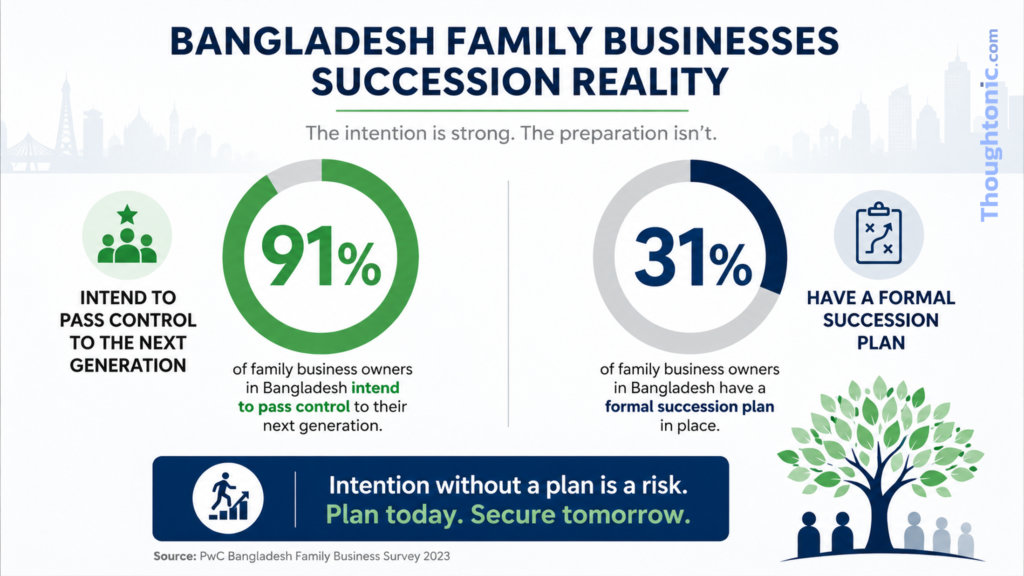
Start with the number that should worry every board member reading this. A 2019 PwC survey, the first Family Business Survey ever conducted in Bangladesh, found that 91% of local family businesses intend to pass control to the next generation, well above the global average. But only 31% of those same companies have even an informal succession plan, and not one firm surveyed had a formalised, communicated plan, compared with 15% globally that do. Around 44% have no plan at all, and 25% do not even know whether one exists. That last figure is the most damning. A quarter of the people running these businesses cannot say with confidence whether a plan for their own survival exists.
The intention to keep the business in the family is nearly universal. The planning to make that happen is nearly absent. Bangladesh is not unique in facing this gap, but it is unusually extreme. In the United States, roughly two-thirds of family businesses still lack a documented succession plan, and only about 30% survive into the second generation, with 12% reaching the third and 3% the fourth, per figures compiled from US Small Business Administration data. Bangladesh’s own numbers, from the PwC study, are structurally similar: of every 100 businesses established here, roughly 60 make it to a second generation, 32 to a third, and barely 16 to a fourth. The difference is that this decline is happening inside companies that employ tens of thousands of people and carry decades of brand equity built around one person’s reputation.
MA Rahim Feroz, vice chairman of DBL Group, put it bluntly at a Metropolitan Chamber of Commerce and Industry seminar in 2025: more than 80% of major businesses worldwide are family owned, and in India, Sri Lanka, and Indonesia those businesses regularly reach a third or fourth generation. In Bangladesh, he said, that sustainability is rare, limited to a handful of families, because of weak family governance, the equivalent of a constitution guiding what happens after the transition.
The Framework Nobody Wants to Build
Here is the part most leadership consultants skip. A weak family business succession process does not just threaten ownership. It quietly damages the brand long before the company changes hands, through a fairly predictable chain of events.
It starts with concentration. In a founder-led company, brand trust, distributor loyalty, and pricing decisions run through one person’s judgment rather than documented systems. That works brilliantly while the founder is active, right up until it does not. When succession is undocumented, the second step is ambiguity: employees, vendors, and channel partners genuinely do not know who holds authority. Ambiguity breeds hesitation up and down the supply chain, from dealers who slow-walk orders to marketing teams who freeze campaigns because nobody wants to approve spend without knowing who signs off tomorrow.
The third step is where it turns visibly public. Family disputes over shares or direction rarely stay contained, and in Bangladesh’s tightly networked business press, whispers travel fast. Once internal disputes become public conversation, consumer and B2B trust both take a hit, because the brand’s implicit promise, stability, continuity, a name you can rely on, is precisely what is being undermined. The fourth step is talent flight: skilled non-family executives running day-to-day marketing and sales tend to leave first, correctly reading ambiguity as career risk. The fifth is channel erosion, as distributors in Bangladesh’s dealer-dependent FMCG sector diversify toward competitors as a hedge. The sixth is brand drift, where marketing direction turns inconsistent because no unified decision-maker approves positioning or campaign tone. By the seventh step, what was once a governance problem has become a market position problem, expensive and slow to reverse.
None of this requires a dramatic public feud. It happens quietly, through delayed decisions, frozen budgets, and a slow erosion of the confidence that partners and consumers place in a name.
A Practical Family Business Succession Framework for Bangladeshi Boards
A workable path through this does not need to be complicated, but it does need to be deliberate. Five steps, in order.
Separate ownership from management early. The decision required is uncomfortable: accepting that being a shareholder and being capable of running the business are different things. The trade-off is that some family members hold equity without operational power, which can breed resentment if not communicated early. Metric: whether decision rights are documented anywhere outside the founder’s head.
Build a family constitution before it is needed. Write down, while relationships are calm, how disputes get resolved, how shares get valued and transferred, and who qualifies for leadership. The trade-off is upfront time and legal cost for a document some family members resist. Metric: does the document exist, is it signed, has it been tested against a real disagreement.
Bring in professional management with real authority. Square Group’s Tapan Chowdhury has said his company is now run by professionals as a team, and that a son or daughter being a major shareholder does not mean they have the capability to run the business. The trade-off is a loss of unilateral family control. Metric: whether non-family executives can make real decisions without family sign-off on routine matters.
Communicate the plan to the market, not just the family. Employees, distributors, and banks all price in uncertainty about who is in charge next. A plan that exists only inside a boardroom does nothing to protect brand trust externally. Metric: whether key channel partners can correctly name the intended successor.
Test the plan before the transition, not during it. Give the incoming generation real authority over a defined unit while the founder can still correct course. Metric: whether the successor has run a full budget cycle independently before taking full control.
Case Studies: What Happens Without a Plan, and What Happens With One
Gucci is the global cautionary tale every business school now teaches, instructive precisely because the brand survived while the family did not. Founded by Guccio Gucci in the early twentieth century, the company passed to his sons without a documented estate or succession plan, which triggered a decades-long power struggle among the surviving heirs, marked by a tax evasion conviction, a prison sentence, and eventually a 1995 killing connected to a family divorce dispute. By 1991, with the family still fighting for control, Gucci had a negative net worth of roughly 17 million dollars. In 1993 the family sold its remaining stake to Investcorp for around 190 million dollars, ending direct family ownership. The brand recovered spectacularly under professional and later corporate ownership, which is the uncomfortable lesson: the Gucci name survived, the family’s control of it did not, and the damage came almost entirely from unresolved succession, not weak products. The limitation for Bangladesh is context; Gucci operated inside a mature Western legal system with functioning courts for shareholder disputes, an advantage many Bangladeshi family firms cannot assume.
Closer to home, Akij Group offers a more mixed picture. Founder Sheikh Akij Uddin built the conglomerate from a small trading operation into one of Bangladesh’s largest industrial groups before his death in 2006. Leadership passed to his sons, and the group kept expanding for close to two decades, including selling its tobacco business to Japan Tobacco International in 2018. But by the mid-2020s, the group had begun formally splitting along family lines, with one son, Sheikh Bashir Uddin, separating a significant portion of the business to launch it under the new name Akij Bashir Group, with the founder’s ten sons each inheriting a share of the original empire. This is not necessarily a failure story; the underlying businesses have largely stayed operational and profitable. But it shows that even a well-run first-generation transition can fragment a conglomerate’s brand architecture once the second generation asserts independent identity, splitting decades of accumulated equity across multiple, less recognisable names.
Contrast both with Square Group and MM Ispahani Ltd, two of the rare Bangladeshi conglomerates leaders regularly cite as having navigated family business succession well. Both attribute their continuity to deliberate professionalisation and governance discipline built well before any transition became urgent, rather than to family harmony alone.
Action Plans: What to Actually Do
For organisations, five moves that most founders resist but should not.
- Commission an independent governance audit within two quarters. Effort: medium.
- Draft a family constitution with outside legal counsel, not a Google template. Effort: high.
- Appoint at least one non-family executive to a genuine decision-making role. Effort: medium.
- Put a documented crisis communication plan in place for the transition, covering media, distributors, and staff. Effort: low.
- Set a fixed, internally communicated timeline for when operational authority transfers. Effort: high.
For individual professionals, especially marketers working inside these companies, five uncomfortable skills worth building now.
- Read organisational power independently of formal titles; real authority in a family firm rarely matches the org chart.
- Document decisions in writing, since undocumented family businesses lose institutional memory the moment a key person leaves.
- Build direct relationships with channel partners rather than routing everything through one gatekeeper.
- Practice presenting business cases to multiple decision-makers at once, since transitions increasingly need consensus, not single-founder approval.
- Learn basic governance and shareholder literacy, since budget authority during a succession period often shifts unpredictably.
Where This Argument Has Limits
Formal succession planning is not a guarantee, and treating it as one would be dishonest. Family constitutions get written and still get ignored once real money and ego enter the room, as Gucci’s own history shows. There is also an ethical risk most succession advice ignores: professionalising a family business can quietly strip capable but non-preferred family members, often daughters, of roles they were qualified for, dressed up as merit-based restructuring. And there is a genuine scenario where doing less outperforms action: a founder still sharp, still trusted by the market, and only a few years from exit may do more damage rushing a public succession announcement than by simply continuing to run the business while planning quietly. Done badly, loudly, or too early, succession planning can create the very instability it is meant to prevent.
Read More Articles:
- The Costly AI Strategy Gap: Why Your Team Is Playing, Not Executing
- The Costly Truth About Minimalist Bangladesh Design Strategy
- The Costly Visual Search Blind Spot That Is Making Bangladesh Brands Invisible
- Quantum Marketing: How 2030’s Technologies Will Shatter Bangladesh’s Status Quo
- Digital Literacy & Brand Purpose: How Education Drives Loyalty in Emerging Markets
Sources
-
- The Business Standard, “Generational gamble: Why Bangladesh’s family businesses often fail after the founders,” 2 September 2025 – https://www.tbsnews.net/bangladesh/generational-gamble-why-bangladeshs-family-businesses-often-fail-after-founders-1227411
- The Business Standard, “Leadership crisis causes family businesses to fail under 2nd, 3rd generations” – https://www.tbsnews.net/economy/leadership-crisis-causes-family-businesses-fail-under-2nd-3rd-generations-211579
- The Business Standard, “How to make a family business survive beyond the founder” – https://www.tbsnews.net/features/panorama/how-make-family-business-survive-beyond-founder-798610
- Growth Shuttle, “Family Business Survival in Bangladesh: Navigating Succession Challenges for a Sustainable Future,” 2025 – https://growthshuttle.com/family-business-survival-in-bangladesh-navigating-succession-challenges-for-a-sustainable-future/
- PwC, “2025 US Family Business Survey” – https://www.pwc.com/us/en/services/audit-assurance/private-company-services/library/family-business-survey.html
- PwC, “PwC’s 12th Family Business Survey: Reclaiming advantage” – https://www.pwc.com/gx/en/issues/assets/pwcs-12th-family-business-survey.pdf
- PwC CEE, “Global NextGen Survey 2024 — CEE Edition” – https://cee.pwc.com/pwc-global-nextgen-survey-2024-cee-edition.html
- Teamshares, “Succession planning statistics in 2025: preserving a legacy” (citing US Small Business Administration data), 2025 – https://www.teamshares.com/resources/succession-planning-statistics/
- Wikipedia, “Akij Group” – https://en.wikipedia.org/wiki/Akij_Group
- Wikipedia, “Sheikh Akijuddin” – https://en.wikipedia.org/wiki/Sheikh_Akijuddin
- Brand Practitioners, “Akij Bashir Group started a new journey with 16 types of business,” 2024 – https://brandpractitioners.com/akij-bashir-group-started-a-new-journey-with-16-types-of-business/
- Tharawat Magazine, “The Violent Family Feud That Nearly Destroyed the Gucci Empire,” 2019 – https://www.tharawat-magazine.com/sustain/gucci-family-feud/
- The Irish Times, “Curse of the Gucci family continues to haunt the heirs,” 1997 – https://www.irishtimes.com/culture/curse-of-the-gucci-family-continues-to-haunt-the-heirs-1.27804
- Today I Found Out, “Family Feud: The Guccis,” 2015 – http://www.todayifoundout.com/index.php/2015/06/family-feud-the-guccis/
- CMG Partners, “The Gucci family: Lessons in legacy, power, and succession,” 2025 – https://cmgpartners.ca/the-gucci-family-lessons-in-legacy-power-and-succession/
- ResearchGate, “Family Business Research in Bangladesh: A Scoping Review and Direction for Research Opportunities,” 2023 – https://www.researchgate.net/publication/375567158_Family_Business_Research_in_Bangladesh_A_Scoping_Review_and_Direction_for_Research_Opportunities