Lo-Fi Marketing Is Winning: The Brutal Truth Why Bangladesh’s Polished Ads Are Failing
Somewhere in Gulshan right now, a brand manager is approving the final cut of a cinematic TVC. Colour grading took two weeks. The drone shots alone cost more than most F-commerce sellers make in a quarter. And it will get outperformed by a fifteen-second phone video shot by an intern in a warehouse.
I’ve watched this happen too many times to call it a coincidence. Lo-fi marketing, the deliberately raw, unscripted, phone-shot style of content, is quietly beating polished production across Bangladeshi feeds, and any brand still betting on cinematic ads is fighting the wrong war. Facebook still reaches 60 million user identities here, but ad costs have jumped roughly 40 percent between 2023 and 2025, and two out of three online businesses launched in that window have already shut down. Something in the model is broken. In my analysis, the break isn’t the algorithm. It’s the belief that looking expensive still equals looking trustworthy.
Why Lo-Fi Marketing Is Beating Polished Ads in Bangladesh
Here’s the thing nobody wants to say in a client meeting: a beautifully lit ad now reads as a sales pitch before the viewer even processes what’s being sold. Nielsen’s long-running trust research puts recommendations from real people at 92 percent trust, against roughly half that for brand advertising, and the gap has only widened as feeds fill with content that looks manufactured. Globally, UGC-style ads pull four times the click-through rate of studio-produced creative, at roughly half the cost per click, according to research popularised by Offerpop and later confirmed across multiple platform studies.
Bangladesh isn’t a side note to this trend, it’s arguably a sharper case of it. Nearly four in ten Bangladeshi online shoppers say social media, reviews, and peer recommendations are what actually informs a purchase, per PCMI’s e-commerce data. Meanwhile, over 96 million people remain offline entirely, and the online majority browses on mid-range Android phones over patchy mobile broadband, DataReportal put median mobile speeds at roughly 28 Mbps in 2025. A glossy four-minute brand film buffers. A twelve-second clip shot on a Redmi doesn’t. This isn’t just a taste preference. It’s an infrastructure reality colliding with a trust deficit built from the 2021-2022 e-commerce fraud wave, when several high-profile platforms collapsed with customer money still in escrow. Bangladeshi consumers learned, expensively, that a polished storefront can hide an empty warehouse. Lo-fi marketing works here specifically because it looks like it has nothing to hide.
The Science Behind Why Raw Content Converts
Let’s get into the mechanism, because this is where it gets interesting, and where most marketing teams get the diagnosis wrong.
The popular explanation is aesthetic: shaky footage, bad lighting, and unscripted dialogue read as “authentic,” so brands hire people to fake that look. This is backwards. Research on social trust consistently shows that what audiences respond to isn’t the grain of the footage, it’s a psychological signal that the person or brand isn’t managing their impression. Overly rehearsed, legally-vetted, focus-grouped content demonstrably weakens trust even when it’s technically excellent, because viewers can sense the impression management underneath the polish. A brand shooting a “raw” ad with a color grade applied afterward is still performing control. Audiences are remarkably good at detecting that.
This explains a pattern I keep seeing in Bangladeshi content audits: brands who hire an agency to “make it look lo-fi” get worse engagement than brands who simply hand a phone to a genuine employee. The format isn’t the variable. The absence of impression management is.
Lo-Fi Marketing vs. Polished Ads: The Signal Comparison
Here’s a simple way to think about the shift, mapped as a comparison:
| Signal | Polished Ad | Lo-Fi Content |
|---|---|---|
| Production cue | Studio lighting, VO, b-roll | Handheld, natural light, ambient sound |
| Viewer’s first read | “This is an advertisement” | “This is a person talking” |
| Cost per click (global benchmark) | Baseline | Roughly 50% lower |
| Engagement multiplier | 1x | Up to 6-7x on organic reach |
| Platform algorithm treatment | Often deprioritised as promotional | Favoured as native, conversational content |
Now overlay the second force at work: rising acquisition costs. When Facebook ad prices climb 40 percent while conversion rates stay flat, and when 68 percent of new online businesses in Bangladesh fold within two years partly because they burned cash chasing paid reach, brands lose the option of buying attention indefinitely. That forces a shift toward earned, organic distribution, which platforms reward specifically for looking native rather than promotional. Polished ads get penalised twice: once by algorithms treating them as low-engagement promotional content, and once by consumers who scroll past anything that visually announces itself as an ad.
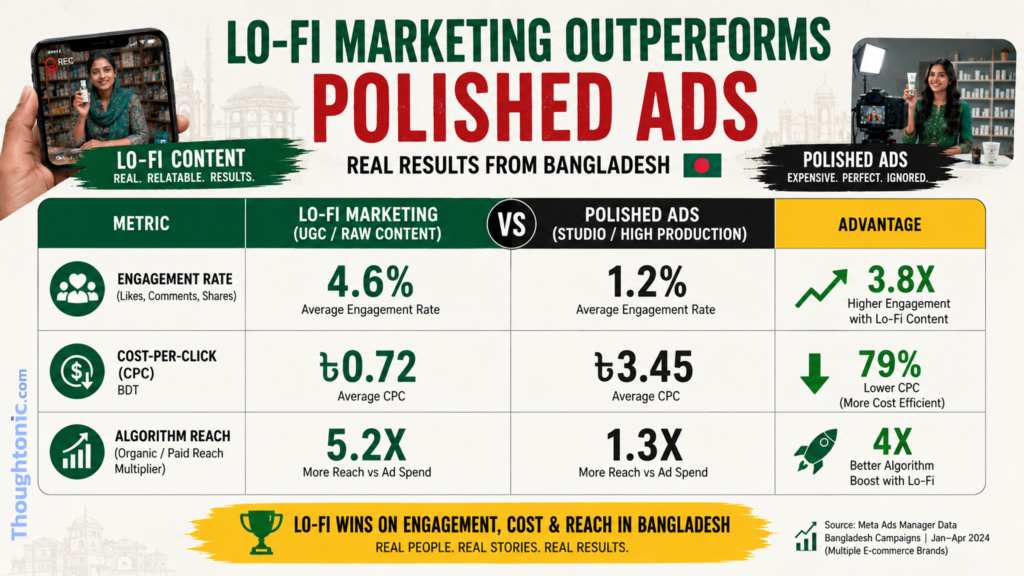
Trace the full chain and it looks like this: rising ad costs remove the safety net of paid reach, which forces brands to earn organic distribution, which platforms only grant to content that doesn’t look like advertising, which polished production structurally cannot achieve, which pushes audiences deeper into skepticism after past e-commerce fraud, which further collapses organic reach for anything glossy, which drives CAC even higher, which locks marketing budgets into discount-driven messaging instead of brand-building, which erodes the very brand equity the polished content was meant to protect. It’s a closed loop, and polish is the thing feeding it.
A Practical Framework for Going Lo-Fi Without Going Reckless
Adopting lo-fi marketing isn’t “post worse videos.” It’s a leadership decision with real trade-offs. Here’s the five-step framework I use with clients making this shift.
1. Diagnose. Audit your last twenty pieces of content for “ad-signal” markers, voiceover, studio lighting, scripted delivery. Leadership decision: accept that the audit will embarrass the marketing department. Trade-off: it exposes how much budget went toward content that never earned organic reach. Metric: cost per organic impression, pre- and post-audit.
2. Recruit real voices. Identify five to ten genuine customers or frontline employees willing to appear on camera, not paid actors reading a script. A mistake I see constantly: brands cast a “relatable-looking” model instead of an actual user, which collapses the entire premise the moment someone recognises the staging.
3. Reframe the brief. Replace hero-shot product ads with documentary-style, phone-first footage. Mandate that at least half of monthly content is shot on a smartphone, not downgraded from a 4K master. Leadership decision: cede visual control that the CMO previously used to signal seriousness to the board. Trade-off: internal stakeholders will initially read it as cheap.
4. Disclose honestly. If a post is paid or sponsored, say so, visibly, in the first few seconds. This one matters more than it looks. Trade-off: disclosure costs some short-term reach. Metric: comment sentiment and trust-related mentions.
5. Institutionalize, don’t outsource. Build a small in-house content function that can respond same-day, rather than routing everything through an agency’s four-week production calendar. Trade-off: you lose polish and gain speed. Metric: content velocity, measured in usable posts per week.
Case Studies: What Works and What Backfires
Ryanair (Global, 2014-2025). For decades before social media existed, Ryanair’s marketing director has described the brand’s voice as direct, blunt, and self-deprecating. Rather than softening that for TikTok, the airline leaned in, mocking its own baggage fees, reposting passenger complaints with dry one-liners, and repurposing customer-shot travel clips instead of commissioning polished campaigns. The airline carried over 200 million passengers in 2025 and built a TikTok following several times larger than easyJet’s, largely through organic engagement rather than paid media. The limitation: Ryanair earned the right to be unpolished because “no-frills” was already its core promise for thirty-five years. A premium airline copying this tone overnight would look like it was mocking its own customers.
Mamaearth / Honasa Consumer (South Asia, 2016-2026). Mamaearth built its early growth almost entirely on UGC and micro-influencer content, real-looking testimonials, unboxing videos, and mom-blogger endorsements, driving year-over-year revenue growth reported above 40 percent in its early scaling years and making it one of the fastest Indian D2C brands to cross ₹1,000 crore in revenue. But the aesthetic of authenticity outran the substance of it. India’s Advertising Standards Council named Honasa Consumer the country’s single largest advertising violator in FY24, with 187 flagged ads, the majority for undisclosed influencer partnerships, alongside disputes over its “toxin-free” and Made Safe certification claims. The limitation is the whole lesson: lo-fi format without operational honesty is just a different costume for the same manipulation, and audiences eventually notice the seams.
Action Plans: What to Actually Do This Quarter
For organisations. Start with one flagship product line and cancel its next agency-produced hero video, redirect that budget (typically BDT 300,000-800,000 per shoot) into a smartphone kit, a ring light, and one month of a junior in-house creator’s time. Timeline: run a six-week A/B test, polished versus lo-fi, same product, same offer, and compare cost per engagement. Mandate visible ad-disclosure on every paid partnership starting immediately, this costs nothing and rebuilds the trust legacy campaigns spent. Within one quarter, shift at least 30 percent of the content calendar to unscripted, employee- or customer-fronted footage.
For professionals. The uncomfortable skill isn’t filming, it’s publishing before it feels finished. Marketers trained for a decade on “get it approved” now have to unlearn that instinct, because the approval chain itself is what kills the spontaneity the format needs. Practice responding to negative comments publicly within the hour instead of escalating to legal. Practice saying no to a fourth round of stakeholder sign-off on a time-sensitive post. These feel like career risks because they invert everything senior marketers were promoted for controlling.
Where This Strategy Can Backfire
Lo-fi marketing isn’t a universal fix, and pretending otherwise is how agencies oversell it as the answer to every brand problem. In regulated categories, banking, insurance, pharmaceuticals, a chaotic or under-produced tone can actively undercut the confidence customers need before handing over money or trusting a health claim. And there’s an ethical risk nobody talks about enough: once you hand employees and customers cameras, you lose centralised control over claims, consent, and brand consistency, which is exactly how misinformation about product safety spreads. Sometimes the right call is doing less, not more. A high-ticket real estate developer or a life insurance provider trying to look “relatable” through shaky handheld footage risks looking unserious about the one thing customers need them to be serious about.
Key Takeaways
- Lo-fi marketing outperforms polished ads because it signals an absence of impression management, not because of its aesthetic alone. That’s why copying the look of lo-fi marketing without changing the substance behind it rarely works.
- Facebook ad costs in Bangladesh rose roughly 40 percent between 2023 and 2025, while 68 percent of new online businesses in that window failed, making paid-only strategies structurally weaker.
- Globally, UGC-style ads generate roughly four times the click-through rate and half the cost-per-click of studio-produced creative.
- Faking the lo-fi aesthetic without operational honesty, as Mamaearth’s parent company learned through repeated advertising violations, does more damage than staying polished.
- Regulated and premium categories should treat lo-fi as a targeted tool, not a blanket strategy.
- The real shift required isn’t cheaper video, it’s less internal control over what gets published and when.
Read More Articles:
- The Costly AI Strategy Gap: Why Your Team Is Playing, Not Executing
- The Costly Truth About Minimalist Bangladesh Design Strategy
- The Costly Visual Search Blind Spot That Is Making Bangladesh Brands Invisible
- Quantum Marketing: How 2030’s Technologies Will Shatter Bangladesh’s Status Quo
- Quantum Marketing: How 2030’s Technologies Will Shatter Bangladesh’s Status Quo
- Digital Literacy & Brand Purpose: How Education Drives Loyalty in Emerging Markets
Bibliography
- DataReportal – Digital 2025: Bangladesh, February 2025
- NapoleonCat – Social Media Users in Bangladesh, November 2025
- PCMI – Bangladesh E-commerce Market: Growth & Trends 2024-2025, January 2025
- Md Faruk Khan – Why 68% of Bangladesh E-commerce Businesses Failed in 2023-2025, February 2026
- ResearchAndMarkets – Bangladesh Digital Ad Spend Business Report 2026, February 2026
- IJRPR – Patterns of News Consumption in the Digital Era of Bangladesh, December 2025
- Loop.fans – UGC Statistics 2025: Trust, Engagement, Conversion & ROI Data, April 2026
- SoPost – User-Generated Content: The New Measure of Authenticity, September 2025
- Billo – 55+ UGC Statistics 2026, May 2026
- DMNews – What Ryanair’s Self-Roasting Social Strategy Quietly Taught Every Content Creator, April 2026
- Startup Spells – Ryanair’s Social Media Marketing Strategy, March 2026
- Boston Waves – Ryanair’s Social Media Strategy, May 2025
- Inventiva – Mamaearth’s Systemic Violation Problem, 2026
- Storyboard18 – Unearthing Mamaearth: Decoding Consumer Feedback, September 2024
- Latterly – Mamaearth Marketing Strategy 2025: A Case Study
- R K Dewan – Mamaearth: A Case Study in Brand Building and Content Marketing, July 2025