Virtual Influencers: The Hidden Cost of a Fake Ambassador
Virtual Influencers: The Hidden Cost of an Ambassador Who Doesn’t Exist
Virtual influencers are computer-generated personas that post like people and sign brand deals. They give brands control, but the evidence I found says audiences punish concealment more than synthetic faces. For Bangladeshi brands, a clearly labeled persona with a named human owner beats a pretend person.
In late 2023, Aitana López had over 120,000 Instagram followers, a pink-haired fitness persona and, her creator says, earnings of up to €10,000 a month. She also doesn’t exist. Virtual influencers like her are landing real sponsorships, and the pitch is hard to resist: always on-brand, never late, never scandalous.
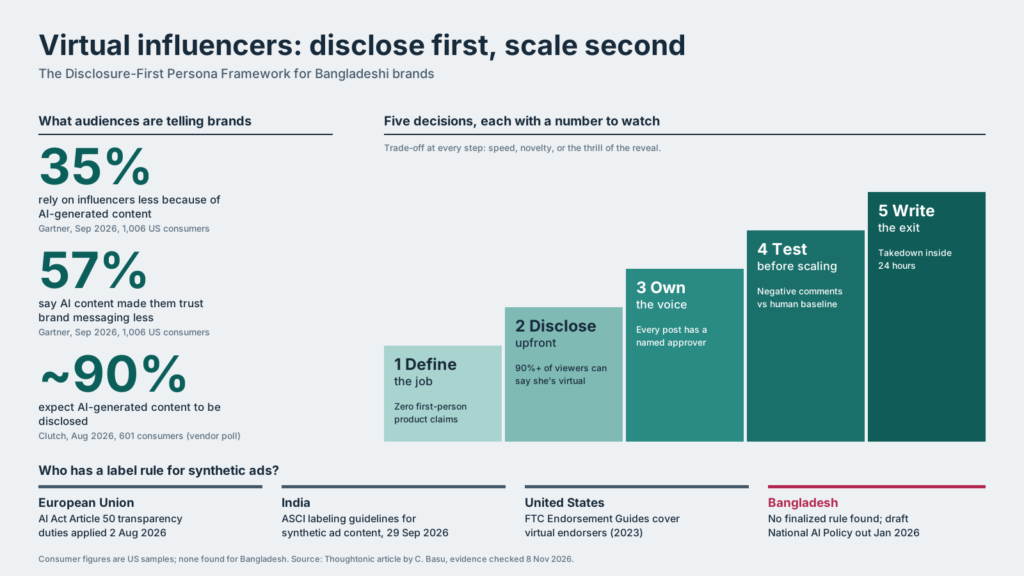
But here’s the thing. The traits that make them attractive are the ones that should make a CXO nervous. Gartner’s 2026 survey of 1,006 US consumers found 35% now rely on influencers less because of AI-generated content. So here’s the question this piece refuses to settle too neatly: would your audience care if they knew?
Why Virtual Influencers Look Like the Safe Bet
The economics are real. Aitana’s founder says he built her after human talent kept delaying or cancelling projects, and her creator told Euronews she averages around €3,000 a month, about €1,000 an ad. Those are self-reported numbers. In Dhaka the pressure is sharper: The Business Standard reported in June 2026 that large influencers often charge fixed fees running into several lakhs of taka per campaign. Attention isn’t scarce, with 82.8 million Bangladeshis online by October 2025 (DataReportal). Trusted voices are.
Now the other side of the ledger. Gartner’s survey, fielded May to June 2026, found 65% of consumers think brands make too much AI content, 57% say it made them trust brand messaging less, and 43% lean more on real people. A Clutch poll of 601 consumers in August 2026, a vendor survey of stated attitudes, found nearly 90% expect AI content to be disclosed. Gartner’s earlier survey of 1,539 US consumers, run in October 2025, found half would rather give their business to brands that avoid generative AI. And the World Federation of Advertisers found in April 2025 that 96% of brands with no plans for virtual influencers cite consumer trust (reported by Digiday).
This is where it gets interesting for Bangladesh. I found no finalized national rule on labeling synthetic ads. A draft National AI Policy 2026-2030 went out for comment on 28 January 2026 and was still being formulated in July. Meanwhile Dismislab analyzed 70 AI-made political videos starring fictional “ordinary citizens” that drew over 23 million views (Dhaka Tribune, 2025). Our feeds already carry convincing fakes. In my analysis, that makes undisclosed synthetic ambassadors a bigger gamble here, not a smaller one. One caveat: the consumer numbers above come from US or global samples. I found no Bangladeshi survey on virtual influencers.
The Science: Why Concealment, Not Code, Breaks Trust
What is a virtual influencer, and how do audiences judge one?
A virtual influencer is a computer-generated persona, run by a human team, that keeps a social account and carries sponsorships. The research is mixed rather than hostile. A University of Amsterdam study found credibility for subtly disclosed virtual influencers was mixed against human ones, and that credibility shaped brand responses. A 2026 literature review by Ács and colleagues concludes that trust in AI communication is conditional, not binary.
My reading: audiences judge the honesty of the arrangement before the pixels. The chain runs like this.
- Control becomes the reason to buy.
- Disclosure shrinks to protect the illusion.
- Audiences sense or discover the synthetic origin.
- Anger attaches to the concealment, and source credibility falls.
- The loss spills from the persona onto the brand.
Guess’s August 2025 Vogue ad shows steps two to five. Its AI credit was tiny, one TikTok critique passed 2.7 million views, and boycott calls followed (CNN). Those were synthetic models rather than influencers with accounts, but the mechanism travels.
| Persona type | Example | Who owns the story | Trust risk |
|---|---|---|---|
| Brand-owned mascot | Lu do Magalu | The retailer, openly | Lower |
| Agency-owned character | Aitana López, Marvella | A studio for hire | Medium |
| Synthetic “real” person | Guess ads, 2025 | Nobody visible | High |
Picture a three-row heat map running from green to red. The redder the row, the more the brand needs you to believe someone is real. My position, not a proven law: audiences forgive pixels faster than they forgive being played.
The Disclosure-First Persona Framework
Five steps, each with the action, an example, the usual mistake and the number I’d watch. Each forces a leadership decision, and each costs something: speed, novelty or the thrill of the reveal.
1. Define the job. Decide whether your persona is a mascot, a character or a customer stand-in. Magalu built Lu as a shop-floor guide first. Mistake: asking a character to vouch for experiences she can’t have. Metric: zero first-person product claims in a content audit.
2. Disclose upfront. Label the bio, every paid post and the opening seconds of video, in Bangla and English. India’s ASCI guidelines, issued 29 September 2026, suggest plain labels such as “created using AI”. Mistake: the Guess-style footnote. Metric: in a small audience sample, 90% or more can correctly say she’s virtual.
3. Own the voice. Name one human editor accountable for every claim, and ban “I tried it” language. Mistake: letting the agency hold both the keys and your reputation. Metric: every post traceable to a named approver.
4. Test before scaling. Run a four-week pilot measuring comment sentiment and whether viewers can say she’s virtual. Mistake: celebrating reach. Marvella’s team cited a million views in days, which says nothing about trust. Metric: negative comment ratio against your human-creator baseline.
5. Write the exit. Contract for likeness rights, a 24-hour pause clause and takedown duties. Mistake: signing a perpetual persona licence with no off switch. Metric: time from crisis to takedown, under 24 hours.
Case Studies: One Disclosed, One Dhaka-Born
Lu do Magalu, Brazil (2003 to 2022 reporting)
Magazine Luiza created Lu in 2003 as the voice of its e-commerce site. A Virtual Humans ranking in April 2022 put her above 31 million followers across platforms, while Forbes Brasil that year cited roughly 55 million, so treat the figure as an estimate. Consumidor Moderno reported a Vogue Brasil cover, and Money Times quoted the company on Lu moving from cost line to revenue source. She shows resilience because she was never passed off as human and the brand owned her story for almost two decades. Limitation: the numbers are third-party or company-reported, and a startup can’t buy that history. The lesson I take is narrower than the hype: the asset was the brand’s honest ownership of the character, not the animation.
Marvella, Bangladesh (from November 2023)
The Wider Collective launched Marvella with Marvel – Be You as a 22-year-old graphic designer modeled on Miquela. Her creators told The Business Standard she drew over a million views within days, with a team smaller than Miquela’s reported 40. The same report noted controversy over her face. What it proves: Dhaka talent can build a persona cheaply. What it doesn’t: I couldn’t find public sales, retention or brand-deal data, or confirm she’s still active. Absence is a finding. Three years on, I can’t point you to a Bangladeshi case showing a synthetic ambassador moved a P&L.
Action Plans for Organizations and Professionals
For organizations. In 30 days, write a synthetic-content policy that bans unlabeled personas (low effort). In 60 days, pilot one labeled persona in a low-involvement category, with a budget capped at one mid-tier human campaign (medium). In 90 days, audit agency contracts for likeness, IP and exit terms, and draft Bangla disclosure copy (medium). The hardest action is telling a board the cheapest option isn’t the safest (high). Expect the first pilot to run about a quarter before you have anything worth a board slide.
For professionals. Build five uncomfortable skills: writing disclosure that doesn’t kill curiosity, spotting synthetic media, reading likeness clauses, measuring trust instead of reach, and saying no upward. Each hurts because it slows the demo and exposes you to whoever wanted the shortcut. If you’re an agency lead, start with the contract clause. If you’re in-house, start with the label.
Critical Perspective: What This Argument Can’t Prove
My evidence is thin where it matters. The big surveys are American, they record stated attitudes rather than purchases, and some come from vendors. Aitana’s earnings are self-reported. Disclosure might also fail to help: Clutch notes responses vary by use case, so some audiences accept labeled AI when it’s useful.
Then the ethical risk I can’t resolve. Even a labeled persona sells a face that never has to age, and every synthetic ambassador is one fewer paid job for a Bangladeshi creator. And if audiences shrug once told, is that consent or fatigue? I don’t know.
There’s an operational risk too. If an agency builds and runs the persona, it holds the face, the voice and the audience, and your brand is a tenant. Doing less may win. A brand with weak product proof should skip the persona and fund honest customer reviews, because Gartner’s 43% are looking for real people. A local startup, Social Square, pitches hundreds of micro-creators paid per thousand views instead of a few stars. That’s a vendor’s claim, but it’s a cheaper way to test authenticity than building a face.
Key Takeaways
- Virtual influencers sell control; audiences punish concealment.
- 35% of US consumers rely on influencers less because of AI (Gartner, September 2026).
- Dismislab found 70 synthetic Bangladeshi videos with over 23 million views, so skepticism is rational.
- I found no finalized Bangladeshi labeling rule; India’s ASCI and the EU have moved.
- Label in Bangla and English, name a human owner, pilot first, write the exit.
- The evidence gap is real: no Bangladeshi survey or verified sales case exists in my research.
Read More Articles:
- Bangladesh Motorcycle Industry: Market Trends, Challenges & Future Outlook
- AI in Marketing in Bangladesh: Costly Hype vs 7 Real Wins
- The Costly AI Strategy Gap: Why Your Team Is Playing, Not Executing
- The Costly Truth About Minimalist Bangladesh Design Strategy
- The Costly Visual Search Blind Spot That Is Making Bangladesh Brands Invisible
Sources
Bangladesh
- Digital 2026: Bangladesh – DataReportal, 2026 (data to October 2025)
- Meet the team behind Marvella, Bangladesh’s first AI influencer – The Business Standard, 16 November 2023
- Meet Marvella, Bangladesh’s first AI “influencer” – The Daily Star, 5 November 2023
- Social Square bets on AI and micro-creators to reshape influencer marketing in Bangladesh – The Business Standard, 6 June 2026
- AI-generated videos stir political storm ahead of Bangladesh elections – Dhaka Tribune, 2025 (exact date not captured)
- Draft National AI Policy Released for Public Review and Feedback – Digibanglatech, 28 January 2026
- Bangladesh formulating human-centric national AI Policy – BSS, July 2026
Global
- Gartner Marketing Survey Finds 35% of Consumers Rely on Influencers Less Due to AI – Gartner, 22 September 2026
- Clutch Reports Consumer Distrust of AI Social Content – Let’s Data Science, reporting Clutch, August 2026 (secondary)
- In graphic detail: virtual influencers click with young audiences – Digiday, date not shown (reports WFA, April 2025)
- Meet the first Spanish AI model earning up to €10,000 per month – Euronews, 2023-2024 (several dated versions)
- Meet 25-year-old Spanish AI model earning Rs 9 lakh per month – Business Today, 27 November 2023
- This Spanish AI Model Is Earning Up To $11,000 A Month – Benzinga, date not shown
- Guess ad in Vogue magazine sparks controversy with its models – ABC News, 1 August 2025
- Controversy over AI models in Guess ads in Vogue – CNN via KVIA, August 2025
- Lu, do Magalu, se torna a maior influenciadora virtual do mundo – Correio Braziliense, April 2022
- Por que a Lu, do Magalu, tornou-se a maior influenciadora virtual do mundo? – Forbes Brasil, May 2022
- Como a Lu do Magalu se tornou a maior influencer virtual do mundo – Consumidor Moderno, 2022
- Como Lu, do Magazine Luiza, passou de linha de despesas para uma máquina de fazer dinheiro – Money Times, 2 June 2022
- FTC Finalizes Updated Guidance for Influencer and Consumer Review Programs – Perkins Coie, 2023
- EU AI Act Article 50: Transparency Obligations Take Effect – Cloud Security Alliance, 29 July 2026
- ASCI issues guidelines for labelling synthetically generated content in ads – Business Standard, 30 September 2026
- Disclosure prominence and virtual influencers – University of Amsterdam repository, date not shown
- Can Algorithms Be Trusted? Consumer Trust and Loyalty in AI-Generated Brand Communication – University of Maribor Press, 2026
- Gartner Marketing Survey Finds 50% of Consumers Prefer Brands That Avoid Using GenAI in Consumer-Facing Content – Business Wire, 16 March 2026
FAQs
Are virtual influencers legal in Bangladesh?
I found no Bangladesh rule written specifically for them as of 8 November 2026. General misleading-advertising duties may still apply, and I haven’t verified how regulators treat synthetic endorsers, so ask counsel.
Are virtual influencers cheaper than human creators?
Possibly, but I found no like-for-like comparison. Aitana earns roughly €1,000 an ad by her creator’s account, while large Dhaka influencers charge lakhs of taka per campaign. Add production and management costs before comparing.
Do consumers trust virtual influencers?
Mixed. Gartner finds eroding trust in AI-heavy content, and the Amsterdam study found mixed credibility when disclosure was subtle. Prominent disclosure is the variable to test.
Does EU or US law affect a Bangladeshi brand?
Only if you advertise into those markets. The FTC applies its endorsement guides to virtual endorsers, and EU AI Act Article 50 transparency duties applied from 2 August 2026.
Methodology and uncertainty: Written from sources retrieved 8 November 2026. Vendor surveys and creator-reported figures are labeled. Verify any figure before citing it.