Bangladesh Motorcycle Industry: Market Trends, Challenges & Future Outlook
Bangladesh motorcycle industry is moving beyond a market defined almost entirely by affordable commuting. The traditional commuter segment remains the commercial foundation, but customer expectations are diversifying. Performance, styling, technology, brand identity and ownership experience are becoming more visible purchase considerations. At the same time, premium motorcycles, new international entrants and electric two-wheelers are changing the competitive conversation.
The market’s structural challenge is that product and customer expectations are evolving faster than parts of the supporting ecosystem. Local assembly has expanded, but component localization remains limited. Distributors must balance inventory, foreign-exchange exposure and dealer economics. Dealers need to build service revenue and customer retention, not depend exclusively on new-bike sales. Customers increasingly expect dependable spare-parts availability, transparent servicing and stronger warranty support.
Reported FY2025–26 retail sales were 422,655 units, almost unchanged from 422,593 in FY2024–25. Yamaha, Suzuki and Honda together accounted for approximately 63.7% of reported sales. These figures suggest a market in which competitive positions can shift even when total demand is relatively flat.
The next phase will depend on the quality of industry development: competitive manufacturing, deeper supplier networks, professional distribution, strong after-sales support, responsible market liberalization and preparation for electric mobility. Bangladesh does not simply need more motorcycles. It needs a stronger motorcycle ecosystem.
1. A market that is changing, but not necessarily growing as expected
For much of its development, Bangladesh’s motorcycle market was relatively straightforward. Most customers wanted an affordable, fuel-efficient and dependable motorcycle for daily commuting, family responsibilities and occasional longer journeys. Manufacturers competed primarily on price, mileage, reliability and distribution reach. The 100cc to 150cc commuter segment formed the commercial backbone of the industry.
That market still exists, but the definition of what a motorcycle represents to a Bangladeshi customer is widening. For one customer, it remains an economical means of transportation. For another, it is a tool for earning through ride-sharing or delivery work. For an expanding group of enthusiasts, it represents performance, lifestyle, individuality and social identity.
These different motivations are creating multiple markets within the same industry. The regulatory opening for locally manufactured higher-capacity motorcycles, Royal Enfield’s arrival, performance-oriented brands and growing interest in electric two-wheelers have made the competitive landscape more complex.
According to figures reported by The Daily Star, Bangladesh sold 422,655 motorcycles in FY2025–26, almost unchanged from 422,593 in FY2024–25. Yamaha, Suzuki and Honda collectively accounted for nearly two-thirds of reported sales. A relatively stagnant overall market can still experience substantial shifts in brand performance, product mix and customer preference.
An important measurement issue must be kept in view: BRTA registrations, manufacturer or distributor dispatches, and retail sales are not the same. For example, BRTA registrations reported for calendar 2025 were 289,830, while industry estimates of sales were materially higher. These numbers should not be combined or compared without explaining their different definitions and periods.
2. How Bangladesh motorcycle industry evolved
Phase 1: The commuter-led market
Historically, affordability and practicality determined purchasing decisions. Japanese brands built strong reputations for engineering and reliability, while Indian manufacturers expanded access to affordable motorcycles. Bajaj, Hero and TVS became familiar names through accessible products, distribution reach and models designed around everyday transportation.
The market was shaped by low purchase prices, fuel efficiency, simple mechanical engineering, affordable maintenance, spare-parts availability and dealer accessibility. Customers generally prioritized functional value over technological sophistication.
Phase 2: Local manufacturing and assembly
The expansion of domestic assembly and manufacturing was a major development. Local industrial groups and international brands invested in facilities, creating a more developed production ecosystem. Companies such as Runner and Bangladesh Honda helped establish Bangladesh as more than an import-dependent market.
However, local assembly should not be confused with complete localization. Many critical components continue to be imported, leaving manufacturers exposed to exchange-rate movements, international logistics costs and supply-chain disruption.
Phase 3: Economic pressure and market contraction
The market experienced a difficult period following the pandemic. Foreign-exchange pressure, restrictions on non-essential imports, inflation, reduced purchasing power and difficulties opening letters of credit affected manufacturers, distributors and customers. BRTA registration data indicate a sharp decline after the 2022 peak, followed by a partial recovery.
| Year | Motorcycle registrations |
| 2022 | More than 500,000 |
| 2023 | More than 310,000 |
| 2024 | 262,715 |
| 2025 | 289,830 |
Source: BRTA figures reported by Bonik Barta in January 2026. Figures for 2022 and 2023 are rounded. Registrations are not equivalent to retail sales.
Phase 4: Premiumization and a new competitive environment
The 2023 regulatory change permitting registration of locally manufactured motorcycles up to 375cc created an opportunity for products that had previously been unavailable through ordinary local-market channels. Royal Enfield’s entry in October 2024 was a visible milestone. Its locally assembled 350cc portfolio helped establish a new reference point for middleweight lifestyle motorcycles.
This was more than the arrival of another brand. It demonstrated that engine capacity, heritage, lifestyle positioning and customer aspiration could create a distinct market opportunity.
3. Who controls the market? The competitive landscape
Bangladesh’s market is led by Japanese and Indian brands, alongside local manufacturing operations and emerging international competitors. The competitive balance, however, has been changing.
Brand-wise reported retail sales, FY2025–26
| Brand | Units sold | Reported share |
| Yamaha | 95,531 | 23% |
| Suzuki | 90,657 | 21% |
| Honda | 83,122 | 20% |
| Hero | 73,762 | 17% |
| Bajaj | 63,256 | 15% |
| Royal Enfield | 7,568 | 2% |
| TVS | 6,370 | 2% |
| Others | 2,389 | 1% |
| Total | 422,655 | Approximately 100% |
Source: Industry figures reported by The Daily Star, 13 July 2026. Percentages are rounded.
Yamaha, Suzuki and Honda together sold 269,310 motorcycles, representing approximately 63.7% of reported sales. Their strength reflects a combination of brand trust, perceived reliability, resale value, product availability and after-sales support, not simply the lowest purchase price.
Hero and Bajaj remain substantial competitors, but established brand recognition does not guarantee market leadership. Product freshness, model launches, positioning and dealer execution matter. Royal Enfield’s reported volume is smaller, but its influence cannot be judged by unit sales alone: it has increased the visibility of the mid-capacity segment and created a distinct lifestyle proposition.
New international competitors
Chinese manufacturers are becoming more visible in performance-oriented categories. KOVE is one example, with products such as the 350RR appearing in the Bangladesh market conversation. CFMoto and QJMotor are also relevant international competitors to monitor, although their current authorized distribution and commercial status in Bangladesh should be independently confirmed before making specific claims.
For newer brands, the real test is not initial launch excitement. It is whether they can establish authorized distribution, genuine spare-parts availability, warranty support, trained technicians, customer confidence and resale value. A brand can generate awareness through product design and launch marketing; a sustainable business requires a complete ownership ecosystem.
4. The CC revolution: What changes when the market opens up?
Engine capacity has historically been one of the most important regulatory constraints shaping Bangladesh motorcycle industry. It influenced product portfolios, customer expectations and investment decisions.
Regulatory distinctions
| Regulatory development | Position |
| Conventional motorcycle registration | Historically restricted to 165cc |
| Locally manufactured motorcycles | Registration permitted up to 375cc from October 2023 |
| CBU imports above 165cc | General restriction remained under final 2026–2029 import-policy reporting |
The 2023 change applied to locally manufactured motorcycles. It did not automatically open the market to fully assembled imports above 165cc. Reports in 2026 discussed possible CBU liberalization, but the final import-policy reporting indicated that the general 165cc CBU restriction remained. This distinction is commercially important because local manufacturers and importers operate under different regulatory and cost structures.
Strategic segmentation by engine capacity
| Indicative segment | Customer proposition | Competitive dynamics |
| 80–110cc | Economy and basic commuting | Price and fuel efficiency |
| 111–125cc | Everyday commuting and utility | Reliability, mileage and comfort |
| 126–165cc | Premium commuter and sporty commuter | Design, features and performance |
| 166–200cc | Entry-level performance | Technology and aspiration |
| 201–250cc | Sports and lifestyle | Performance and styling |
| 251–375cc | Premium, sports, touring and leisure | Brand experience and ownership ecosystem |
| Above 375cc | Specialist and enthusiast market | Limited addressable demand and regulation |
This is a strategic segmentation, not an official BRTA sales breakdown. No sufficiently verified, publicly accessible national dataset was identified in the research reviewed that provides a complete, recent CC-wise sales breakdown. It would therefore be misleading to assign precise market shares to the 200cc, 250cc or 350cc categories.
Three possible market effects
First, customer migration may occur as buyers who previously purchased the highest available engine capacity consider 200cc, 250cc or 350cc products. This could raise average selling prices, but not every customer will upgrade. Purchase price, fuel consumption, maintenance and practical riding needs remain constraints.
Second, competitive repositioning will become more important. Brands that previously competed mainly on affordability may need broader portfolios, while performance and lifestyle brands gain room to establish themselves.
Third, local manufacturing economics will be tested. Higher-capacity products can support investment, but the business case depends on volumes, taxation, component sourcing, factory utilization and localization. Production capacity is not the same as actual demand.
A useful national dataset should report sales by engine band, brand and model, and distinguish retail sales from registrations and wholesale dispatches.
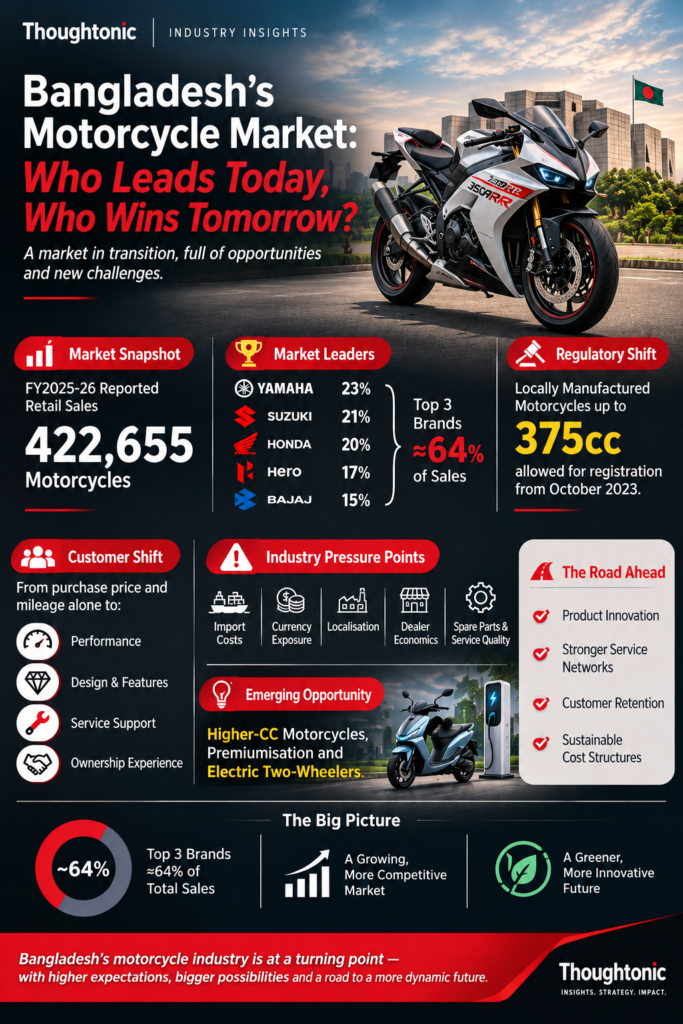
Key market figures, competitive landscape and emerging opportunities in Bangladesh motorcycle industry.
5. The changing customer: From transportation to ownership experience
One of the most important changes is the evolution of customer expectations. The traditional buyer wanted an affordable, economical and dependable motorcycle. The contemporary buyer may also evaluate design, technology, performance, brand image, safety and the quality of the ownership experience.
Design and styling
Sports styling, muscular fuel tanks, LED lighting, digital instrument clusters and distinctive bodywork help products stand out, particularly among younger urban consumers.
Performance
Engine capacity is increasingly relevant to customers who want acceleration, highway capability and a more engaging riding experience. But performance is not determined by displacement alone. Power delivery, torque, gearing, weight, handling and braking also matter.
Technology
Fuel injection, ABS, traction control, slipper clutches, ride modes and smartphone connectivity can differentiate premium products. Manufacturers need to understand which technologies customers value enough to pay for.
Brand image and community
Motorcycles increasingly communicate personal identity. Customers may choose a brand because of its heritage, racing association, design language, community or perceived status. Riding clubs, owner groups and digital communities can strengthen loyalty.
After-sales confidence
A customer buying a higher-value motorcycle is also buying an expectation of long-term support. A reliable service network, genuine parts and transparent warranty policies can influence the final decision as much as product specifications.
Customer segments
| Customer segment | Main priority | Purchase trigger |
| Economy commuters | Price and mileage | Affordability |
| Family-oriented users | Reliability and comfort | Practical value |
| Young professionals | Design and technology | Lifestyle and aspiration |
| Enthusiasts | Performance and handling | Riding experience |
| Long-distance riders | Comfort and touring capability | Product suitability |
| Delivery and ride-sharing users | Running costs and durability | Income economics |
| Premium customers | Brand, quality and exclusivity | Ownership experience |
The purchase journey has also changed. Customers research through YouTube reviews, Facebook groups, owner communities, comparison videos and social media before visiting a showroom. Dealers are no longer the only source of product information. Service complaints and owner experiences can influence prospective buyers well before they enter a dealership.
6. The manufacturer’s perspective: Is local manufacturing commercially sustainable?
The expansion of local manufacturing has been significant, but the next challenge is more complicated than establishing assembly facilities. It is about developing a competitive manufacturing ecosystem.
CBU, CKD and deeper localization
| Business consideration | CBU | CKD | Deeper localization |
| Initial investment | Lower factory investment | Assembly investment | Higher industrial investment |
| Import dependency | High | High | Potentially lower over time |
| Local employment | Limited | Higher | Higher |
| Supply-chain development | Limited | Moderate | Significant potential |
| Cost competitiveness | Depends on global production and duties | Depends on local volume and duties | Depends on supplier capability and scale |
These are general operating characteristics, not a comparison of actual Bangladesh-specific landed costs. Model-level customs, tax and cost data are needed for a precise comparison.
The localization problem
A July 2026 report by The Business Standard quoted industry leaders saying that, although a motorcycle requires more than 700 components, local suppliers manufacture only a small number of major categories, including chain drives, seats, stands and batteries. Component counts depend on how parts and subassemblies are classified, but the broader challenge is clear: local assembly has advanced faster than the domestic vendor ecosystem.
This creates foreign-exchange exposure, longer procurement lead times, imported-component cost fluctuations, supply-chain vulnerability and limited control over critical components. Localization should not be treated only as a policy requirement; it can become a source of long-term cost competitiveness.
Factory utilization and investment returns
The domestic market remains relatively small compared with major regional markets. Industry executives have argued that annual sales approaching one million units would help justify deeper localization and vendor development. The investment question is therefore not simply whether a factory can be built, but whether sufficient demand exists to use its capacity efficiently.
Underutilized capacity increases unit manufacturing costs and places pressure on overhead absorption, inventory financing, working capital, pricing and investment recovery. Manufacturers should avoid basing investment decisions solely on optimistic market forecasts.
What manufacturers need to do next
- Develop domestic suppliers where local production is technically and economically viable.
- Improve factory utilization, reduce wastage and strengthen quality consistency.
- Build product portfolios around distinct customer segments rather than relying on a narrow range of commuter models.
- Develop export competitiveness and meet international quality requirements.
- Invest in engineering, testing, quality assurance and technician capability.
7. The distributor’s perspective: Selling a brand is no longer enough
The distributor translates an international manufacturer’s brand and product strategy into a functioning local commercial operation. This involves product selection, import planning, inventory management, brand positioning, dealer recruitment, sales forecasting, pricing, spare-parts distribution, warranty administration and service infrastructure.
Inventory is a major working-capital issue. Distributors must manage multiple models, colours and variants. Excess stock creates financing costs, warehouse expenses, model obsolescence and pressure for discounting. Inadequate stock creates lost sales and customer dissatisfaction. Exchange-rate movements, import lead times and regulatory uncertainty make forecasting harder.
The distributor’s role must become more customer-centric. Dealer management systems, retail sales tracking, customer databases, digital warranty registration, service reminders, satisfaction monitoring and demand forecasting can help connect the entire ownership lifecycle.
Promotional pricing can stimulate short-term demand, but repeated discounting may weaken brand perception and dealer profitability. In premium categories, the proposition should be based on product differentiation, ownership value and customer experience.
8. The dealer’s perspective: Is motorcycle retail still attractive?
Dealers are the final commercial link between manufacturers and customers, and the physical face of the brand. Their economics include showroom rent, staff salaries, inventory financing, sales incentives, demonstration motorcycles, local marketing, workshop facilities and spare-parts stock.
Sales volume alone does not reveal dealership profitability. A dealership selling 100 motorcycles with weak margins, high overhead and poor inventory turnover may be less profitable than one selling 70 with stronger service revenue.
The service workshop can provide recurring revenue and strengthen customer relationships. Motorcycles require periodic maintenance, lubricants, tyres, batteries, brake components and other consumables. However, if authorized service is perceived as expensive, inconvenient or unreliable, customers may move to independent workshops.
The future dealership should operate as a customer-experience and mobility centre, combining product discovery, test rides, financing guidance, delivery, maintenance, parts, accessories and community engagement.
Dealers should track monthly sales, service return rates, genuine-parts sales, repeat purchases, lead conversion, customer recommendations, inventory turns and gross profit by business line. These measures provide a better picture of dealership health than unit sales alone.
9. After-sales service and spare parts: A long-term differentiator
After-sales support is one of the most important parts of the motorcycle ecosystem. Customers judge a brand through the experience of owning the motorcycle. A good product with poor service support can become a disappointing purchase; a dependable product with accessible servicing and parts can build loyalty.
Common customer concerns include delayed replacement parts, high prices of imported components, limited availability outside major cities, uncertainty about genuine versus counterfeit parts, long repair times and inconsistent warranty handling. These issues become more serious as the number of brands and models increases.
Higher-capacity motorcycles may require different technical capabilities, diagnostic equipment and model-specific components. Modern products can include fuel-injection systems, electronic control units, ABS modules, sensors, liquid cooling and advanced instrumentation. Service personnel need training and appropriate tools.
A strong after-sales programme should include standardized service intervals, transparent pricing, technician certification, genuine-parts identification, digital service histories, warranty tracking, complaint resolution, geographic service coverage, parts-availability monitoring and customer satisfaction measurement.
After-sales should not be treated merely as a cost centre. It is an investment in retention, resale value and future sales.
10. Electric motorcycles: A new competitor or a different market?
Electric mobility is one of the most significant changes in the global two-wheeler industry. Bangladesh needs to distinguish between electric scooters, low-speed electric two-wheelers and performance-oriented electric motorcycles. They do not necessarily serve the same customer or compete directly with conventional motorcycles.
Bangladesh electric two-wheeler market
Recent local reporting indicates increasing interest in electric two-wheelers, particularly scooters. One report described monthly electric scooter sales rising from 969 units in November 2025 to 3,414 in August 2026, with a higher reported level during April 2026 when fuel shortages affected conventional vehicle users. These figures are reported estimates and should not be interpreted as a verified national market share for electric motorcycles.
Bangladesh introduced the Electric Motor Vehicle Registration and Operation Policy, 2023, providing a regulatory foundation for electric vehicle registration and operation.
Why customers may choose electric two-wheelers
- Potentially lower running costs, depending on electricity tariffs, charging losses and battery efficiency.
- Fewer moving powertrain components and potentially lower routine maintenance.
- Suitability for short-distance urban commuting.
- Reduced exposure to petrol and octane price movements.
What prevents mass adoption?
| Challenge | Business implication |
| Purchase price | Initial affordability |
| Battery lifespan | Long-term ownership cost |
| Charging access | Customer convenience |
| Charging time | Operational practicality |
| Battery replacement | Future financial liability |
| Service network | Customer confidence |
| Resale value | Ownership risk |
| Battery recycling | Environmental sustainability |
Global electric two-wheeler developments
The International Energy Agency’s Global EV Outlook 2026 estimates that global electric two-wheeler sales approached 10 million units in 2025, around 14% of total two-wheeler sales. China sold more than 7 million, India remained below 1.3 million, and Vietnam recorded approximately 735,000. Definitions and national datasets can differ, so direct comparisons should be treated carefully.
| Market | Approximate 2025 electric two-wheeler sales | Key observation |
| China | More than 7 million | Largest market; strong manufacturing and battery ecosystem |
| India | Below 1.3 million | Growing market, with adoption still a minority of total two-wheeler sales |
| Vietnam | Approximately 735,000 | Electric models exceeded 20% of new two-wheeler sales |
The electric opportunity for Bangladesh
Early opportunities may be strongest in urban commuting scooters, delivery and logistics fleets, corporate mobility, short-distance commercial transport, battery swapping, local assembly, battery diagnostics and recycling. Electric mobility should be evaluated as a distinct business model, not simply another motorcycle product category.
11. What Bangladesh can learn from China, India, Thailand and Europe
International comparisons are useful, but the markets have different consumer profiles, manufacturing capabilities, regulatory environments and economic structures. The objective is to identify lessons that can realistically be adapted.
China: Scale, supply-chain integration and electric mobility
China demonstrates how manufacturing scale and supplier integration can create cost advantages, and how electric mobility can become a mass-market business when supported by battery production, distribution and suitable urban use cases. Its experience points to local supplier development, technology transfer, competitive manufacturing costs and electrical-component expertise. Bangladesh should not assume, however, that every part of China’s market structure can be replicated.
India: Mass-market manufacturing and premiumization
India is a particularly relevant comparison for conventional motorcycles. SIAM reported approximately 19.6 million two-wheeler sales in FY2024–25, including around 12.25 million motorcycles. India’s strengths include large-scale manufacturing, domestic component suppliers, exports, extensive dealer networks, product segmentation and financing. It demonstrates that a manufacturer can maintain a mass-market commuter business while expanding into premium categories.
Thailand: Manufacturing and export competitiveness
Thailand offers a useful manufacturing benchmark. Its industry has developed through foreign investment, component suppliers, production infrastructure and export-oriented operations. The country’s experience suggests that industrial competitiveness is built through a supplier ecosystem and consistent policy, not simply by assembling imported components.
Europe: Premium ownership, safety and a different riding culture
European motorcycle markets are more closely associated with leisure, touring, premium ownership and recreational riding than with low-cost commuting alone. Europe offers lessons in rider training, safety standards, emissions compliance, premium customer experience and brand communities. Its electric transition is not uniform: adoption differs between mopeds and larger motorcycle categories.
| Market | Main industry strength | Relevant lesson for Bangladesh |
| China | Manufacturing scale and electric mobility | Supply-chain integration |
| India | Mass-market production and exports | Localization and product segmentation |
| Thailand | Manufacturing and component ecosystem | Export-oriented industrial development |
| Europe | Premium ownership and safety culture | Customer experience and responsible riding |
Bangladesh should not attempt to replicate any single market. It can combine India’s manufacturing lessons, Thailand’s supplier-development approach, China’s electric-mobility capabilities and Europe’s emphasis on customer experience and safety.
12. The changing economics of motorcycle ownership
A customer does not simply purchase a motorcycle; the customer commits to a continuing stream of expenses. These include purchase price, registration and insurance, fuel or electricity, servicing, lubricants, tyres, replacement parts, repairs, financing costs and depreciation.
Fuel-price changes can alter purchase behaviour. Reporting during 2026 described pressure on conventional motorcycle sales during a period of higher fuel costs, alongside increased interest in electric two-wheelers. Such developments show why total cost of ownership matters.
The lowest purchase price does not necessarily represent the lowest ownership cost. A motorcycle with a higher initial price may still be attractive if it offers better fuel efficiency, lower maintenance costs and stronger resale value. An electric scooter may offer lower operating costs but requires a careful assessment of battery replacement and residual value.
Manufacturers and distributors have an opportunity to communicate ownership economics transparently rather than relying only on headline purchase prices.
13. Distribution, financing and the next retail transformation
The future of the industry will also depend on how customers access products. Outright purchases will remain important, but financing can make higher-value motorcycles accessible to a wider group of customers. Potential developments include bank partnerships, consumer financing, dealer-supported instalment plans, salary-based financing, corporate fleet financing, delivery-rider financing and leasing. These models require responsible credit assessment and transparent disclosure.
The used-motorcycle market is another opportunity. A structured certified pre-owned programme could help customers upgrade and allow authorized dealers to participate in more of the ownership lifecycle. Possible services include trade-ins, inspection and certification, warranty-backed used motorcycles, resale-value guarantees and digital ownership records.
Customers increasingly research online before visiting showrooms. A connected retail journey could move from digital discovery to enquiry, showroom test ride, financing, purchase, delivery, servicing and eventual repeat purchase. Manufacturers and distributors that connect these touchpoints will better understand customer behaviour.
14. Road safety: Can the industry grow without addressing its biggest externality?
Motorcycle growth brings a responsibility to address road safety. The increasing availability of powerful motorcycles, inexperienced riders, weak enforcement and inadequate safety awareness create challenges for the entire industry.
Road Safety Foundation figures reported by Bonik Barta indicated that 2,671 people died in motorcycle accidents in Bangladesh in 2025, representing more than 36% of reported road fatalities. These figures make road safety a public-policy and industry issue.
Manufacturers should improve braking technology, promote ABS where appropriate, maintain vehicle quality and support rider education. Distributors and dealers should provide delivery orientation, explain safe operation, promote certified helmets and offer maintenance education. Regulators should strengthen licensing, enforcement, rider training and vehicle standards. Customers must use certified helmets, avoid reckless riding, maintain motorcycles and follow traffic rules.
A growing premium segment should not simply mean more powerful motorcycles. It should mean better-equipped motorcycles and more responsible riders.
15. What lies ahead? The next five years
Exact market-size forecasts are difficult because demand depends on macroeconomic conditions, regulation, purchasing power and consumer confidence. Nevertheless, several developments are likely to shape the next phase.
Greater product segmentation. Entry-level commuters, premium commuters, sports motorcycles, lifestyle motorcycles and electric scooters will require distinct product and marketing strategies.
More service-led competition. Service coverage, genuine parts, warranty, resale value and ownership experience will become more important differentiators.
Greater visibility for Chinese manufacturers. Chinese brands can compete through design, technology, variety and pricing, but long-term success depends on local distribution and service infrastructure.
A localization competitiveness test. Component manufacturing, technology transfer, supplier development and exports will determine whether Bangladesh becomes a competitive production base.
Expansion of electric two-wheelers. Electric scooters and practical urban mobility products may find growing opportunities, depending on battery economics, affordability, registration, charging and service.
Experience-driven ownership. Brand communities, riding clubs, touring experiences and digital engagement can play larger roles in customer retention.
Dealer professionalization. Dealers will need stronger financial management, service operations, inventory discipline and digital customer engagement.
16. A practical business agenda for each stakeholder
| Stakeholder | Strategic priorities |
| Manufacturers | Localization, quality, factory efficiency, new products and exports |
| Distributors | Portfolio management, demand forecasting, brand development and service infrastructure |
| Dealers | Workshop profitability, customer retention, inventory efficiency and digital lead management |
| Customers | Total ownership cost, safety, product suitability and service quality |
| Regulators | Stable policy, transparent taxation, safety standards and industrial incentives |
| Component suppliers | Quality certification, investment, technology and production scale |
| Financial institutions | Responsible consumer financing and used-bike financing |
Five priorities for the industry as a whole
- Build a transparent market-intelligence system that tracks retail sales, registrations, CC-wise demand, brand share and customer behaviour.
- Develop local suppliers and encourage investment in viable component categories.
- Strengthen after-sales infrastructure and treat service quality as a core part of brand strategy.
- Support responsible market liberalization that balances customer choice, industrial investment, competition and road safety.
- Prepare for electric mobility through appropriate products, battery expertise, service systems and commercial partnerships.
17. The bigger question: What kind of motorcycle industry does Bangladesh want to build?
Bangladesh motorcycle industry has reached an interesting point in its development. It has moved beyond an almost exclusively commuter-led market, developed domestic assembly capabilities, attracted international brands and created opportunities for premium motorcycle ownership.
But it still has significant structural weaknesses. Its component ecosystem remains underdeveloped. Market intelligence is fragmented. Dealer profitability and after-sales quality need greater attention. Electric mobility is emerging without a fully developed supporting ecosystem.
Industry growth should not be measured only by the number of motorcycles sold. A market selling 700,000 motorcycles with heavy import dependency, weak customer support and limited domestic value addition may be less industrially competitive than a smaller market with stronger local manufacturing, supplier capabilities and exports.
The next stage should focus on the quality of industry growth. For manufacturers, that means competitive production. For distributors, sustainable brand and channel development. For dealers, profitable customer relationships. For customers, better products and dependable ownership experiences. For policymakers, an environment where competition, industrial development and road safety can progress together.
Bangladesh’s motorcycle industry does not simply need more motorcycles. It needs a stronger motorcycle ecosystem.
Selected sources and further reading
- The Daily Star: Japanese big three pick up speed in a flat bike market (13 July 2026).
- The Daily Star: Japanese brands take the lead as motorcycle market recovers (January 2026).
- Bangladesh Investment Development Authority: Motorcycle and Parts Industry. https://www.boi.gov.bd/motorcycle-parts
- International Energy Agency: Global EV Outlook 2026.
- Society of Indian Automobile Manufacturers: Annual Report 2024–25.
- Royal Enfield: Bangladesh manufacturing and market entry announcement (October 2024).
- Thailand Office of Industrial Economics: Industrial economics reports and statistics.
- Road Transport and Highways Division: Policies, including electric motor vehicle policy.
Read More Articles:
- AI in Marketing in Bangladesh: Costly Hype vs 7 Real Wins
- The Costly AI Strategy Gap: Why Your Team Is Playing, Not Executing
- The Costly Truth About Minimalist Bangladesh Design Strategy
- The Costly Visual Search Blind Spot That Is Making Bangladesh Brands Invisible
- Quantum Marketing: How 2030’s Technologies Will Shatter Bangladesh’s Status Quo
Research limitations and points requiring final verification
The absence of reliable public CC-wise data is itself an industry finding. It should be disclosed, not concealed by unsupported estimates.
This report combines published market reporting, regulatory information and international industry benchmarks. Market figures are reproduced with their stated reporting periods and definitions. Retail sales, wholesale dispatches and BRTA registrations are different measures and should not be treated as interchangeable. Where reliable public data are unavailable, the gap is identified rather than filled with an estimate.