Live Commerce in Bangladesh: Ignoring It Is a Costly Mistake
47 people are watching. Someone just asked if it comes in red. The seller answers in nine seconds, tilts the phone toward the window so the colour shows properly, and promises the last two pieces to the first two people who send an address. Three comments later, both are gone. That’s live commerce in Bangladesh.
The scene is a composite, but anyone who has watched a Dhaka seller go live will recognise it. It isn’t the glossy studio show China made famous. It’s New Market in the last week of Ramadan, haggling included, with a phone for a shopfront.
Plenty of brands still file it under “low-end.” In my analysis, that’s one of the costliest classification errors in Bangladeshi marketing right now.
Why Live Commerce in Bangladesh Gets Misread as Low-End
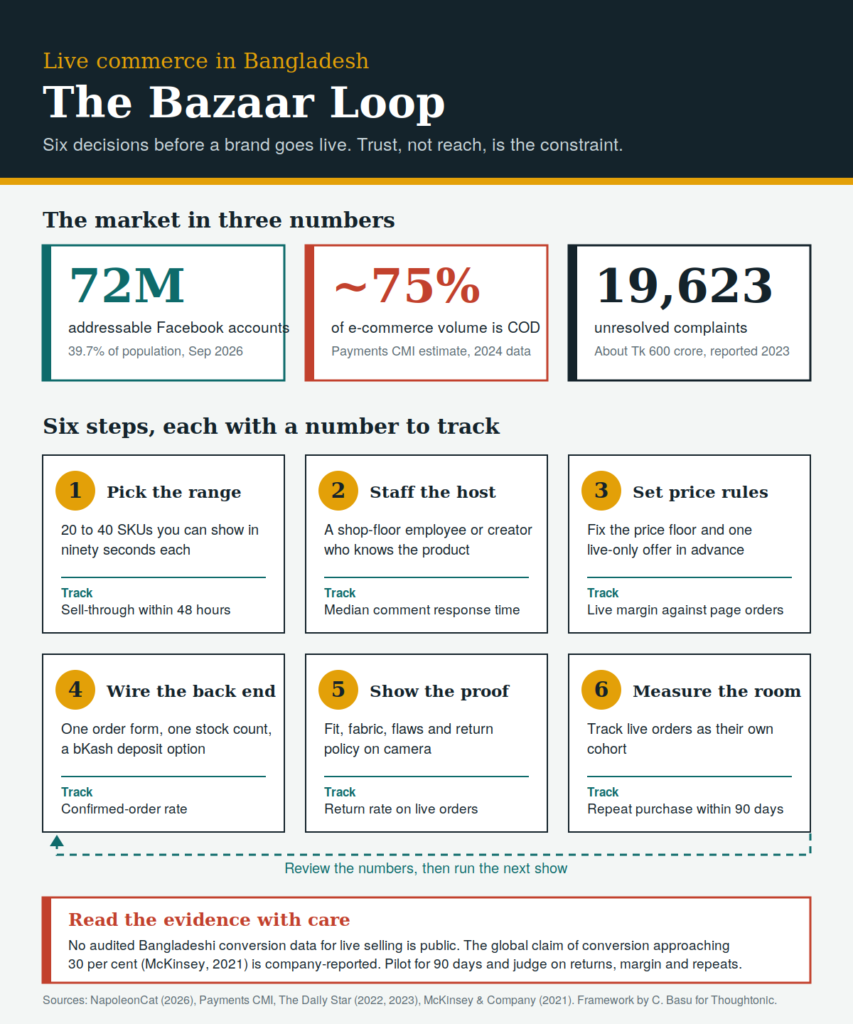
Start with scale. Industry sources put Facebook-based sellers at roughly five lakh, over 60 per cent of them women-owned, and claim about 80 per cent of online lifestyle sales run through them [1]. Treat those as industry estimates, not audited counts. The audience is easier to size: about 72 million addressable Facebook accounts in September 2026, or 39.7 per cent of the population [2]. Even so, the same tracker swung between roughly 72 and 77 million within 2026, and DataReportal counted 64.0 million social media user identities in October 2025 [3]. Read audience as a range.
But here’s the thing: reach isn’t the scarce resource. Trust is. By 2023, 19,623 complaints against 50 e-commerce firms, worth about Tk 600 crore, sat unresolved at the consumer rights directorate [4]. Cash on delivery carried roughly 75 per cent of e-commerce volume by PCMI’s estimate [5], even as card spending averaged Tk 21.85 billion a month between August 2025 and June 2026 [6]. Facebook sellers escaped the scam fallout because customers either know the owner or can watch them live [1]. Live selling isn’t the cheap channel. It’s the proof channel.
Globally the signal is similar, with caveats. McKinsey estimated China’s live commerce at $171 billion in 2020, with companies reporting conversion approaching 30 per cent [7]. That’s self-reported. Google, Temasek and Bain found video commerce grew five-fold in three years across Southeast Asia, heading for 25 per cent of e-commerce GMV in 2025 [8]. That figure covers all video, not only live.
I couldn’t find audited Bangladeshi conversion data for live selling. So I won’t call it the fastest-growing channel. I’ll call it the least measured one, which is exactly why brands underrate it.
The Science of the Haggle: Why a Streamed Bargain Builds Trust
Proof is the product
Think about what a Bangladeshi shopper actually fears: the wrong size, a different shade, thinner fabric than the photo, or no delivery at all. e-CAB’s president has said cash on delivery persists mainly because of distrust, with buyers receiving something inferior to the listing [9]. A live stream attacks each fear in public. The fabric is under the camera, the size question gets answered in the comments, and other buyers watch the exchange. That’s social proof you can’t buy with a banner.
How live commerce in Bangladesh borrows the bazaar’s trust model
A bazaar runs on four signals: a price said aloud, stock you can touch, an answer in seconds, and a shopkeeper you’ll see again. Live selling restores all four. This is where it gets interesting, because a static ad can’t.
| Trust signal | Neighbourhood bazaar | Live seller | Typical brand post |
|---|---|---|---|
| Price | Spoken, negotiable | Announced live | Fixed, static |
| Product | Handled in person | Shown on camera | Edited image |
| Response | Instant | Seconds, in public | Hours, via inbox |
| Accountability | Known face | Named host, visible chat | Brand name |
The table is my own framing, not a study.
McKinsey supplies the mechanism: live formats shorten the journey from awareness to purchase, and time-limited tactics such as one-off coupons create urgency [7]. It also warns that live works best for awareness and trial, less for loyalty, and that many impulse buyers never return [7]. Keep that in mind. It shapes the framework below.
Returns matter too. Coresight data cited by Shopify says live shoppers are about 40 per cent less likely to return items [14]. That’s second-hand and drawn from other markets, so test it on your own orders before banking it.
One structural fact surprised me. Facebook closed native Live Shopping on 1 October 2022 [10], but the feature was only available in the US and Thailand [11]. Bangladeshi sellers never had it. They run on comments, Messenger and a notebook, and a 2021 Future Startup interview already called the process less than optimal [12]. TikTok adds roughly 56 million users aged 18 and over, per DataReportal figures reported in June 2026 [13], though I couldn’t verify native TikTok Shop checkout in Bangladesh. Treat it as a discovery and live-audience channel, with orders closed in chat.
The format works despite the tooling. That tells you how strong the underlying behaviour is. Brands waiting for perfect tooling will wait a long time.
The Bazaar Loop: Six Decisions Before You Go Live
Each decision carries a trade-off leadership has to own. Here’s the loop, with a metric for each step.
1. Pick the range. Choose 20 to 40 SKUs you can show in ninety seconds each. Example: a fashion label features only this week’s Eid collection. Mistake: streaming the whole catalogue, then answering “stock ache?” forty times. Track: sell-through of featured SKUs within 48 hours.
2. Staff the host. Use a shop-floor employee or creator who knows the product. Example: the store manager who already fields size questions. Mistake: hiring a celebrity who can’t explain a fabric. Track: median response time to a comment.
3. Set the haggle rules. Fix the price floor and one live-only offer before the stream. Mistake: discounting on impulse, which teaches viewers to wait for the next one. Track: gross margin on live orders against page orders.
4. Wire the back end. One order form, one stock count, one confirmation message. Example: a small bKash deposit on cash-on-delivery orders; entrepreneurs have long used advance charges to filter fake orders [15]. Mistake: taking orders in comments and reconciling by hand at midnight. Track: confirmed-order rate.
5. Show the proof. Demonstrate fit, fabric, flaws and the return policy on camera. Mistake: hiding defects on screen, which brings them back as returns. Track: return rate on live orders.
6. Measure the room. Track live orders separately: confirmation rate, return rate, repeat purchase. Example: a unique code per show. Mistake: counting viewers and calling it performance. Track: repeat purchase within 90 days.
For live commerce in Bangladesh, step four decides whether the brand experience survives the courier handoff.
Two Brands, Two Lessons: Douglas and bKash
Douglas: expertise instead of discounts
German beauty retailer Douglas was an early European adopter. It streams several shows a week, from expert workshops to influencer talks, and reports conversion of up to 40 per cent, according to McKinsey’s account of a December 2020 report [7]. It’s a useful case because the brand sold advice, not markdowns, so the channel grew without cheapening the label. The limits: that’s a company-reported peak, from one category in one market, and I found no independent loyalty data. McKinsey itself notes live audiences often differ from a brand’s usual customers, and that some companies saw their share of younger shoppers rise by up to 20 per cent, though that isn’t Douglas-specific [7].
bKash and six lifestyle brands: borrowed trust
In March 2025, bKash ran daily Eid live sessions on its own page, its business page and merchant pages. Hosts presented collections from Le Reve, SaRa Lifestyle, Sailor, Raw Nation, Fabrilife and Shelai, buyers could claim up to Tk 500 off with a coupon, and sharing the stream could win gifts [16][17]. The cultural fit is obvious. Dhaka Tribune describes bargaining and late-night market visits as a long-standing part of Eid [18]. What’s new is a payments brand lending credibility to merchants while nudging buyers toward digital payment. Metrics on record: six merchants, daily sessions across three kinds of pages, a Tk 500 incentive ceiling. That’s haggling energy with a coupon code. The limit: no sales or conversion results were published, and the cashback muddies how much came from the format. In my analysis, the lesson is the structure, not a result.
What to Do Monday Morning: Budgets, Timelines and Skills
Run a 90-day pilot. The budgets below are my own illustrative planning ranges, not sourced benchmarks, so adjust them to your category. They exclude stock and salaries.
- Days 1 to 30, set up (Tk 1 to 2 lakh): audit stock accuracy, pick the range, train two hosts, buy lighting and audio, build the order form.
- Days 31 to 60, pilot (Tk 1.5 to 3 lakh): four weekly shows on one hero category, with published price floors and a deposit option.
- Days 61 to 90, judge (minimal cost): compare live orders against site and page orders on return rate, margin and repeat purchase. Scale only if returns and margin hold. Name one owner for live, not a committee, and define failure up front, for example a return rate above your site average.
Five actions leadership resists:
- Give a store employee the mic. Effort: low.
- Hold a price floor in public. Effort: medium.
- Add a deposit to cash-on-delivery orders. Effort: medium.
- Connect live to one shared stock counter. Effort: high.
- Report live as its own P&L line. Effort: medium.
Five skills professionals avoid, and why:
- Improvising on camera: there’s no script to hide behind.
- Negotiating in public: every concession is visible.
- Answering within seconds: speed beats polish.
- Reading operations: you must know stock and courier lead times.
- Defending numbers: finance will ask for return rate, not reach.
Where This Argument Breaks
The evidence is thin where it matters. Conversion claims are self-reported and mostly from China and Europe. McKinsey’s 2021 forecast that live could reach 10 to 20 per cent of e-commerce by 2026 drew on China’s experience [7], and I haven’t seen evidence it has materialised elsewhere. Platforms can also change terms overnight, as Meta showed in 2022 [10]. One study also finds most F-commerce transactions are cash-based and unrecorded, so channel contribution is hard to see [21].
The ethical risk is false scarcity. Failing to deliver after taking advance payment was treated as fraud and criminal breach of trust in the home ministry’s Evaly review [19].
And sometimes doing less wins. A brand with unreliable stock or slow couriers should run one show a week, or none. A dead chat and a late parcel cost more equity than absence. Rural reach is another limit: the Porshi project chose catalogue and bookkeeping over live performance, and its own evaluation reports 94 per cent of retained women saw higher income [20]. That’s self-published, so weigh it accordingly.
Key Takeaways
- Live commerce in Bangladesh is the bazaar’s trust model on a phone: price, product, answers and accountability in public.
- “Low-end” is a measurement gap, not a verdict. No audited Bangladeshi conversion data exists publicly.
- About 72 million addressable Facebook accounts (September 2026) meet roughly 75 per cent cash on delivery. Trust, not reach, is the constraint.
- 19,623 unresolved e-commerce complaints worth about Tk 600 crore explain why visible proof sells.
- Run the Bazaar Loop: pick, staff, set rules, wire, show, measure.
- Pilot for 90 days and judge on return rate, margin and repeat purchase, not views.
- Protect price floors and stock accuracy. False scarcity is a legal and brand risk.
- If operations can’t keep up, do less.
Read More Articles:
- AI in Marketing in Bangladesh: Costly Hype vs 7 Real Wins
- The Costly AI Strategy Gap: Why Your Team Is Playing, Not Executing
- The Costly Truth About Minimalist Bangladesh Design Strategy
- The Costly Visual Search Blind Spot That Is Making Bangladesh Brands Invisible
- Quantum Marketing: How 2030’s Technologies Will Shatter Bangladesh’s Status Quo
Sources
- Digital sales take off as Eid nears – The Daily Star, 18 April 2022
- Facebook users in Bangladesh, September 2026 – NapoleonCat, 2026
- Digital 2026: Bangladesh – DataReportal, data as of October 2025
- Ecommerce Scam: Customers yet to get Tk 600cr back – The Daily Star, 2023
- Understanding Bangladesh’s E-Commerce Landscape – Payments CMI, 2024 data
- From cash to cards: e-commerce shift gathers pace – The Financial Express, 2026
- It’s showtime! (live commerce feature) – McKinsey & Company, 21 July 2021
- e-Conomy SEA 2025 – Google, Temasek and Bain & Company via Google Blog, 2025
- We discourage cash on delivery (interview with e-CAB president) – The Business Standard, date not confirmed
- Facebook To End Live Shopping on October 1 – Search Engine Journal, August 2022
- Facebook to scrap live shopping feature in October – Interaksyon (Philstar), 9 August 2022
- Live commerce and convergence of commerce and entertainment (Rashedun Nabi interview) – Future Startup, 25 January 2021
- Social media as final battleground for votes – The Observer BD, 22 June 2026
- Live selling guide – Shopify, undated (cites Coresight Research)
- Practical tips: how to deal with fake orders in e-commerce or f-commerce – Future Startup, 31 January 2017
- bKash’s Facebook live sessions facilitate Eid shopping with top brands – The Daily Star, 17 March 2025
- bKash’s Facebook live facilitates Eid shopping at top brands – The Financial Express, 2025
- Eid fashion: From tailors to online stores – Dhaka Tribune, 16 March 2026
- Ministry finds Evaly violated laws – The Business Standard, date not confirmed
- Going Once, Going Twice, Going Viral – Innovision Consulting, 2026
- The Present Scenario of F-Commerce in Bangladesh – Zenodo, 2025