AI Personalization in Bangladesh: The Costly Illusion
Check your phone’s SMS inbox right now. Odds are good you’ll find a message that opens with your first name and then pitches something you’ve never looked at. That’s the state of AI personalization in Bangladesh: a mail-merge field dressed up as intelligence. The demand is real. McKinsey found that 71 percent of consumers expect personalized interactions and 76 percent get frustrated when they don’t get them. But here’s the thing. Gartner’s 2025 research says nearly half of personalized digital messages miss the mark because customers find them creepy, irrelevant, or both. In my analysis, Bangladeshi brands aren’t failing at algorithms. They’re failing at identity, consent and data hygiene, the layers underneath every algorithm. Here’s a five-level maturity model to show you where you really stand.
Why AI Personalization Stalls at the Mail-Merge Stage in Bangladesh
The demand side for AI personalization looks healthy. DataReportal counts 82.8 million internet users in Bangladesh at the end of 2025 and 64.0 million social media identities. Money moves digitally too. Bangladesh Bank data, reported by the Daily Ittefaq, put 2024 mobile financial services transactions at Tk 17.37 lakh crore, up 28.42 percent, across about 239 million registered accounts.
Now the uncomfortable part. Roughly 89 million of those accounts were active in January 2025, which is about 37 percent by my calculation. Registered accounts aren’t people, and AI personalization needs people. One customer can exist as a Facebook profile, a bKash wallet and a delivery address on a cash-on-delivery order. Cash on delivery still dominates e-commerce, even though card-based online payments hit Tk 20.35 billion in February 2025, up 23.6 percent year on year, according to the e-Commerce Association of Bangladesh’s administrator. Anonymous cash orders mean your model learns from the connected minority and guesses about everyone else.
Globally, the pattern is the same and the stakes are clear. Twilio Segment’s 2024 survey found 61 percent of companies worry that inaccurate data weakens AI personalization. Gartner found customers are 1.8 times more likely to pay a premium when an experience feels personalized. The prize is real. So is the penalty.
This is where it gets interesting. Bangladesh adds a third risk: custody. Hackers took 410 gigabytes from Shwapno’s customer database in August 2025, including names, phone numbers and purchase histories of about 40 lakh customers, and The Daily Star reports the company told customers nothing for seven months. Separately, the Election Commission found five institutions had leaked NID data to third parties. AI personalization runs on data. Hoard it carelessly and it becomes a liability.
The Five-Level Maturity Model: From Mail-Merge to One-to-One
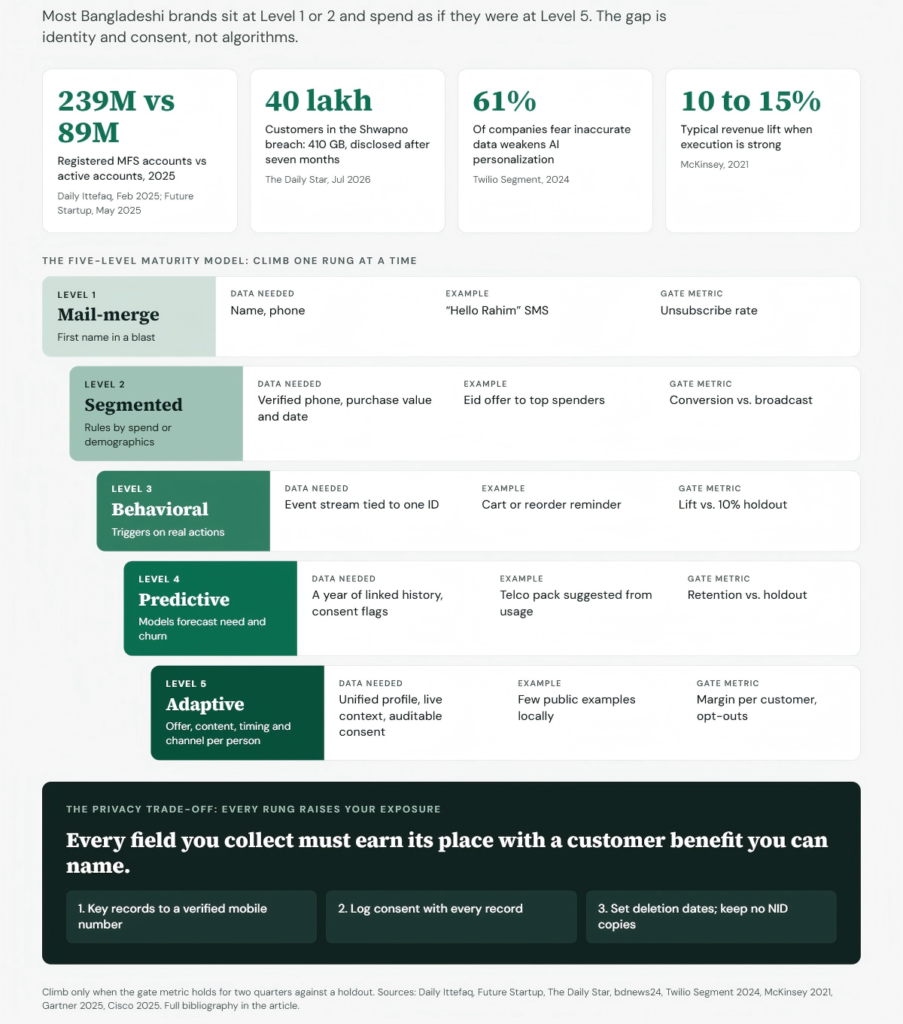
Five-level AI personalization maturity model for Bangladesh brands, from mail-merge to adaptive one-to-one, with data needs, gate metrics and privacy risks.
Maturity models are cheap to draw and hard to apply, so I built this one around a single test: what data and decision rights does each level demand? McKinsey found personalization most often lifts revenue 10 to 15 percent, with company results ranging from 5 to 25 percent depending on sector and execution. Execution is the variable you control, and in AI personalization it depends on your level.
| Level | What it does | Data required | Example | Gate metric |
|---|---|---|---|---|
| 1. Mail-merge | First name in a blast | Name, phone | “Hello Rahim” SMS | Unsubscribe rate |
| 2. Segmented | Rules by spend or demographics | Verified phone, purchase value and date | Eid offer to top spenders | Conversion vs. broadcast |
| 3. Behavioral | Triggers on real actions | Event stream tied to one ID | Cart or reorder reminder | Lift vs. holdout |
| 4. Predictive | Models forecast need and churn | A year of linked history, consent flags | Telco pack suggested from usage | Retention vs. holdout |
| 5. Adaptive | Offer, content, timing and channel chosen per person | Unified profile, live context, auditable consent | Few public examples locally | Margin per customer, opt-outs |
Data requirements for AI personalization, level by level
Levels 1 and 2 run on a spreadsheet; real AI personalization starts at Level 3. Level 3 needs an event stream that ties web, app and order data to one key. In Bangladesh that key is almost always a mobile number, so you need verified numbers, not typed ones. Level 4 adds memory: in my experience models need about a year of linked behavior to beat simple rules, plus consent flags that travel with every record. Level 5 needs live context and the discipline to explain any decision to a customer or a regulator.
Most brands I see sit at Level 1 or 2 and spend on AI personalization like they’re at Level 5. That mismatch is the costly part. Generative tools can write a thousand message variants overnight, but if the profile underneath is wrong, you’ve produced a thousand wrong messages.
The privacy trade-off in AI personalization at every rung
Every level of AI personalization asks for more data, so every level raises your exposure. The Personal Data Protection Ordinance won Advisory Council approval in October 2025 and, per The Daily Star, became the Personal Data Protection Act on 15 April 2026. Gazette coverage says citizens gain rights to access, correct and delete data and to restrict automated decisions. One law firm’s analysis adds that confidential and restricted data must stay inside Bangladesh. Quality is contested. Transparency International Bangladesh argued the October draft dropped principles like purpose limitation and data minimization, and a Daily Star analysis argues the Act has no mandatory breach notification. Read that carefully. Weak enforcement isn’t weak consequence, because customers won’t wait for a regulator before they stop trusting you. Cisco’s 2025 benchmark found 96 percent of privacy professionals say returns on privacy spending exceed costs.
The trade-off is simple to state and hard to live: every field you collect must earn its place with a customer benefit you can name.
A Six-Step AI Personalization Playbook for Climbing the Maturity Ladder
1. Audit what you actually know. Count orders, not accounts, that link to a verified mobile number. Say a grocery chain finds one in three does; that’s its real Level 3 audience, whatever the CRM headcount says. Decision for leaders: who signs off on that number? Mistake: treating registered accounts as customers.
2. Resolve identity. Key every record to a verified number with a consent log. Example: a pharmacy app that asks for the number once, at checkout, and states why. Mistake: matching on names, which collide constantly.
3. Pick one decision, not one campaign. Send time, next pack, reorder reminder. Example: a telco testing one recommendation slot. Mistake: launching ten use cases at once and learning nothing from any of them.
4. Build consent into the data model. Collect fewer fields, store them apart from payment and NID data, and set deletion dates. Mistake: keeping NID copies “just in case,” the exact shadow-copy habit The Daily Star describes.
5. Prove lift. Hold out 10 percent of customers and compare. Example: Eid week, when everything sells. Mistake: crediting AI personalization for sales that would have happened anyway.
6. Climb one level at a time. Move up only when the gate metric holds for two quarters. Example: a retailer waiting on Level 4 until reorder lift is proven. Mistake: buying Level 5 tooling to fix a Level 2 data problem. AI personalization rewards patience.
Case Studies: What Netflix and Grameenphone Prove, and What They Don’t
Netflix, 2006 to 2015. Netflix treats its AI personalization engine as a retention system, not a marketing feature. Executives Carlos Gomez-Uribe and Neil Hunt wrote in 2015 that it saves about $1 billion a year in avoided cancellations, and RTInsights reports it cut churn by several percentage points, a result that took years of tuning. The limitation: the $1 billion is a company estimate no outsider can audit, and it rests on logged-in profiles with years of viewing history. Few Bangladeshi retailers have that.
Grameenphone’s MyGP, 2016 to 2024. By mid-2024 MyGP had 20 million monthly active users against 85.3 million subscribers, about 23 percent, with over 30 million installs. It handles up to 8,000 transactions per second, digitizes 99 percent of GP’s services and offers AI-powered pack recommendations built on usage patterns. Culture matters here, and it’s where global playbooks usually fail. Bangladeshis top up in small, frequent amounts, often from a wallet, so a recommendation matched to someone’s real recharge rhythm beats a generic bundle. In my analysis, MyGP sits around Level 3 to 4. The limitation: GP hasn’t published a lift figure tied to AI personalization, so engagement can’t be separated from plain convenience, and subscriber counts are SIMs, not unique people.
Both brands run AI personalization on an authenticated identity. Brands without an app should build theirs on the verified mobile number, with consent, before buying anything else.
Action Plans: 90 Days for the Organization, 12 Months for You
For organizations. My indicative budget for a mid-size consumer brand is Tk 15 to 40 lakh over 90 days, mostly engineering time. That’s an estimate, not a benchmark.
- Days 1 to 30 (low effort): name one accountable data owner at C-level and audit verified-number coverage. Leaders resist this because the answer is embarrassing.
- Days 31 to 60 (high effort): build a phone-keyed identity layer with a consent log, and delete fields nobody uses. Deleting feels wasteful, which is why it rarely happens.
- Days 61 to 90 (low effort): launch one Level 3 trigger with a 10 percent holdout and report incremental lift to the board.
- Months 4 to 12 (medium effort): freeze generative AI personalization experiments until the gate metric holds for two quarters.
For professionals. The budget is mostly evenings, and the payoff is credibility when AI personalization budgets get questioned. Add one skill per quarter.
- Translate the Act into campaign rules with your legal counsel. Uncomfortable because law feels like someone else’s job.
- Design holdout tests. Uncomfortable because tests expose campaigns that don’t work.
- Write the data dictionary. Unglamorous, and nobody applauds it.
- Say no to a senior stakeholder’s data request. Political risk, plain and simple.
- Explain a model’s decision to a customer in plain Bangla or English. It forces you to admit what the model can’t know.
The Critical View: When Doing Less Beats Doing More
Three cautions. First, much of the benchmark data is Western. Gartner’s late-2024 survey sample covered North America, the UK, Australia and New Zealand, and McKinsey’s headline figures date from 2021. Bangladeshi consumers may behave differently. Second, AI personalization can deepen exclusion. In January 2024, 65.8 percent of Bangladesh’s social media users were male, per DataReportal, so models trained on connected behavior can quietly skew toward men. Inferring religion, health or financial stress from purchase and wallet patterns is another ethical line teams cross without noticing. Third, doing less can win. Not every brand needs AI personalization this year. My rule of thumb: if fewer than a third of your orders carry a verified number, one excellent, well-localized mass campaign plus a reorder reminder will likely beat a one-to-one system built on guesswork. Reasonable people will argue with that threshold. Good.
Key Takeaways
- Bangladesh’s AI personalization problem is an identity problem: about 239 million registered MFS accounts, roughly 89 million active.
- “Hello {FirstName}” is Level 1. Don’t buy Level 5 tooling to fix Level 2 data; AI personalization compounds your data quality, good or bad.
- Key every record to a verified mobile number and a consent log before anything else.
- Gate each level with a metric, and prove AI personalization lift against a holdout.
- McKinsey’s typical 10 to 15 percent revenue lift comes from execution, not from buying a tool.
- Every collected field is a liability: Shwapno’s breach covered about 40 lakh customers and 410 GB.
- Build for the Personal Data Protection Act now, because customer trust moves faster than regulators.
- If verified coverage is thin, do less and do it well. AI personalization at scale is earned level by level.
Read More Articles:
- AI in Marketing in Bangladesh: Costly Hype vs 7 Real Wins
- The Costly AI Strategy Gap: Why Your Team Is Playing, Not Executing
- The Costly Truth About Minimalist Bangladesh Design Strategy
- The Costly Visual Search Blind Spot That Is Making Bangladesh Brands Invisible
- Quantum Marketing: How 2030’s Technologies Will Shatter Bangladesh’s Status Quo
Bibliography
- Digital 2026: Bangladesh – DataReportal, late 2025
- Digital 2024: Bangladesh – DataReportal, early 2024
- Record mobile banking transactions in December – The Daily Ittefaq, 16 Feb 2025
- The State of Mobile Financial Services (MFS) Industry in Bangladesh at the Beginning of 2025 – Future Startup, 6 May 2025
- E-Commerce can be Bangladesh’s next growth engine, if policy keeps pace – The Daily Star, 25 Aug 2025
- Why Bangladesh’s new data protection law may fail to protect your data – The Daily Star, 7 Jul 2026
- Election Commission uncovers evidence of NID data leaks at five institutions – bdnews24.com, 10 Feb 2025
- Govt issues gazettes of 2 landmark ordinances on data protection, governance – Prothom Alo, 2025
- TIB press release on the Personal Data Protection and National Data Governance Ordinances – Transparency International Bangladesh, 11 Oct 2025
- Key Highlights of the Personal Data Protection Ordinance 2025 for Businesses – Law firm briefing (mahbub-law.com), Oct 2025
- GP revenue rises by 5.6pc to Tk 42.2b in Q2’24 – The Observer (Bangladesh), 26 Jul 2024
- The value of getting personalization right or wrong is multiplying – McKinsey & Company, Nov 2021
- Gartner Marketing Symposium interview on personalized interactions and customer-shared data – Gartner, 4 Jun 2025
- Gartner Survey Reveals Personalization Can Triple the Likelihood of Customer Regret at Key Journey Points – Business Wire (Gartner), 3 Jun 2025
- The State of Personalization Report 2024 – Twilio Segment, 2024
- Cisco’s 2025 Data Privacy Benchmark Study – Cisco, 2 Apr 2025
- The Netflix Recommender System: Algorithms, Business Value, and Innovation – ACM Transactions on Management Information Systems, Dec 2015
- How Machine Learning Fuels Your Netflix Addiction – RTInsights, c. 2016
Sources checked on 27 October 2026. Format: Source – Publication, Date.