Marketing Talent: Bangladesh Brands Are Losing the Quiet War
Key Answer: Bangladeshi brands are losing the fight for marketing talent not because graduates are scarce, but because hiring is slow, development is thin and nobody owns retention. Six steps close the gap: count, fund, hire, grow, keep, prove. I call the sequence the Talent Ledger.
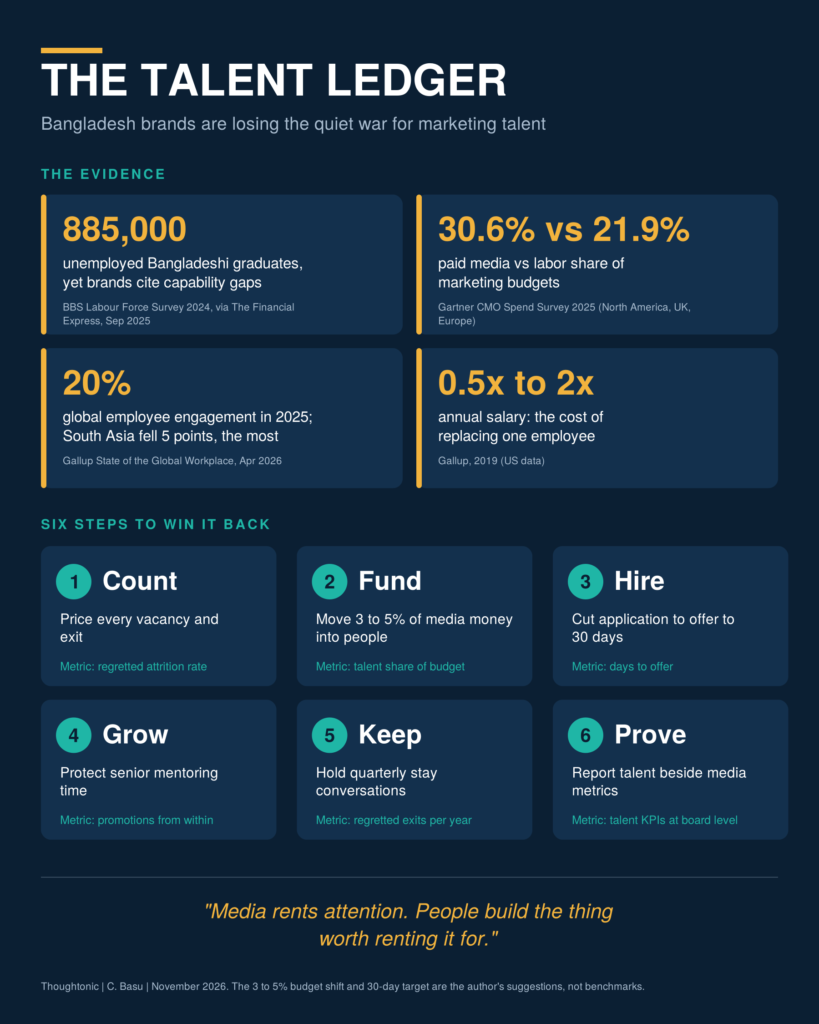
Every Dhaka brand can quote its rival’s ad spend, and DataReportal counts 68.3 million social media user identities in Bangladesh for them to chase (October 2026). Few can name the strategist, designer or copywriter they lost last year, or where that person went. That’s the quiet war for marketing talent, and most of us haven’t turned up. Here’s the oddity. Bangladesh’s 2024 labour survey found nearly 885,000 unemployed graduates, yet agency and client leaders keep saying in public that good people are hard to find. Both are true. My argument: the shortage isn’t of bodies. It’s of developed, retained, well-managed capability.
Why Is the Marketing Talent Shortage Really a Retention Problem?
Because the pool is deep and the bench is shallow. The 2024 Labour Force Survey put unemployment at 3.66 percent, a three-year high, with about 885,000 graduates jobless (The Financial Express, 14 September 2025). The Daily Star reported on 29 September 2025 that one in three graduates stays unemployed for up to two years, and that roughly 36 percent of jobless young people relied mainly on relatives and friends to find work. That’s a market where connections often outrun competence.
Hiring speed is the second leak. A banker writing in The Business Standard (15 September 2025) says entry-level hiring at large corporates can take about six months, and the best candidates walk. It’s commentary, not a survey, so treat it as informed opinion.
The industry diagnosed this years ago. At the 2019 Communication Summit, Grameenphone’s Sharmin Rahman said Bangladeshi advertising lacks the ability to attract, nurture and retain creative talent (The Daily Star, 3 August 2019). I found no published data showing that gap has closed.
Outside options make it worse. The ICT Division has cited roughly 650,000 freelancers, about 60 percent of them in creative and multimedia work (The Business Standard, date not shown), although counts vary widely by source. For a designer or copywriter, leaving an employer with no growth path for a client list isn’t exotic. Brands now compete for marketing talent against their own former staff.
Globally, budgets tell the same story. Gartner’s 2025 CMO Spend Survey, covering 402 leaders mostly at firms above $1 billion in revenue, found paid media takes 30.6 percent of budgets while labor gets 21.9 percent (AdNews, June 2025; MediaPost, 2025). Gallup’s 2026 report says global engagement fell to 20 percent in 2025, with South Asia dropping most, five points, and manager engagement there down eight (Gallup, April 2026). Caveats: Gartner’s sample is Western, and Gallup’s South Asia reading is driven largely by India.
Bangladesh doesn’t have a graduate shortage. It has a development and retention shortage.
How Does Talent Loss Actually Damage a Brand?
Through a compounding loop, not a single bad day. A brand is a promise kept consistently, and consistency lives in people.
Definitions. Marketing talent means the strategists, designers, copywriters, analysts and managers who turn a brand promise into work. Regretted attrition means exits the company would have preferred to prevent. Why does this belong in the brand conversation? Customers meet a brand through its output, and output comes from marketing talent, not from media plans.
The causal chain
Here’s the chain I use. It’s my analysis, built on adjacent evidence, not a measured Bangladeshi result.
- Budgets favour media over people, so development is the first cut.
- Slow, network-led hiring leaves roles empty and rewards familiarity.
- Juniors learn without structured mentoring, so quality varies.
- The strongest people leave for multinationals, startups, freelancing or abroad.
- Replacement costs land. Gallup’s 2019 US analysis puts them at half to two times annual salary.
- Institutional knowledge goes, and tone, standards and craft drift.
- Customers notice inconsistency, the brand buys more media to compensate, and step 1 repeats.
Why marketing talent exits compound over time
This is where it gets interesting. Gallup found 52 percent of voluntary leavers said their manager or organization could have prevented the exit, and 51 percent said nobody discussed their future in the preceding three months (Gallup, 2019, US data). That points at managers, not perks, and Gallup’s 2025 report shows global manager engagement sliding from 30 to 27 percent. Meanwhile the World Economic Forum’s Future of Jobs Report 2025 says employers expect 39 percent of core skills to change by 2030, and 63 percent call skill gaps a major barrier. A brand that doesn’t grow its people falls behind on both counts.
Visual: the table below links each talent signal to what customers eventually see (my inference).
| Talent signal | What customers eventually see |
|---|---|
| Months-long hiring | Late campaigns, rushed vendors |
| Senior exits | Drifting tone of voice |
| Thin mentoring | Safe, imitative creative |
| Disengaged managers | Rework, rising cost per output |
None of these symptoms shows up in a media report, which is why leadership misses them.
How Do You Run the Talent Ledger in Six Steps?
The Talent Ledger puts people on the brand balance sheet. Each step needs a leadership decision, and each assumes one thing: someone senior owns marketing talent as a measurable asset.
- Count. Price every vacancy and exit, using Gallup’s half-to-double-salary range as a check. Example: a team losing two seniors a year can show finance the loss in an afternoon. Mistake: counting salary and ignoring lost client knowledge.
- Fund. Move a slice of media money into people. I’d start at 3 to 5 percent of paid media (my suggestion, not a benchmark). Example: a mentoring budget. Mistake: buying perks instead of development.
- Hire. Cut time to offer and test real work, not GPA. Example: a paid two-hour brief replaces a third interview. Mistake: letting referrals skip the test.
- Grow. Pair every junior with a named senior and protect that senior’s time. Example: a weekly work review. Mistake: calling it mentoring but scheduling it nowhere.
- Keep. Hold stay conversations quarterly. Example: three questions on what keeps you, what could push you out, what you want next. Mistake: waiting for the exit interview.
- Prove. Put talent metrics on the same board slide as media metrics. Example: attrition beside cost per lead. Mistake: promising causal links the data can’t carry.
Which Brands Are Winning the Fight for Talent?
Adobe: retention treated as a product (global, 2012 to 2015)
In 2012 Adobe replaced annual reviews with continuous “Check-In” conversations. Adobe says it saved roughly 80,000 manager hours a year (Adobe blog, 10 March 2014). Secondary reports cite a 30 percent fall in voluntary attrition (SHRM), and Fortune confirmed more involuntary, non-regrettable exits (Fortune, 16 June 2015). Reports of a 50 percent rise in forced exits conflict with SHRM’s wording, so treat that figure as unverified. Limitations: company-reported, no control group, and Adobe is a product firm, not a marketing department.
Unilever Bangladesh: recruiting before the CV arrives (2021 to 2024)
Unilever Bangladesh ran the 15th edition of its BizMaestros campus competition in 2024 (Unilever Bangladesh, 2024). In November 2021 it launched the Frontliners Academy, whose first 34 graduates completed training and secured distributor jobs (Business Post, 9 November 2021). A Unilever South Asia HR leader told The Daily Star around 2022 that Bangladeshi teams reached the Future Leaders League final five times and won twice, and that women’s share of staff rose from 10 to 40 percent in four years. Those are company claims. In a market where jobs flow through relatives and friends, building campus relationships first is a deliberate counter to network hiring. Limitations: no independent retention data, a frontline and management-trainee focus rather than creative roles, and a budget few brands match.
The common thread isn’t money. Both brands built routines that touch people before and after hiring, and kept them running when budgets tightened. That’s the lesson for any team competing for marketing talent.
What Should Organizations and Professionals Do Next?
For organizations
Budgets and timelines are my starting points, not benchmarks. Begin with the cheapest actions and sequence the rest across two quarters.
- Publish a talent line in the marketing budget. Effort: medium. 30 days, 3 to 5 percent of paid media.
- Cut application to offer to 30 days. Effort: high. 90 days, mostly manager time.
- Protect senior mentoring time as real workload. Effort: high. 90 days, one half-day a week per senior.
- Run quarterly stay conversations. Effort: low. Start next month, no cash cost.
- Report attrition beside media metrics. Effort: low. Next board cycle.
For professionals
You’re part of this war too. Treat your own career like a brand, and ask what evidence you’d put in front of an employer.
- Negotiate with numbers. Uncomfortable because pay talk feels rude.
- Read a P&L and media plan. It exposes how little most marketers see of the money.
- Publish your work. Public work invites public criticism.
- Ask for a development conversation before you resign. It feels like admitting restlessness.
- Use AI tools while owning the judgment. It challenges the identity of craft.
Where Does the Talent Ledger Break Down?
In three places. First, copying a multinational’s academy without its funding rarely works; Unilever’s programme runs on decades of consistency. Second, an ethical risk: development money can become lock-in through training bonds or withheld paperwork. I have no Bangladeshi data on how common that is, but retention that traps people isn’t loyalty. Third, doing less can win. A small brand that skips the academy, pays fairly, briefs clearly and keeps a trusted fractional senior on call may beat a badly run in-house programme. Also, I found no published attrition benchmark for Bangladeshi marketing roles, so my chain is inference. And don’t overclaim: a strong year of results may owe more to media timing than to the team behind it.
Media rents attention. People build the thing worth renting it for.
Method: prepared 15 November 2026 by C. Basu from 20 public sources (10 Bangladeshi, 10 global). The causal chain and budget suggestions are my analysis, not measured findings.
Key Takeaways
- Bangladesh has about 885,000 unemployed graduates and still reports a talent gap, so the gap is development and retention.
- Gartner’s 2025 survey puts paid media at 30.6 percent of budgets and labor at 21.9 percent.
- Slow, network-led hiring costs brands their best marketing talent.
- Retention is a management job: 52 percent of leavers in Gallup’s 2019 US data say the exit was preventable.
- The Talent Ledger runs in six steps: count, fund, hire, grow, keep, prove.
- Start small: shift 3 to 5 percent of media money and run stay conversations.
- Small teams may do better by doing less, and doing it well.
- Professionals should negotiate with numbers and publish their work.
Read More Articles:
- Virtual Influencers: The Hidden Cost of a Fake Ambassador
- Bangladesh Motorcycle Industry: Market Trends, Challenges & Future Outlook
- AI in Marketing in Bangladesh: Costly Hype vs 7 Real Wins
- The Costly AI Strategy Gap: Why Your Team Is Playing, Not Executing
- The Costly Truth About Minimalist Bangladesh Design Strategy
Frequently Asked Questions
Is there really a marketing talent shortage in Bangladesh?
There’s a shortage of developed talent, not graduates. About 885,000 graduates are unemployed, yet leaders cite capability gaps. I found no marketing-specific vacancy data.
How much does losing a marketing employee cost?
Gallup’s 2019 US analysis puts replacement at half to two times annual salary. I found no Bangladeshi benchmark.
Where should a Bangladeshi brand start?
Count your last twelve months of exits, move 3 to 5 percent of media money into people and shorten hiring to 30 days.
Why does marketing talent matter more than media spend?
Because media only buys attention, while people decide what that attention meets. Gartner’s 2025 data shows brands already fund media more heavily than labor, so the gap shows up as sameness in the work.
Should small brands build an academy?
Usually not. Pay fairly, brief clearly and hold stay conversations first.
Sources
- Unemployment clouds future for graduates – The Financial Express, 14 Sep 2025
- One in three graduates remains jobless for up to 2yrs in Bangladesh – The Daily Star via Asia News Network, 29 Sep 2025
- Bridging the skills gap: Why corporates are losing the battle for talent – The Business Standard, 15 Sep 2025
- Buoyant economy demands building brand image: experts – The Daily Star, 3 Aug 2019
- Digital 2027: Bangladesh – DataReportal, Oct 2026 data
- Unilever Bangladesh launches platform for jobless youth – Business Post, 9 Nov 2021
- Unilever Frontliners Academy launched – The Daily Star, Nov 2021 (day not shown)
- South Asia, Bangladesh talent factory – The Daily Star, c. 2022 (date not shown)
- BizMaestros x UFLP 2024 – Unilever Bangladesh, 2024
- Global Employee Engagement Falls to Lowest Level Since 2020 – Gallup press release, Apr 2026
- State of the Global Workplace 2025 Report – Gallup, Apr 2025
- This Fixable Problem Costs U.S. Businesses $1 Trillion – Gallup, 2019
- Gartner 2025 CMO Spend Survey Reveals Marketing Budgets Have Flatlined at 7.7% – Business Wire, 12 May 2025
- CMOs look to agencies to save their budgets – AdNews, 6 Jun 2025
- Gartner: Marketing Budgets ‘Flatline,’ But Media’s Share Rises Due To Inflation – MediaPost, 2025 (day not shown)
- The Future of Jobs Report 2025, Skills outlook – World Economic Forum, 7 Jan 2025
- Lessons Learned with Check-in – Adobe Blog, 10 Mar 2014
- Why Adobe’s employees stay – Fortune, 16 Jun 2015
- Without Performance Reviews, How to Handle Pay Equity, Firings – SHRM, date not shown
- Freelancing: Successes are there, problems too – The Business Standard, date not shown