Diaspora Marketing in Bangladesh: A Costly Blind Spot
Diaspora Marketing in Bangladesh: The Costly Mistake of Targeting the Wrong Decision-Maker
Key answer: Diaspora marketing in Bangladesh works when brands serve two buyers, not one: the sender abroad who funds and limits big purchases, and the recipient at home who carries them out. Most campaigns reach neither well. The Two-Desk Model fixes this in five moves: map, reach, prove, collect, serve.
Every month, about $3 billion lands in Bangladeshi accounts from people who aren’t in the room. Bangladesh Bank data, reported by BSS on 1 July 2026, put FY2025-26 inflows at a record $35.56 billion, up 17.3% on the year before. Now think about who your last campaign addressed. Probably the family in Dhaka, Cumilla or Sylhet. Diaspora marketing, meaning offers, proof and payment paths designed for the person abroad who funds the purchase, barely exists as a budget line here. I searched for a public Bangladeshi campaign built around the sender for weddings, motorbikes or gadgets and found none. In my analysis, that’s the costliest blind spot in local consumer strategy. But here’s the thing: the answer isn’t simply “target the son abroad.”
How Big Is the Remittance Money, and Who Actually Spends It?
The money is enormous, and its decisions are split between two people. Migrants sent $728.6 billion to low- and middle-income countries in 2025, more than four times global aid (IFAD, 14 September 2026). Bangladesh was the seventh-largest recipient in 2025 at $33.88 billion, per World Bank data reported by bdnews24 on 22 July 2026. Sources differ by calendar and fiscal year, and one payments founder argues part of the headline is misclassified service income (TBS, 25 April 2026). Treat the number as a ceiling. The 2.5% cash incentive and tighter controls on informal hundi channels pushed more money into formal banking (UN DESA, November 2025), so part of the recent growth is channel shift, not new money.
Housing shows where it lands. Stakeholders told The Business Standard that about 20% of FY2021 inflows went into housing, roughly Tk40,000 crore by one planners’ estimate, though accurate sector data doesn’t exist (24 February 2022). In Cumilla, developers say expatriate families are 70% of flat buyers (TBS, 16 March 2024). That’s reporting, not an audit. Diaspora marketing is a budget line nobody owns.
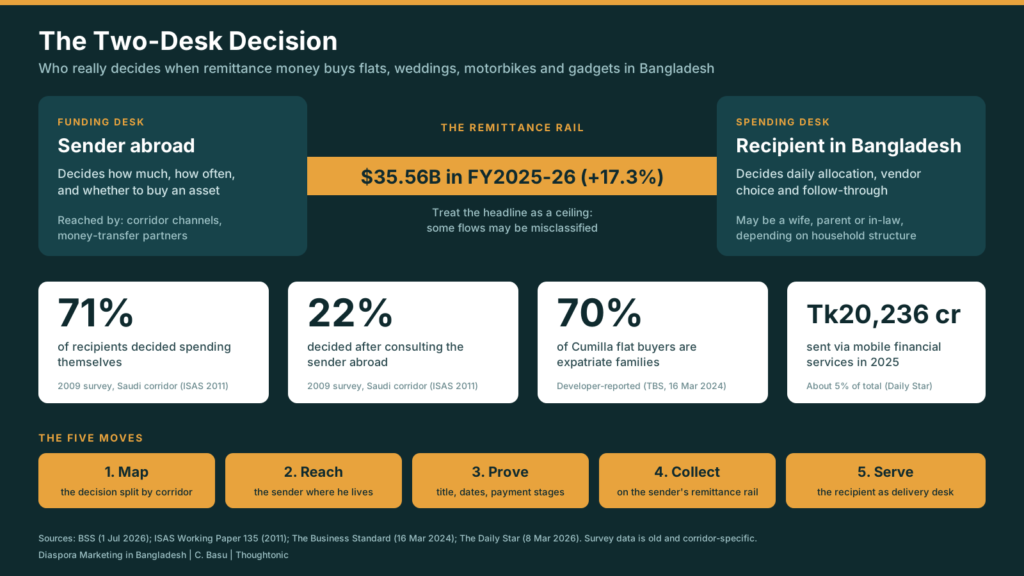
This is where it gets interesting. The only decision data I found is an IOM household survey from 2009, analysed by ISAS for the Saudi corridor: 71% of recipients decided spending themselves, and 22% decided after consulting the husband abroad. It’s old and narrow, and it covers household spending, not assets. Still, it kills the myth that the sender approves everything.
Why Does Diaspora Marketing in Bangladesh Miss the Real Decision-Maker?
Because it assumes one buyer. Remittance-funded purchases move through two desks. The funding desk is the sender abroad: how much, how often, and whether to buy an asset. The spending desk is the recipient at home: daily allocation, vendor choice and follow-through. I call this the Two-Desk Model, and it’s the named framework for the rest of this piece.
What diaspora marketing looks like when two people decide
Each desk needs different messages, proof and service. The table shows where evidence exists.
| Purchase | Funding desk (sender) | Spending desk (recipient) | Evidence |
|---|---|---|---|
| Land and flats | Often buys directly | Visits, collects papers | Reported cases, TBS 2022 and 2024 |
| Daily household needs | Sets the amount | Mostly decides use | Survey, ISAS 2011 (2009 data) |
| Weddings | Unknown | Unknown | No verified dataset found |
| Motorbikes, gadgets | Unknown | Unknown | No verified remittance link found |
Even the spending desk isn’t one person. A 2025 qualitative study (Halim and Riya, 31 October 2025) finds husbands abroad keep influencing decisions remotely, while wives’ control is higher in nuclear families and lower in extended ones. So your “recipient” may be a mother-in-law. The same Observer piece cites home-loan rates near 14%, which is its figure, not mine. If that holds, financing squeezes price-led offers even harder.
Here’s the causal chain, in my analysis. Brands plan around the visible household. The sender gets no direct message. He relies on relatives and brokers, so trust stays with intermediaries. Fraud stories attach to the whole category, not one developer; one 2026 opinion piece describes expatriates abandoning home-building plans after fraud and stalled projects (The Observer, 4 July 2026). Without sender-side data, budgets drift back to in-market proxies, and the cycle repeats.
In remittance-funded categories, trust is the product and price is only the entry ticket.
How Do You Run Diaspora Marketing in Five Moves?
Run the Two-Desk Model as five moves. Each forces a leadership decision and costs something.
- Map the split. Decide, by corridor, which choices sit with the sender and which with the recipient. Trade-off: a slower launch. Example: add “who paid” and “who visited” to every booking form. Mistake: treating Saudi-based workers and UK-based professionals as one segment. Metric: share of leads tagged by desk.
- Reach the sender. Shift budget toward corridor channels such as Facebook, WhatsApp and money-transfer partners. Saudi Arabia, home to over 3.5 million Bangladeshis, supplies about 20% of inflows (bdnews24, 1 November 2026). Trade-off: dual creative. Mistake: scheduling Bangla ads on Dhaka time. Metric: cost per qualified sender lead.
- Prove before you pitch. Publish title status, handover dates and payment stages. Trade-off: margin and exposure. Mistake: glossy renders without documents. Metric: cancellation and dispute rate.
- Collect on the sender’s rail. Accept instalments through banks and mobile financial services (MFS) on the sender’s calendar, including Eid. Trade-off: reliance on rails and the 2.5% incentive, which the FY2026-27 budget kept (Prothom Alo, 11 June 2026). Mistake: payment links that need a local card. Metric: share of bookings paid via remittance rails.
- Serve the recipient. Name a home-side owner who answers to the sender, with video proof. Trade-off: headcount. Mistake: leaving the relative to chase the broker. Metric: days from sender approval to handover.
What Did Ayala Land and bKash Get Right, and Where Did They Fall Short?
Ayala Land isn’t a household name outside Asia, but it’s the best-documented diaspora sales operation I could verify. The Philippine developer launched international sales in early 2005 to chase overseas workers (East Asia Forum, 3 August 2018). Global Property Guide reported overseas Filipinos at 37% of its sales in 2006, 32% in 2007 and 24% in 2008. A September 2023 Rappler profile cited 22% of sales, worth ₱23 billion (period not stated), with offices in North America, Hong Kong, Singapore, Dubai, Rome and London. Limitation: the share swings with prices and cycles, and sources disagree on 2007 (31% versus 32%).
bKash shows the Bangladeshi rail diaspora marketing runs on. MFS remittances rose from Tk315 crore in 2019 to Tk20,236 crore in 2025, excluding Nagad. bKash says 41 lakh accounts received remittances in 2025, almost double the year before, and it connects 135 money-transfer operators across 170-plus countries (The Daily Star, 8 March 2026). Limitations: MFS is still about 5% of the total, tickets are small, banks win large sums, and operators, not bKash, hold the sender relationship. Growth also rides incentives that critics say are being gamed.
Culture matters here. Land is the trusted asset, and village reporting shows a steel dealer whose customers are 80% expatriates. Land in central Feni town now exceeds Tk1 crore per decimal, above some Dhaka areas, which locals attribute to expatriate cash (TBS, 16 March 2024). Remittances reprice local markets, and brands inherit that pricing. Absence is a finding too: I found no verified Bangladeshi wedding, motorbike or gadget campaign built around the sender. That’s either open ground or private data. Don’t invent a case.
What Should Organisations and Professionals Do in the Next 90 Days?
Start with one corridor and one product. As an indicative planning assumption, not a benchmark, redirect 10 to 15% of acquisition spend into a 90-day diaspora marketing pilot.
Organisations, ordered by how hard they’ll be resisted:
- Add sender and corridor fields to every lead form (low effort, weeks 1 to 2).
- Interview 30 senders in your pilot corridor (medium, weeks 2 to 6).
- Name a home-side delivery owner for each sender (medium, weeks 4 to 8).
- Accept remittance-rail instalments (medium, weeks 6 to 10).
- Publish title, timeline and payment-stage proof (high, weeks 4 to 12). Legal and finance will push back. Review at day 90 against three metrics: cancellation rate, rail-paid share and handover days.
Professionals, with why each is uncomfortable:
- Corridor segmentation: data is scattered and nobody hands you a dashboard.
- Dual-audience copy: one message must satisfy a sender and a sceptical relative.
- Title and escrow literacy: marketers usually avoid legal detail.
- Off-hours service: your best leads message at night, Dhaka time.
- Saying no: pausing a campaign when delivery isn’t ready costs you credit.
Build one skill per fortnight over ten weeks, starting with the one your team avoids most.
Where Could This Argument Be Wrong?
Three places. First, the numbers. Official figures miss informal flows (World Bank, December 2024), yet a payments founder says incentive arbitrage inflates the formal total (TBS, 25 April 2026). Both can be true. Second, thin evidence: for weddings, motorbikes and gadgets I found no remittance link. Industry voices credited the 2025 motorbike rebound to pent-up demand and pricier models (Bonik Barta, 12 January 2026), or to easing prices, lower registration costs and aggressive marketing (The Daily Star, 8 July 2025). Neither source I read named remittances. Third, ethics. In the 2009 Saudi-corridor survey, about 61% of migrants still owed loans after an average seven years abroad (ISAS, 2011). Pushing aspirational purchases at indebted workers is a reputational and moral hazard. Sometimes doing less wins: if handover is your weak spot, pause sender campaigns and fix delivery first.
Key Takeaways
- Remittances hit a record $35.56 billion in FY2025-26, about $3 billion a month. Treat it as a ceiling, not a market size.
- Two desks decide. In the only national data I found, 71% of recipients decided spending themselves and 22% consulted the sender (2009, Saudi corridor).
- Diaspora marketing starts with a decision map by corridor and purchase type.
- Housing is the best-evidenced category. Weddings, motorbikes and gadgets are unproven.
- Trust is the entry ticket. Show title, timelines and payment stages.
- Collect on remittance rails: MFS carried Tk20,236 crore in 2025.
- Pilot one corridor for 90 days before scaling.
Read More Articles:
- Virtual Influencers: The Hidden Cost of a Fake Ambassador
- Bangladesh Motorcycle Industry: Market Trends, Challenges & Future Outlook
- AI in Marketing in Bangladesh: Costly Hype vs 7 Real Wins
- The Costly AI Strategy Gap: Why Your Team Is Playing, Not Executing
- The Costly Truth About Minimalist Bangladesh Design Strategy
FAQs
What is diaspora marketing? Offers, proof and payment paths designed for the person abroad who funds a purchase, plus delivery designed for the family member who carries it out.
Who decides how remittance money is spent in Bangladesh? Mostly the recipient for daily spending, with the sender involved in bigger choices. The 2009 survey found 71% self-decided and 22% consulted the sender.
Which categories depend most on remittances? Housing has the clearest reported evidence. I found no verified remittance data for weddings, motorbikes or gadgets.
How should brands reach senders abroad? Use corridor channels, money-transfer partners and remittance-rail payments, and publish verifiable proof before asking for money.
Sources
- BSS – Remittance inflow hits record $35.56bn in FY26 – BSS, 1 Jul 2026
- bdnews24 – From $10mn to $35.6bn, remittances tell a story – bdnews24, 22 Jul 2026
- Sohel Parvez – MFS emerges as fast-growing remittance channel – The Daily Star, 8 Mar 2026
- Kamran Siddiqui, Jasim Uddin and Saleh Shafiq – How expats’ money reshaping lives in villages – The Business Standard, 16 Mar 2024
- Rezaul Karim – Housing gets remittance boost – The Business Standard, 24 Feb 2022
- Staff Correspondent – Motorcycle sales rebound in 2025 after two years of decline – Bonik Barta, 12 Jan 2026
- Jagaran Chakma – Motorcycle demand picks up speed after three-year slump – The Daily Star, 8 Jul 2025
- Opinion – Bangladeshi Expatriates Are Losing Faith in the Dream of Homeownership – The Observer, 4 Jul 2026
- Zakaria Swapan – Why the 2.5% remittance incentive should be retired – The Business Standard (opinion), 25 Apr 2026
- Prothom Alo – Govt to continue 2.5pc cash incentive on remittances – Prothom Alo, 11 Jun 2026
- bdnews24 – Remittance inflows climb 12% in October amid West Asia conflict – bdnews24, 1 Nov 2026
- Md Mizanur Rahman – Does Labour Migration Bring about Economic Advantage? A Case of Bangladeshi Migrants in Saudi Arabia, ISAS Working Paper 135 – ISAS, National University of Singapore, 20 Sep 2011
- Abdul Halim and Subata Zannat Riya – Gendered Impact of Labor Migration: Left-Behind Wives’ Decision-Making Abilities in Bangladesh – International Journal of Multicultural and Multireligious Understanding, 31 Oct 2025
- IFAD – Remittances nearly doubled in a decade to reach US$729 billion in 2025 – IFAD, 14 Sep 2026
- World Bank – In 2024, remittance flows to low- and middle-income countries are expected to reach $685 billion – World Bank People Move blog, Dec 2024
- UN DESA – World Economic Situation and Prospects: November 2025 Briefing No. 196 – UN DESA, Nov 2025
- East Asia Forum – Philippine businesses cashing in on diaspora spending – East Asia Forum, 3 Aug 2018
- Global Property Guide – Philippine housing market weakens – Global Property Guide, 2009
- Rappler – Ayala Land names first female chief – Rappler, 5 Sep 2023