Google Isn’t the Front Door Anymore: Why Ignoring Generative Engine Optimization Is a Costly Mistake for Bangladeshi Brands
A rider in Uttara types “best motorbike showroom in Dhaka” into ChatGPT instead of Google. In four seconds he gets a confident, conversational answer naming two or three showrooms, a rough price comparison, and a suggestion to check warranty terms before buying. No blue links. No scrolling. No mention of the showroom three streets away that has spent five years and a real budget ranking on page one of Google for that exact phrase. That showroom did everything the SEO textbook told it to do, and the AI never opened the book. This is what generative engine optimization is actually about, and almost no brand in Bangladesh has a plan for it.
The Zero-Click Reality: Why Generative Engine Optimization Can’t Wait
Here’s the uncomfortable part. This isn’t a future problem. It’s already showing up in the data, both globally and, more quietly, in Bangladesh’s own numbers.
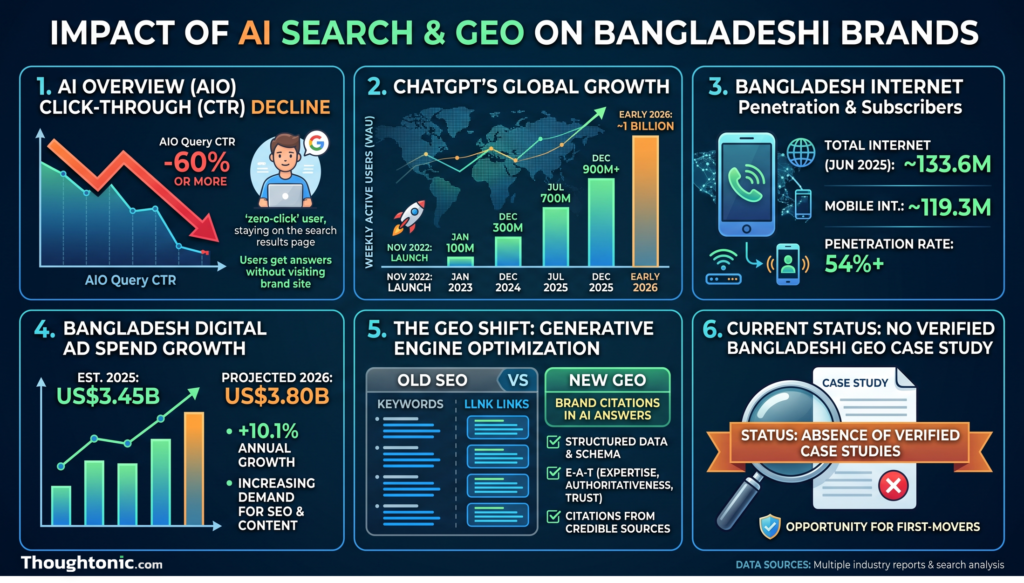
Globally, the click has been dying for a while. Pew Research Center tracked real browsing behavior from 900 US adults across roughly 69,000 Google searches in March 2025 and found people clicked a traditional result only 8% of the time when an AI Overview appeared, versus 15% without one. Sessions ended without any click 26% of the time, well above the 16% baseline. That traffic doesn’t move to a competitor. It simply disappears from the open web. Separately, an Ahrefs-based analysis found the click-through rate for the top organic result fell by roughly 58% when an AI Overview was present, up from an earlier estimate of 34.5%. Treat any single percentage with some caution since studies vary by query type and market, but every study points the same direction: down.
Bangladesh’s version of this story is less measured but arguably more urgent. There were 77.7 million internet users in Bangladesh at the start of 2025, at 44.5% online penetration, and 60 million social media user identities, and the country’s digital ad market is projected to hit roughly $3.8 billion this year. ChatGPT alone crossed 900 million weekly active users globally by February 2026, more than double its base from a year earlier, with India’s weekly active users reaching 100 million in the same window. Nobody has published a verified figure for how many Bangladeshi consumers now ask ChatGPT or Meta AI for recommendations instead of Googling them, and I’ll be upfront that I don’t have that number. But given India’s growth curve next door, betting Bangladesh is somehow immune would be reckless. Every AI answer that skips your showroom, your restaurant, or your product isn’t a missed click. It’s a missed first impression, delivered with the full authority of a machine the customer already trusts.
How Generative Engines Actually Choose an Answer
To fix a blind spot you have to understand why it exists, and the “why” here is genuinely different from classical SEO, not just a rebrand of it.
Traditional search engines rank whole pages against a query and hand you a list. Generative engines like ChatGPT, Gemini, Perplexity, and Google’s own AI Overviews don’t do that. They pull relevant passages from many sources, judge which ones are trustworthy and easy to lift, and stitch a handful of them into one synthesized answer. The unit of competition has shifted from the page to the passage. A page can rank well on Google because of ten years of backlinks and still be invisible in an AI answer because the specific paragraph that answers the question is buried on page four, badly worded, or missing entirely.
The Research Behind Generative Engine Optimization
The term itself comes from a real academic paper, “GEO: Generative Engine Optimization,” by Aggarwal and colleagues, tested on both synthetic benchmarks and a live system, Perplexity.ai. Their headline finding was that applying GEO techniques, primarily adding statistics, citations, and quotations to content, improved a page’s visibility inside generative answers by up to 40%, and the gains were strongest for pages that were not ranking at the top of classical search, which is a genuinely useful piece of news for smaller Bangladeshi brands that can’t outspend a multinational on backlinks. The same research found that classic keyword stuffing did almost nothing for generative visibility, which should tell you something about why some agencies are still selling last decade’s SEO tactics under a new label.
A few consistent patterns show up across the more credible industry write-ups of this research and related studies, and I’ll flag that these are aggregated observations from multiple secondary sources rather than a single controlled study, so treat the specific numbers as directional:
- Content that states the direct answer in one clean, self-contained sentence near the top of a section gets lifted more often than content that builds up to the point.
- Specific, verifiable numbers beat vague claims. A model extracting facts prefers “cuts response time by roughly 50%” over “significantly improves service.”
- Consistency of how a brand is described across the web (name, category, location) appears to matter for whether a generative engine treats you as a coherent, citable entity rather than a fragmented mess of pages.
- Freshness matters more than it used to. One industry analysis found pages not updated on a quarterly basis were three times more likely to lose their AI citations over time.
- Third-party credibility signals help. Brands with active profiles on review platforms were found in one analysis to have roughly three times higher odds of being cited, likely because those platforms are themselves heavily indexed by the models.
Picture this as a simple two-column table if you’re building the internal deck: on one side, “Ranks well on Google,” and on the other, “Gets cited by ChatGPT.” For most Bangladeshi brands right now, the left column has entries and the right column is empty. That gap is the whole opportunity.
A Five-Step Generative Engine Optimization Framework for Bangladeshi Brands
I’m not going to pretend this is settled science. It isn’t. But here’s a working framework based on what the research above actually supports, built for a Dhaka-based marketing team with a real budget constraint.
- Audit your AI visibility first. Decision: a senior person, not an intern, asks ChatGPT, Gemini, and Meta AI the ten questions your customers ask most, in English and Bangla. Trade-off: real strategist hours spent on interpretation, not raw output. Metric: percentage of priority queries where your brand gets mentioned at all.
- Rewrite your highest-traffic pages passage-first. Decision: approve rewriting existing pages before commissioning new ones, which feels less exciting than a fresh content calendar. Trade-off: rankings may wobble slightly during the rewrite. Metric: core pages with a fact-dense answer in the first 100 words of each section.
- Build one canonical brand description everywhere. Decision: lock a single, factual description and enforce it across your website, Facebook Page, Google Business Profile, and directories. Trade-off: less creative freedom in bios and taglines. Metric: platforms using the identical core description.
- Get listed and reviewed where AI models actually crawl. Decision: fund review generation on Google, Facebook, and sector directories instead of only paid ads. Trade-off: diverts budget from performance media short-term. Metric: verified review count and rating growth per quarter.
- Re-test monthly and treat it as a moving target. Decision: assign one named owner for AI visibility, because shared ownership means no ownership. Trade-off: a recurring line item for an already-stretched team. Metric: month-over-month change in AI mention rate.
Common mistake I see already: teams treating this as a one-time project with a deadline. Generative engines change their citation behavior constantly. One analysis found roughly 70% of the pages cited inside AI Overviews shift within a two-to-three-month window. GEO is a maintenance habit, not a campaign.
Case Studies: One Global Win, One Bangladesh Gap
Globally, there’s at least one documented example worth studying. According to Backlinko’s research, when someone searched “best teleprompter 2026” inside ChatGPT, the software brand BIGVU appeared directly inside the generated answer, cited as a source. It’s a small, single-query example, not a full campaign case study with revenue numbers, and I want to flag that limitation rather than oversell it. What it proves is the mechanism: a narrow, well-answered query pulled a specific brand into the answer itself, ahead of far bigger competitors in that category.
On the Bangladesh side, I have to be honest: I could not find a single published, verified case study of a Bangladeshi brand’s generative engine optimization performance, good or bad. That absence is itself the story. Local agencies are investing in AI, Grameenphone’s customer-service chatbot reportedly cut response times by roughly half, and firms like FastCom AI are building agentic tools, but none of that is the same as optimizing to be the answer an AI gives about your brand. If your agency can’t show you a screenshot of your brand named inside a ChatGPT or Gemini answer, they haven’t started this work yet, whatever the invoice says.
Action Plan: What to Do Monday Morning
For organizations, roughly in order of resistance:
- Run the ten-query AI audit this week. Effort: low.
- Rewrite your top five landing pages passage-first within one quarter. Effort: medium.
- Consolidate your brand description across every public listing. Effort: medium.
- Fund review generation (roughly BDT 30,000 to 50,000 a month for a mid-sized brand, redirected from a stagnant boosting budget). Effort: medium.
- Assign a named owner for AI visibility with a monthly report to leadership. Effort: high, because it’s organizational, not tactical.
For professionals, five uncomfortable skills worth building this year:
- Prompt-based competitive research, because it feels like cheating next to a proper keyword tool.
- Structured, answer-first writing, which fights the narrative-building instinct most of us were trained on.
- Basic schema markup literacy, because it edges into a developer’s territory.
- Reading the actual research on AI search behavior instead of secondhand blog summaries.
- Saying “I don’t know yet” to a client, since this industry rewards confident answers even while the ground shifts.
Where This Falls Apart: The Contrarian View
I’d be doing you a disservice if I didn’t push back on my own argument. GEO strategies built entirely around US and UK case studies often fail here for a boring reason: nearly half the population still isn’t online, per the Bangladesh Bureau of Statistics’ count of 48.9% direct internet usage as of September 2025, and AI-search behavior is concentrated among the smartphone-owning, English-comfortable, urban minority. Chasing ChatGPT citations for a mass-market FMCG brand whose buyers aren’t asking AI anything yet may simply be premature.
There’s an ignored operational risk too: content optimized to be maximally extractable by AI models is also maximally easy for a competitor’s tool to scrape and repurpose, pricing and testimonials included, faster than any complaint can catch up. And there’s a real scenario where doing less wins: a relationship-driven B2B brand whose sales run on personal trust, common in Bangladesh’s family business culture, may gain more from protecting its exclusivity than from being freely summarized by a chatbot.
Key Takeaways
- Click-through on the top Google result drops an estimated 34% to 58% when an AI Overview appears, and the trend is worsening, not stabilizing.
- Bangladesh had 77.7 million internet users and a $3.8 billion projected digital ad market in 2026, yet zero published, verified case studies on Bangladeshi brands’ generative engine optimization performance exist as of this writing.
- The core GEO research shows visibility gains of up to 40% from statistics, citations, and answer-first structure, not from more keywords.
- Nearly half of Bangladeshis, 48.9% per BBS data from September 2025, are still offline. GEO priority should scale with your audience’s actual AI literacy, not be applied blindly.
- Being cited inside an AI answer requires a different unit of optimization: the passage, not the page.
- Assign a single, named owner for AI visibility. Shared ownership means no ownership.
- The most realistic first move for most Bangladeshi teams is a low-cost audit, not a rebuild.
Read more articles:
- The Costly AI Strategy Gap: Why Your Team Is Playing, Not Executing
- The Costly Truth About Minimalist Bangladesh Design Strategy
- The Costly Visual Search Blind Spot That Is Making Bangladesh Brands Invisible
- Quantum Marketing: How 2030’s Technologies Will Shatter Bangladesh’s Status Quo
- Digital Literacy & Brand Purpose: How Education Drives Loyalty in Emerging Markets
Sources
- MediaNama – Google AI Overviews Reduce Clicks By 58%, Study Finds, Feb 2026
- Seer Interactive – AIO Impact on Google CTR: September 2025 Update
- Omnibound – Google AI Overviews Statistics (2026)
- eMarketer – Google AI Overviews decrease CTRs by 34.5%, per new study
- thestacc – Google AI Overviews in 2026: 48% of Searches Have AI Overviews
- Slate – Google AI Overviews Statistics: CTR, Usage & Traffic
- DataReportal – Digital 2025: Bangladesh
- The Daily Star – Half of Bangladeshis still offline despite rapid digital expansion, Dec 2025
- The Business Standard – 54.8% of households are now internet users: BBS, Aug 2025
- The Daily Star – Bangladeshi companies look beyond chatbots with agentic AI
- Demandsage – ChatGPT Statistics (August 2026)
- Omnibound – ChatGPT User Statistics 2025-26
- arXiv – GEO: Generative Engine Optimization (Aggarwal et al., original paper)
- Medium (Sourin) – GEO Lessons From the Original Research Paper
- Backlinko – Generative Engine Optimization (GEO): How to Win in AI Search
- Exposure Ninja – Generative Engine Optimisation: How To Rank in AI Search
- Enrich Labs – Generative Engine Optimization (GEO): The Complete 2026 Guide
- GlobeNewswire – Bangladesh Digital Ad Spend Business Report 2026
- Ngital – The State of Digital Marketing in Bangladesh 2026: A Founder’s Perspective
- Wikipedia – Internet in Bangladesh