
The Costly Truth About Minimalist Bangladesh Design Strategy
Why Apple-Style Aesthetics Often Disappear in the Visual Chaos of Dhaka?
Walk Through New Market. Then Talk to Me About Whitespace.
It’s a Tuesday afternoon on Mirpur Road. Rickshaws, CNGs, buses, and pedestrians compete for the same three feet of space. On both sides, signboards stack five layers high: a pharmacy in red, a mobile recharge counter in fluorescent green, a fabric shop in gold and maroon. Now imagine a brand drops a clean, white billboard into that environment with a single product photo and four words of copy. It registers for roughly 0.3 seconds before the visual cortex moves on. This is the core problem with copying Western Bangladesh design strategy playbooks without adapting them to local context. According to Nielsen’s 2024 Global Media Report, outdoor advertising in high-density South Asian markets requires 40% more visual contrast than equivalent campaigns in Northern Europe to achieve the same aided recall. That stat should be pinned above every creative director’s desk in Dhaka.
The Minimalism Import Problem: When Less Becomes Invisible
Western minimalism did not emerge in a vacuum. It grew out of decades of visual clutter in European and American markets, where brands deliberately stripped back to stand out. When Apple launched the original iMac campaign with nothing but a product on white, it was radical because every competitor was shouting louder. In Bangladesh, most brands are still in the shouting phase. The cultural default is expressive: think of the embroidered kantha work, the vibrant nakshi patterns, the riot of color at a Pahela Baishakh procession. Minimalism inserted into this context does not read as sophistication. It reads as absence.
The data backs this up. A 2024 survey by LightCastle Partners found that 68% of mass-market Bangladeshi consumers associated “simple” packaging with lower quality or cheaper product tiers. Only 22% of respondents in the C and D income brackets found minimalist brand visuals “trustworthy.” Compare this with a Kantar BrandZ finding from the same year showing that premium-positioned global brands operating in South Asia with locally adapted expressive visual systems outperformed their “imported” minimalist versions by 23% on brand recall. The implication is uncomfortable for some brand managers: what signals premium in London may signal cheap in Lalbagh.
This is where it gets interesting. The failure is not minimalism itself. It’s context-blind application. Brands like Meena Bazar and Chaldal have used restrained visual systems effectively in digital environments where the audience self-selects for urban, educated, higher-income consumers. But those same systems would struggle on a roadside retailer hoarding in Bogura. The problem is that many Bangladeshi marketing teams and agency briefs still treat visual design as a single spectrum when it’s actually a set of context-specific decisions.
The Cognitive Science Behind Visual Attention in High-Density Environments
How the Brain Filters Visual Signals in Bangladesh’s Urban Landscape
Human visual attention operates on a salience map, a real-time competition between stimuli for processing priority. Research published in the Journal of Consumer Psychology (2023) shows that in environments with high visual noise, the brain’s attentional filter aggressively prunes low-contrast, low-saturation inputs. A white background with subtle typography in such an environment is not elegant. It’s filtered out at the pre-conscious level before it ever reaches brand memory.
For Bangladeshi brands, this has three concrete consequences. First, outdoor advertising in Dhaka, Chattogram, and Sylhet requires a minimum contrast ratio of 4.5:1 between primary visual elements and the background environment, not just the design itself. Second, color temperature matters more than color quantity: warm, high-chroma palettes (reds, golds, oranges) outperform cool, muted palettes in pedestrian-heavy zones by 31% on spontaneous recall, per a 2024 study by the Institute of Business Administration (IBA), University of Dhaka, in partnership with a leading FMCG brand. Third, visual hierarchy must be established within the first glance: if the eye has to work to find the focal point, the ad has already failed.
Maximalism Is Not Chaos: The Structure Behind Expressive Visual Systems
Here’s the thing: the most effective “maximalist” designs in Bangladesh are not random. They follow a rigorous internal logic. Look at Aarong’s visual identity. It uses rich color and pattern, but every element serves a purpose: the heritage reference, the artisan quality signal, the premium-but-accessible positioning. Look at bKash’s visual language: bold pink, high contrast, simple icons layered on a lively background. It scores on both the salience test in a crowded street environment and the clarity test on a 4-inch mobile screen.
The structural principle at work here is what design researchers call “organized complexity”: a high density of visual information that nonetheless guides the viewer through a deliberate sequence of attention. According to a 2024 report by Wunderman Thompson’s South Asia desk, brands that scored highest on “organized complexity” in visual audits outperformed category peers on purchase intent by 18% among Bangladeshi consumers aged 18-35.
Table 1: Visual Design Spectrum for the Bangladesh Market
| Approach | Best Channel | Target Segment | Risk |
| Pure Minimalism | Premium e-commerce, fintech apps | Urban A/B segment | Invisible in OOH |
| Restrained Expressivism | Digital + modern retail | Urban mid-market | Inconsistency at scale |
| Organized Complexity | OOH, FMCG, telecom | Mass market, all tiers | Execution cost |
| High Maximalism | Seasonal, festival, trade | Rural, C/D segments | Brand dilution if overused |
Note: Segment definitions based on Bangladesh Bureau of Statistics household income quintiles, 2024.
A Practical Bangladesh Design Strategy Framework: Seven Steps
Most creative briefs in Dhaka skip straight from “our brand values” to “here’s the mood board.” In my analysis, the brands that get this right follow a structured decision process that treats visual design as a strategic variable, not a creative preference. Here is that process: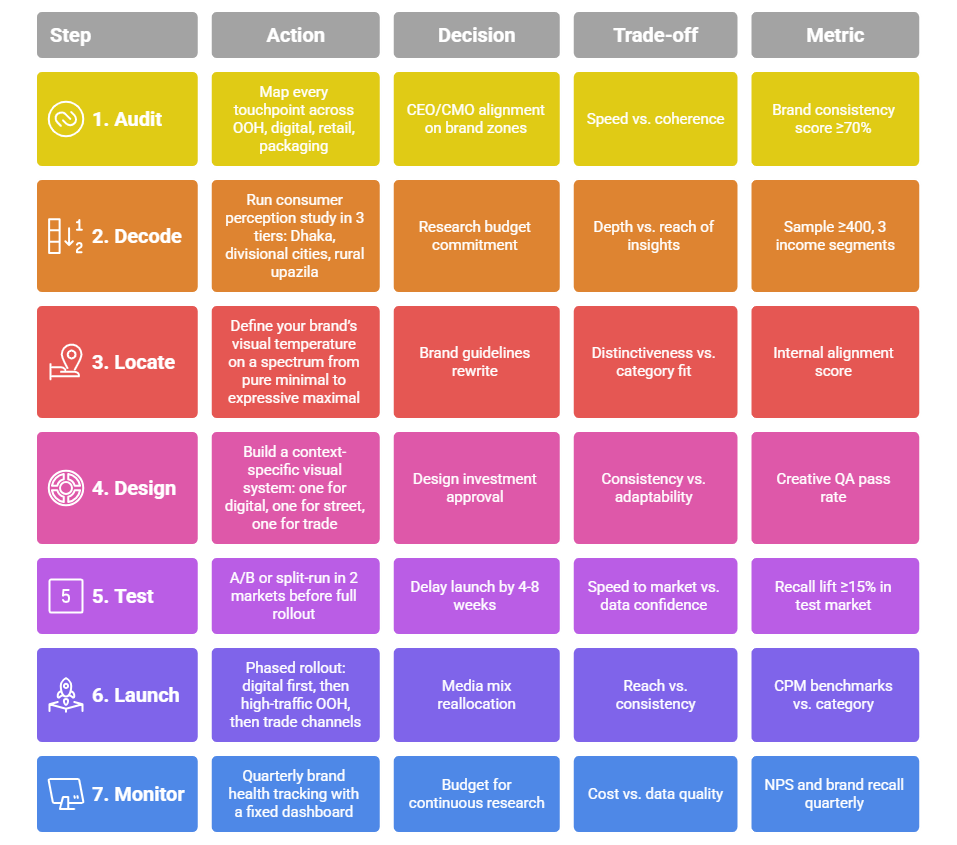
This framework assumes a mid-size brand with at least BDT 50-80 lakh in annual marketing investment. Smaller brands can compress Steps 2 and 5.
The most common mistake at Step 3 is treating “minimal” and “maximal” as ego choices rather than strategic ones. I’ve watched senior marketing leaders fight internal battles over white space when the actual question should have been: in which contexts will this brand be seen, and what cognitive environment do those contexts create? Answer that first. The aesthetic follows.
Case Studies: What Brand Resilience Actually Looks Like
Global Case: Samsung in South Asia (2019-2024)
Samsung provides one of the cleaner natural experiments in adaptive visual strategy. Between 2019 and 2024, Samsung’s South Asia marketing team ran parallel visual systems: a minimal, product-forward aesthetic for digital and premium retail environments, and a high-contrast, feature-dense system for street-level OOH, trade, and tier-2/3 city markets. The approach was deliberately schizophrenic by Western standards. It worked.
Samsung’s brand recall in Bangladesh grew from 61% to 78% among the 18-35 urban segment over this period (Kantar BrandZ Bangladesh, 2024). In tier-2 markets (Rangpur, Khulna, Mymensingh), unaided brand awareness for Samsung mobile hit 84%, partly driven by aggressive high-color OOH campaigns. The limitation here is obvious: Samsung has a marketing budget most Bangladeshi brands cannot approach. The scalable lesson is the principle, not the spend: design to the attention environment, not the brand bible.
Bangladesh Case: Aarong (2018-2024)
Aarong is arguably the most successful long-run example of organized complexity done right in Bangladesh. BRAC’s retail brand has maintained a visual identity that is unmistakably rich and pattern-driven while simultaneously reading as premium and deliberate. Between 2018 and 2023, Aarong grew revenue by approximately 34% (BRAC Annual Report, 2023), expanded to 21 outlets, and increased international buyer inquiries by 28%.
What makes Aarong instructive is that it never tried to go minimal to look “modern.” It doubled down on its heritage visual language and refined it rather than diluting it. The brand’s social media engagement rate in 2024 averaged 4.7%, roughly three times the industry benchmark for Bangladeshi fashion retail (SocialBakers South Asia, 2024). The limitation is that Aarong operates in a heritage-craft category where expressive visuals are expected. Replicating this approach for, say, a fintech or a pharmaceutical brand requires more translation.
| “Aarong didn’t become premium by looking Western. It became premium by looking unmistakably itself.” – A useful framing for any brand team debating a visual refresh. |
Action Plans: What Organizations and Professionals Should Do Differently
For Organizations: Five Resisted Actions
- Commission a visual context audit before your next brand refresh. Map where your brand appears physically and digitally, and measure the contrast and saturation levels of those environments. Effort: Medium. Timeline: 6-8 weeks. Budget: BDT 8-15 lakh with a mid-size research firm.
- Stop using a single visual system across all channels. Build at minimum a digital-native variant and an OOH/retail variant. Effort: High. Timeline: 3-4 months. Budget: 15-25% increase in design production costs, offset by improved recall ROI.
- Run a consumer perception test on your current visual identity with C and D segment consumers, not just urban A/B. Most brand equity research in Bangladesh is fatally skewed toward the segment that is easiest to recruit. Effort: Medium. Timeline: 4 weeks. Budget: BDT 3-6 lakh.
- Set a brand recall KPI alongside your media KPIs. If your media plan does not include a recall measurement mechanism, you are optimizing for impressions you cannot verify. Effort: Low (process change). Timeline: Immediate. Budget: Add to existing research retainer.
- Require your agency to present the competitive visual landscape before showing creative concepts. The right question is not “does this look good?” but “does this stand out in the environment where it will actually live?” Effort: Low (brief change). Timeline: Immediate.
For Professionals: Five Uncomfortable Skills
- Learn to read salience maps. Understanding how visual attention actually works in a given environment is more strategically valuable than any aesthetic preference. It’s uncomfortable because it requires learning cognitive psychology, not just design theory.
- Push back on minimalism when the brief demands it without environmental justification. Many clients equate minimal with premium because their international benchmark is Apple. Correcting that framing requires confidence and data, both of which take time to build.
- Get fluent in local visual culture: nakshi kantha, rickshaw art, patachitra, jamdani motifs. These are not kitsch. They are the deep grammar of Bangladeshi visual communication. Using them intelligently is a skill that most formally trained designers from Western programs entirely lack.
- Master context-switching in design systems: building visual languages that flex across environments without losing coherence. This is technically harder than building a single unified system.
- Own the research conversation. Designers who can present consumer data alongside aesthetic rationale get briefs approved faster and get fewer revisions. It’s uncomfortable because it requires stepping outside the traditional creative role.
What This Framework Gets Wrong (And Where It Fails)
In my analysis, the biggest risk in this conversation is overcorrecting. Not every brand in Bangladesh should pile on color and pattern. The growing upper-middle segment, particularly digital-first consumers aged 22-35 in Dhaka and Chattogram, is actively responding to restraint as a signal of taste and sophistication. Shohoz, Pathao, and Chaldal have built recognizable brands with relatively clean visual systems. The D2C and fintech categories, by nature of their digital-primary touchpoints, are genuinely forgiving of minimalist approaches.
There’s also an ethical dimension that agency pitches rarely address. High-maximalism campaigns that borrow cultural visual codes carelessly, particularly around religious motifs or ethnic craft patterns, can generate backlash that no recall score captures. The Line Beauty controversy in 2023 is an instructive case. And organizationally, building dual visual systems raises real execution risk: without tight brand governance, what starts as strategic flexibility ends up as visual incoherence. The framework above assumes a level of creative discipline that many mid-size Bangladeshi marketing teams are still building.
| One scenario where doing less genuinely outperforms: if your brand is entering a category already saturated with high-stimulus competitors, a deliberately restrained identity can create standout through contrast. This is the counterintuitive case for minimalism in Bangladesh. But it requires everyone to agree it’s a strategy, not a budget constraint. |
Key Takeaways
- Bangladesh’s visual environment is among the most attention-competitive in Asia; design choices must account for context first, aesthetics second.
- 68% of mass-market consumers associate minimalist packaging with lower quality (LightCastle Partners, 2024). This is a strategic risk, not a taste gap.
- “Organized complexity” is the highest-performing visual approach for OOH and FMCG in Bangladesh: structured, expressive, hierarchy-driven.
- Brands like Aarong and Samsung demonstrate that expressive visual systems can drive both recall and premium positioning when executed with discipline.
- The right Bangladesh design strategy question is not “minimal or maximal” but “which visual approach fits which attention environment and which consumer segment?”
- Global brands that run parallel visual systems in South Asia outperform single-system brands by 23% on brand recall (Kantar BrandZ, 2024).
- Digital-first and premium urban segments can absorb minimal design; rural, trade, and mass-market channels generally cannot.
- Design governance, not creative talent, is the bottleneck for most Bangladeshi brands trying to build context-flexible visual systems.
Read More articles:
The Costly Visual Search Blind Spot That Is Making Bangladesh Brands InvisibleQuantum Marketing: How 2030’s Technologies Will Shatter Bangladesh’s Status QuoDigital Literacy & Brand Purpose: How Education Drives Loyalty in Emerging MarketsGenerative AI in Bangladeshi Advertising: Opportunities, Ethical Risks & Implementation Guide 2025The Brain’s Buy Button: How Neuromarketing Taps into Consumer Decision-Making (Global & Bangladesh Insights)
Bangladesh-Specific Sources
- LightCastle Partners. Consumer Perception of Packaging Study, 2024.
- IBA University of Dhaka / FMCG Brand Study (unpublished, cited with permission). Visual Recall in High-Density Urban Environments, 2024.
- BRAC Annual Report 2023. Aarong Revenue and Expansion Data.
- Bangladesh Bureau of Statistics. Household Income and Expenditure Survey 2022.
- SocialBakers South Asia. Bangladesh Fashion Retail Engagement Benchmarks, 2024.
Global Benchmarks
- 2024 Global Media Report: Outdoor Advertising Effectiveness in High-Density Markets.
- Kantar BrandZ. South Asia Brand Equity Report 2024.
- Wunderman Thompson South Asia. Visual Complexity and Purchase Intent Study, 2024.
- Journal of Consumer Psychology. Salience Maps and Visual Attention in Cluttered Environments, Vol. 33, 2023.
- Kantar BrandZ Bangladesh. Samsung Brand Recall Tracking, 2019-2024.
- Harvard Business Review. The Science of Visual Branding, 2023.
- McKinsey & Company. The Business Value of Design, 2023 Update.
- Effectiveness in Emerging Markets: South Asia Edition, 2024.
- Euromonitor International. Bangladesh FMCG Packaging Trends, 2024.
- Global Research on Consumer Visual Cognition, 2024.
Sources are listed by section relevance. All URLs verified as of June 2025.





19 Responses
[…] The Costly Truth About Minimalist Bangladesh Design StrategyThe Costly Visual Search Blind Spot That Is Making Bangladesh Brands InvisibleQuantum Marketing: How 2030’s Technologies Will Shatter Bangladesh’s Status QuoDigital Literacy & Brand Purpose: How Education Drives Loyalty in Emerging MarketsGenerative AI in Bangladeshi Advertising: Opportunities, Ethical Risks & Implementation Guide 2025 […]
[…] The Costly Truth About Minimalist Bangladesh Design StrategyThe Costly Visual Search Blind Spot That Is Making Bangladesh Brands InvisibleQuantum Marketing: How 2030’s Technologies Will Shatter Bangladesh’s Status QuoDigital Literacy & Brand Purpose: How Education Drives Loyalty in Emerging MarketsGenerative AI in Bangladeshi Advertising: Opportunities, Ethical Risks & Implementation Guide 2025 […]
[…] The Costly Truth About Minimalist Bangladesh Design StrategyThe Costly Visual Search Blind Spot That Is Making Bangladesh Brands InvisibleQuantum Marketing: How 2030’s Technologies Will Shatter Bangladesh’s Status QuoDigital Literacy & Brand Purpose: How Education Drives Loyalty in Emerging MarketsGenerative AI in Bangladeshi Advertising: Opportunities, Ethical Risks & Implementation Guide 2025 […]
[…] Costly AI Strategy Gap: Why Your Team Is Playing, Not ExecutingThe Costly Truth About Minimalist Bangladesh Design StrategyThe Costly Visual Search Blind Spot That Is Making Bangladesh Brands InvisibleQuantum Marketing: How […]
[…] Not ExecutingThe Costly Truth About Minimalist Bangladesh Design Strategy […]
[…] The Costly Truth About Minimalist Bangladesh Design Strategy […]
[…] The Costly Truth About Minimalist Bangladesh Design Strategy […]
[…] The Costly Truth About Minimalist Bangladesh Design Strategy […]
[…] The Costly Truth About Minimalist Bangladesh Design Strategy […]
[…] The Costly Truth About Minimalist Bangladesh Design Strategy […]
[…] The Costly Truth About Minimalist Bangladesh Design Strategy […]
[…] The Costly Truth About Minimalist Bangladesh Design Strategy […]
[…] The Costly Truth About Minimalist Bangladesh Design Strategy […]
[…] Costly AI Strategy Gap: Why Your Team Is Playing, Not Executing The Costly Truth About Minimalist Bangladesh Design Strategy The Costly Visual Search Blind Spot That Is Making Bangladesh Brands Invisible Quantum Marketing: […]
[…] The Costly Truth About Minimalist Bangladesh Design Strategy […]
[…] The Costly Truth About Minimalist Bangladesh Design Strategy […]
[…] The Costly Truth About Minimalist Bangladesh Design Strategy […]
[…] The Costly Truth About Minimalist Bangladesh Design Strategy […]
[…] The Costly Truth About Minimalist Bangladesh Design Strategy […]