Generative AI for Content Creation: The Costly Trade of Brand Voice for Speed
Generative AI for content creation has solved the wrong problem in most Dhaka marketing teams. We asked it to remove the speed bottleneck, and it did. What it removed along with it was the one thing customers actually remember: how you sound. Bangladesh added 5.3 million internet users in the twelve months to October 2025, reaching 82.8 million (DataReportal, 2026), so the pressure to publish more has never been higher. Globally, 71% of organisations now use generative AI regularly (McKinsey, 2025). Everyone is getting faster. Almost nobody is getting more distinctive. In my analysis, the brands that win the next three years won’t publish the most. They’ll be the ones whose content still sounds like them after the machine has touched it.
The Content Demand Problem: Why Generative AI for Content Creation Fills Calendars and Empties Brands
Start with demand, because that’s where the pressure comes from. Social media user identities in Bangladesh reached 64.0 million by October 2025, about 36.3% of the population (DataReportal, 2026). Every one of those people scrolls past your competitors too, and every competitor is now experimenting with generative AI for content creation. Meanwhile, in my experience, most in-house teams here are three to six people covering Facebook, YouTube, TikTok, email, the website and WhatsApp.
So the team reaches for generative AI for content creation, and the early numbers look wonderful. In a controlled study published in Science, college-educated professionals using ChatGPT finished writing tasks about 40% faster, and independent graders rated the quality 18% higher (Noy and Zhang, 2023).
But here’s the thing. Those gains are measured task by task. Brand damage shows up across the portfolio. A 2024 study in Science Advances found AI-assisted stories were rated more creative individually, yet more similar to each other (Doshi and Hauser, 2024). Collective sameness is exactly what a brand can’t afford.
Bangladesh adds a second layer. Our audience moves between Bangla, English and Banglish in a single scroll, while most mainstream models are strongest in English. The draft National AI Policy 2026-2030 prioritises a Bangla-language model, which tells you the gap is recognised (The Daily Star, 2025). Add the audience skew, with 65.8% of social media users male in early 2024 (The Daily Star, 2024), and a generic tone aimed at everybody lands with nobody. A LightCastle and Dalberg study released in October 2025 also separates Bangladeshi users into power users, aspiring users and people on the cusp of going online. One voice, copy-pasted across those segments, won’t hold.
The Quality-vs-Volume Tension: What Research Says About Generative AI for Content Creation
Here’s the mechanism in plain terms. A language model predicts the most probable next word. Probable is another word for average. So when generative AI for content creation runs without a brand spec, it produces the statistical centre of your category: the same ‘committed to excellence’ sentence your competitor published last week. That’s the quality-vs-volume tension in one paragraph.
Where Generative AI for Content Creation Helps and Where It Hurts
The cleanest evidence is a Harvard Business School and BCG experiment with 758 consultants. On tasks inside the AI’s capability frontier, they completed 12.2% more tasks, 25.1% faster, at quality rated over 40% higher. On a task placed deliberately outside that frontier, consultants using AI were 19 percentage points less likely to reach the correct answer (Dell’Acqua et al., 2023). Now map that onto generative AI for content creation in a marketing team. Inside the frontier: product descriptions, FAQ drafts, report summaries, webinar repurposing, first-pass Bangla translation that a native editor will rework. Outside it: your founder’s point of view, a crisis statement, an Eid or Pohela Boishakh campaign that has to read the room. One wrong tone there costs more than a month of saved drafting.
Search engines add a hard edge. Google’s March 2024 spam update introduced a ‘scaled content abuse’ policy aimed at content produced in bulk mainly to manipulate rankings, however it’s produced (Google Search Central, 2024). Volume for its own sake now carries organic-search risk, not just brand risk, so generative AI for content creation without editorial control can hurt your search visibility too.
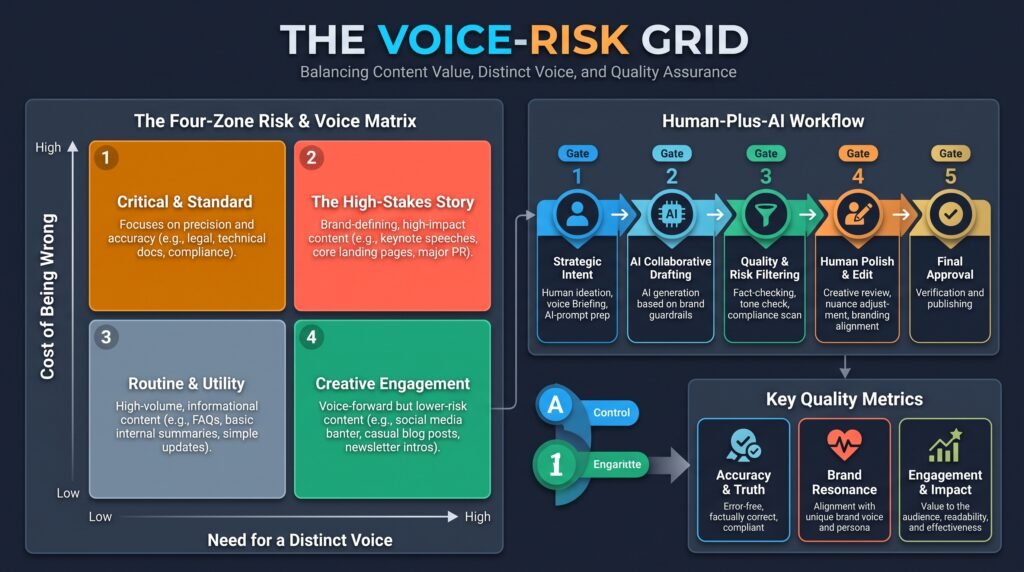
This is where it gets interesting. In boardrooms I use a two-axis picture, and I’d suggest you build the same one.
Visual: the Voice-Risk Grid. The horizontal axis is cost of being wrong, low to high. The vertical axis is need for a distinct voice, low to high. That gives four zones:
- Low risk, low voice (price lists, FAQs, alt text): AI drafts, a human skims.
- Low risk, high voice (social posts, newsletters): AI assists, a human writes the hook and the close.
- High risk, low voice (compliance notices, disclosures): AI summarises, legal and a human own the text.
- High risk, high voice (founder letters, crisis responses, hero campaigns): human only.
In my analysis, most content calendars hide work in that last zone that teams are quietly handing to a chatbot.
Then there’s the part nobody wants to fund. A brand voice is a specification, not a vibe. If it lives in the creative director’s head, you can’t hand it to a model, a new hire or an agency. Write it down: tone sliders from formal to casual, five words you always use and five you never use, typical sentence length, rules for switching between Bangla and English, and ten gold-standard examples. That document turns generative AI for content creation from a random generator into a controlled drafting tool.
Finally, change what you measure. Pieces published rewards the exact behaviour that erases voice. Track cost per accepted piece, edit distance (how much humans rewrite) and unaided recall.
Five Gates That Keep Generative AI for Content Creation On Brand
Here’s the workflow I’d put in front of any team using generative AI for content creation. Five gates, one owner each. The examples are illustrative composites, not client data.
- Codify the voice. Action: write a two-page voice spec and name a single owner. Example: a Dhaka fintech bans ‘guaranteed returns’ and fixes ‘apni’ as the default form of address. Mistake: copying the global brand book and ignoring how your audience mixes Bangla and English.
- Split the work. Action: tag every content type with a tier from the Voice-Risk Grid. Example: AI drafts product pages, humans write the founder’s Eid message. Mistake: letting each marketer decide case by case.
- Brief with context. Action: give the model ten gold-standard pieces, banned phrases, audience notes and verified facts. Example: a retail brand’s festive brief includes delivery cut-offs and last year’s best post. Mistake: one-line prompts that return average copy.
- Gate the edit. Action: a human reviews four things: facts, voice, cultural and religious sensitivity, and claims. Example: a reviewer catches an unverified health claim in an ad draft. Mistake: editing only for grammar.
- Measure and prune. Action: review cost per accepted piece, edit distance and enquiries per post every month. Example: a team trims its calendar by a quarter and watches enquiries. Mistake: celebrating output.
Each gate costs time. That’s the point, because the gates are where voice survives. In my analysis, the review time you add is a fraction of the drafting time that generative AI for content creation saves, provided the brief is good.
Case Studies: Duolingo’s Wobble and Cadbury’s Disciplined Scale
Neither case is about a chatbot writing posts. Both show what happens to a brand voice when generative AI for content creation enters the system. I couldn’t find a Bangladeshi brand that has published audited results for AI-assisted content, which is itself a finding, so I’ve used a South Asian case alongside a global one.
Duolingo, 2025 to 2026. In April 2025 the CEO announced an ‘AI-first’ direction. Social reaction was fierce: the brand’s TikTok account reportedly lost more than 400,000 followers by May (GH Falcon, 2026). Management pulled back its edgy posts and said daily active user growth came in at 40% for the June quarter, the low end of its 40 to 45% guidance (Business Insider, 2025). The brand held. It reached 52.7 million daily users and 35% revenue growth to $282.9 million by the fourth quarter of 2025 (Customer Experience Dive, 2026), then 56.5 million daily users in early 2026 (Nasdaq, 2026). Limitation: growth slowed to 30% by that fourth quarter, and the cause is contested because monetisation changes happened at the same time. My read is that the announced intent broke the voice, not the tool, and years of affection bought time. Most Bangladeshi brands don’t have that cushion.
Cadbury Celebrations, India, Diwali 2021. The ‘Shah Rukh Khan-My-Ad’ campaign used AI so small shopkeepers could generate ads in which the star named their own shop. WARC’s Effective 100 entry reports 130,000 unique ad versions, a 35% sales uplift and household chocolate penetration at a three-year high of 9.4% (WARC, 2024). The idea, generosity toward local stores, stayed fixed while AI handled the variants. That’s generative AI for content creation done right: the machine multiplies a human idea, it doesn’t invent the brand. Limitation: these are award-submission figures from the brand and its agencies, they cover one festive window, and the idea relied on a licensed celebrity likeness that not every brand can replicate.
Bangladesh has the same structure. Eid and Pohela Boishakh concentrate demand, and neighbourhood shops still matter. The lesson to borrow for generative AI for content creation is the division of labour: humans own the idea and the voice, machines own the variants.
Action Plans for Generative AI for Content Creation: 90 Days for Organisations and Professionals
For organisations. Budgets for generative AI for content creation here are my planning estimates, not quotes.
- Days 1 to 30, own and codify. Name one voice owner with veto power. Write the voice spec and tier your content. Cost: mostly internal time, plus BDT 1 to 3 lakh if you hire a facilitator. Effort: high for the owner, medium for the spec.
- Days 31 to 60, pilot. Run Tier 1 content through the five gates with two writers. Tool seats run roughly USD 20 to 30 a month each, about BDT 2,500 to 3,700. Add a native Bangla editor, part-time at first. Effort: medium.
- Days 61 to 90, cap and measure. Drop post-count KPIs, cap monthly volume, and track cost per accepted piece. Effort: medium.
- In parallel, set the data rule. Write what staff may and may not paste into public tools. It’s the hardest item because legal, IT and marketing must agree. Effort: high.
- Every quarter, show ten customers unlabelled posts and ask which are yours.
For professionals. Budget three hours a week for 90 days to build generative AI for content creation skills that most people skip because they’re uncomfortable.
- Edit for voice, because you’ll delete fluent sentences you didn’t write.
- Write a voice spec, because it forces you to say what the brand is not.
- Brief with context, because it exposes how little you know about your customer.
- Fact-check confident text, because polished prose lowers your guard.
- Refuse volume targets, because it means arguing with your boss using data.
Critical Perspective: Where This Advice Breaks
Four honest limits on generative AI for content creation. First, my evidence leans on English-language settings. Bangla-specific quality data is thin, so test outputs with native editors. Second, the Voice-Risk Grid is a working heuristic from practice, not a validated model. Third, there’s a risk many teams ignore: staff pasting customer data, unreleased pricing or vendor details into public tools. Bangladesh’s national AI policy is still being finalised (Policy Magazine, 2026), so there’s no settled rulebook on disclosure or liability. Fourth, the contrarian case. A founder-led brand that posts about eight times a month and is already recognised for its voice may do better adding no AI at all. Doing less can outperform doing more when your edge is being unmistakable rather than being everywhere. And strategies fail here for a mundane reason: approvals run through hierarchy, so a senior leader’s taste quietly overrides the voice spec.
The Average Brand Why AI Makes Everyone Sound the Same
Key Takeaways
- Generative AI for content creation is a capacity fix, not a brand strategy.
- Bangladesh’s internet base reached 82.8 million by October 2025, up 6.9% in a year, so content demand will keep outrunning team size.
- Drafting can be about 40% faster, yet AI-assisted output also tends to be more similar across writers.
- Outside the AI’s capability frontier, consultants were 19 percentage points less likely to be correct.
- Write the voice spec first. It’s the cheapest guardrail you can buy.
- Tier content with the Voice-Risk Grid and keep founder letters, crisis responses and hero campaigns human-only.
- Measure cost per accepted piece, edit distance and unaided recall instead of post counts.
- Set a data rule for public tools before your first pilot, because generative AI for content creation outpaces Bangladesh’s draft AI policy.
Read More Articles:
- AI in Marketing in Bangladesh: Costly Hype vs 7 Real Wins
- The Costly AI Strategy Gap: Why Your Team Is Playing, Not Executing
- The Costly Truth About Minimalist Bangladesh Design Strategy
- The Costly Visual Search Blind Spot That Is Making Bangladesh Brands Invisible
- Quantum Marketing: How 2030’s Technologies Will Shatter Bangladesh’s Status Quo
Bibliography
- Digital 2026: Bangladesh – DataReportal, late 2025
- Digital 2025: Bangladesh – DataReportal, 2025
- Social media use in Bangladesh grows by 22.3% in 2024; Facebook leads – The Daily Star, 2024
- Measuring the Pulse of Digital Media Usage in Bangladesh – LightCastle Partners with Dalberg Advisors, Oct 5, 2025
- Draft AI policy targets innovation, better public services – The Daily Star, 2025
- Govt drafts AI policy to tap its potential, tackle concerns – The Daily Star, 2024
- ICT minister: Bangladesh drafting human-centric national AI policy – Dhaka Tribune, 2026
- Bangladesh’s AI Moment: Testing the Implementation Gap – Policy Magazine, 2026
- Students can reshape learning in Bangladesh with AI – teachers.gov.bd, accessed Oct 2026
- The State of AI – McKinsey, March 2025
- Experimental evidence on the productivity effects of generative AI – Noy and Zhang, Science, July 2023
- Navigating the Jagged Technological Frontier – Dell’Acqua et al., Harvard Business School Working Paper 24-013, Sept 2023
- Generative AI enhances individual creativity but reduces the collective diversity of novel content – Doshi and Hauser, Science Advances, July 2024
- March 2024 core update and new spam policies – Google Search Central Blog, March 2024
- Cadbury: Shah Rukh Khan-My-Ad – WARC Effective 100, 2024
- Not Just a Cadbury Ad – LBB Online, accessed Oct 2026
- Duolingo’s CEO says he learned a hard lesson about ‘edgy posts’ and going viral – Business Insider via AOL, Aug 2025
- Duolingo limits friction as growth slows – Customer Experience Dive, 2026
- How Duolingo is doing after its AI-first backlash – GH Falcon, 2026
- Duolingo Is One of the Most Interesting AI Plays Nobody’s Talking About – Nasdaq (Motley Fool), June 2026