Spatial Commerce: Why Waiting for Headsets Is a Costly Mistake for Bangladeshi Brands
Picture a customer in Mirpur scrolling through a sofa listing at midnight, zooming into a flat product photo that tells her nothing about scale, fabric texture, or whether it’ll actually fit her cramped living room. She closes the app without buying. Multiply that moment by millions, and you start to understand why only three in ten Bangladeshis currently shop online, even with the country’s internet base sitting above 130 million subscribers. That gap, between digital reach and digital trust, is exactly the territory spatial commerce is built to close. Globally, the AR and VR market is projected to grow from roughly USD 75 billion in 2025 to nearly USD 700 billion within a decade. Most Bangladeshi brands are still treating this as a Silicon Valley curiosity. That’s the costly mistake.
Why Bangladesh’s Online Shoppers Don’t Trust What They Can’t Touch
Here’s the uncomfortable part: Bangladesh’s e-commerce market is forecast to hit USD 7.41 billion in 2025, growing at 8.3% a year. That sounds healthy until you look at what’s actually driving it. Seventy-nine percent of Bangladeshi online shoppers say they buy online because it’s cheap, not because the experience is good. Cash-on-delivery still accounts for more than 90% of transactions, a sign that most people don’t trust a product enough to pay before they’ve physically held it. Compare that to global retail, where products marketed with AR or VR content convert up to 94% better than products without it. The gap is stark. Brands abroad are using spatial tools to build confidence before the sale happens. Brands here are still discounting their way to it.
This isn’t a uniquely Bangladeshi failure of imagination, though. It’s an infrastructure timing problem stacked on top of a trust problem. Smartphone ownership in Bangladeshi households reached 72.4% in 2025, climbing fast. But only 3 to 4% of mobile subscribers currently own 5G-compatible handsets, and Robi, one of the country’s largest operators, estimates it’ll take five to seven years for 5G adoption to reach today’s 4G levels. So the headset-and-5G version of spatial commerce dominating Western trade press is genuinely years away here. But that’s not the version that matters first. The mobile AR layer, the one running on a decent Android camera right now, is already viable. Brands waiting for the cinematic version are missing the practical one sitting in their customers’ pockets today.
The Spatial Commerce Stack: From Flat Screens to Walkable Storefronts
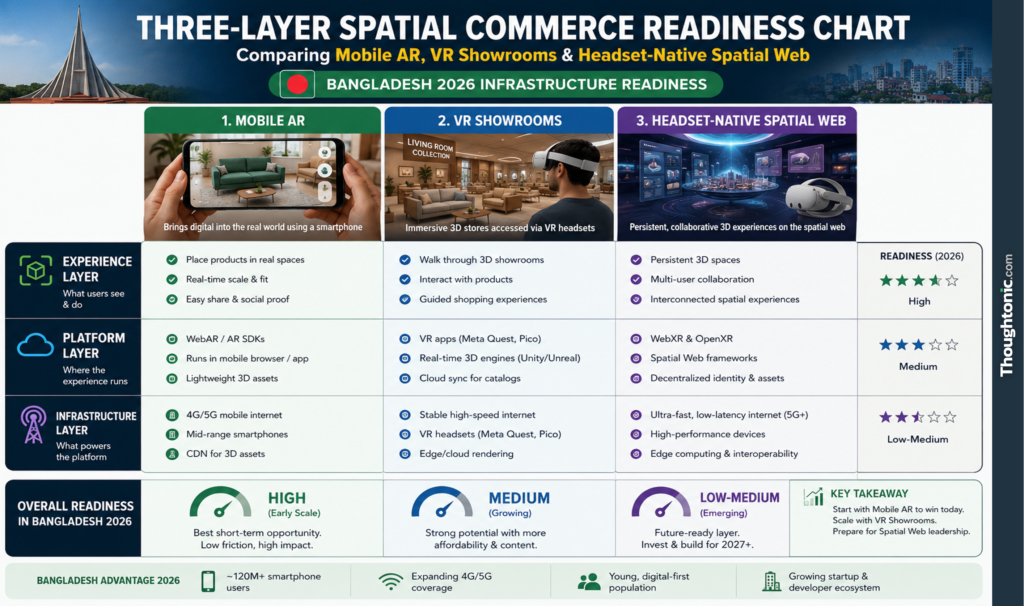
Spatial commerce isn’t one technology. It’s three layers stacked on top of each other, and confusing them is where most strategy conversations go wrong.
| Layer | What it actually is | Hardware needed | Bangladesh readiness (2026) | Best near-term use case |
| Mobile AR / WebAR | Camera-based product visualization in a browser or app, no download required | Any ARCore/ARKit-capable Android or iPhone | High, and rising fast on the mid-range Android base | Fashion sizing, furniture placement, jewelry and eyewear try-on |
| Immersive VR showrooms | Fully rendered 3D store environments viewed on phone, desktop, or entry-level headset | Smartphone, desktop, or budget VR headset | Moderate, mostly Dhaka and Chattogram, depends on fixed broadband | Real estate walkthroughs, B2B sourcing, showroom-style retail |
| Full spatial web (headset-native) | Persistent 3D environments accessed through dedicated AR/VR headsets or smart glasses | Apple Vision Pro, Meta Quest, smart glasses | Low, with a five-to-seven-year adoption runway | Flagship brand experiences, premium real estate, enterprise training |
The science behind why this works isn’t speculative. Threekit’s research found 40% of consumers will pay more for a product they can experience in AR. IKEA Place users report 98% purchase confidence versus 85% for shoppers who don’t use it. Mobile AR experiences outperform desktop AR by an average of 33%, simply because phones already have the camera, the sensors, and fewer steps between curiosity and checkout. This is where it gets interesting for a market like ours: Bangladesh leapfrogged the desktop internet entirely. There was never a meaningful PC-browsing era here. The country went straight from feature phones to mobile broadband, which means the mobile-first layer of spatial commerce, the one requiring no headset at all, fits the existing behavior pattern better than it does in markets that built their digital habits on desktops.
Bangladesh’s Spatial Commerce Reality Check
The hard numbers matter here. Bangladesh has 4G coverage across 100% of the country on paper, but real-world usage tells a different story: only around 55% of mobile users actually access 4G speeds consistently, and the country’s internet subscriber base has been volatile, falling from roughly 196 million mobile connections in mid-2025 to under 186 million by early 2026 after a regulatory SIM ownership cap. Average mobile data consumption climbed from 1.2 GB per user per month in 2020 to 8.2 GB by 2025, which tells you appetite for richer content is already there. Total tax on mobile data and voice services exceeds 54%, among the highest in the world, which keeps the cost of “more data” high even as appetite grows. None of this kills the case for mobile AR. It just means the rollout has to be lighter, faster-loading, and less data-hungry than the showcase demos brands see from Meta or Apple.
In my analysis, the brands that win this transition won’t be the ones with the flashiest headset pilot. They’ll be the ones who quietly fix product uncertainty using tools that already work on a mid-range Android phone, while everyone else waits for hardware that’s still half a decade out for the mass market.
The Five-Step Path to Spatial Commerce Readiness
You don’t need a metaverse strategy. You need a sequence.
- Audit your visual assets. Most Bangladeshi catalogs are built on flat photography. Leadership has to approve reallocating part of the paid media budget toward 3D asset creation instead. The trade-off: less reach spend this quarter, more reusable infrastructure for years. Track it by the percentage of SKUs with 3D-ready models.
- Pilot mobile AR on your highest-return category, not your whole catalog. Pick the category bleeding the most money on returns or refund disputes, whether that’s fashion, furniture, or eyewear. The mistake most teams make is trying to launch AR across the entire site at once, which kills momentum before anyone sees results. Measure return-rate reduction in that one category.
- Build for the browser before the app store. WebAR needs no install, which matters in a market where trust in downloading unfamiliar apps is still shaky. The trade-off is losing some of the stickiness a native app provides. Measure AR session-to-conversion rate.
- Localize the trust layer inside the experience itself. BDT pricing, Bangla labels, local sizing standards, and a visible eCAB-aligned return policy need to live inside the AR view, not buried three clicks away. This requires legal, CX, and marketing actually sitting in the same room. Measure the conversion delta against a non-localized control.
- Govern the data before you scale it. Face and body scans for virtual try-on generate biometric data. Leadership needs a data governance policy in place before rollout, not after a breach forces one. The trade-off is slower launches in exchange for fewer regulatory and reputational landmines. Measure opt-in rate as a proxy for trust.
Two Brands That Proved Spatial Commerce Pays
IKEA built the global reference case. Its Place app, launched in 2017 on Apple’s ARKit, let shoppers scale furniture into their own rooms with around 98% size accuracy. The results compiled across multiple industry studies: an 11% lift in purchase likelihood for app users, return rates down by roughly 30 to 40% in furnishings, and browsing time per session nearly tripling from three minutes to eight. The limitation worth naming: IKEA had the catalog scale, engineering budget, and existing global brand trust to make an 8-million-download app worth building. Most Bangladeshi retailers don’t have that war chest, which is exactly why the lighter WebAR layer matters more here than a custom app ever would.
The more relevant case for this market is Lenskart in India. Facing a population where roughly 90% of the eyewear trade was unorganized and untrusted, Lenskart built a 3D virtual try-on tool that generated 38.6 million try-ons in FY25 alone, with 46% of eye tests coming from first-time customers the category had never reached before. Revenue grew at a 43% compound rate over three years, reaching Rs 6,652 crore in FY25, while the company expanded to over 2,700 stores. The cultural parallel to Bangladesh is direct: a fragmented, trust-poor, price-sensitive retail category, solved not by discounting harder but by removing the specific uncertainty (will this actually look right on my face) that kept people offline. The limitation: Lenskart paired its AR layer with a massive physical store network and home eye-checkup service, treating digital as one node in a bigger trust system rather than a replacement for human contact. That blended model, not a pure digital play, is the one Bangladeshi brands should actually be studying.
What to Do Monday Morning
For organizations, five moves leadership tends to resist, ranked by effort:
- Reallocate 10 to 15% of a single category’s ad budget toward 3D asset creation (medium effort, BDT 8 to 15 lakh for a 10 to 20 SKU pilot over 8 to 10 weeks).
- Launch a WebAR pilot on your three highest-return products before touching the rest of the catalog (low effort, low cost, fastest path to proof).
- Train merchandising and CX teams to write spatial content briefs, not just photo briefs (medium effort, internal capability building, 4 to 6 weeks).
- Embed local trust signals (BDT pricing, Bangla copy, visible return policy) directly inside the AR experience (medium effort, cross-functional coordination required).
- Write a data governance policy for biometric capture before scaling any face or body-scan feature (high effort, legal and compliance heavy, but non-negotiable).
For professionals, five uncomfortable skills worth building now:
- Basic fluency in briefing 3D and AR vendors, uncomfortable because most marketers were trained for flat, 2D campaign formats.
- Treating return rate as a creative metric, uncomfortable because it’s traditionally seen as an operations problem, not a marketing one.
- Working directly with data and compliance teams, uncomfortable because most marketers avoid those conversations until forced.
- Running small, slow pilots instead of big visible launches, uncomfortable because careers in this industry still reward scale over rigor.
- Killing a pilot that doesn’t move the numbers, uncomfortable because nobody wants to be the one who calls their own innovation project a failure.
Where This Goes Wrong
Most spatial commerce attempts in Bangladesh will fail for a predictable reason: teams import a global AR playbook wholesale, built for markets with reliable broadband, app-download trust, and credit-card-first payment habits, and wonder why it doesn’t translate. The ignored risk nobody wants to discuss openly is biometric data. Face and body scans for virtual try-on sit in a regulatory gray zone here, and a single mishandled dataset could do more brand damage than the AR feature was ever worth. And there’s a real scenario where doing less wins: low-margin, high-COD-dependency categories like daily groceries or low-cost accessories simply don’t carry enough average order value to justify the investment yet. A reasonable colleague could argue that with trust and logistics still this fragile, spending on spatial layers before fixing the basics is premature. They wouldn’t be wrong to raise it. The honest answer is that both things are true at once: fix the fundamentals, and build the spatial layer in parallel, on the categories where it actually pays for itself.
Key Takeaways
- Spatial commerce is not one future technology; it’s three layers, and the mobile AR/WebAR layer is viable in Bangladesh today, not in five years.
- Only 3 to 4% of Bangladeshi mobile subscribers own 5G-compatible handsets, which rules out headset-native strategies for the mass market through at least 2030.
- Products marketed with AR or VR content convert up to 94% higher globally; Bangladeshi brands are still competing almost entirely on discount instead.
- IKEA’s AR catalog cut furniture return rates by roughly 30 to 40% and tripled browsing time per session.
- Lenskart’s AR try-on drove 38.6 million sessions in a single year and helped pull millions of first-time customers into an underserved category, a direct playbook for Bangladesh’s own unorganized retail segments.
- Cash-on-delivery above 90% and price-driven buying (79% of shoppers) signal a trust deficit spatial tools are specifically built to close.
- The biggest organizational resistance isn’t budget, it’s discomfort: marketers trained on flat campaigns have to learn spatial briefs, and leadership has to govern biometric data before scaling, not after.
- Not every category should move yet; low-AOV, high-return-friction segments should wait until unit economics justify the investment.
Read More Articles:
- The Costly AI Strategy Gap: Why Your Team Is Playing, Not Executing
- The Costly Truth About Minimalist Bangladesh Design Strategy
- The Costly Visual Search Blind Spot That Is Making Bangladesh Brands Invisible
- Quantum Marketing: How 2030’s Technologies Will Shatter Bangladesh’s Status Quo
- Digital Literacy & Brand Purpose: How Education Drives Loyalty in Emerging Markets
Sources
- DataReportal (Kepios) – Digital 2025: Bangladesh, February 2025. datareportal.com/reports/digital-2025-bangladesh
- BSS News – Steady rise in internet use in recent years: BBS, December 21, 2025. bssnews.net/news/343905
- The Daily Star – Bangladesh’s 5G moment: promise, challenges, and the road ahead, January 20, 2026. thedailystar.net/news/bangladeshs-5g-moment-promise-challenges-and-the-road-ahead-4085521
- GlobeNewswire / ResearchAndMarkets – Bangladesh B2C Ecommerce Market Forecast Report 2025-2029, January 29, 2026. globenewswire.com/news-release/2026/01/29/3228360
- Future Startup – The State of Bangladesh’s Digital Economy at The Beginning of 2026, February 23, 2026. futurestartup.com/2026/02/23
- Asia News Network – 5G goes live in Bangladesh, but with few phones to connect, September 4, 2025. asianews.network
- PCMI (Payments CMI) – Bangladesh E-commerce Market: Growth & Trends 2024-2025, January 20, 2025. paymentscmi.com/insights/bangladesh-ecommerce-market-insights
- Bangladesh Telecommunication Regulatory Commission (BTRC) – Internet Subscribers Data, accessed June 2026. btrc.gov.bd
- Mordor Intelligence – Virtual, Augmented and Mixed Reality (VR/AR) Market Size, January 16, 2026. mordorintelligence.com/industry-reports/virtual-augmented-and-mixed-reality-market
- Precedence Research – Augmented Reality and Virtual Reality Market Size to Hit USD 693.01 Billion by 2035, December 16, 2025. precedenceresearch.com/augmented-reality-and-virtual-reality-market
- IDC – XR Market Expands 44.4% in 2025 as Smart Glasses Take Center Stage, March 25, 2026. idc.com/promo/arvr
- Spherical Insights – Top 15 Augmented Reality in E-Commerce Market Size To 2035, August 28, 2025. sphericalinsights.com
- Single Grain – AR Experiences That Boosted Conversion Rates by 189%, October 17, 2025. singlegrain.com
- Renascence – How IKEA Uses Technology to Improve Customer Experience (CX) in Retail. renascence.io
- Ozturkcan, S. – Service innovation: Using augmented reality in the IKEA Place app, Journal of Information Technology Teaching Cases, 2021. researchgate.net/publication/343231529
- MarkHub24 – Lenskart’s 3D Virtual Try-On: Technology as a Market-Making Strategy in Indian Eyewear Retail, April 3, 2026. markhub24.com
- The D2C Pulse – Lenskart Omnichannel Strategy: A Case Study, March 25, 2026. thed2cpulse.com