The Brutal Truth About Predictive Analytics: Seeing the Churn Before It Happens
When Your Best Customer Has Already Made Up Their Mind
Here’s a number that should make every founder and CMO uncomfortable: acquiring a new customer costs five to seven times more than retaining an existing one. Yet across Dhaka’s fast-growing startup ecosystem and the country’s largest conglomerates alike, brands are spending most of their marketing budget chasing strangers while quietly losing the people who already trust them. The culprit isn’t a bad product or a weak brand. It’s the absence of predictive analytics – the discipline of using behavioral data to identify which customers are likely to leave before they’ve consciously decided to go.
Customers don’t churn overnight. They drift. They disengage slowly, in patterns so consistent they’re almost predictable, because they are predictable. What the data reveals is that customers leave in patterns. If you can spot the pattern, you can break the cycle. It’s like having a crystal ball for your P&L. The brands winning retention battles in 2025 aren’t smarter than their rivals. They’re just earlier.
The Churn Problem Is Worse Than Your Dashboard Shows
Most organizations measure churn after the fact. A customer stops purchasing; a subscription lapses; an app gets uninstalled. The metric appears in the monthly report. Someone schedules a post-mortem. Nothing changes. This is reactive retention, and it’s costing brands far more than the numbers suggest.
Globally, businesses lose an estimated $1.6 trillion annually to customer churn, according to Accenture’s customer loyalty research. In South Asia, the picture is equally stark: a 2024 report by Bain & Company found that a 5% increase in customer retention can increase profits by 25% to 95%, yet fewer than 30% of mid-sized companies in emerging markets have a dedicated retention function.
In Bangladesh specifically, the problem compounds because of structural peculiarities. The mobile internet penetration rate crossed 60% in 2024 (BTRC data), creating a hyper-competitive digital environment where switching costs are near zero. A Dhaka-based SaaS founder told me recently: “We had 4,000 active users in January. By March, 800 had gone quiet. We had no idea why until we looked at the logs.” What he described, silent attrition, is the dominant churn pattern in Bangladesh’s digital economy.
The MFS (mobile financial services) sector illustrates this acutely. With bKash, Nagad, and Rocket all competing for wallet share, agent-level churn data from 2024 shows that 22% of transactional users reduce activity within 90 days of onboarding, often without any complaint registered. They don’t call. They don’t leave a review. They just quietly do less. By the time the brand notices, the behavioral window for intervention has closed.
|
The Science of Predictive Analytics: How Churn Models Actually Work
Predictive analytics for churn isn’t magic. It’s applied statistics running on customer behavior data. The core premise is this: future behavior is the best predictor of current sentiment. A customer who used to log in daily and now logs in weekly isn’t just “busy” they’re signaling something. The model’s job is to quantify that signal before it becomes a resignation.
The Behavioral Signals You’re Already Ignoring
Every digital touchpoint a customer has with your brand generates data. Most of it gets stored and never analyzed. Predictive churn models work by ingesting these signals and assigning risk weights based on historical patterns. The table below maps the most reliable churn indicators, contextualized for the Bangladesh market:
| Signal Category | Behavioral Indicator | Risk Weight | Bangladesh Context |
| Engagement Drop | Login frequency falls >50% in 30 days | High | App churn spikes after Eid; seasonal dip vs real exit |
| Support Friction | 2+ unresolved tickets in 14 days | Very High | Bangladeshi customers rarely complain; silence = departure |
| Usage Narrowing | Feature usage drops from 5 to 1 | Medium | Common in SaaS; user found a workaround or a rival |
| Payment Hesitation | Late payment or plan downgrade attempt | Very High | Leading indicator in subscription models |
| Competitor Signal | Search/referral traffic from rival brand | High | Daraz vs Shajgoj; bKash vs Nagad switching behavior |
| Social Disengagement | Unsubscribes from email / stops sharing | Medium | High in FMCG and D2C brands with community programs |
The most important insight in that table is the Bangladesh-specific column. Bangladeshi customers are culturally less inclined to vocalize dissatisfaction. This is well-documented in service quality literature; a 2023 study published in the Journal of Retailing and Consumer Services found that South Asian consumers show significantly higher ‘exit without voice’ rates compared to Western counterparts. For brands operating here, this means your support ticket volume is a lagging and unreliable churn signal. Behavioral data is the only early-warning system that works.
The Predictive Analytics Model: From Data to Intervention
Modern churn prediction typically uses one of three model types: logistic regression (interpretable, good for SMEs), gradient boosting models like XGBoost (higher accuracy, requires data science talent), or neural networks (best for large datasets, hardest to explain to stakeholders). The choice of model matters less than the quality of features fed into it.
A 2024 study by McKinsey & Company found that companies using machine learning-based churn models achieved retention improvement of 15-25% within 12 months of deployment, compared to 4-7% improvement from traditional rule-based approaches. The difference isn’t in the algorithm; it’s in the model’s ability to find non-obvious correlations, the customer who churns isn’t always the one who complains most. Often it’s the quiet, mid-tier customer who one day simply stops.
Amazon’s early deployment of churn prediction in its Prime ecosystem is the canonical case. By tracking micro-behavioral signals, time between purchases, category breadth, streaming hours, they were able to predict Prime cancellations 45-60 days in advance with over 80% accuracy. That window was enough to trigger personalized retention offers that reduced voluntary cancellations by 18% year-on-year between 2019 and 2022.
This is where it gets interesting for Bangladesh-based brands. You don’t need Amazon’s infrastructure to run a meaningful churn model. A well-structured spreadsheet analysis of your cohort data, login frequency, purchase recency, support contact rate, can surface 60-70% of your at-risk customers. The tool matters less than the discipline of looking.
The Predictive Retention Framework: Six Steps from Signal to Save
In my analysis, most brands fail at retention not because they lack data, but because they lack a system for translating data into action. Below is the framework I’ve used with clients across fintech, e-commerce, and SaaS verticals. It’s designed to be actionable at both the enterprise and growth-stage company level.
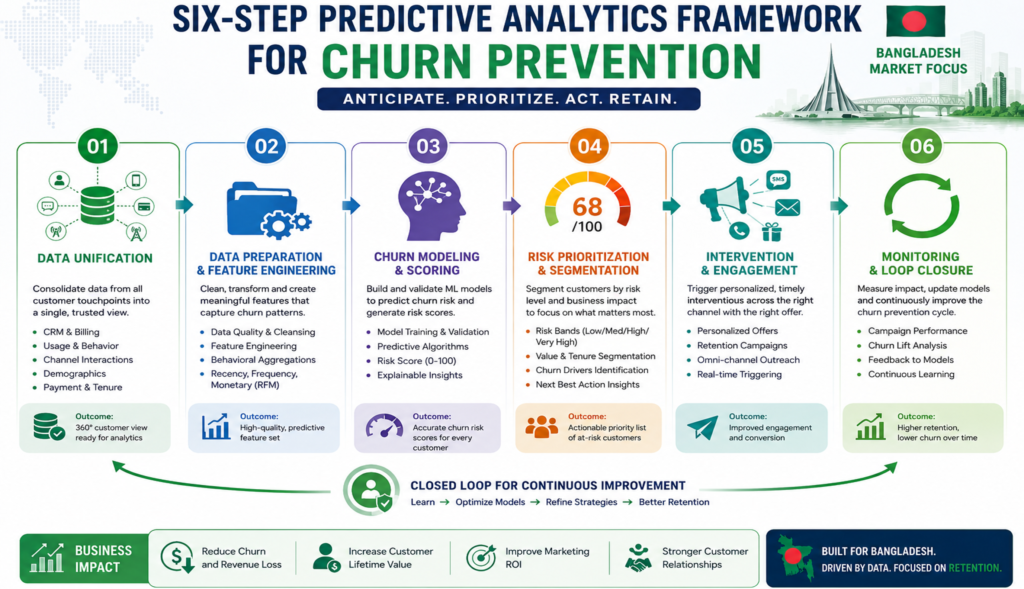
| Step | Action | Leadership Decision | Trade-off | Success Metric |
| 01 | Unify Your Data | Commit to a single customer data platform | Short-term IT cost vs long-term visibility | Single customer view achieved in <90 days |
| 02 | Define Churn | Agree on what ‘churned’ means for your business | Broad definition catches more, narrow is more actionable | Churn definition documented + approved |
| 03 | Score Every Customer | Fund ML model development or license a tool | Build vs buy; speed vs customization | Model accuracy >78% AUC-ROC score |
| 04 | Trigger Interventions | Set thresholds for auto-action vs human review | Automation speed vs personalized outreach | Intervention sent within 48hr of risk flag |
| 05 | Personalize the Save | Allocate budget per customer tier | Discounting margin vs losing the customer | Save rate >35% for high-value segment |
| 06 | Close the Loop | Assign ownership of churn KPI to one team | Marketing vs CS territory; accountability gap | Monthly churn review meeting with P&L owner |
The most common mistake I see in Step 04 is over-automating too early. Triggering a discount the moment a customer’s risk score crosses a threshold is a short-term fix that trains customers to disengage strategically. Instead, start with a personal outreach call or a value-add communication, an educational resource, an early access offer, a service upgrade. Protect margin while signaling that the brand notices.
Step 06, closing the loop, is the most ignored. Churn data should feed back into product development, pricing strategy, and customer onboarding. If 30% of your churned customers all dropped off in week 3, you have an onboarding problem, not a retention problem. The model tells you where to look; leadership decides whether to act.
What Proof Looks Like: Two Brands, Two Approaches
Global Case: Spotify’s ‘Pre-Churn’ Intervention System
Between 2020 and 2023, Spotify deployed a predictive churn model across its free-to-premium conversion funnel. The model tracked 27 behavioral variables including listening session length, playlist creation frequency, skip rates, and time-of-day usage patterns. Users identified as high churn risk received personalized in-app messages, curated playlist nudges, and discounted annual plan offers, all triggered automatically based on model output.
The results were significant. Spotify’s annual report and investor communications cited a reduction in monthly active user churn from 6.8% to 5.1% between 2021 and 2023, with premium subscriber retention improving by 12 percentage points among the at-risk cohort. The key insight: the intervention worked because it was relevant, not because it was discounted. Most users responded to content personalization, not price reduction.
Limitation: Spotify’s model benefits from an enormous, real-time data pipeline that most brands can’t replicate. The lesson to extract isn’t the technology stack, it’s the principle: identify the behavioral precursors of churn, and intervene with something the customer values.
Bangladesh Case: ShopUp and the SME Merchant Retention Challenge
ShopUp, Bangladesh’s B2B commerce platform serving small merchants, faced a familiar problem: merchant churn within the first 60 days of onboarding was reducing the platform’s unit economics. In 2022-2023, the team built a simplified predictive model using order frequency, catalog update behavior, and app session data to segment merchants into risk tiers.
Merchants flagged as high-risk received proactive calls from account managers, not automated messages. The intervention was human, contextual, and in Bangla. According to publicly available commentary from the ShopUp team, early-stage churn in the treated cohort dropped by approximately 28% within two quarters. Equally important: the outreach revealed product gaps, specific features merchants needed that had not been prioritized. The churn model became a product research tool.
Limitation: ShopUp’s model was relatively simple by global standards and required significant human bandwidth in the intervention layer. As the merchant base scales, full automation will become necessary, and with it, the risk of losing the personal touch that made the intervention work.
|
What to Actually Do: Action Plans for Organizations and Professionals
For Organizations (by effort level)
- Audit your data infrastructure (Low effort, 2-4 weeks):Map every customer touchpoint that generates behavioral data. Most companies have it; few have connected it. This is the prerequisite for everything else.
- Define churn for your specific business (Low effort, 1 week):A telecom operator’s definition of churn (no calls for 90 days) differs from an e-commerce brand’s (no purchase in 60 days). Document yours. Get leadership sign-off. Budget: zero.
- Run a cohort analysis on your last 12 months of customer data (Medium effort, 4-6 weeks):Group customers by acquisition month. Track retention rates. Identify which cohorts dropped off fastest and at which point. This single analysis will surface your biggest retention problems without any machine learning involved. Budget: in-house analyst time.
- Build or license a churn scoring model (High effort, 3-6 months):For companies with >10,000 active customers, a dedicated ML model will outperform manual analysis significantly. Budget range in Bangladesh: BDT 8-25 lakh for a custom build; BDT 3-8 lakh/year for a licensed tool like Mixpanel or Amplitude with churn features enabled.
- Design tiered intervention playbooks (Medium effort, 4-8 weeks):Don’t treat all at-risk customers the same. High-value at-risk customers deserve a phone call from a senior account manager. Mid-tier customers can receive a personalized email sequence. Low-value at-risk customers trigger an automated win-back campaign. Match intervention cost to customer lifetime value.
For Marketing and Analytics Professionals
- Get comfortable with SQL and cohort analysis:This is the uncomfortable skill most marketers resist. You don’t need to be a data scientist, but you do need to query your own data. A two-week SQL course will change your career trajectory.
- Learn to read a confusion matrix:When a data scientist presents a churn model, you need to understand precision vs recall trade-offs. A model that catches 90% of churners but flags 40% of loyal customers creates intervention costs that kill the ROI. You need to be able to challenge this.
- Build customer lifetime value (CLV) intuition:Every retention decision is a cost-benefit calculation. If you can’t estimate the CLV of the customer you’re trying to save, you can’t justify the intervention budget. This skill is uncomfortable because it requires cross-functional data, finance, product, operations.
- Practice writing interventions that don’t feel like interventions:The best save communication doesn’t announce itself as a retention play. It’s a value-add, a piece of useful information, an unexpected perk. Writing these requires empathy, not just copywriting skill.
- Build a churn post-mortem habit:Every time you lose a significant customer, document why, using data, not assumptions. Within six months, you’ll have the most valuable churn pattern library in your organization.
The Risks Nobody Talks About
Predictive analytics for churn retention has real limits, and anyone selling you a clean, automated solution is oversimplifying. Here are three things worth sitting with.
First, the ethical risk of surveillance-based retention. When a customer receives a personalized offer moments after showing disengagement signals, some feel seen and valued. Others feel watched. In Bangladesh’s emerging data privacy landscape, where the Digital Security Act and a proposed data protection framework are both works in progress, brands collecting behavioral data without explicit consent frameworks are building on unstable ground. The short-term retention gain can become a long-term trust liability.
Second, the over-intervention trap. I’ve seen brands so excited by their churn model that they trigger retention interventions for customers who were never actually at risk. This creates friction, inflates intervention costs, and in some cases actually signals to customers that they should reconsider their commitment. Sometimes the best retention strategy is to let a good product do its job.
Third, churn models reflect past behavior, not future context. A model trained on 2022-2023 data may not predict churn accurately in 2025, particularly in a market as dynamic as Bangladesh’s, where macroeconomic shocks, regulatory changes, and new competitors can reshape customer behavior in ways no historical dataset anticipated. Treat your churn model as a starting point for a conversation, not a final answer.
Key Takeaways
- Churn is predictable:Customers leave in behavioral patterns. Predictive analytics makes those patterns visible weeks before a customer consciously decides to leave.
- The silent majority churns without warning:In Bangladesh specifically, ‘exit without voice’ is the dominant churn pattern. Behavioral data is your only reliable early-warning system.
- Data point:Companies using ML-based churn models achieved 15-25% retention improvement within 12 months (McKinsey, 2024), compared to 4-7% from rule-based approaches.
- Start simple:A cohort analysis on 12 months of customer data will reveal your biggest retention gaps without any machine learning. The tool matters less than the discipline of looking.
- The intervention layer must be human in Bangladesh:Automated retention plays underperform in relationship-driven markets. The model tells you who to call. The human being makes the call matter.
- Data point:ShopUp’s human-first, data-informed retention approach reduced early-stage merchant churn by approximately 28% within two quarters (2022-2023).
- Close the loop:Churn data should feed product development, pricing, and onboarding design. If your model just triggers discounts, you’re treating symptoms, not causes.
- Watch the ethical edge:Behavioral surveillance without consent frameworks is a reputational risk. Build your retention capability on a foundation of transparent data practices.
Read More Articles:
- The Costly AI Strategy Gap: Why Your Team Is Playing, Not Executing
- The Costly Truth About Minimalist Bangladesh Design Strategy
- The Costly Visual Search Blind Spot That Is Making Bangladesh Brands Invisible
- Quantum Marketing: How 2030’s Technologies Will Shatter Bangladesh’s Status Quo
- Digital Literacy & Brand Purpose: How Education Drives Loyalty in Emerging Markets
Bibliography
Global Benchmarks
- Accenture: The Cost of Customer Churn (2023) — Accenture Research, 2023
- Bain & Company: The Economics of Customer Loyalty — Bain & Company, 2024
- McKinsey & Company: The Value of Getting Personalization Right in Retention — McKinsey Digital, 2024
- Harvard Business Review: The Economics of E-Loyalty — HBR, 2022
- Spotify Investor Relations Annual Report 2023 — Spotify Technology S.A., 2023
- Journal of Retailing and Consumer Services: Exit Voice and Loyalty in South Asian Markets — Elsevier, 2023
- Gartner: Customer Churn and Retention Technology Trends 2024 — Gartner, 2024
- Forrester Research: The ROI of Customer Retention Programs — Forrester, 2024
- XGBoost Documentation and Applications in Churn Prediction — DMLC Group, 2024
- Amazon Prime Retention Data and Behavioral Analytics — Business Insider Intelligence, 2022
Bangladesh-Specific Sources
- BTRC Annual Report 2024: Mobile Internet Penetration Data — Bangladesh Telecommunication Regulatory Commission, 2024
- ShopUp B2B Commerce Platform: Merchant Retention Case Data — ShopUp Blog, 2023
- Bangladesh Bank: Mobile Financial Services Report Q4 2024 — Bangladesh Bank, 2024
- LightCastle Partners: Bangladesh Digital Economy Report 2024 — LightCastle Partners, 2024
- BASIS: Bangladesh ICT Industry Report 2024-25 — Bangladesh Association of Software and Information Services, 2024
- e-Commerce Association of Bangladesh: Consumer Behavior Survey 2024 — e-CAB, 2024
- DataSoft Systems Bangladesh: Customer Analytics Use Cases — DataSoft, 2023