The Brutal Truth About Gen Z Alpha Marketing: Why Your Brand Is Already Invisible to the Bridge Generation
I watched a group of 15-year-olds at a Gulshan pop-up last week. One of them spotted a brand display and pulled out her phone. She didn’t Google it. She didn’t click an ad. She typed the name into Instagram, scrolled for four seconds, said “it doesn’t feel right,” and moved on. The brand had a functioning website, an active Facebook page, and had run TikTok ads that same quarter. None of it registered as real to her.
This is the defining problem of Gen Z Alpha marketing right now. Born roughly between 2010 and 2025, this bridge generation sits at the intersection of Gen Z’s cultural skepticism and Gen Alpha’s full digital nativity. They didn’t grow up tolerating ads. They grew up inside content. And most Bangladeshi brands are structurally invisible to them, not for lack of budget, but because of how that budget is being deployed.
The Problem Goes Deeper Than Creative
The default diagnosis is that your creative needs work. The real issue is more structural.
Gen Z Alpha didn’t learn ad skepticism from older generations. They developed it by living inside the algorithm since childhood. By age twelve, the average member of this cohort can identify paid content in under two seconds. Globally, 65% of Gen Z actively use ad blockers as of 2024, according to Statista. On Bangladesh’s mobile-first, data-conscious devices, that behavior is likely even more entrenched.
But here’s the thing: the problem isn’t blocking alone. It’s discovery architecture. Google’s own internal research, widely reported since 2022, found that 40% of Gen Z prefer TikTok and Instagram over Google for product and brand search. That was three years ago. The gap has widened.
In Bangladesh, the stakes are generational. The Bangladesh Bureau of Statistics estimates roughly 38 million people are currently aged 10 to 24, around 23% of the total population. These are consumers in brand formation years. The preferences they establish now will govern purchase decisions for decades. Brands that don’t establish cultural familiarity with them today don’t just lose a campaign. They lose the long game.
Traditional media compounds the problem. Kantar’s 2024 South Asia Media Trends report found only 8% of Gen Z aged 13 to 24 watch conventional television daily. FMCG giants, telecom providers, and banks that built recall through TVC frequency across two decades are rebuilding from zero. They have awareness without resonance. And awareness without resonance, where a demographic recognizes your brand but feels nothing about it, is arguably more dangerous than being unknown. At least an unknown brand has no expectations to disappoint.
How Gen Z Alpha Actually Processes a Brand
The Trust Architecture Has Completely Inverted
Understanding why conventional approaches fail this generation means understanding how they actually encounter and evaluate brands, not how they’re supposed to.
Gen Z Alpha grew up during peak influencer saturation. They watched early Gen Z monetize trust, and they watched that trust erode in public. By 2024, the Edelman Trust Barometer found only 27% of Gen Z trust brand-sponsored influencer content. That’s nearly three-quarters of your target demographic approaching your paid content with active skepticism before they’ve watched a single frame. Think about what that means for the average macro-influencer deal in Bangladesh today.
What they trust instead is peer endorsement embedded in natural behavior. Not reviews. Not positioned testimonials. The casual, incidental mention. The product that appears in the background of a creator’s video with no comment. The “I’ve been using this, it’s fine” energy that no brand brief can manufacture. When a brand appears organically in content made by someone this generation already trusts, the message bypasses the skepticism filter entirely, because it doesn’t read as a message at all.
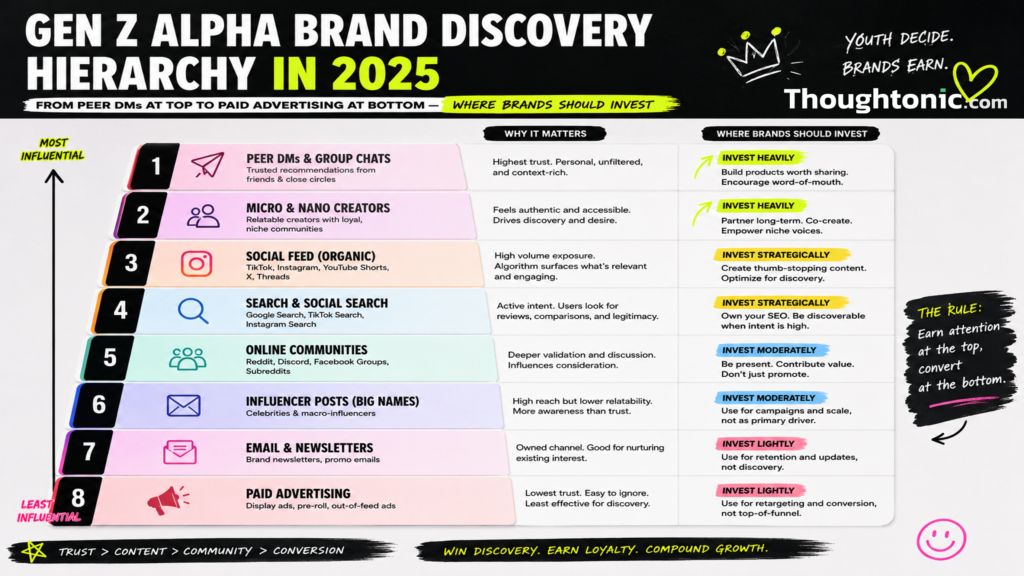
The discovery hierarchy for this cohort in 2025 looks roughly like this, from highest to lowest trust: peer mentions in DMs or group chats (zero brand control, highest conversion intent); organic short-form content from micro-creators they follow; algorithm-served content on Reels and TikTok; exploratory Instagram or YouTube search; Google search; traditional paid advertising. Most brand budgets in Bangladesh remain weighted toward the bottom three. The channels with the highest trust receive the least strategic investment because they resist clean measurement.
What Makes Bangladesh’s Context Specifically Different
Global Gen Z Alpha frameworks miss several realities that define this cohort in Bangladesh.
Device context shapes content aesthetics in ways that matter. Most of Bangladesh’s Gen Z Alpha are on entry-level Android devices. Compressed video, lightweight apps, and data-conscious viewing mean that high-production, polished brand content can actually feel foreign and corporate. Local creators filming in natural light on a mid-range phone frequently outperform technically superior branded content because the aesthetic matches the viewer’s actual environment.
Community structure here is also tighter and more geographically concentrated than in dispersed urban populations. Peer endorsement networks in Dhaka’s schools and neighborhoods carry density that global frameworks don’t model. A recommendation from one trusted peer can reach fifty people within 48 hours. That’s an opportunity and a risk in equal measure. Negative word-of-mouth moves identically.
Language behavior adds another layer. Bangladesh’s Gen Z Alpha code-switches constantly and naturally between Bangla, English, and a digital-native hybrid that borrows freely from both. Content that commits too firmly to either formal Bangla or formal English reads as institutional. Brands that figure out the conversational register produce content that gets remixed and shared. The ones that don’t produce content that gets scrolled past politely.
DataReportal’s 2025 Bangladesh Digital Report records 51.8 million social media users in the country, with users aged 13 to 24 as the fastest-growing segment. The market is there. The question is whether brands are showing up in a way that passes a 15-year-old’s four-second vibe check.
A Five-Step Framework for Gen Z Alpha Marketing That Actually Works
Step 1: Map the Vibe Architecture Before Spending
Before any content production decision, spend two weeks inside the organic content your target cohort is consuming. Not dashboards, actual scrolling. Identify 10 to 20 micro-creators under 50,000 followers whom your demographic genuinely follows. Note the tonal patterns, visual language, and humor registers they operate in. Audit where your brand sits against that aesthetic. This is cultural ethnography, not market research. Leadership trade-off: this delays campaign launches by two to three weeks. The alternative is spending budget on content that fails the vibe check immediately. Key metric: organic mention volume and sentiment in peer-adjacent content.
Step 2: Build in Their Native Format, Not Yours
Vertical video is mandatory. But vertical video produced with TV logic doesn’t work. The most effective short-form content for Gen Z Alpha runs 18 to 45 seconds, opens with visual tension in the first two seconds rather than a logo, and rewards attention with a genuine payoff. Hire creators as content architects, not distribution channels. Leadership trade-off: reallocating 30 to 40% of traditional media budget toward creator-led production feels like losing control. That loss of control is the strategy. Metric: watch completion rate and saves-to-likes ratio as stronger signals than raw view counts.
Step 3: Earn Community Entry Through Micro-Creators
Stop briefing creators with scripts. Brief them with context: what the brand stands for, what feeling it should create, who it genuinely serves. The creator translates this into their native language. A script produces an advertisement. Context produces content. Metric: comment sentiment, unpaid follow-up mentions, and creator audience retention rate.
Step 4: Speak in Vernacular, Not Campaign Language
Annual content calendars are already a relic for this cohort. Cultural moments move faster than planning cycles. Brands need a rapid-response content infrastructure capable of turning around culturally relevant material in 24 to 48 hours. This requires fewer approval layers and more trusted operators with real decision authority. Metric: share and remix rate on branded content.
Step 5: Remove Friction at the Discovery-to-Action Point
If someone finds your brand on Reels at 11pm and the only conversion path is a website they have to search for separately, you’ve lost them. Social commerce integration, WhatsApp-based inquiry handling, and DM response infrastructure are baseline requirements for this cohort, not future roadmap items. Metric: drop-off rate between social discovery and first purchase or inquiry.
Two Brands That Built Gen Z Alpha Trust Deliberately
Global: Duolingo’s Calculated Surrender of Brand Control (2021–2024)
Between 2021 and 2024, Duolingo turned its TikTok account into something most brand managers would never have approved through a formal process. The owl mascot became a chaotic, self-aware character engaging in trending formats, responding to comments in character, and occasionally going fully off-script in ways that felt genuinely surprising. No polished films. No macro-influencer endorsements.
The account grew from zero to over 10 million TikTok followers. App downloads among 18 to 25-year-olds increased approximately 30% during peak TikTok activity. Morning Consult brand perception data showed Gen Z respondents shifting their description of Duolingo from “educational tool” to “brand with personality.” Duolingo built a full-time creator team briefed to operate with creator logic, not marketing logic. Legal and brand teams were uncomfortable. Leadership made the trade-off consciously.
The limitation for Bangladesh: this model requires institutional trust in a small team moving at high speed. In most Bangladeshi corporates, where content approval chains run five to seven people deep, replicating that agility is a structural problem before it’s a creative one.
Bangladesh: How Shajgoj Built Community Before Commerce (2020–2024)
Shajgoj, Bangladesh’s largest beauty and lifestyle platform, grew to over two million app downloads not through advertising-led growth but through community-first content. The platform developed user-generated beauty content, peer-to-peer product reviews in Bangla, and creator partnerships with voices genuinely embedded in local beauty culture. The peer recommendation loop this built organically became its primary growth engine. Products launched through community context consistently outperformed those launched through paid channels alone.
The limitation: Shajgoj operates in the beauty category, where community trust is inherently strong and peer recommendation is already natural behavior. Replicating this in categories with lower social dynamics, utilities, banking, telecom, requires significantly heavier upfront investment in community architecture before any commercial results appear.
Both cases share one structural truth: trust was built before conversion was attempted. That sequencing is the strategy. Brands that try to skip to conversion without earning cultural entry aren’t just failing at a campaign. They’re creating negative associations in a cohort with long memories.
What Organizations and Professionals Should Do Now
For organizations, five actions generate the most resistance internally, which is usually a reliable signal that they’re the right moves:
Redirect display and banner budgets targeting under-25 segments toward micro-creator partnerships and short-form production. Commission a cultural audit using actual members of the demographic, not analysts who study them. Build a micro-creator roster of 15 to 25 voices under 50,000 followers, briefed on brand context rather than product copy. Restructure content approval timelines to under 48 hours. Integrate social commerce and WhatsApp inquiry handling as standard infrastructure.
For individual marketing professionals, the uncomfortable skills are where the real leverage sits:
Learn to read culture qualitatively through daily native scrolling, not for competitive reports, but for instinct. Write feeling-based briefs rather than execution scripts. Defend long-term community investment when short-term ROI questions arise, which requires being able to explain trust-building economics to people who don’t yet believe in them. Brief creators on outcomes and let them own the translation. Admit when your brand doesn’t have cultural permission in Gen Z Alpha spaces yet, because forcing presence before earning it makes the problem worse.
Where This Analysis Has Real Limits
Here’s where I need to push back on my own arguments.
Gen Z Alpha marketing as a strategic priority can become cover for undisciplined brand strategy. Not every organization needs a TikTok presence or a micro-creator roster. A Bangladeshi B2B firm, a pension fund, a commercial real estate company: these brands have no urgent business restructuring their content strategy for a demographic that won’t be their buyer for 10 to 15 years. Chasing relevance in the wrong context wastes resources and weakens positioning.
The ethical risk is also real and largely ignored here. Targeting minors aged 10 to 14 with commercial creator content sits in a legally ambiguous space in Bangladesh. No clear regulatory framework exists, yet this age group represents a core Gen Z Alpha segment. Brands operating there are accumulating risk they haven’t priced.
And finally: some brands will outperform aggressive Gen Z Alpha content strategies simply by building excellent products and letting peer recommendation do the work naturally. Sometimes the most effective Gen Z Alpha marketing is a product people actually want to talk about. That’s not a framework. It’s still the truth.
Key Takeaways
- Gen Z Alpha (born 2010–2025) represents approximately 38 million people in Bangladesh, or 23% of the population, in or approaching brand formation years. Brands not engaging now are ceding preference to competitors who are.
- 65% of Gen Z globally use ad blockers (Statista, 2024). This isn’t a creative problem. It’s a channel allocation problem.
- Google is no longer the primary discovery engine for this cohort. 40% prefer TikTok and Instagram for brand and product search, per Google’s own internal research.
- Only 27% of Gen Z trust brand-sponsored influencer content (Edelman Trust Barometer, 2024). Micro-creator community relationships, built on context, not scripts, consistently outperform macro-influencer paid deals.
- The discovery hierarchy places peer DMs and organic creator content at the highest trust level. Most brand budgets in Bangladesh are inverted against this hierarchy.
- In Bangladesh specifically, device context and community density shape Gen Z Alpha content preferences in ways that global playbooks miss. Entry-level Android aesthetics can outperform high-production content.
- Community before commerce is the only sequencing that works with this cohort. Brands that attempt conversion before trust-building create negative brand equity that takes years to reverse.
- Not every brand has cultural permission to enter Gen Z Alpha spaces immediately. Earning it over 12 to 18 months frequently outperforms forcing early presence.
Read More Articles:
- The Costly AI Strategy Gap: Why Your Team Is Playing, Not Executing
- The Costly Truth About Minimalist Bangladesh Design Strategy
- The Costly Visual Search Blind Spot That Is Making Bangladesh Brands Invisible
- Quantum Marketing: How 2030’s Technologies Will Shatter Bangladesh’s Status Quo
- Digital Literacy & Brand Purpose: How Education Drives Loyalty in Emerging Markets
Bibliography
- Statista — Ad Blocking Among Gen Z, 2024
- Google Internal Research on Gen Z Search Behavior — reported by TechCrunch, 2022
- Edelman Trust Barometer 2024
- Bangladesh Bureau of Statistics — Population Estimates 2024
- DataReportal — Digital 2025: Bangladesh Report
- Kantar — Media Trends & Predictions South Asia, 2024
- Morning Consult — Most Trusted Brands Gen Z 2024
- eMarketer — Gen Z Social Commerce Trends 2024
- McKinsey & Company — “True Gen”: Generation Z and Its Implications for Companies
- GSMA — Mobile Economy South Asia 2024
- Sprout Social — Social Media Statistics and Trends 2024
- Social Media Examiner — Influencer vs. Creator Trust Report 2024
- The Business Standard Bangladesh — Gen Z Consumer Behavior
- Adweek — How Duolingo Became TikTok’s Most Beloved Brand
- Campaign Asia — Shajgoj Platform and Creator Economy in Bangladesh
- Nielsen — Bangladesh Consumer Insights 2024
- Sprinklr — Gen Z Marketing Trends and Insights 2024