The Hidden Truth About Neuromarketing: Why Logic Is the Enemy of Conversion
Here’s what surprised me the most after a decade in marketing strategy: the campaigns that converted best were rarely the ones with the most thorough feature lists or the sharpest pricing slides. They were the ones that made someone feel something first. And yet, most of the briefs I see across Dhaka’s corporate marketing teams still open with “key product benefits” and close with a price comparison table.
Neuromarketing – the application of brain science to buying behavior – tells us exactly why this is a problem. According to Nielsen’s Consumer Neuroscience division, purely rational advertising scores 20% lower on long-term memory encoding than emotionally-driven campaigns. And the brain makes a purchase-related decision in as little as 2.5 seconds, processed almost entirely by the limbic system before your prefrontal cortex the logical, analytical part; even wakes up.
In my analysis, we are running logic-first campaigns in an emotion-first brain. And in a market like Bangladesh, where purchasing decisions are even more deeply woven into trust, relationships, and social reputation, this gap between how we market and how people actually decide costs brands more than they realize.
The Problem: We Think Our Buyers Are Rational. They’re Not.
The classical marketing assumption – that buyers evaluate options, weigh pros and cons, and choose the most rational option – has been dismantled systematically by neuroscience over the past 30 years. Daniel Kahneman’s foundational work in “Thinking, Fast and Slow” (2011) introduced the world to System 1 and System 2 thinking. System 1 is fast, emotional, instinctive. System 2 is slow, deliberate, logical. Here’s the thing most marketers miss: System 1 makes the call. System 2 writes the justification memo afterward.
This isn’t a B2C phenomenon. Forrester Research found that even in B2B purchasing, 71% of buyers who experience high emotional connection with a vendor brand deliver twice the value over their lifetime compared to those who don’t. The CXO signing the software contract is not purely optimizing for ROI – they’re thinking about how this decision reflects on them, whether the vendor feels trustworthy, and what happens to their reputation if the deal goes sideways.
In Bangladesh, this dynamic is particularly pronounced. A 2024 survey by the Digital Marketing Association Bangladesh (DMAB) found that 73% of digital ad campaigns in the country led with product attributes rather than emotional messaging. Meanwhile, LightCastle Partners reported that average e-commerce conversion rates in Bangladesh sat at just 1.1-1.4% against a global benchmark of 2.5-3.2%. That gap isn’t explained by platform quality or internet penetration alone. It’s explained by emotional disconnect.
Bangladeshi buyers – whether they’re a garment factory owner in Narayanganj evaluating an ERP solution, or a middle-income family in Mirpur shopping on Daraz – are making decisions through the same limbic filter as every other human on the planet. Features don’t move that filter. Feelings do.
The Science: What’s Actually Happening in Your Buyer’s Brain
Why the Limbic System Controls Your Conversion Rate
The limbic system is the brain’s emotional processing center. It includes the amygdala (which flags threat and reward signals) and the hippocampus (which encodes memories). Antonio Damasio’s somatic marker hypothesis, documented in “Descartes’ Error” (1994), showed that damage to the emotional brain doesn’t make humans more rational – it actually makes them incapable of deciding. Patients with lesions in emotional brain regions couldn’t choose between two breakfast options. Emotion isn’t noise in the decision-making process. It’s the engine.
When a buyer encounters your brand, the amygdala responds first. It asks: does this feel safe? Does this feel aspirational? Does this feel like something people like me do? If the answer is no, or neutral, the message doesn’t make it into long-term memory. No memory formation means no brand recall. No brand recall means you lose at the moment of purchase.
This is where most B2B marketing fails silently. The deck gets sent. The proposal is detailed. The case studies are thorough. But the emotional hook was never set, so when the buyer is evaluating three vendors six weeks later, your brand doesn’t surface with any emotional weight. You become the spreadsheet row, not the preferred choice.
The Role of Loss Aversion
Nobel laureate Kahneman and Amos Tversky established through prospect theory that losses feel psychologically twice as powerful as equivalent gains. This has direct implications for how you should frame marketing messages. “Increase revenue by 20%” is weaker than “Stop losing 20% of revenue to inefficiency.” But here’s what gets interesting in the Bangladeshi context: loss aversion takes cultural shape. In a market with high uncertainty and where business relationships are deeply personal, the fear of reputational damage – choosing a vendor that fails publicly – is an even stronger loss aversion trigger than in more transactional Western markets.
Smart campaigns tap into specific, culturally-tuned fears. Not manufactured fear, but real, present anxieties that your product actually resolves. That’s the ethical line.
A Practical Map: What Emotion Does to Your Funnel
| Funnel Stage | Emotional Driver | Logic’s Role | Mistake to Avoid |
| Awareness | Curiosity / Aspiration | None yet | Leading with specs |
| Consideration | Trust / Fear of wrong choice | Supporting role | Burying the emotional proof |
| Decision | Loss aversion / Identity | Justification only | Reversing the order |
| Retention | Belonging / Pride | Minimal | Treating post-sale as purely rational |
The pattern is clear: logic earns its place only after emotion has opened the door. Used too early, logic closes that door.
The FEEL Framework: A Practical System for Emotion-Led Marketing
I’ve tested variations of this across campaigns in financial services, tech, and FMCG in Bangladesh. The underlying structure is consistent regardless of category.
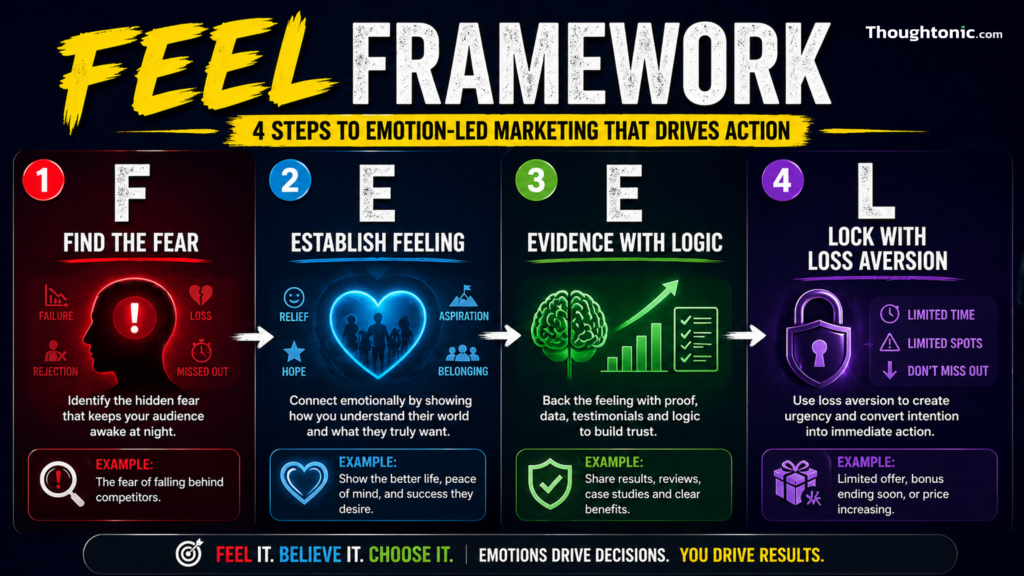
Step 1: Find the Fear
Every purchase is ultimately driven by either the pursuit of pleasure or the avoidance of pain. Pain is the stronger driver. Before writing a single line of copy, identify the primary emotional fear your buyer carries. For an HR tech solution, it might be “fear of being seen as behind.” For a logistics company, it might be “fear of a delivery failure that costs a client relationship.” The fear must be real, specific, and present – not manufactured.
The mistake here: substituting demographic research for emotional research. Knowing that your buyer is a 38-year-old male CFO tells you nothing about what keeps him up at night. Emotional audience research – interviews, observational research, customer journey mapping at the emotional layer – is the actual input you need.
Step 2: Establish the Feeling
Your first touchpoint – whether that’s a LinkedIn ad, a landing page headline, or the opening line of a sales email – must trigger an emotional response before it delivers any information. bKash’s “Taka Pathao, Shopno Pathao” (Send Money, Send Dreams) is the local gold standard for this. They didn’t open with transfer limits or fee schedules. They opened with the feeling of a migrant worker sending home something more than money.
The leadership decision required: approve messaging that doesn’t mention your product’s features in the first 8 seconds of exposure. This is genuinely difficult to get signed off internally.
Step 3: Evidence with Logic
This is where logic earns its seat at the table. Once emotional resonance is established, your buyer’s System 2 needs ammunition to justify what System 1 has already decided. Case studies, data, testimonials, and ROI calculators all belong here – after the emotion, not before it. Salesforce’s 2024 State of Sales report found that deals initiated with emotional value framing close 37% faster than those opened with feature comparisons. Logic doesn’t close deals. It validates decisions that emotion already made.
Step 4: Lock with Loss Aversion
At the bottom of the funnel, reframe the decision. The question shouldn’t be “why should you buy this?” It should be “what happens if you don’t?” The cost of inaction, expressed in emotionally-resonant terms specific to your buyer’s context, is consistently the highest-converting bottom-of-funnel message. In Bangladesh’s B2B market, where competitors are closing fast and decision windows are narrow, this framing works particularly well.
Step 5: Loop and Test
Gut instinct is not enough. Build a lightweight testing framework: A/B test emotional vs. rational variants of the same ad. Track scroll depth, time-on-page, and demo request rates as behavioral proxies for emotional engagement. Even without dedicated eye-tracking infrastructure (which exists in Dhaka through a small number of UX research firms), you can measure emotional effectiveness through behavioral signals.
Case Studies: Two Brands That Let Emotion Lead
Apple and the iPod (2001-2004): Features Are the Supporting Cast
Apple launched the iPod into a market that already had MP3 players. The rational pitch was available: better storage, sleeker design, faster sync. Apple ignored all of it. “1,000 songs in your pocket” was not a feature statement – it was a freedom statement. It told the buyer what their life would feel like, not what the device would do.
Within 24 months, iPod held 70% of the digital music player market. Apple’s stock rose 40% in the first year after launch. iTunes sold 1 million songs in its first six days. The competitors had comparable hardware and lost anyway – because they spoke to the head while Apple spoke to the gut.
The limitation worth acknowledging: Apple had years of design identity and brand equity working in its favor. Emotional messaging without aesthetic credibility or brand history is weaker.
bKash in Bangladesh (2015-2023): Building Financial Trust Through Feeling
bKash didn’t enter the market selling mobile banking. It entered selling connection. Bangladesh’s internal migration economy – millions of workers in Dhaka’s garment factories sending money back to families in Sylhet, Rajshahi, Mymensingh – created a deeply emotional use case. bKash’s messaging consistently anchored to the feeling of supporting family, maintaining dignity, and closing distance.
The numbers tell the story: bKash grew from 10 million registered accounts in 2015 to 67 million by 2023. Brand recall in rural Bangladesh exceeded 91% according to LightCastle Partners’ 2023 brand study. Transaction volume crossed BDT 1 trillion in 2022. In a category where the rational pitch (fees, speed, security) was table stakes, emotional storytelling built a near-unassailable market position.
The limitation: bKash had BRAC’s institutional network, aggressive agent expansion, and near-monopoly conditions through much of this period. Emotional messaging accelerated growth that structural advantages had already enabled.
Action Plans: Where to Start This Week
For Organizations
Audit your current messaging – Effort: Low, Timeline: 1 week. Pull your last five campaigns. How many seconds before your product’s name appears? How many before an emotional trigger? If the answer to the first question is “zero seconds,” you have a structural problem.
Rewrite one landing page with emotion-first structure – Effort: Medium, Timeline: 2 weeks. Take your highest-traffic landing page. Move the feature list to the second screen. Put loss aversion or aspiration at the headline. Run it for 30 days against the original. The conversion delta will tell you more than any neuromarketing book.
Run emotional audience research on one key persona – Effort: Medium, Timeline: 3-4 weeks. Commission 8-10 depth interviews focused not on what your buyers do, but what they feel before, during, and after a purchase decision in your category. Map the emotional journey separately from the rational journey.
Train your marketing team – Effort: Low, Timeline: Ongoing. BASIS-affiliated training programs are beginning to include behavioral economics modules. Kahneman’s work is available. Pradeep’s “The Buying Brain” is practical and accessible. A reading budget of BDT 5,000 per person will do more for campaign quality than another design tool subscription.
Build a loss aversion message into every bottom-of-funnel asset – Effort: Medium, Timeline: 2 weeks. Every proposal, every follow-up email, every final-stage landing page should answer: “What does inaction cost my buyer, in terms they actually feel?”
For Individual Professionals
Stop calling your buyer rational. The discomfort here is professional identity – you’ve built your pitch style around “data-driven” and “ROI-focused” language. Neuromarketing asks you to accept that those are justification tools, not decision drivers.
Learn to write emotionally without being manipulative. This is a skill. Fear-based messaging that isn’t grounded in real product utility destroys trust faster in Bangladesh than in most markets, because word-of-mouth networks (especially on Facebook groups and community WhatsApp channels) are dense and fast.
Defend emotional campaigns to finance, the results timeline is longer, the measurement is harder, but brand equity compounds. The discomfort is real. Do it anyway.
The Critical Perspective: Where This Gets Complicated
Neuromarketing is not a manipulation toolkit. Applied carelessly, emotional tactics can push buyers toward decisions that don’t serve them – and in Bangladesh’s rising consumer awareness environment, the backlash is fast and public. A brand that engineers fear or fabricates social proof faces viral exposure on Facebook and YouTube within hours.
There’s also a legitimate counterargument: in a market where 87% of businesses are micro or small enterprises managing week-to-week cash flow, rational price signals sometimes genuinely do override emotional marketing. A street vendor buying packaging material isn’t in a limbic-driven decision state. Context matters. Neuromarketing is a powerful tool for building brand preference over time – it doesn’t override survival economics at the transactional layer.
And sometimes, doing less is the right answer. For a new brand with no earned credibility, a clean and honest functional message may outperform a sophisticated emotional campaign. You can’t activate an emotional memory structure that doesn’t yet exist. Build the product experience first. Then build the emotional story around it.
Key Takeaways
- The human brain makes purchase decisions in approximately 2.5 seconds, driven by the limbic system before logic activates.
- Nielsen Consumer Neuroscience found that purely rational ads score 20% lower on long-term memory encoding than emotionally-driven ones.
- In Bangladesh, only 1.1-1.4% of e-commerce visits convert – well below the global benchmark of 2.5-3.2% – a gap emotional disconnection partly explains.
- Emotion does not replace logic in the buying process; it precedes logic. Logic justifies what emotion decides.
- Loss aversion is psychologically twice as powerful as equivalent gain framing. Frame the cost of inaction.
- bKash’s growth from 10 million to 67 million accounts is the definitive local case study for emotion-led brand building.
- Neuromarketing without product integrity is manipulation – and in Bangladesh’s dense social networks, the reputational cost is severe.
- B2B buyers are not immune to emotion. Forrester found emotionally-connected B2B customers deliver twice the lifetime value.
Read More Articles:
- The Costly AI Strategy Gap: Why Your Team Is Playing, Not Executing
- The Costly Truth About Minimalist Bangladesh Design Strategy
- The Costly Visual Search Blind Spot That Is Making Bangladesh Brands Invisible
- Quantum Marketing: How 2030’s Technologies Will Shatter Bangladesh’s Status Quo
- Digital Literacy & Brand Purpose: How Education Drives Loyalty in Emerging Markets
Bibliography
- Kahneman, Daniel – “Thinking, Fast and Slow,” Farrar, Straus and Giroux, 2011
- Nielsen Consumer Neuroscience – “The Science of Advertising Effectiveness,” 2023
- Damasio, Antonio – “Descartes’ Error: Emotion, Reason, and the Human Brain,” Avon Books, 1994
- Harvard Business Review – “The New Science of Customer Emotions,” 2015
- Salesforce – “State of Sales Report,” 2024
- Forrester Research – “How Emotion Drives B2B Buying,” 2023
- Statista – “Global E-Commerce Conversion Rate Benchmarks,” 2024
- LightCastle Partners – “Bangladesh E-Commerce Landscape,” 2024
- LightCastle Partners – “bKash Brand and Financial Inclusion Study,” 2023
- BTRC – “Annual Report on Digital and Internet Usage,” 2024
- BASIS – “Bangladesh Tech Talent and Skills Report,” 2024
- Digital Marketing Association Bangladesh (DMAB) – “State of Digital Advertising Survey,” 2024
- Pradeep, A.K. – “The Buying Brain: Secrets for Selling to the Subconscious Mind,” Wiley, 2010
- World Bank – “Bangladesh Financial Inclusion and Digital Finance Report,” 2023
- Ipsos Bangladesh – “Consumer Sentiment and Purchase Behavior Survey,” 2024
- Kahneman, D. & Tversky, A. – “Prospect Theory: An Analysis of Decision under Risk,” Econometrica, 1979