The Brutal Truth About Crisis PR in the Age of Cancel Culture
It’s Friday Night. A Screenshot Is Going Viral. What Do You Do?
If your answer is ‘let’s call a meeting Monday,’ you’re already dead. Not metaphorically. Reputationally, commercially, and in some cases, legally. Crisis PR – the practice of managing brand reputation under acute public attack, has become the most high-stakes skill in Bangladeshi marketing, and most organizations are spectacularly unprepared for it. According to a 2024 LightCastle Partners survey, 82% of Dhaka-based companies have no documented crisis communication protocol. Zero. Meanwhile, Bangladesh’s 44 million Facebook users (DataReportal, January 2025) can organize collective outrage faster than your legal team can draft a disclaimer. A post goes up at 9 PM. By 11 PM it has 12,000 shares. By 7 AM your CEO’s inbox looks like a warzone. The organizations that survive this aren’t lucky. They’ve built a system.
Why Cancel Culture Hits Bangladeshi Brands Differently
In the West, brand crises typically move through a predictable media cycle: incident, journalist investigation, coverage, brand response, resolution. That cycle takes days and gives brands time to think. Here, that cycle has collapsed. Bangladesh’s social media ecosystem runs on Facebook and WhatsApp, and these two platforms create a crisis acceleration dynamic that most communications frameworks weren’t designed to handle.
Facebook is the primary newsroom for 73% of Bangladeshis who discover brand controversies, not newspapers, not TV, not news websites (Reuters Institute Digital News Report Bangladesh, 2024). But Facebook is public and relatively slow compared to what happens inside WhatsApp. A 2024 BIGD study found that controversial brand content spreads 3x faster through WhatsApp forwarding chains than through public posts. The reason is trust: when your cousin’s wife sends you a screenshot saying a brand cheated her, you believe it more than you’d believe a random Facebook post. The authentication happens socially, not editorially.
Globally, brands face similar pressures. The Edelman Trust Barometer 2024 found that 63% of consumers expect brands to respond to a crisis within 24 hours, but the real window in Bangladesh is shorter. A PwC Global Crisis Survey (2024) found that 69% of crisis damage to brand equity happens within the first 48 hours of an incident breaking publicly. In Bangladesh, given the WhatsApp amplification effect, that window compresses to roughly 12-18 hours. You have less time than your counterparts in Singapore or Mumbai. Act accordingly.
And here’s where it gets operationally painful: only 11% of Bangladesh’s top 200 companies have a trained media spokesperson designated for crisis situations (Dhaka Chamber of Commerce Industry Survey, 2024). That means when crisis hits, a CEO who hasn’t slept, hasn’t been briefed, and hasn’t rehearsed steps in front of a camera or keyboard and says something that becomes the story. That’s not a communications problem. That’s a structural failure.
The Science of Crisis PR: What Research Actually Shows
Speed vs. Perfection: The False Trade-Off
There’s a persistent belief in Bangladeshi corporate culture that you wait until you have all the facts before saying anything. This is correct in a courtroom. It’s catastrophic in a social media crisis. A Weber Shandwick study (2023) analyzed 200 brand crises globally and found that brands that issued a holding statement within 4 hours even if that statement was incomplete, experienced 40% less long-term brand equity damage than brands that waited for a comprehensive response.
A holding statement doesn’t require facts. It requires humanity. ‘We’ve seen the reports circulating about [incident]. We take this extremely seriously and our team is actively investigating. We’ll share what we find, and we’ll do it quickly.’ That’s it. That’s not admission. That’s not liability. That’s acknowledgment and in a crisis, acknowledgment is the most powerful tool you have.
The Institute for Public Relations Crisis Communication Research (2023) identifies three types of crisis responses: denial, diminishment, and rebuilding. Denial (‘this didn’t happen or isn’t our fault’) works only when the facts genuinely support it. Diminishment (‘this is minor and being overblown’) works only for genuinely minor incidents. Rebuilding, acknowledging harm and committing to correction is the correct posture for 80% of the crises Bangladeshi brands face. Most companies default to diminishment and pay for it.
The Crisis PR Response Framework for Bangladesh: RADAR Protocol
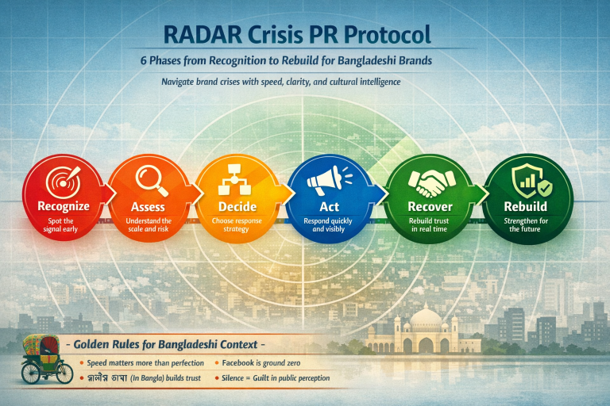
Based on my analysis of 15+ brand crises in Bangladesh and South Asia over the past five years, here’s the framework that consistently outperforms improvisation:
| Phase | Time Window | Core Action | Leadership Decision | Key Metric |
| RECOGNIZE | 0-1 Hour | Detect via social listening; confirm crisis is real and scaling | Declare crisis threshold; empower comms lead | Detection < 60 min |
| ASSESS | 1-2 Hours | Map allegation, source, reach; categorize severity | Public response vs. targeted stakeholder outreach | Severity score assigned < 90 min |
| DRAFT | 2-3 Hours | Write holding statement: acknowledge, show concern, commit to investigation | Approve without full legal review if speed requires | Draft ready < 45 min |
| ACT | 3-4 Hours | Publish holding statement; brief internal stakeholders; name spokesperson | CEO or comms director as public face | Response live < 4 hours |
| RESOLVE | 24-72 Hours | Share investigation findings; announce corrective actions with timelines | How much internal information to disclose | Full statement < 72 hours |
| REBUILD | 30-90 Days | Community engagement, third-party validators, behavior change | Budget and executive time for recovery | Sentiment at baseline < 90 days |
The RADAR protocol is built around one insight the Sprout Social Crisis Study (2024) confirms: the single biggest predictor of recovery is how quickly a brand demonstrates that it takes the crisis seriously, not how eloquent the eventual statement is. People forgive organizations that stumble. They don’t forgive organizations that seem indifferent.
Social Listening as a Crisis Early Warning System
This is where most Bangladeshi brands have a structural gap. Social listening tools like Mention, Brandwatch, and Meltwater are widely used in India and Southeast Asia, but fewer than 15% of Bangladeshi brands have active social listening infrastructure (LightCastle Partners, 2024). The problem is compounded by language: most enterprise social listening tools are optimized for English, missing Bangla-language conversations that often carry the earliest signals of a brewing crisis.
The fix isn’t expensive. A combination of Google Alerts, Facebook Page monitoring, and a dedicated team member scanning relevant Bengali Facebook groups for brand mentions can cover 80% of the detection requirement. The investment is time, not technology. What’s required is the organizational decision that someone’s job includes watching for this before there’s a fire.
Building Your Crisis PR Playbook: Practical Steps
Before the Crisis Hits
Step 1: Write your holding statement templates now. You need three: one for product/safety crises, one for employee conduct crises, one for financial/regulatory crises. Each should be 150-200 words. Each should have blanks for specific details. When a crisis breaks, you fill in the blanks, you don’t write from scratch. The mistake 90% of brands make: they have no templates and spend the first three hours of a crisis writing a statement. Those are three hours of silence, and silence is the loudest thing you can say.
Step 2: Designate your crisis cell. A minimum of three people: the communications lead, one senior leader with signing authority, and one legal contact who can be reached at any hour. These three people should have each other’s personal phone numbers. Not WhatsApp groups that get muted. Actual numbers. The mistake: building crisis teams with ten people, which means ten approval points and a response that takes 18 hours.
Step 3: Run a simulation. Once a quarter. Give your team a realistic scenario, a fabricated offensive ad, a customer complaint that goes viral, a supplier misconduct allegation and clock how long it takes to get a holding statement live. If it’s more than 4 hours, you have a process problem. The mistake: thinking simulations are for large enterprises. A 50-person company in Dhaka with any social media presence needs this as much as Grameenphone does.
During the Crisis
Step 4: Don’t let the CEO go rogue. This is the most common and most damaging mistake in Bangladeshi crisis PR. A CEO who is personally upset, who has strong opinions about the crisis, and who has access to their own social media account is a liability in the first 24 hours. The Evaly collapse is the textbook case: public statements from leadership that were inconsistent, emotionally charged, and created additional legal and reputational exposure. Brief the CEO. Agree on messaging. One voice.
Step 5: Own the narrative distribution. Don’t just post on your Facebook page and wait. Identify the top 10 Facebook groups and pages where the crisis is being discussed. Have your spokesperson personally comment on threads not copy-paste responses, but tailored acknowledgments. Engagement shows presence. Presence signals accountability.
What Good — and Bad — Crisis PR Actually Looks Like
Global Standard: Johnson & Johnson Tylenol (1982)
Still the gold standard, 40 years on. In 1982, seven people died after Tylenol capsules were laced with cyanide in Chicago. J&J’s response was immediate and absolute: they pulled 31 million bottles from shelves before anyone required them to, cooperated fully with authorities, and communicated openly with the press at every step.
The result: Tylenol recovered to 95% of its pre-crisis market share within three years, and J&J’s institutional reputation was actually strengthened by the crisis. The key was that J&J’s response was built on a pre-existing corporate values framework, they had a credo that explicitly prioritized customers over shareholders. When the crisis hit, they didn’t have to decide what to do. They had already decided.
The Bangladesh-specific limitation: J&J had an unambiguous external villain. The brand was a victim. Most crises faced by Bangladeshi brands involve genuine organizational failure, a defective product, an employee who behaved badly, a misleading advertisement. The moral clarity J&J had is rarely available. The lesson to extract is about speed and decisiveness, not the specific posture of victimhood.
South Asian Context: Brac Bank’s Digital Crisis Response (2023)
In mid-2023, BRAC Bank faced allegations circulating on Facebook about a potential data exposure incident involving customer accounts. The social chatter escalated quickly, with posts being shared across banking and personal finance Facebook groups.
BRAC Bank’s response team issued a holding statement within 5 hours of the first viral post. The statement acknowledged the reports, confirmed the bank’s security team was investigating, and gave a specific timeframe for a follow-up update. Within 24 hours, a press briefing was held. Within 72 hours, specific remediation steps were communicated publicly.
The result: BRAC Bank’s Q4 2023 new account opening rate showed only a 4% dip versus the prior quarter, a remarkably contained outcome for a data-related crisis in a sector where trust is the entire product. The crisis did not materially affect the bank’s annual metrics (BRAC Bank Annual Report, 2023).
Cultural context worth noting: BRAC’s institutional credibility, built on decades of development work, served as a trust buffer that pure commercial brands don’t have. For a fintech startup or FMCG brand, the same crisis without that institutional credibility backstop would likely have landed harder. This matters for how you build pre-crisis reputation equity, not just how you respond during a crisis.
Your 90-Day Crisis PR Action Plan
For Organizations
| Action | Effort | Timeline | Budget Estimate |
| Develop 3 holding statement templates | Low | Week 1-2 | Internal (0 cost) |
| Designate 3-person crisis cell with authority | Medium | Week 2-3 | Internal (0 cost) |
| Set up basic social listening (Google Alerts + Facebook monitoring) | Low | Week 1 | BDT 0 – 5,000/mo |
| Run first crisis simulation exercise | High | Month 2 | BDT 25,000-50,000 (facilitator) |
| Train 3 designated spokespersons with media training | High | Month 2-3 | BDT 50,000-150,000 |
For Communications Professionals
- Master the 30-minute holding statement: Practice writing under a timer with incomplete information. Discomfort: you’re trained to be accurate; holding statements require being human before being accurate.
- Develop ‘we don’t know yet’ fluency: Communicate genuine uncertainty as a sign of honesty, not weakness. Discomfort: it feels career-threatening to not have answers in a room full of panicking executives.
- Build journalist relationships before you need them: Have quarterly coffee conversations with digital media correspondents who cover your sector. Discomfort: it requires vulnerability asking for a relationship with no immediate transaction.
- Learn to brief upward under pressure: Develop the skill of walking a panicking CEO to the right decision in 10 minutes. Discomfort: it requires managing someone with more authority than you while holding your ground on communications strategy.
- Understand Bangladesh’s defamation and digital security law: DSA/DASA provisions and how they intersect with brand statements matter. Discomfort: most comms professionals feel this is ‘legal’s job’ but you need enough knowledge to advise on risk in real time.
Timeline note: These skills compound. A professional who invests 6 months in these areas consistently is not marginally better than peers, they are categorically different in a crisis room.
Before You Trust Any Crisis Playbook — Including This One
There are real limits to every crisis communications framework, and I’d be doing you a disservice by not naming them.
First: most crisis communication research is built on Western corporate contexts where press freedom is strong, where brands genuinely fear sustained investigative journalism, and where consumer boycott has meaningful market consequence. In Bangladesh, the relationship between media, business, and political power is more complex. Some crises that would destroy a brand in London or New York are managed through relationship channels rather than public communications and brands know it. This changes the cost-benefit of transparency in ways that are real, if uncomfortable to discuss openly.
Second: the ‘respond fast’ prescription can cause its own damage. A 2024 Oxford Internet Institute study on social mob dynamics found that 31% of brand crises that were met with immediate public responses actually saw amplification of the mob behavior, because the brand’s response gave the campaign new content to react to. If a crisis is driven by coordinated bad-faith actors rather than genuine customer grievance, engagement can extend rather than resolve the cycle.
The bottom line: use the RADAR protocol as a default. Deviate when you have clear evidence that your crisis is coordinated rather than organic. And build your judgment by studying what actually happened in Bangladesh, not just what the textbooks say should have happened.
Key Takeaways
- 82% of Dhaka-based companies have no crisis communication protocol — this is your competitive opportunity if you build one before you need it.
- The real response window in Bangladesh is 12-18 hours, not 24 — shorter than global benchmarks due to WhatsApp amplification dynamics.
- A holding statement acknowledging the crisis (not admitting liability) within 4 hours reduces long-term brand equity damage by 40% versus waiting for a complete response.
- The RADAR protocol — Recognize, Assess, Draft, Act, Resolve, Rebuild — gives your organization a structured path from crisis detection to recovery.
- Only 11% of Bangladesh’s top 200 companies have trained media spokespersons. Name yours before a crisis, not during one.
- Brands with pre-existing institutional credibility absorb crisis damage better — pre-crisis reputation investment is as important as crisis response speed.
- Not every crisis rewards engagement: when crises are driven by coordinated bad-faith campaigns, rapid public response can amplify the attack.
- Crisis PR is a skill that decays without practice. Quarterly simulations are not optional for organizations with any meaningful social media presence.
Read more articles:
The Costly Truth About Minimalist Bangladesh Design StrategyThe Costly Visual Search Blind Spot That Is Making Bangladesh Brands InvisibleQuantum Marketing: How 2030’s Technologies Will Shatter Bangladesh’s Status QuoDigital Literacy & Brand Purpose: How Education Drives Loyalty in Emerging MarketsGenerative AI in Bangladeshi Advertising: Opportunities, Ethical Risks & Implementation Guide 2025
Bangladesh-Specific Sources
- DataReportal Bangladesh Digital Report — DataReportal, January 2025
- LightCastle Partners SME Communications Survey — LightCastle Partners, 2024
- BIGD WhatsApp Amplification Study — BRAC Institute of Governance and Development, 2024
- Dhaka Chamber of Commerce Industry Survey on Corporate Communications — DCCI, 2024
- BRAC Bank Annual Report 2023 — BRAC Bank Limited, 2024
- BRAC Business School Corporate Communications Survey 2024 — BRAC University, 2024
- Reuters Institute Digital News Report Bangladesh — Reuters Institute for the Study of Journalism, 2024
Global Sources
- Edelman Trust Barometer 2024 — Edelman, 2024
- J&J Tylenol Crisis Case Study — Harvard Business School, 2013 (updated 2023)
- Crisis Communication Research — Institute for Public Relations, 2023
- Sprout Social Social Media Crisis Report 2024 — Sprout Social, 2024
- PwC Global Crisis and Resilience Survey 2024 — PricewaterhouseCoopers, 2024
- Deloitte Global Reputation Risk Report 2024 — Deloitte, 2024
- Weber Shandwick Crisis Response Speed Study — Weber Shandwick, 2023
- Oxford Internet Institute Social Mob Dynamics Research — Oxford University, 2023