UGC Engines: The Proven Power of Letting Customers Create Your Ads
The Uncomfortable Math Behind Brand Trust
Here’s a stat that should make every marketing manager in Dhaka put down their coffee: 92% of consumers trust peer recommendations over any form of advertising. Not 52%. Not 72%. Ninety-two percent. And yet, most Bangladeshi brands are spending the bulk of their budgets on content that falls into the 8% category. User-generated content marketing, the deliberate strategy of turning customers into your content engine, is no longer optional for brands that want to earn trust in a market saturated with commercial noise. Bangladesh now has 60 million social media users (DataReportal, January 2025), most of them on Facebook, most of them making buying decisions based on what their networks say, not what brand pages post. The window to build a UGC engine before your competitors is still open. But it won’t be for long.
Why Branded Content Is Fighting a Losing Battle
The average person encounters somewhere between 4,000 and 10,000 advertisements per day. In Bangladesh, where Facebook reaches 77.1% of the country’s entire internet user base (DataReportal, 2025), the competition for attention in any given feed is brutal. Brands are paying more, reaching more people, and converting fewer of them. This isn’t a media buying problem. It’s a trust problem.
And here’s where the Bangladesh context sharpens this considerably. Social media usage in Bangladesh grew 13.3% between early 2024 and early 2025. The country’s e-commerce market hit USD 7.5 billion in 2024 and is growing at 17.61% annually. But digital commerce here still runs on cash-on-delivery infrastructure because consumers don’t fully trust what they see in ads. They ask friends. They look for posts from actual buyers. They look for unboxing videos and hauls from people who look like them and live where they live.
A 2025 study published in the Journal of Business and Economic Development examined social media marketing’s effect on purchase decisions in Bangladesh’s restaurant industry. The researchers found that brand trust was the single most significant variable driving purchase behavior, far ahead of informativeness or interactivity. Ads can inform. Peer content creates trust. The distinction matters enormously.
Globally, only 16% of brands have a dedicated UGC strategy (Marketing LTB, 2025). In Bangladesh, that number is almost certainly lower. This means most brands are investing in the content type their own customers trust least, while leaving the most credible content format almost entirely to chance.
The Mechanics of User-Generated Content Marketing
Why Authenticity Outperforms Polish
User-generated content marketing works because of a fundamental cognitive shortcut: we trust people who have no financial incentive to recommend something. When a customer posts about your product on their story, their followers assume it’s an honest opinion. That assumption, true or not, is commercially powerful. Research published on ResearchGate in 2025 confirms that UGC is perceived as authentic and trustworthy precisely because it originates from real user experiences rather than polished corporate narratives.
The data is consistent across sources. UGC is considered 2.5x more authentic than branded content (Nosto). Ads that use UGC achieve 4x higher click-through rates and 50% lower cost per click compared to non-UGC ads (Marketing LTB, 2025). Brands using UGC see 29% more web conversions than those without it. UGC in email marketing increases click-through rates by 78%. And perhaps most striking for any CFO reading this: Walmart reported 28% higher conversions and 15% fewer returns during 2024 when showcasing customer videos on product pages.
This is where it gets interesting. UGC doesn’t just reduce acquisition costs. It reduces return rates. It reduces support queries. It builds the kind of product confidence that makes customers feel smart about their purchase before they’ve even received it.
The Platform Reality in Bangladesh
Platform choice matters enormously here. Facebook dominates Bangladesh with 67.17 million users as of December 2024, and 49.3% of its user base falls in the 18 to 24 age group. This is a young, digitally fluent, socially influenced demographic. They share things. They post stories. They go live. TikTok had 37.36 million users in Bangladesh as of early 2024, with 48.3% of internet users on the platform.
Facebook Live and Messenger-based commerce are distinctly Bangladeshi UGC phenomena that most global UGC frameworks don’t account for. In Bangladesh, a customer doing a Facebook Live unboxing of your product, especially if it’s in Bangla, carries extraordinary commercial weight. That’s peer content at scale, happening without any formal UGC program. The question is whether your brand has a system to find it, amplify it, and incentivize more of it.
The UGC Performance Table
| Metric | UGC | Branded Content |
| Click-Through Rate | 4x higher | Baseline |
| Cost Per Click | 50% lower | Baseline |
| Web Conversions | +29% | Baseline |
| Consumer Trust | 92% trust peers | 8% trust ads |
| Content Authenticity | 2.5x more authentic | Baseline |
| Email CTR Boost | +78% | No UGC benefit |
| Product Return Rate | -15% (Walmart, 2024) | Higher without reviews |
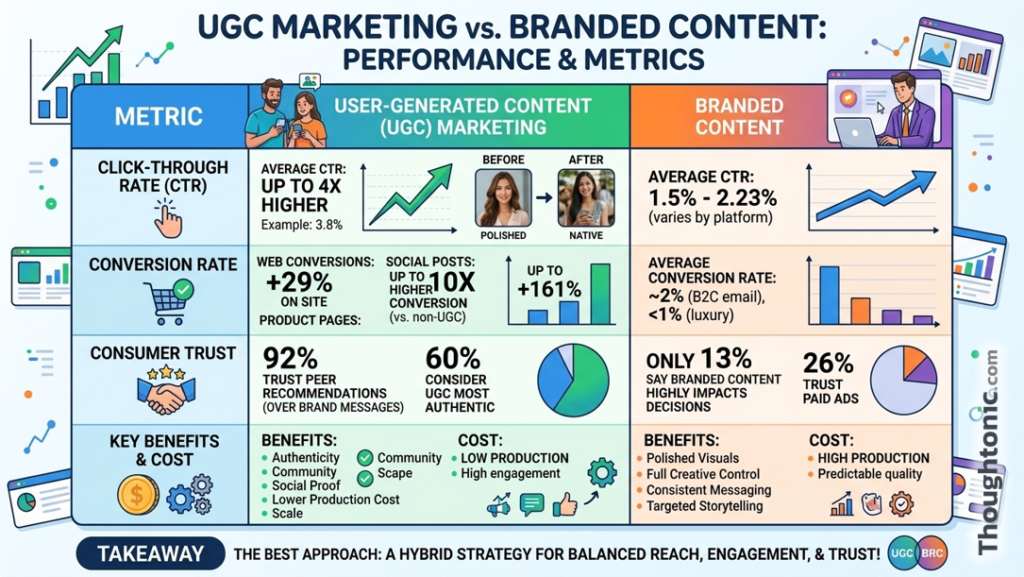
Source: Marketing LTB, Walmart/Mordor Intelligence, Nielsen, Nosto, 2024-2025
The UGC Engine: A Six-Step Framework for Bangladeshi Brands
Step 1: Engineer the Shareable Moment
Before you ask customers to post, give them something worth posting about. This might be distinctive packaging that invites an unboxing video. It might be a product result that’s visually obvious, like a skincare transformation or a food delivery that arrives beautifully presented. In Bangladesh’s social commerce context, even a thoughtful handwritten note inside a package gets shared. The mistake: expecting authentic content from a mediocre product experience.
Step 2: Build an Incentive Stack That Doesn’t Cheapen the Content
Cash incentives drive volume but attract manufactured posts. Recognition-based incentives, being featured on the brand page, getting named in a story, or receiving early access to new products, attract genuine fans. In my analysis, the most effective incentive stacks combine small material rewards with meaningful recognition. Seventy-seven percent of consumers say they’d submit UGC to receive a reward (Bazaarvoice). That’s your opt-in rate before you’ve even launched a campaign.
Step 3: Create a Frictionless Capture System
A branded hashtag is the minimum viable system. But add a direct submission channel, a Google Form, a Messenger bot, or a simple email address, so customers who want to contribute don’t have to navigate algorithm uncertainty. Make sure every submission path includes an explicit content rights consent. You need permission before you run customer content in paid ads.
Step 4: Curate Ruthlessly
Not all UGC is good UGC. Poor lighting, garbled audio, and unflattering product angles do your brand more harm than good when amplified. Set quality standards and stick to them. But here’s the trade-off: don’t filter so aggressively that you end up only featuring content that looks like branded content. The grain and the imperfection are part of what makes it credible.
Step 5: Amplify Strategically Across Channels
The highest-performing UGC goes into paid rotation, specifically in retargeting campaigns where potential customers are already considering a purchase. In Bangladesh’s Facebook-dominant landscape, this means creating specific ad sets that use customer-shot video and real reviews, not stock footage and brand voice. UGC ads yield 4x higher click-through rates at half the cost. That math should move any budget conversation.
Step 6: Close the Loop Publicly and Fast
When a customer posts about your brand, reply within 24 hours. Tag them. Thank them publicly. This does two things simultaneously: it rewards the contributor and it signals to every observer that contributing to this brand’s community creates social value. Facebook Live sellers in Bangladesh have known this instinctively for years. Formal brand pages have been slower to learn it.
Case Studies: What Sustained UGC Looks Like in Practice
Global: GoPro’s Million Dollar Challenge
GoPro didn’t invent user-generated content marketing. But they formalized it into a scalable engine more effectively than almost any other brand in history. When the HERO8 Black and MAX cameras launched in 2019, GoPro ran their Million Dollar Challenge: submit your best footage for a chance to win a share of USD 1 million. The result was staggering.
The campaign drew 42,000 submissions from 170 countries. The final highlight reel reached 857 million people, generated 70 million engagements, and achieved an 8.1% engagement rate, the highest the brand had ever recorded. It won a Shorty Award for Best User-Generated Content. And critically, it required no professional production budget for the campaign’s most successful content because customers created it.
But here’s the number that should matter most to finance-minded leaders: GoPro more than doubled its net income from 2010 to 2011 while spending only USD 50,000 more in marketing costs (Fast Company). The UGC model kept marketing cost growth almost flat while revenue scaled. That’s not a social media win. That’s a business model advantage.
“We were essentially finding people posting amazing content on social media platforms like YouTube, and it became very clear that we didn’t really have to do the marketing for ourselves. Our customers were doing the marketing for us.” — GoPro Senior Director, Global Media Relations
Limitation: GoPro makes a product inherently suited to visual content creation. Brands selling services, B2B products, or commodities need a more creative translation of this model, not a direct copy.
South Asian: Daraz Bangladesh’s Review-Driven Commerce
Daraz Bangladesh, the country’s largest e-commerce platform, offers a more nuanced and cautionary case study. The platform’s product review system is, functionally, its most important UGC engine. Research from BRAC Business School confirms that consumer trust and the volume of positive reviews are among the most statistically significant drivers of purchase behavior on the platform.
During Daraz’s 2024 Brand Meet event, the company highlighted its Choice supply chain solution, which is partly designed to improve the product experience that generates better reviews. Sellers with substantive, authentic positive reviews consistently outperform those without, in search ranking, conversion, and repeat purchase rate. This is peer-generated content functioning as both marketing asset and quality signal simultaneously.
But the cultural insight here goes deeper. In Bangladesh, where consumer protection mechanisms are still maturing, UGC reviews serve as a substitute for institutional trust. A hundred five-star reviews on a Daraz product listing accomplish what a warranty certificate and a return policy accomplish in more established markets. The brand that systematically earns positive UGC isn’t just winning marketing efficiency. It’s building an asset class that’s nearly impossible to buy outright.
The cautionary note: Daraz has faced persistent problems with fake reviews, which have created widespread skepticism about the review ecosystem’s integrity. This is the most direct lesson available to any Bangladeshi brand thinking about UGC: volume without quality controls is self-defeating. Manufactured authenticity accelerates distrust faster than no strategy at all.
What to Actually Do: Plans for Organizations and Professionals
For Marketing Leaders and Founders
Audit your touchpoint map this week (Low effort, high impact). Walk your own customer journey and identify every moment where a customer might feel something strong enough to share. Most brands find two or three moments they’ve never intentionally designed. Start there.
Assign UGC ownership before launching a campaign (Medium effort). This cannot be a side responsibility for an already stretched social media manager. Someone needs to own collection, curation, rights management, and distribution. Even a part-time ownership model beats ambiguous collective responsibility.
Run a 30-day UGC ad test (Low effort once the content exists). Take your three best pieces of existing customer content, run them against your best branded creative in a properly structured Facebook A/B test, and present the results to leadership. The data will do the rest of the advocacy work for you.
Build a creator acknowledgment ritual into your community management process (Low effort, high signal). Reply publicly to every customer post within 24 hours. Feature one customer a week on your page. This costs almost nothing and signals to your entire audience that contributing creates social value.
Set a realistic UGC volume target and work backward (Medium effort). If your goal is to have 50 rights-cleared, high-quality UGC assets per month, how many customers need to create content? What incentive is needed to achieve that volume? What quality standard separates usable from unusable? Start with the target, build the system around it.
For Individual Marketing Professionals
Learn to write UGC briefs (not influencer briefs). The brief for a UGC creator should describe the situation and the feeling you want to evoke, not the shot list and the caption format. Controlling too much kills the authenticity that makes UGC work.
Develop editorial judgment for real vs. manufactured UGC. This is a skill that takes time. Train your eye by studying the content that performs best from actual customers in your category, not just your brand. The patterns of authentic enthusiasm are identifiable.
Build a basic rights management process. A simple consent template and a clear submission flow are all you need to start. This is not legal complexity. It’s operational hygiene that most Bangladeshi brand teams are skipping.
Learn to present UGC ROI in financial terms. Reach and engagement don’t move budget conversations. Cost per acquisition, conversion lift, and return rate reduction do. If you can connect your UGC program to any of those numbers, you have a business case that survives a CFO review.
Where This Can Go Wrong
In my analysis, the most common failure mode for UGC programs in Bangladesh isn’t a lack of content. It’s a lack of systems. Brands launch campaigns, collect content, and then have no process for rights management, quality control, or sustained distribution. The content sits in a Google Drive folder, gets used once, and the program quietly dies.
The ethical risk is real and underappreciated. When brands offer incentives for reviews without requiring disclosure, they’re creating content that looks organic but isn’t. International platform policies already require disclosure for incentivized content. Bangladesh’s regulatory environment is catching up. The brands that build transparent UGC programs now will be ahead of compliance requirements, not scrambling to meet them retroactively.
And the most important contrarian point: a UGC engine amplifies what’s already happening at the product level. If your product is genuinely excellent, UGC will make that excellence visible at scale. If your product has unresolved problems, UGC will make those problems visible faster than any formal feedback mechanism. Before you build the engine, make sure what it’s amplifying is worth sharing.
Key Takeaways
- 92% of consumers globally trust peer recommendations over advertising; in Bangladesh’s high-context, word-of-mouth-driven market, this trust asymmetry is even more pronounced.
- Bangladesh has 60 million social media users as of early 2025, with Facebook reaching 77.1% of the internet user base, making peer content the dominant influence in the purchase funnel.
- UGC ads achieve 4x higher click-through rates and 50% lower cost per click compared to non-UGC ads, with brands seeing 29% more web conversions when UGC is in the content mix.
- Walmart reported 28% higher conversions and 15% fewer returns in 2024 by featuring customer videos on product pages, demonstrating UGC’s effect on the full purchase cycle, not just awareness.
- Only 16% of brands globally have a formal UGC strategy. In Bangladesh, the gap is almost certainly wider, representing a significant first-mover opportunity for brands willing to build deliberate systems.
- The six-step UGC engine framework: engineer the shareable moment, build an authentic incentive stack, create a frictionless capture system, curate ruthlessly, amplify strategically, and close the loop publicly.
- Daraz Bangladesh demonstrates that peer reviews function as institutional trust substitutes in markets with low consumer protection infrastructure, making UGC a strategic asset beyond its marketing function.
- Volume without quality controls is self-defeating. Manufactured authenticity erodes trust faster than no UGC strategy at all.
Read More Articles:
The Costly Visual Search Blind Spot That Is Making Bangladesh Brands InvisibleQuantum Marketing: How 2030’s Technologies Will Shatter Bangladesh’s Status QuoDigital Literacy & Brand Purpose: How Education Drives Loyalty in Emerging MarketsGenerative AI in Bangladeshi Advertising: Opportunities, Ethical Risks & Implementation Guide 2025The Brain’s Buy Button: How Neuromarketing Taps into Consumer Decision-Making (Global & Bangladesh Insights)
Bibliography
-
- Backlinko – UGC Statistics 2025 (January 30, 2025). https://backlinko.com/ugc-statistics
- DataReportal – Digital 2025: Bangladesh (March 2025). https://datareportal.com/reports/digital-2025-bangladesh
- The Daily Star – Social Media Use in Bangladesh Grows 22.3% in 2024 (2024). thedailystar.net (Social Media Bangladesh)
- Markedium – Social Media Usage in Bangladesh Sees Steady Growth in 2024 (January 2025). markedium.com
- Marketing LTB – 70+ Powerful UGC Statistics (2025) (October 2025). marketingltb.com/blog/statistics/ugc-statistics/
- Ecomezi – Best 10 Future of E-Commerce in Bangladesh: What to Expect by 2026 (October 2025). ecomezi.com/future-of-e-commerce-in-bangladesh/
- Campaign US / Modern Retail – GoPro’s Bet on UGC (July 2023). campaignlive.com (GoPro UGC Case Study)
- Modern Retail – GoPro’s Million Dollar Challenge UGC Strategy (June 2023). modernretail.co (GoPro UGC Year-Round)
- ResearchGate – The Impact of User-Generated Content on Consumer Trust and Brand Loyalty (January 2025). researchgate.net (UGC Trust Study)
- Journal of Business and Economic Development – Social Media Marketing and Purchase Decisions in Bangladesh (2025). Neger M. & Aorna H.J. sciencepublishinggroup.com (Bangladesh Restaurant Study)
- InBeat Agency – 50 UGC Statistics and Strategic Implications 2025 (2025). inbeat.agency/blog/ugc-statistics
- Taggbox – User-Generated Content Facts and Stats 2025 (December 2025). taggbox.com/blog/user-generated-content-facts-and-stats/
- Digital Implevista – Top Digital Marketing Trends in Bangladesh for 2025 (November 2024). digital.implevista.com
- IIDE.co – Marketing Strategy of Daraz 2025 (April 2025). iide.co/case-studies/marketing-strategy-of-daraz/
- BRAC Business School – Chaldal & Daraz Case Studies (2022-2024). dspace.bracu.ac.bd (Chaldal Case Study)
- Podium – How UGC Stats Are Shaping Marketing in 2025 (2025). podium.com/article/ugc-stats
- Mordor Intelligence – User Generated Content Platform Market 2025 (January 2026). mordorintelligence.com (UGC Platform Market)
- 1idea.com.bd – Social Media Strategy in Bangladesh 2025 (November 2025). 1idea.com.bd/social-media-strategy-bangladesh
- Ngital – Bangladesh Social Media Trends 2025 (2025). ngital.com/bangladesh-social-media-trends-2025/
- The Shelf – UGC Is Redefining Social Media Marketing in 2025 (April 2025). theshelf.com (UGC 2025)