The Costly Full-Time CMO Trap: Why the Fractional CMO Model Is Winning in 2026
Most companies don’t have a marketing problem. They have a leadership problem.
I’ve seen it play out in boardrooms across Dhaka, in strategy decks from Gulshan to Motijheel, and in conversations with mid-market founders in Chittagong who are spending real money on marketing with no clear return. The pattern is consistent: a company hires a “Head of Marketing” who is, functionally, a glorified campaign manager. Or they spend BDT 40 lakh a year on a full-time senior hire who spends most of their week in meetings and the rest approving ad creatives. Neither produces strategy.
The fractional CMO model changes this equation. It’s not a workaround for companies that can’t afford the real thing. It’s a structural rethink of how marketing leadership should work for businesses that haven’t yet crossed the threshold where a full-time, full-cost CMO makes financial or operational sense. And the data behind it is more compelling than most founders realize.
The Real Problem: You’re Hiring the Wrong Person for the Wrong Job
Here’s the uncomfortable truth: most growing companies in Bangladesh are systematically hiring for execution when they need strategy.
According to LightCastle Partners’ Bangladesh Startup Ecosystem Report 2024, fewer than 15% of Bangladeshi startups have a dedicated C-suite marketing role. That number isn’t surprising once you see the economics. A competitive full-time CMO package in Dhaka’s corporate market runs BDT 30–50 lakh per year in total compensation. For a Series A company managing runway carefully, that’s not a strategic hire, it’s a high-stakes gamble on a single individual.
The typical alternative is worse. Companies promote a capable mid-level marketer into a senior role, give them a strategic-sounding title, and expect leadership output. That person is often talented. They can run Facebook campaigns, brief agencies, manage content calendars, and hit monthly output targets. What they haven’t done is build a positioning framework from scratch, decide which markets to enter, or make a credible case to the CFO for which marketing investments will compound over three years. That’s not a capability gap, it’s an experience gap. And it doesn’t close with a title change.
Globally, the structural mismatch is visible in CMO tenure data. Spencer Stuart’s 2023 CMO Tenure Study found that average CMO tenure at Fortune 500 companies dropped to 40 months, down from 54 months in 2018. That instability reflects a systemic problem: companies aren’t clear on what they need from marketing leadership, so they hire for the wrong things and replace people when results don’t arrive on schedule.
The Gartner CMO Spend Survey 2024 adds a sharper edge to this: 67% of marketing teams report that execution demands leave them less than 20% of bandwidth for strategic work. You’re paying a senior salary for operational management while strategy goes unmade. That’s the gap the fractional CMO model was built to fill, not by providing cheaper labor, but by delivering concentrated senior thinking without the overhead of a permanent hire.
The Science Behind Why the Fractional CMO Model Works
The Doer-Thinker Split That Most Companies Get Wrong
Understanding why the fractional CMO model delivers value requires understanding how marketing leadership actually creates it, and it’s not through hours logged or meetings attended.
Marketing organizations fail in a predictable sequence. The company grows. Revenue is inconsistent. Leadership decides marketing needs to “do more.” They hire an executor: someone who runs campaigns, manages agencies, fills the content pipeline. What they actually needed was a thinker: someone who steps back and identifies why acquisition costs are rising, where positioning is blurring against competitors, and what the brand narrative needs to be for the next 18 months.
A fractional CMO is structurally built around the thinker function. A well-scoped engagement runs 8–15 hours per week, focused entirely on strategy, prioritization, and leadership decisions. The fractional CMO doesn’t write copy. They decide whether copy-led marketing is even the right channel approach. That distinction matters more than most founders appreciate, because the cost of a wrong strategic decision isn’t one bad campaign, it’s six months of budget allocated in the wrong direction.
What the Research Actually Shows
A 2024 Deloitte Global Marketing Trends report found that companies with clearly defined C-suite marketing leadership achieve 2.3x better revenue growth consistency than those without. Critically, the key variable is whether senior strategic thinking is consistently applied to marketing decisions, not whether that thinking comes from a full-time or fractional leader.
Harvard Business Review’s 2023 analysis of flexible executive models found that fractional and interim C-suite roles deliver outcomes comparable to permanent hires in engagements lasting 6–18 months, particularly for companies in the $2M–$50M revenue range. That range covers the majority of Bangladesh’s high-growth startups and mid-market firms.
This is where it gets interesting: the Grand View Research Fractional Executive Market Report 2024 projects the global fractional executive market will reach $9.8 billion by 2027. The fastest growth is in sectors where specialized expertise outweighs institutional presence, SaaS, e-commerce, consumer brands, professional services. Those four categories describe Bangladesh’s current growth economy precisely.
The Compounding Effect of Strategic Clarity
The ROI of a fractional CMO isn’t measured in what they produce in hour ten. It’s measured in what bad decisions they prevent. A fractional CMO with 15 years of cross-industry experience doesn’t need six months to diagnose weak positioning. They see it in week two. That early diagnosis can save a company from spending BDT 80 lakh on a brand campaign built on an unvalidated insight.
LinkedIn’s B2B Institute Marketing Measurement Report 2024 documented that brands with consistent strategic positioning outperform inconsistent brands on revenue growth by 41% over five years. Positioning is a strategic decision, not an executional one. It requires the pattern recognition that comes from having built brands across multiple categories, and that’s exactly what a qualified fractional CMO brings to the table.
What an effective fractional CMO engagement looks like:
| Element | Description | Most Common Failure Mode |
| Defined Scope | 8–15 hrs/week, specific strategic deliverables | Scope creeping into execution |
| Data Access | Full access to analytics, finance, and CRM | Operating without ground truth |
| Leadership Alignment | Regular CEO/founder strategic touchpoints | Strategy without decision authority |
| Outcome Metrics | 90-day milestones tied to business results | Measuring activity, not outcomes |
The structure isn’t complicated. What’s hard is holding it. Most companies hire a fractional CMO and slowly collapse them into operational management because daily execution feels more productive than weekly strategy. It isn’t. The moment a fractional CMO is spending their hours approving Instagram graphics, you’ve lost the model’s entire value proposition.
A Practical Framework for Getting the Fractional CMO Model Right
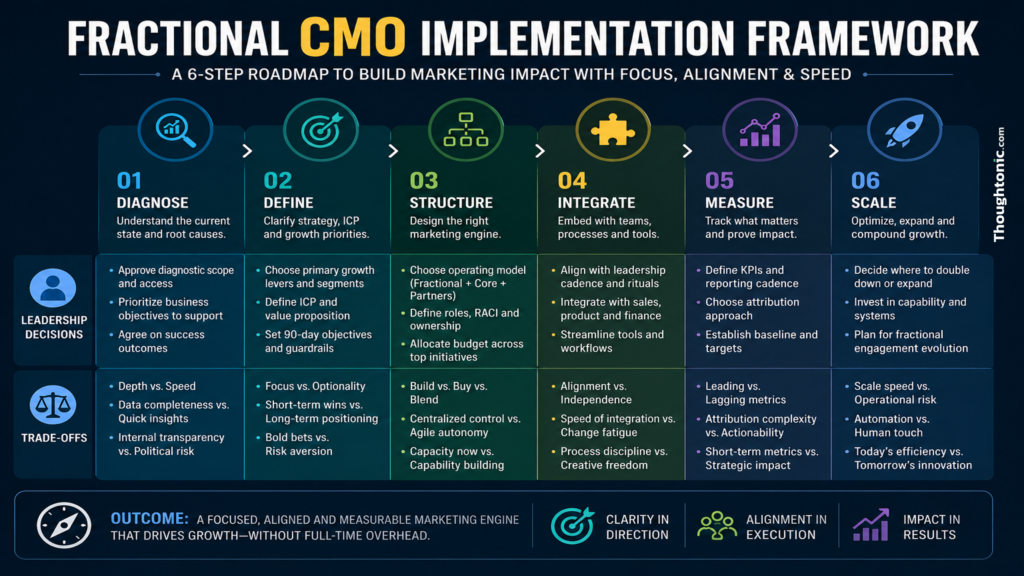
Step 1: Diagnose Before You Hire
Run a marketing maturity audit across five dimensions: brand clarity, channel strategy, measurement infrastructure, team capability, and budget allocation logic. Score each from 1–5. Most companies score a 2 on their first audit. That score defines what the fractional CMO needs to fix first.
Common mistake: skipping the audit because leadership assumes it already knows the problem. Leadership usually knows the symptom. The fractional CMO needs to know the cause.
Step 2: Define the Leadership Gap in Writing
Document exactly which decisions are not being made well in your marketing function. Is it positioning? Channel prioritization? Agency selection? Budget allocation? The fractional CMO engagement should be scoped around plugging that specific gap. If you can’t articulate the gap clearly, you’re not ready to hire.
Step 3: Structure the Engagement Correctly
Set scope, hours, deliverables, and decision authority in the agreement before day one. A fractional CMO with real budget authority makes better decisions than one in a pure advisory role. In Bangladesh’s corporate culture, this requires a deliberate shift, most founders are reluctant to extend strategic authority to someone they haven’t known for years. That reluctance costs the engagement its highest-value outputs.
Step 4: Integrate, Don’t Isolate
Give the fractional CMO access to everything: analytics dashboards, team leads, weekly leadership meetings, customer research. An isolated fractional CMO produces generic strategy. An integrated one produces company-specific insight. This is the most consistently skipped step in markets like Dhaka where information is treated as internal currency.
Step 5: Measure Outputs, Not Attendance
KPIs should connect to strategic deliverables: positioning framework completed, go-to-market plan approved, agency brief quality measurably improved, CAC trend reversed. Not hours logged or slides presented.
Step 6: Scale or Transition with Deliberate Intent
At the six-month mark, make a conscious decision. Has the fractional CMO built enough internal capability that you can reduce engagement intensity? Has revenue growth justified a full-time hire? Have you identified internal talent worth promoting? The fractional model is not permanent by design. That’s a feature, not a flaw, but only if you treat the transition as a planned outcome, not an afterthought.
Case Studies: Where This Model Has Worked
Global: Calendly’s Strategy-First Marketing Architecture (2019–2021)
Calendly is one of the cleaner case studies for what concentrated strategic thinking produces. Before its formal marketing organization scaled, Calendly focused its early marketing leadership attention on a single strategic call: make the product the distribution channel. That is a positioning decision, not an executional one.
From 2019 to 2021, Calendly grew from roughly 2 million to over 10 million users with a lean marketing structure. By 2021, the company reached a $3 billion valuation. Its marketing philosophy in that phase mirrors the fractional CMO logic precisely: strategic thinking concentrated on a few high-leverage decisions, rather than distributed execution across many low-leverage activities.
Limitation: Calendly had exceptional product virality. Not every business has a product that markets itself. The fractional model works best when strategic clarity can accelerate a distribution motion that already has momentum.
Bangladesh: Shajgoj’s Founder-Led Strategic Concentration (2018–2022)
Shajgoj, Bangladesh’s leading beauty and personal care platform, built its early market position through something that closely resembles fractional CMO logic: high-quality strategic thinking applied by category experts, rather than large team overhead.
During its growth phase from 2018 to 2022, Shajgoj grew to over 500,000 monthly active users and raised a Series A funding round while maintaining a lean structure. Its differentiation, community-first content, authentic product reviews, localized beauty education in Bangla, was a positioning call, not a campaign decision. That is exactly the kind of strategic clarity a fractional CMO engagement is designed to produce for companies that don’t have it built in.
In my analysis, what Shajgoj executed instinctively, concentrating senior strategic thinking at the leadership level while keeping execution lean, is what the fractional CMO model formalizes for companies whose founders don’t naturally operate that way.
Limitation: Shajgoj’s founder brought category passion and customer empathy that external advisors cannot replicate. A fractional CMO can provide strategic architecture but cannot provide founder conviction.
The common thread: The highest-leverage marketing decisions in a growing company require senior thinking, not senior headcount. Whether that thinking comes from a category-expert founder or a fractional CMO with 15 years of cross-industry pattern recognition, the output is the same, clarity that compounds over time.
Action Plans: What to Do in the Next 90 Days
For Organizations
Commission a Marketing Audit, Low Effort, High Resistance Before your next marketing hire, spend two weeks auditing your current marketing function. What decisions are being made well? Which aren’t being made at all? This becomes the brief for your fractional CMO engagement. Most leadership teams resist this because the findings are uncomfortable.
Timeline: 2 weeks. Cost: Internal time only.
Pilot a 90-Day Fractional CMO Engagement, Medium Effort Before committing to a full-time CMO salary, run a structured 90-day fractional engagement. Define 3–5 strategic deliverables. Measure outcomes. Use the period to determine whether a permanent hire is warranted or whether the fractional model can sustain longer.
Timeline: 90 days. Budget: BDT 3–8 lakh for a senior engagement in the Dhaka market, a fraction of a full-time annual package.
Separate Strategy from Execution in Your Hiring Architecture, Medium Effort Stop writing one job description that asks a single person to think strategically and execute tactically. Write two: one for a fractional CMO to own strategy, one for a strong executor to own delivery. Most companies resist this because it requires admitting the current team structure isn’t built for both.
Give the Fractional CMO Real Authority, High Effort, Non-Negotiable The fractional CMO model underperforms when the CMO sits in a pure advisory role. Give them authority over channel strategy and agency decisions at minimum. This is the hardest shift for Bangladeshi founders raised in hierarchical corporate cultures, but it’s also the difference between a fractional engagement that produces reports and one that produces results.
For Marketing Professionals Considering the Fractional Path
- Learn to scope and price engagements like a consultant. Most marketing professionals are salary-trained. Consulting requires pricing for outcomes, not hours.
- Build a portfolio of strategic outcomes. Not campaigns managed, positioning frameworks delivered, market entries advised, budgets reallocated with documented results.
- Develop the ability to generate strategic clarity in limited weekly hours. This demands extreme prioritization and the confidence to tell a client what not to do.
- Navigate without formal authority. A fractional CMO leads through insight and influence, not org chart position. That’s a skill that takes deliberate practice.
- Say no to execution requests. When a client asks you to write ad copy, the right answer is: “That’s not what you’re paying me for. Let me help you find the right person for that.”
The Limits of This Model: A Perspective Worth Having
The fractional CMO model is not a universal answer. In the Bangladesh context specifically, it carries risks that most advocates understate.
First, the model assumes a baseline of organizational readiness. A fractional CMO plugs into a marketing system. If there’s no system, no CRM, no brand documentation, no measurement infrastructure, the fractional engagement produces strategy that no one can execute. This describes a significant share of Bangladeshi SMEs and early-stage startups. The fractional CMO arrives with a strategic framework and finds no operational foundation to build on.
Second, in a market as small and interconnected as Dhaka’s startup scene, fractional CMOs often work with multiple clients in adjacent categories simultaneously. Conflict of interest policies are rarely formalized in these engagements. That is an ethical and operational risk the market has not yet addressed.
And here’s the contrarian view worth sitting with: a founder with strong product intuition and direct customer relationships may outperform a fractional CMO in year one. Strategic frameworks need ground truth. Sometimes the founder is the only one who has it. The fractional model works best when a company has genuinely outgrown founder instinct, not as a substitute for the strategic clarity the founding team should already be building.
Key Takeaways
- Most marketing failures in growing companies are leadership failures, not execution failures, the fractional CMO model addresses the root cause, not the symptom
- Fewer than 15% of Bangladeshi startups have a dedicated C-suite marketing role, creating a structural leadership gap across the ecosystem (LightCastle Partners, 2024)
- The global fractional executive market is on track to reach $9.8 billion by 2027, the adoption curve is already in motion (Grand View Research, 2024)
- A fractional CMO works 8–15 hours per week on strategy, not execution; the moment that boundary blurs, the model breaks
- Brands with consistent strategic positioning outperform inconsistent competitors by 41% on revenue growth over five years (LinkedIn B2B Institute, 2024)
- In Bangladesh, a structured 90-day fractional CMO engagement costs BDT 3–8 lakh, compared to BDT 30–50 lakh for a full-time annual package
- The fractional model requires organizational readiness: data systems, team infrastructure, and founder willingness to share strategic authority
- The six-month transition decision is not optional, the model is designed to evolve, not to be a permanent workaround
Read More Articles:
- The Costly AI Strategy Gap: Why Your Team Is Playing, Not Executing
- The Costly Truth About Minimalist Bangladesh Design Strategy
- The Costly Visual Search Blind Spot That Is Making Bangladesh Brands Invisible
- Quantum Marketing: How 2030’s Technologies Will Shatter Bangladesh’s Status Quo
- Digital Literacy & Brand Purpose: How Education Drives Loyalty in Emerging Markets
Bibliography
- LightCastle Partners – Bangladesh Startup Ecosystem Report — LightCastle Partners, 2024
- LinkedIn Salary Insights Bangladesh — LinkedIn, 2024
- Bangladesh Investment Development Authority (BIDA) – SME Growth Data — BIDA, 2024
- BASIS Annual Report 2023 — Bangladesh Association of Software and Information Services, 2023
- Bangladesh Brand Forum – Marketing Leadership Survey — Bangladesh Brand Forum, 2023
- Spencer Stuart CMO Tenure Study — Spencer Stuart, 2023
- Gartner CMO Spend and Strategy Survey — Gartner, 2024
- Grand View Research – Fractional Executive Market Report — Grand View Research, 2024
- Harvard Business Review – Flexible Executive Models — Harvard Business Review, 2023
- Deloitte – Global Marketing Trends 2024 — Deloitte, 2024
- LinkedIn B2B Institute – Marketing Measurement Report — LinkedIn, 2024
- Forrester – The State of the CMO 2024 — Forrester Research, 2024
- McKinsey & Company – The New CMO — McKinsey, 2024
- MarketingWeek – Global CMO Confidence Survey — Marketing Week, 2024
- Emerald Research – Flexible Leadership in Emerging Markets — Emerald Publishing, 2023