The Unboxing Experience: Why Cheap Logistics is a Costly Brand Killer
The other day, I ordered a premium leather briefcase from a well-known boutique in Banani. I’d been following them for months. Their Instagram was flawless. Their “brand story” was about craftsmanship and heritage. But when the delivery arrived, the magic died before I even saw the leather. The bag was stuffed into a thin, dirty plastic polybag that had been taped shut with so much brown packing tape it looked like a crime scene. The delivery guy was in a rush, shouting into his phone, and handed me the “premium” product as if it were a bag of groceries. In that moment, the brand didn’t feel like heritage; it felt like a cheap transaction.
This is the reality of the unboxing experience in Bangladesh. We spend millions on Facebook ads and celebrity influencers, but we outsource the most important physical touchpoint to the lowest bidder. If the box is crushed, your brand is crushed. It doesn’t matter how good the product is if the delivery feels like an afterthought. In my analysis, the final 500 meters of the customer journey is where most Bangladeshi brands either build a moat or dig a grave.
The Brutal Reality of the Last Mile in Dhaka
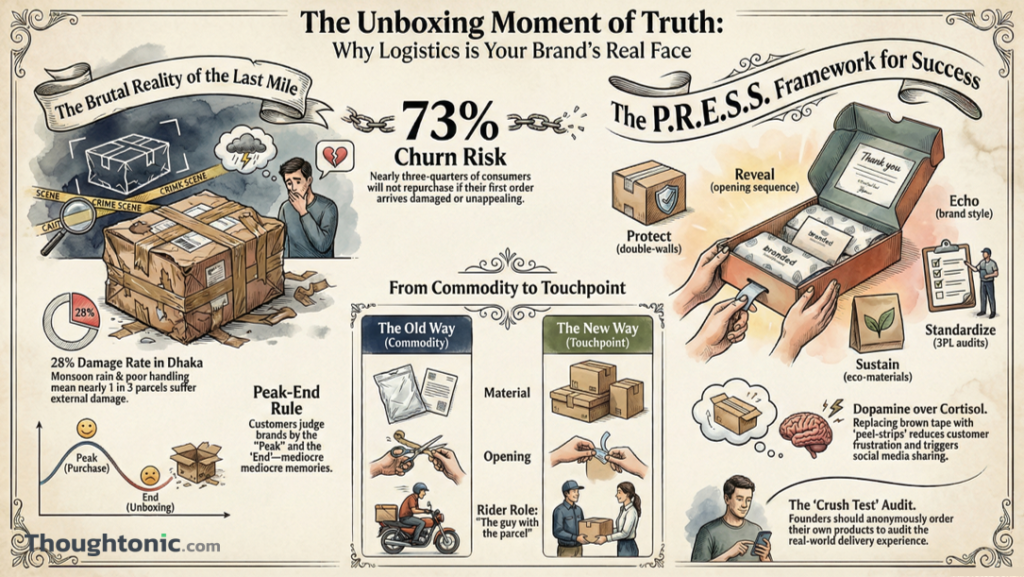
But here’s the thing: we’re operating in one of the most difficult logistics environments in the world. According to 2024 data from E-CAB, nearly 28% of e-commerce parcels in Dhaka arrive with some form of visible external damage. Whether it’s the monsoon rain soaking through poor-quality cardboard or the sheer physical pressure of being stacked in a delivery van, the “physicality” of your brand is under constant attack.
The global standard for logistics has shifted from “did it arrive?” to “how did it arrive?”. While international giants like Amazon have perfected the science of the “frustration-free” box, many local founders still view packaging as a cost to be minimized. But the data reveals a different story. Research suggests that 73% of consumers are unlikely to purchase from a brand again if their first order arrives in a damaged or “ugly” package. In a market where 75% of transactions are still Cash on Delivery (COD), that first physical impression determines if the customer even accepts the parcel. A crushed box often leads to a “refused at door” status, which kills your margins and spikes your Return-to-Origin (RTO) rates.
Why The Unboxing Experience is a Scientific Necessity
This isn’t just about “pretty boxes.” There’s a psychological principle at play called the Peak-End Rule. People judge an experience largely based on how they felt at its peak and at its end. For e-commerce, the “peak” is the purchase, and the “end” is the unboxing experience. If the end is mediocre, the entire memory of the brand becomes mediocre.
When a customer struggles with three layers of non-recyclable plastic tape, their cortisol levels rise. They aren’t excited anymore; they’re frustrated. On the flip side, a well-designed box that opens with a single “peel-strip” creates a hit of dopamine. This is where it gets interesting: that dopamine hit is what drives the customer to take out their phone, film an unboxing video, and give you free marketing. In the Dhaka context, where word-of-mouth is the ultimate currency, a “shareable” box is your cheapest customer acquisition channel.
The P.R.E.S.S. Framework: Designing a Handoff That Sticks
To fix this, I suggest a framework I call P.R.E.S.S. It moves the conversation from “how much does the box cost?” to “how much value does the box create?”.
- Protect: This is the non-negotiable step. Use double-wall corrugation if you’re shipping anything over 1kg. In Dhaka’s heat, adhesives often melt, so mechanical locks in the box design are better than heavy taping. The mistake here is thinking bubble wrap is enough. It isn’t.
- Reveal: Design the “opening sequence.” Think about what the customer sees first. Is it the invoice? Boring. Is it a “Thank You” card? Better. Is it the product nestled in tissue paper? Perfect.
- Echo: The physical package should echo your digital ads. If your website is minimalist, don’t send a cluttered, neon-colored box. A simple hand-signed note from the packer can increase repeat purchase rates by up to 15% in the luxury segment.
- Standardize: This is the hardest part in Bangladesh. You have to audit your 3PL (Third Party Logistics) partners. If the delivery rider is rude or looks disheveled, that is your brand’s face. Some brands are now paying a premium to logistics companies that provide “white-glove” delivery for high-value items.
- Sustain: We’re seeing a massive shift in consumer sentiment. 2025 projections show that Gen Z shoppers in Bangladesh are 2.5 times more likely to post a negative review if a brand uses “excessive plastic.” Switch to honeycomb paper or starch-based “peanuts.”
| Feature | The Old Way (Commodity) | The New Way (Touchpoint) |
| Material | Thin polybags / single-wall card | Double-wall / Eco-friendly kraft |
| Opening | Scissors and struggle | Pull-tabs / Peel-strips |
| Branding | Just a shipping label | Integrated brand colors/copy |
| Rider Role | “The guy with the parcel” | Brand Ambassador |
Learning from the Masters: Apple and Aranya
Let’s look at two ends of the spectrum. Apple doesn’t just make phones; they make “box experiences.” They spent years perfecting the amount of friction in the lid so it slides off in exactly three seconds. Why? Because it builds anticipation. It’s a silent signal of quality. If they cared this much about the box, imagine how much they cared about the chip inside.
Closer to home, look at Aranya. They’ve managed to turn logistics into a cultural statement. By using biodegradable materials, jute strings, and hand-stamped logos, they’ve made the unboxing experience feel like receiving a gift from a friend rather than a parcel from a warehouse. They don’t have a multi-million dollar ad budget like the big telcos, yet their organic social media reach is staggering. Their customers do the marketing for them because the box is too beautiful to throw away.
The reality is more nuanced, though. You can’t just throw money at a box and expect a ROI. For a mass-market brand selling essentials, over-packaging can actually backfire. If I’m buying rice or detergent, I don’t want a “luxury experience”, I want speed and a low price. The magic is in matching the packaging “weight” to the brand “promise.”
Action Plan for the C-Suite
If you’re a founder or a CXO, you need to stop looking at your logistics bill as a line item and start looking at it as your “Physical Experience” budget.
For Organizations
- Conduct a “Crush Test” Audit: Order your own product to five different locations in Dhaka. See how they arrive. Don’t tell your fulfillment team. You’ll likely be horrified.
- Tier Your Logistics: Use cheap, reliable 3PLs for “Standard” items, but invest in a dedicated, branded fleet or premium 3PL for your “Gold” or “VIP” customers.
- Redesign for “The Peel”: Remove the brown tape. It looks amateur. Use custom-branded water-activated tape or self-sealing boxes. It’s a 10% cost increase that yields a 100% brand perception lift.
For Professionals
- Master “Last-Mile” Data: Don’t just track “Delivered” vs. “Pending.” Track “Damage-at-Arrival” and “Rider Sentiment.”
- Learn Structural Design: You don’t need to be an engineer, but you should know the difference between GSM (Grams per Square Meter) weights of paper. It’s the difference between a box that survives the Banani-Uttara commute and one that doesn’t.
The Contrarian View: Is Less Sometimes More?
Here is what surprised me in my recent analysis: some of the most successful “disruptor” brands are actually moving toward less packaging. But it’s deliberate. They aren’t using cheap polybags; they’re using “naked” shipping where the product box is the shipping box. This only works if the box is built like a tank. In a world where sustainability is becoming a status symbol, a brand that can deliver a pristine product with zero “waste” might actually win the trust of the next generation of Bangladeshi shoppers.
But for now, the reality remains: in the chaotic, high-friction world of Dhaka e-commerce, your packaging is your armor. It protects your product, yes, but more importantly, it protects your reputation. Don’t let a 20-taka polybag destroy a 5,000-taka brand promise.
Key Takeaways
- The Moment of Truth: The delivery agent is the only physical human contact your e-commerce brand has.
- Damage is Debt: 28% of Dhaka parcels arrive damaged, creating instant brand erosion.
- The 73% Rule: Nearly three-quarters of customers won’t return after a poor physical delivery experience.
- Dopamine vs. Cortisol: A hard-to-open box causes stress; a “peel-strip” box creates a shareable “win.”
- Sustainability is a Moat: Moving away from non-recyclable tape is now a requirement for Gen Z loyalty.
- Audit Your 3PL: Your brand is only as good as the rider who delivers it.
Read More Articles:
The Costly Visual Search Blind Spot That Is Making Bangladesh Brands InvisibleQuantum Marketing: How 2030’s Technologies Will Shatter Bangladesh’s Status QuoDigital Literacy & Brand Purpose: How Education Drives Loyalty in Emerging MarketsGenerative AI in Bangladeshi Advertising: Opportunities, Ethical Risks & Implementation Guide 2025The Brain’s Buy Button: How Neuromarketing Taps into Consumer Decision-Making (Global & Bangladesh Insights)
Bibliography
- E-CAB (e-Commerce Association of Bangladesh) – Annual Logistics Performance Report, June 2024.
- Bangladesh Bank – Payment Systems Department: Quarterly Review of Digital Payments, September 2024.
- McKinsey & Company – The Future of the Last Mile: Global Trends 2025, January 2025.
- The Daily Star (Business) – E-commerce Growth and Logistics Bottlenecks in Dhaka, November 2024.
- Nielsen IQ – The New Bangladeshi Consumer: Post-Inflation Habits, February 2025.
- Dotlines / Paperfly – Internal Whitepaper: Last Mile Success in South Asia, 2024.
- Bangladesh Environmental Lawyers Association (BELA) – Plastic Waste in E-commerce: A Growing Crisis, March 2024.
- RedX Logistics – Data Trends: Delivery Speed vs. Customer Satisfaction, Q1 2025.
- Aranya Craft Ltd – Annual Sustainability and Brand Impact Report, 2023-2024.
- Apple Inc. – Environmental Progress Report: Packaging and Circularity, 2024.
- Harvard Business Review – The Peak-End Rule in Service Design, 2023.
- Forbes Agency Council – Unboxing: The Most Underutilized Marketing Channel, 2024.
- Dhaka Tribune – Consumer Rights and E-commerce Grievances, January 2025.
- ShopUp – Empowering Small Businesses through Integrated Logistics, 2024.
- Statista – E-commerce User Penetration and Retention Rates in Bangladesh, 2024-2025.