Why a Mindful Marketing Strategy is the Brutal Fix Your Brand Needs
It’s 11:15 PM on a Tuesday. You’ve just put your phone down to sleep, and it buzzes. Is it an emergency? A family member? No, it’s a generic SMS from a telecom operator telling you about a 2GB data pack you don’t need.
We have all been there. And if you’re a marketer in Bangladesh, you’ve probably been the one sending that SMS.
Here’s the reality we need to face: With over 140 million internet subscribers in Bangladesh, we aren’t suffering from a lack of connection. We are suffering from an overdose of it. The era of “always-on” marketing is hitting a wall of consumer burnout.6 To survive 2026, smart brands must pivot to a mindful marketing strategy.
The Core Problem: The Noise is Deafening
In Bangladesh, we skipped the gradual evolution of digital adoption. We went from dial-up scarcity to 4G ubiquity almost overnight. The result? A chaotic marketplace where “strategy” often just means “frequency.”
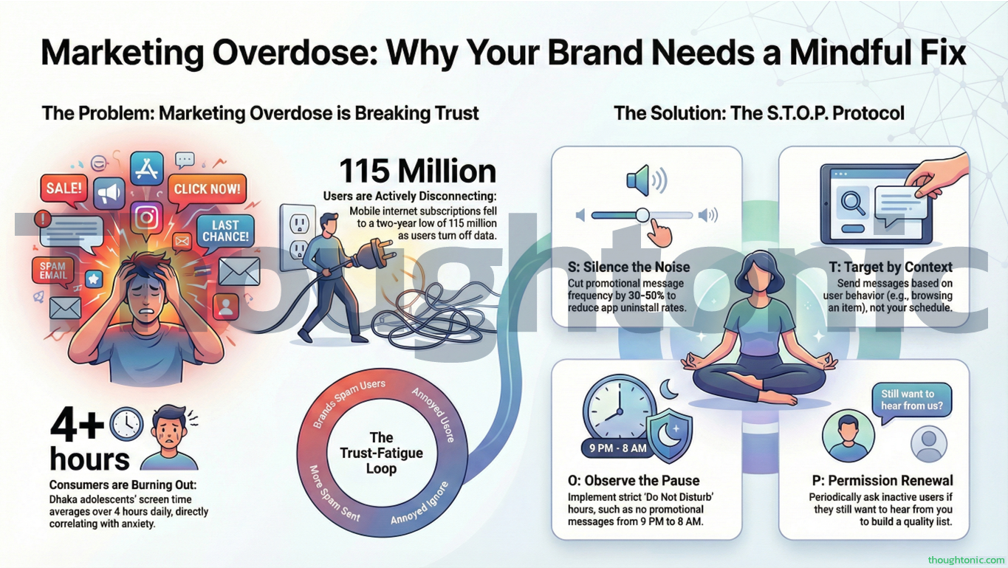
The data paints a worrying picture. A 2025 study on Dhaka adolescents showed that unsupervised screen time now averages over 4 hours daily, correlating directly with heightened anxiety. Our consumers are physically online, but mentally, they are checking out.
Consider this: Despite our massive internet penetration, mobile internet subscriptions in Bangladesh actually dropped to a two-year low of 115 million in late 2025. People are keeping their SIMs active for calls but turning off their data to escape the noise. When 67% of consumers globally report “marketing fatigue” and actively block brands that annoy them, we have to ask: Is your notification strategy building loyalty, or is it just teaching your customers to hate you?
The Science of Silence: Why Less is More
Cognitive Load Theory explains why the “spray and pray” method is failing. The human brain has a limited bucket for processing information. When a brand floods a consumer with irrelevant notifications—like a frantic e-commerce app pinging you five times a day during a meeting—it triggers a “threat” response.
The brain stops seeing the “Offer.” It starts seeing “Clutter.”
This leads to what I call the Trust-Fatigue Loop:
- Brand spams user.
- User gets annoyed (Cortisol spike).
- User ignores the next message, even if it’s valuable.
- Brand sees low engagement, so they send more messages to compensate.
- User blocks the brand or uninstalls the app.
In a market where 75% of e-commerce transactions are still Cash on Delivery (COD), trust is already fragile. We don’t trust the product will arrive, and now, we don’t trust the brand to respect our time.
A Practical Framework: The S.T.O.P. Protocol
So, how do we fix this without tanking sales? You need a framework that prioritizes “Share of Care” over “Share of Voice.”
- Silence the Noise (The Audit)
- The Action: Cut your outbound push/SMS frequency by 30-50% for one month.
- The Trade-off: You will see a dip in low-quality session traffic.
- Success Metric: Watch your “Unsubscribe” or “App Uninstall” rates drop.
- Mistake to Avoid: Don’t go silent on transactional messages (shipping updates). Those are anxiety-reducers, not noise.
- Target by Context (The Relevance)
- The Action: Stop sending blasts based on your schedule. Send them based on their behavior. Did they just browse “Running Shoes”? That warrants a nudge. A random Tuesday blast does not.
- The Example: Instead of sending a generic “Lunch Time!” SMS to everyone, a food delivery app should target users who ordered at 1 PM last week.
- Observe the Pause (The Rest)
- The Action: Implement strict “Do Not Disturb” hours. No promotional SMS between 9 PM and 8 AM. Period.
- The Trade-off: You lose the late-night doom-scrollers.
- Success Metric: Positive brand sentiment on social media.
- Permission Renewal (The Consent)
- The Action: This is scary, but powerful. Once a quarter, ask your inactive users: “Do you still want to hear from us?“
- The Outcome: You will lose 20% of your list. But the 80% who stay are the ones who actually buy. You stop paying to annoy people who will never convert.
Case Studies: The Power of Restraint
Global Benchmark: Lush Cosmetics
Lush did the unthinkable: they deleted their Facebook and Instagram accounts. They decided the algorithms were too toxic for their customers’ mental health.
- The Outcome: It didn’t kill them. It solidified their cult following. Their customers now seek them out on owned channels (website, newsletter), creating a deeper, higher-value relationship. They traded “Reach” for “Resonance.”
Local Insight: The “Aranya” Approach vs. Mass E-commerce
Look at a brand like Aranya in Dhaka. They don’t bombard you with “FLASH SALE” neon graphics every hour. Their social presence is calm, educational, and focused on the artisan’s story.
- The Result: When they do post, people pay attention.
Contrast this with the typical mass-market e-commerce strategy in Bangladesh (you know who I mean). They generate millions of sessions through sheer notification volume, but they also generate massive churn and have to burn cash to re-acquire the same users constantly. One builds a brand; the other builds a treadmill.
Action Plans
For Organizations (The CXO Level)
- Budget Shift: Move 20% of your “Retargeting” budget into “Content Quality.” Better creative fatigues slower than bad creative.
- Tech Stack: Invest in a CDP (Customer Data Platform) that can actually cap frequency across channels. If you SMS, Email, and Push a user on the same day, your tech stack has failed.
For Professionals (The Marketer Level)
- The Uncomfortable Skill: Learn to say “No” to the sales team when they demand a blast. Show them the data on uninstall rates.
- The New Metric: Stop celebrating “Impressions.” Start measuring “Retention Rate” and “Time on Site.”
- The Human Test: Before you hit send, ask: “Would I be annoyed if I received this while having dinner with my family?” If the answer is yes, kill the campaign.
Critical Perspective: When Silence Fails
I’m not naive. I know that for some categories—like ride-sharing during a storm or commodity trading—speed and noise are the product. If Pathao doesn’t notify me that a bike is available, I’m stranded.
Furthermore, in a price-sensitive market like Bangladesh, “Mindful Marketing” can sometimes be mistaken for “Expensive Marketing.” If you go too quiet, the consumer might assume you’ve gone out of business. The key is not total silence, but meaningful sound.
Key Takeaways
- Screen Time is a Health Risk: Dhaka teens are on screens 4+ hours/day; adding to this load hurts your brand.
- The “Disconnect” is Real: Mobile internet subs dropped to 115M in late 2025—users are tuning out.
- Frequency $\neq$ Loyalty: High frequency often correlates with high churn in the long run.
- COD is a Trust Proxy: 75% COD rates prove we have a trust issue, not a traffic issue.
- Adopt S.T.O.P.: Silence, Target, Observe, Permission.
- Quality over Quantity: One relevant message is worth 100 generic blasts.
Read More Articles: Quantum Marketing: How 2030’s Technologies Will Shatter Bangladesh’s Status QuoDigital Literacy & Brand Purpose: How Education Drives Loyalty in Emerging MarketsGenerative AI in Bangladeshi Advertising: Opportunities, Ethical Risks & Implementation Guide 2025The Brain’s Buy Button: How Neuromarketing Taps into Consumer Decision-Making (Global & Bangladesh Insights)Beyond the Bot: The Empathy Mandate for AI-Driven Customer Service in Bangladesh: A Data-Driven Roadmap
Bibliography
- BTRC. (2025). Mobile Phone & Internet Subscriber Statistics (Monthly Reports). Bangladesh Telecommunication Regulatory Commission.
- Financial Express. (2025). Mobile internet subscriptions fall to two-year low. The Financial Express BD.
- Okoone / Optimove. (2024). 67% of Consumers will have ‘Marketing Fatigue’. Optimove Insights.
- PCMI. (2025). Bangladesh E-commerce Market: Growth, Trends & Payment Methods. Payments & Commerce Market Intelligence.
- NIH / IJCMPH. (2024). Screen Time and Its Health Consequences in Adolescents. National Institutes of Health (PMC).
- BBF Digital. (2024). Digital Trends & Ad Fatigue in Bangladesh. Bangladesh Brand Forum.
- Backlinko. (2025). Average Screen Time Statistics Worldwide. Backlinko Data.
- WifiTalents. (2025). Ad Fatigue Statistics & Reports. WifiTalents Research.
- Lush UK. (2021). The Anti-Social Media Policy Statement. Lush Press Room.
- FICCI. (2024). Bangladesh’s Digital Future and Connectivity Dividend. Federation of Indian Chambers of Commerce & Industry.
- Red Sparrow Digital. (2025). Digital Marketing Trends in Bangladesh. Red Sparrow Digital Blog.
- Inderscience. (2024). Consumers’ trust in digital marketing: evidence from Bangladesh. International Journal of Internet Marketing and Advertising.
- Marketing Tech News. (2024). Consumer Shopping Intentions and Marketing Fatigue. Marketing Tech News.
- Research and Markets. (2025). Digital Mental Health Market Report. Research and Markets Global Data.
- Implevista. (2024). Top Digital Marketing Trends in Bangladesh. Implevista Insights.