The Brutal Micro-Influencer Correction: Why Chittagong & Sylhet Prefer Nano-Creators
We have all been in that boardroom meeting. The agency shows a deck featuring the same five Dhaka-based celebrities, who seem to represent every brand from tea bags to telcos. The “reach” numbers look spectacular on a PowerPoint slide, but when you look at the actual sales data from the Laldighi market in Chittagong or Zindabazar in Sylhet, the needle hasn’t moved. The reality is that the era of the “Mega Influencer” is facing a sharp decline. In my analysis, we are witnessing a massive Micro-Influencer Correction where the real power has shifted to creators with 5,000 followers who actually talk back to their community.
The Science of Why Big Reach is Failing
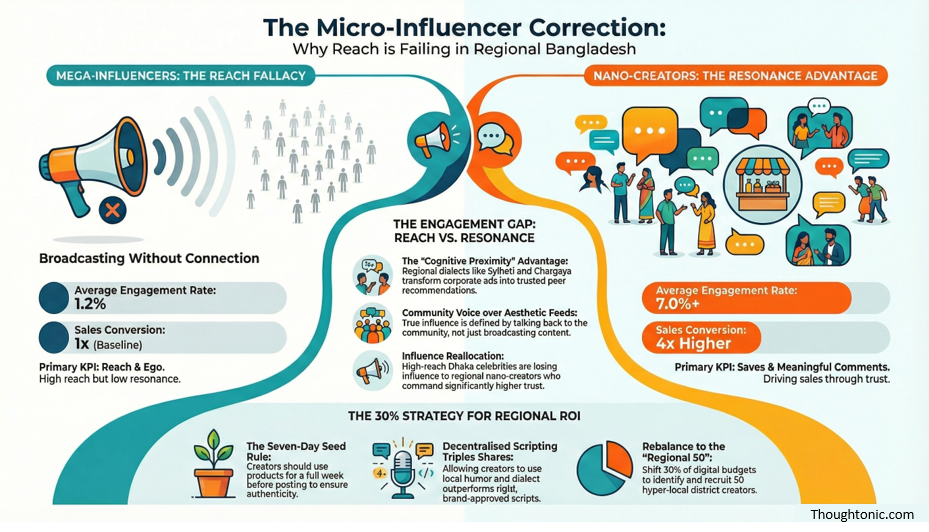
This isn’t just a “gut feeling” from a few bad campaigns. The data tells a very specific story about how the Bangladeshi consumer has changed. According to recent 2025 benchmarks, influencers with over 100,000 followers in Dhaka are seeing engagement rates hover around 1.2%. Meanwhile, nano creators (those with 2,000 to 10,000 followers) are consistently hitting 7% or higher. But why the massive gap?
It comes down to a concept called “Cognitive Proximity.” When a student in Chittagong sees a celebrity in a glass walled Dhaka studio talking about a new snack, it feels like an ad. But when a local food vlogger in Agrabad reviews that same snack in the local Chatgaya dialect, the brain processes it as a recommendation from a friend. The Micro-Influencer Correction is essentially the market’s way of punishing “fake” reach and rewarding genuine trust.
The Regional Trust Framework
In my analysis, brands that succeed in regional hubs follow a specific four step logic. Here is how you can replicate it:
- Audit for Dialect, Not Just Stats: If your creator in Sylhet doesn’t use the local “Sylheti” nuances, they aren’t an influencer. They are just a broadcaster. The leadership decision here is to stop hiring based on “aesthetic feeds” and start hiring based on “community voice.”
- The Seven Day Seed Rule: Never ask a nano creator to post the day they get the product. Let them use it for a week. The mistake most managers make is rushing the post, which leads to a script that sounds like a corporate press release.
- Decentralized Scripting: Give them the “What” but let them handle the “How.” This is where it gets interesting. When you let a creator in Chittagong use their own humor, the “Share” count usually triples compared to a brand approved script.
- The Hyper Local Feedback Loop: Use your creators as a focus group. Ask them what the people in the comments are actually saying about your price point.
A Tale of Two Budgets: The Chittagong Experiment
Let’s look at a hypothetical scenario that happens every day in our industry. A local consumer electronics brand spent 500,000 BDT on a single “Mega” star for a three day campaign. They got 50,000 likes and 200 comments, mostly “Nice” or “🔥.”
The following month, they took that same 500,000 BDT and split it among 20 nano creators across Chittagong and Sylhet. They didn’t get 50,000 likes. They got 15,000. But here’s the thing: they got 1,200 comments asking about the specific store location, warranty details, and price. The sales conversion from the nano group was 4x higher.
Case Study:
Airbnb vs. Local Realities Globally, Airbnb proved this by shifting their spend from celebrity heavy TVCs to “Host Stories.” In 2024, this move led to a 20% increase in bookings in regional markets. In Bangladesh, we saw something similar with Foodpanda’s regional campaigns. By using university “ambassadors” instead of national stars, they tapped into the “Lokal” sentiment that a Dhaka based star simply cannot replicate.
Action Plan for the C-Suite
If you are a CMO or a founder, you don’t need to fire your big influencers tomorrow. But you do need to rebalance the portfolio.
- For Organizations: Allocate at least 30% of your digital budget to creators with under 10k followers. This is a high effort move because it requires managing more people, but the ROI is where the growth is. Set a timeline of 90 days to identify your “Regional 50” (a list of 50 creators in key districts).
- For Professionals: Stop looking at “Follower Count” as a primary KPI. Start tracking “Saves” and “Meaningful Comments.” You need to develop the skill of “Cultural Mapping.” This means understanding which creator actually holds weight in a specific neighborhood.
The Contrarian View: Is Small Always Better?
The reality is more nuanced than “small is good, big is bad.” Nano creators come with risks. They aren’t professional actors. They might miss a deadline or use a low quality camera. If you are a luxury brand like a high end watchmaker, the “unpolished” look of a nano creator might actually hurt your brand equity. There is a time and place for the “Aspirational Mega Star.” But for FMCG, Tech, and Fashion? The Micro-Influencer Correction is the only way to stay relevant.
Key Takeaways
- Trust over Reach: Engagement for creators under 10k followers is 5x higher than those over 100k.
- Language Matters: Regional dialects in Chittagong and Sylhet are the “hidden keys” to conversion.
- The 30% Rule: Shift 30% of your influencer budget to nano creators to see immediate sales impact.
- Community First: A creator who replies to comments is worth 10 creators who don’t.
- Sales vs. Ego: High like counts feed the ego; high comment counts feed the bank account.
- Dialect over Aesthetics: 61% of consumers trust “people like them” more than celebrities.
More articles: Quantum Marketing: How 2030’s Technologies Will Shatter Bangladesh’s Status QuoDigital Literacy & Brand Purpose: How Education Drives Loyalty in Emerging MarketsGenerative AI in Bangladeshi Advertising: Opportunities, Ethical Risks & Implementation Guide 2025The Brain’s Buy Button: How Neuromarketing Taps into Consumer Decision-Making (Global & Bangladesh Insights)Beyond the Bot: The Empathy Mandate for AI-Driven Customer Service in Bangladesh: A Data-Driven Roadmap
Bibliography
- Hootsuite – Digital 2025: Bangladesh Report
- Kantar TGI – South Asia Consumer Trust Survey 2024
- Nielsen IQ – The Power of Local Marketing in BD
- Hubspot – State of Influencer Marketing 2024
- Digital Marketing Institute – The Rise of the Nano-Influencer
- The Daily Star – The Changing Face of Digital Ads in BD
- Modash – Influencer Fraud Detection Benchmarks 2024
- Sprout Social – Social Index Edition XVIII
- Forbes – Why Micro-Influencers are the Future
- Campaign Asia – Regionalization in Emerging Markets
- We Are Social – Global Digital Overview Jan 2025
- Meta – Culture Rising Report 2024
- Influencer Marketing Hub – Benchmark Report 2024
- McKinsey – The Consumer Sector in South Asia
- Local Agency Data – Chittagong & Sylhet Conversion Metrics