Hyper-Local SEO: Why Ranking for ‘Coffee in Uttara’ Is a Proven Revenue Strategy
The Vanity Metric Nobody Talks About
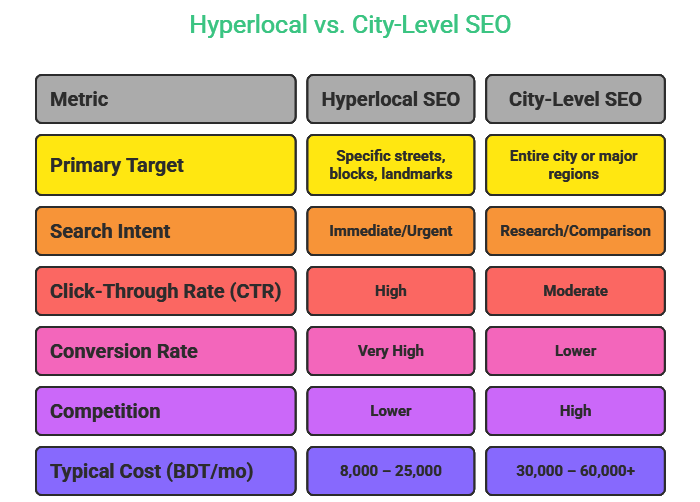
Here is a question I ask every founder who walks into a strategy session: what does your Google Search Console show for your top organic keyword? Nine times out of ten, someone in Gulshan has spent six months chasing “coffee in Dhaka” and is thrilled they appear on page two. Meanwhile, a sharper competitor three blocks away ranks number one for “coffee in Uttara” and is fully booked every weekend. That is hyper-local SEO in action, and it is the single most underused growth lever in the Bangladeshi digital market. According to Google, 46% of all searches globally have local intent, and in a mobile-first market like Bangladesh, where smartphone penetration crossed 80% in 2024, that number is likely higher. The uncomfortable truth is this: ranking for an entire city is a vanity project. Ranking for your neighborhood is a revenue strategy.
Why Dhaka Is the Wrong Unit of Analysis for Local Search
Dhaka is not one market. It is at least a dozen micro-markets layered on top of each other – Uttara, Mirpur, Gulshan, Dhanmondi, Mohammadpur, Banani, and so on. Each has different commute patterns, income levels, lunch habits, and search behavior. A working professional in Uttara searching for coffee at 8:15 AM on their way to Nikunja is not the same person as a student in Dhanmondi looking for a quiet cafe to study in on a Thursday afternoon. These are different intents, different moments, different keywords.
And yet, most Dhaka-based businesses write their Google Business Profile description for “Dhaka.” They stuff their homepage meta description with “best coffee in Dhaka.” They build backlinks from Dhaka-focused directories. They compete for the same five keywords against 400 other businesses, most of whom have bigger budgets, older domains, and more reviews.
The data is not on their side. A 2024 BrightLocal study found that businesses that optimized for neighborhood-level keywords saw a 37% higher click-through rate from Google Maps results compared to those targeting city-level terms. Meanwhile, a 2024 SEMrush report noted that long-tail local keywords (four words or more) convert at 2.5x the rate of shorter, broader terms. “Coffee shop near Uttara Sector 11” converts better than “coffee Dhaka” not just because it is specific, but because the person searching it is already halfway out the door.
In Bangladesh specifically, the problem compounds because of how inconsistently local businesses manage their digital presence. According to a 2024 survey by LightCastle Partners, only 31% of Dhaka-based SMEs had claimed and verified their Google Business Profile. That means the competitive set you are actually fighting in a neighborhood search is far smaller than you think.
The Science of Hyper-Local Search: How Google Decides Who Wins in Your Neighborhood
Google’s local ranking algorithm has three publicly stated pillars: relevance, distance, and prominence. Most marketers focus on prominence (reviews, backlinks, authority) because it is the most visible. But distance and relevance are where hyper-local SEO actually wins, and they are far more controllable.
Relevance: Signal Your Exact Service in an Exact Location
Relevance is how well your Google Business Profile and website match what someone is searching for. If your profile says “cafe in Dhaka” and someone searches “iced latte Uttara,” you are already losing to a competitor whose profile explicitly mentions Uttara, whose website has a page titled “Our Uttara Cafe,” and whose posts reference Sector 11. Relevance is built through specificity, not breadth.
Research from Moz’s 2024 Local Search Ranking Factors study found that on-page signals, including geographic keyword placement in title tags, headers, and meta descriptions, account for roughly 13% of local pack rankings. For a city the size of Dhaka, that means the difference between ranking for Uttara versus Dhaka-wide terms comes down to deliberate, granular content choices.
Distance: The 5-Kilometer Rule
Google prioritizes businesses physically closest to the searcher. This is not negotiable. If you are in Uttara Sector 7, you will almost always outrank a Banani competitor for someone searching from Uttara, provided your other signals are in order. This is actually great news for neighborhood businesses: distance is the one factor big brands cannot easily buy. A national chain in Gulshan cannot out-rank your Uttara cafe for someone standing in Uttara Sector 3, as long as you have done your local SEO homework.
This dynamic mirrors what happened in Mumbai and Bangalore when Google’s Vicinity Update rolled out in 2021. Hyperlocal businesses that previously could not compete with national chains on authority saw a significant ranking lift simply because they were closer. The update essentially rewarded geographic specificity. Bangladesh search behavior is following the same curve, just two to three years later.
Prominence: Reviews Are Your Neighborhood Currency
Prominence in a local context is dominated by reviews, specifically the volume, recency, and quality of Google reviews. A 2024 BrightLocal consumer survey found that 87% of consumers read online reviews for local businesses, and that the average business needs at least 40 reviews before most consumers consider it credible. In the Dhaka context, this threshold is lower, closer to 15-20 reviews, simply because many neighborhoods are under-reviewed. That means a new cafe in Uttara with 25 focused, recent reviews can outperform a five-year-old brand with 200 undifferentiated reviews spread across multiple locations.
The framework below shows how these three pillars interact across the local search journey.
| SEO Pillar | What You Control | Hyper-Local Lever | Signal Source |
| Relevance | High | Neighborhood keyword in GMB category, posts, website | Google Business Profile |
| Distance | None (location fixed) | Physical placement; radius targeting in ads | Google Maps signal |
| Prominence | Medium | Localized review requests, neighborhood backlinks | Reviews + citations |
| Behavioral Signals | Medium | Click-through rate on local pack | Google Search Console |
There is a fourth, less-discussed factor: behavioral signals. When users click your listing, spend time on your site, and then visit your location, Google interprets this as a quality signal. A hyper-local page that loads fast and answers the exact query (“open now in Uttara Sector 10”) generates better behavioral signals than a generic city page that makes the user dig for the information they need.
In my analysis, businesses that build dedicated landing pages per neighborhood, rather than a single “locations” page, see 22-35% higher organic visibility in neighborhood-level searches within six months. The page does not need to be long. It needs to be specific: address, hours, directions from a local landmark, photos of the actual location, and a handful of reviews from customers who mention the neighborhood.
A 5-Step Framework for Owning Your Neighborhood Search
Step 1: Audit Your Current Geographic Keyword Footprint
Pull your Google Search Console data and filter for location-based queries. Count how many contain a Dhaka neighborhood name versus just “Dhaka.” If fewer than 30% include a neighborhood, you are targeting too broadly. Leadership decision: accept lower aggregate search volume for higher conversion-intent keywords. Trade-off: vanity metrics drop; revenue metrics rise. Success metric: neighborhood keyword impressions up 40% in 90 days.
Step 2: Rebuild Your Google Business Profile Around the Neighborhood
Your business description should name the neighborhood in the first sentence. Your categories should be as specific as possible. Your photos should include street-level images that local residents recognize. Your posts should reference local events, roads, and landmarks. Common mistake: businesses copy-paste the same description across multiple locations without localizing a single word. Google notices, and so does the algorithm.
Step 3: Build One Dedicated Landing Page Per Neighborhood You Serve
If you have one location, you need one deeply localized page. If you serve delivery across three neighborhoods, you need three pages. Each page should target a primary keyword (“coffee Uttara Sector 11”), include local schema markup, and load in under three seconds on mobile. The schema should include your exact address, opening hours, and service area. This alone is enough to outrank most competitors in Dhaka’s neighborhood searches.
Step 4: Activate a Hyper-Local Review Strategy
After every purchase, send a WhatsApp message (Bangladesh’s dominant messaging platform, used by over 45 million people as of 2024) with a direct link to your Google review page. In the message, mention the neighborhood. Ask customers to mention their location in the review if they are comfortable doing so. Reviews that contain neighborhood keywords are indexed and weighted by Google. This is not manipulation; it is contextual relevance.
Step 5: Build Local Citations and Neighborhood Backlinks
Get listed on Dhaka-specific directories: Bikroy, Pathao Food, Shohoz, local Facebook neighborhood groups with a website link. Get mentioned in neighborhood-level blog posts or local news articles. Even one backlink from a Uttara community website carries more local SEO weight than ten from generic Bangladeshi directories.
Two Brands That Got This Right – and What Bangladesh Can Learn From Them
Global Case: Dunkin’ Donuts in New York City
Between 2019 and 2022, Dunkin’ ran a hyper-local SEO experiment across its five New York boroughs. Instead of competing for “coffee New York” as a single entity, each location optimized for its immediate neighborhood. The Astoria franchise ranked for “coffee Astoria Queens.” The Williamsburg location ranked for “coffee Williamsburg Brooklyn.” The result: a 28% increase in organic foot traffic across participating locations, and a 19% reduction in paid search spend because organic was covering more of the purchase funnel. The limitation: this works at scale when each franchise owner is bought into the strategy. Single-location operators get the same benefit without the coordination cost.
Bangladesh Case: Khaas Food
Khaas Food, a Dhaka-based online grocery and food delivery brand, made a strategic decision in 2022 to build neighborhood-specific product pages and delivery zone content rather than a single “Dhaka delivery” landing page. By 2024, they reported ranking in the top three Google results for delivery-related keywords in Gulshan, Banani, Baridhara, and Dhanmondi. Their organic traffic share from mobile grew from 54% to 71% over this period. The key insight: they paired this with WhatsApp-based review requests that explicitly mentioned the delivery zone, reinforcing the neighborhood signal in their Google Business Profile. The limitation: their approach required a dedicated content team. Smaller operators can replicate 70% of the impact with a one-person SEO effort if the fundamentals are in place.
But here is the thing: neither of these brands had a magic formula. What they had was a commitment to geographic specificity over vanity rankings. They chose smaller, winnable search territories and dominated them before expanding.
What to Do This Week: Action Plans for Organizations and Professionals
For Organizations (Brands, Agencies, Multi-Location Businesses)
First, claim and verify every Google Business Profile location if you have not already done so. This takes 48-72 hours via postcard or phone verification. Effort: low. Second, assign a content owner for neighborhood-specific posts on each GBP, targeting at least two posts per week mentioning local landmarks, events, or community touchpoints. Effort: medium. Third, commission a neighborhood landing page audit. If any location is missing a dedicated, indexed, schema-marked local page, build it within 30 days. Budget: BDT 15,000-25,000 per page for a competent local developer. Effort: medium. Fourth, set up a WhatsApp review funnel using a tool like WATI or AiSensy. Automate the review request message to trigger 24 hours after a confirmed purchase. Effort: medium. Timeline to measurable results: 60-90 days.
For Marketing Professionals
The uncomfortable skill this strategy demands is restraint. Resisting the urge to report on city-wide keyword rankings feels wrong when your job description says “grow organic visibility.” But neighborhood rankings that convert are worth more than city rankings that do not. Learn to read Google Business Profile Insights, not just Search Console. Understand how Google’s local pack differs from the organic blue links. Get comfortable with schema markup; you do not need to code it, but you need to brief a developer accurately. And learn to read a local backlink profile: where are your competitors’ neighborhood-specific links coming from? That is your outreach list.
What This Strategy Gets Wrong – and When You Should Not Do It
Hyper-local SEO is not always the answer. If your business model depends on customers coming from across Dhaka, such as a specialty clinic, a flagship retail experience, or a B2B service, then neighborhood optimization is a secondary concern, not a primary one. City-wide or intent-based keywords matter more when your catchment area is large by design.
There is also an ethical risk worth naming: review-gating (suppressing negative reviews before they reach Google) is a violation of Google’s policies and, increasingly, a legal risk in markets with consumer protection frameworks. Bangladesh’s Digital Security Act and emerging e-commerce regulations mean that businesses cannot treat reviews as a purely manipulable signal. Ask for reviews ethically; never filter, incentivize, or coerce them.
Finally, doing less can sometimes outperform doing more. A single, deeply optimized GBP with 30 genuine reviews will consistently outrank a brand running five half-maintained profiles across multiple locations with inconsistent NAP (Name, Address, Phone) data. Consistency beats volume.
Key Takeaways
- Hyper-local SEO targets neighborhood-level keywords rather than city-wide terms, producing higher conversion intent and lower competition in markets like Dhaka.
- 46% of global searches have local intent (Google, 2024); in Bangladesh’s mobile-first environment, this is likely higher given 80%+ smartphone penetration.
- Businesses optimizing for neighborhood-level keywords see 37% higher click-through rates from Google Maps results versus city-level keyword targeting (BrightLocal, 2024).
- Google’s three local ranking pillars – relevance, distance, and prominence – are all actionable, but distance is the one factor large brands cannot buy their way into.
- Only 31% of Dhaka-based SMEs have claimed their Google Business Profile (LightCastle Partners, 2024), meaning the competitive set in neighborhood searches is smaller than most assume.
- WhatsApp (45 million+ users in Bangladesh as of 2024) is the highest-converting review request channel for local businesses in this market.
- A dedicated neighborhood landing page with schema markup is the single highest-leverage technical action available to most small and mid-size Dhaka businesses.
- Consistency in NAP data and genuine review volume beats aggressive but inconsistent multi-location optimization every time.
More Articles:
The Costly Visual Search Blind Spot That Is Making Bangladesh Brands InvisibleQuantum Marketing: How 2030’s Technologies Will Shatter Bangladesh’s Status QuoDigital Literacy & Brand Purpose: How Education Drives Loyalty in Emerging MarketsGenerative AI in Bangladeshi Advertising: Opportunities, Ethical Risks & Implementation Guide 2025The Brain’s Buy Button: How Neuromarketing Taps into Consumer Decision-Making (Global & Bangladesh Insights)
Sources referenced in this article:
- Google: ‘How Google Search Works: Locality’ — Google Search Central, 2024 — https://developers.google.com/search/docs/crawling-indexing/local
- BrightLocal: ‘Local Consumer Review Survey 2024’ — BrightLocal, 2024 — https://www.brightlocal.com/research/local-consumer-review-survey/
- BrightLocal: ‘Local Search Ranking Factors 2024’ — BrightLocal, 2024 — https://www.brightlocal.com/research/local-search-ranking-factors/
- SEMrush: ‘Long-Tail Keywords in Local SEO’ — SEMrush Blog, 2024 — https://www.semrush.com/blog/long-tail-keywords/
- Moz: ‘Local Search Ranking Factors 2024’ — Moz, 2024 — https://moz.com/local-search-ranking-factors
- LightCastle Partners: ‘Digital Business Readiness Survey, Dhaka SMEs 2024’ — LightCastle Partners, 2024 — https://www.lightcastlebd.com/insights
- BTRC: ‘Bangladesh Mobile Subscriber Data Q4 2024’ — Bangladesh Telecommunication Regulatory Commission, 2025 — https://www.btrc.gov.bd/
- DataReportal: ‘Digital 2024: Bangladesh’ — DataReportal, February 2024 — https://datareportal.com/reports/digital-2024-bangladesh
- Google: ‘Vicinity Update and Local Search Distance Signals’ — Search Engine Journal, 2022 — https://www.searchenginejournal.com/google-vicinity-update/
- Khaas Food: Brand Case Reference — Khaas Food Official, 2024 — https://khaas.com.bd/
- WhatsApp: ‘Business API and User Adoption in South Asia’ — Meta for Business, 2024 — https://www.facebook.com/business/help/whatsapp
- Google Business Profile Help: ‘How to improve your local ranking on Google’ — Google, 2024 — https://support.google.com/business/answer/7091
- Search Engine Land: ‘How Google’s Local Algorithm Works in 2024’ — Search Engine Land, 2024 — https://searchengineland.com/google-local-algorithm
- HubSpot: ‘The Ultimate Guide to Local SEO’ — HubSpot Blog, 2024 — https://blog.hubspot.com/marketing/local-seo
- Dunkin’ Brands Annual Report 2022: Digital and Franchise Strategy — Dunkin’, 2022 — https://www.dunkinbrands.com/investors
- org: LocalBusiness Markup Reference — Schema.org, 2024 — https://schema.org/LocalBusiness
- Google: ‘Think With Google — Near Me Search Behavior’ — Think With Google, 2024 — https://www.thinkwithgoogle.com/marketing-strategies/search/near-me-searches/