Gen Alpha Marketing Is Brutally Different: What Bangladesh Brands Must Do Now
I watched my 11-year-old nephew use an iPad last weekend. He opened YouTube, and before I could even register what ad was playing, he hit skip. Three seconds. Every time. No hesitation, no curiosity, no pause. He has been doing this since he was six. And here is the uncomfortable truth for every marketer in this room: gen alpha marketing is not about reaching kids who cannot yet buy. It is about reaching the generation that already shapes what their parents buy, what household brands get repurchased, and what companies survive the next decade in markets like Bangladesh. A 2024 McCrindle Research report estimates that Gen Alpha, born between 2010 and 2025, will be the largest generation in history, surpassing 2 billion people globally. In Bangladesh alone, children under 14 account for roughly 26% of the population, per the Bangladesh Bureau of Statistics 2022 census. That is not a niche. That is your future customer base, and they are already online, already judging your brand, and already talking.
Why Traditional Advertising Fails Gen Alpha: The Bangladesh Reality
Most brands in Bangladesh are still running playbooks designed for millennials. Television spots, banner ads, Facebook campaigns optimized for parents in the 30-45 bracket. That strategy is not wrong for today’s buyers. But it is completely blind to the influence loop that Gen Alpha has already created inside Bangladeshi households.
Consider this: a 2024 survey by GSMA Intelligence found that 64% of children aged 8-12 in South Asia actively use a smartphone or tablet daily. In urban Bangladesh, that number skews higher. Dhaka’s middle-class children are growing up with Minecraft, Roblox, YouTube Shorts, and increasingly, local content on Facebook Reels and TikTok, before they are in secondary school. A 2023 study by LightSpeed Research found that 75% of parents in emerging markets said their children directly influenced household purchase decisions in categories from food and beverages to technology and fashion. Bangladesh is squarely in that trend.
But here is the thing: influence is not the same as susceptibility. Gen Alpha is perhaps the most ad-literate cohort ever studied. Nielsen’s 2024 Kids Audience Report noted that children aged 6-12 can identify native advertising, influencer promotions, and sponsored content with a detection accuracy that rivals adults who have taken media literacy courses. They were born into algorithmic feeds. They know when they are being sold to. And when they feel sold to, they disengage fast and permanently.
For Bangladeshi brands, this creates a specific problem. The local digital advertising ecosystem is still maturing. Ad budgets on platforms like YouTube and Meta are often allocated almost entirely toward adults aged 18 and above, because that is where conversion data lives. The result is that brands are systematically ignoring the most vocal and digitally engaged age group in the country, and building zero brand equity with a generation that will control purchasing power within 10 years.
The Behavioral Science Behind Gen Alpha: Why This Generation Responds Differently
How the Gen Alpha Brain Processes Marketing Signals
Neuroscience research from the University of California (2023) on adolescent media cognition found that children aged 8-13 exhibit stronger activation of the anterior cingulate cortex, the brain region associated with detecting social incongruence, when exposed to obviously branded content. In plain terms: their brains are wired to flag inauthenticity faster than adult brains. This is not anecdotal. It is measurable, and it has direct implications for how brands should structure their communication.
Gen Alpha also processes information differently because of dual-screen habituation. Most members of this generation have grown up consuming content on a primary screen while a secondary device runs simultaneously. Microsoft’s 2023 attention research found that the average human attention span on digital media has shifted to 8.25 seconds, down from 12 seconds in 2000. Among Gen Alpha specifically, content must deliver a value signal within the first 2 seconds or it is abandoned. This is not a failure of attention. It is highly evolved pattern recognition.
The Parent-Child Influence Loop in Gen Alpha Marketing
This is where it gets interesting. Gen Alpha does not just consume. They curate and recommend. Research from Wunderman Thompson’s 2024 ‘Future of Youth’ report found that 68% of children aged 8-14 say they regularly tell their parents what brand to buy, and 52% say they have changed their parent’s purchasing decision at least once in the past month. In Bangladesh, where joint family structures and parent-child co-purchasing are more common than in Western markets, this influence loop is likely amplified.
Think about the Shajgoj story in beauty, or the way Daraz ran its early campaigns. Neither was built for children. But Gen Alpha’s household presence meant that kids who watched unboxing content on YouTube, or saw influencer reviews shared by older siblings, began requesting specific brands. The brands that benefited did not plan for it. The brands that fail going forward will be the ones that still do not.
The Five Channels That Actually Work
Based on analysis of global research and observable brand behavior in Bangladesh’s digital market, five channels show genuine engagement with Gen Alpha, as opposed to accidental reach:
A 6-Step Practical Framework for Gen Alpha Marketing in Bangladesh
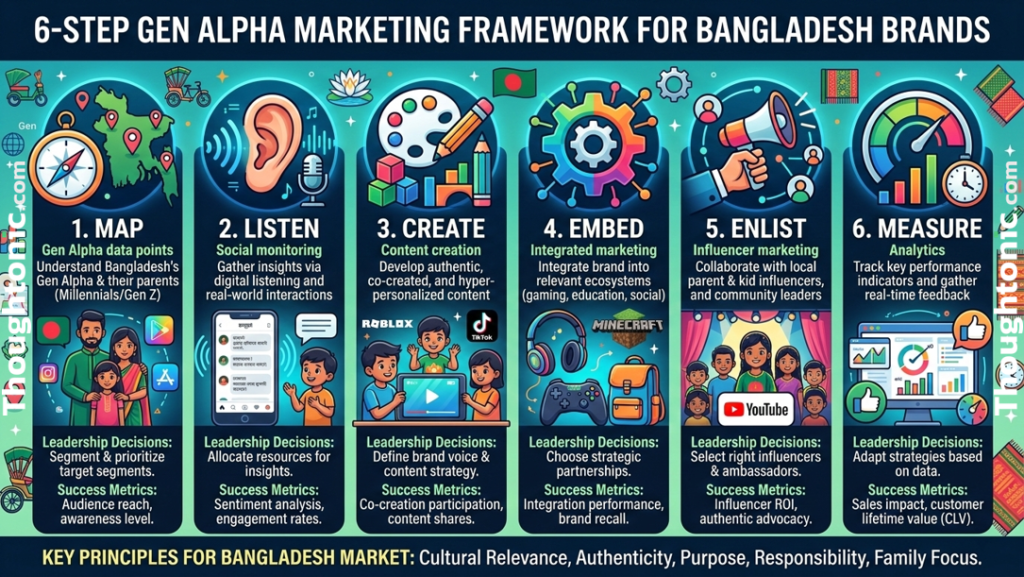
The table below outlines the framework for any brand seeking to build a coherent Gen Alpha strategy. Each step requires a leadership decision, creates a trade-off, and produces a measurable outcome.
| Step | Leadership Decision | Trade-off | Success Metric |
| 1. Map | Assign dedicated Gen Alpha budget | Short-term ROI vs. long-term brand equity | % of audience under 18 engaged |
| 2. Listen | Hire a youth insight lead or agency | Speed vs. depth of insight | Avg. session time on youth content |
| 3. Create | Allow content autonomy to youth creators | Brand control vs. authenticity | Organic share rate |
| 4. Embed | Shift 15% ad budget to in-environment | Reach vs. contextual relevance | In-content engagement rate |
| 5. Enlist | Partner with kid influencers ethically | Compliance risk vs. trust earned | Peer recommendation rate |
| 6. Measure | Redefine KPIs beyond impressions | Vanity metrics vs. behavioral signals | Brand recall lift among 10-14 age group |
What Each Step Looks Like in Practice
- Map: Run a dedicated audit of your brand’s current touchpoints with the under-15 audience. Not impressions, actual engagement. Most brands in Dhaka will find this data does not exist, which itself is finding. Common mistake: assuming adult engagement data tells you anything about Gen Alpha behavior.
- Listen: Commission qualitative research with children aged 8-14, through in-school or community panels. BRAC has done this effectively in its communications campaigns. What do kids associate with your brand? What do they not? This step is skipped by 90% of brands.
- Create: Develop content in collaboration with young creators, not just content about young people. The difference matters enormously to authenticity signals. Give a 14-year-old partial creative control over one campaign element. Watch the reception differ.
- Embed: Move a portion of your advertising budget into in-environment placements: gaming, interactive apps, educational platforms. In Bangladesh, platforms like 10 Minute School have youth audiences that are deeply engaged. Sponsored content there outperforms generic Instagram ads for this demographic.
- Enlist: Build a kid ambassador or youth panel program. Brands like Pran-RFL could do this effectively given their product range spanning snacks, beverages, and school supplies. Ethical compliance matters here: ensure parental consent frameworks are in place.
- Measure: Redefine success metrics. For Gen Alpha campaigns, the right signals are organic share rates, brand mention frequency in youth communities, recall lift, and parental purchase attribution. Not click-through rates.
Case Studies: Who Is Getting Gen Alpha Marketing Right (and Who Is Not)
Global: LEGO’s Digital-Physical Integration Strategy (2020-2025)
LEGO was nearly bankrupt in 2003. What saved it, beyond financial restructuring, was a fundamental repositioning toward creative participation rather than passive play. By 2020, LEGO had built LEGO Ideas, a platform where fans, including children as young as 10, submit designs that get made into real products. LEGO also partnered with Roblox to create interactive building games, and launched LEGO Education coding kits for school-age children.
The results were significant. LEGO reported revenue growth of 17% in 2023, reaching DKK 65.9 billion (approximately USD 9.5 billion), making it one of the world’s most valuable toy brands. Among Gen Alpha specifically, LEGO scored in the top 5 of brand affinity surveys conducted by Beano Studios in 2024. The brand worked because it made children co-creators, not consumers.
The limitation: LEGO has a price point that excludes large portions of markets like Bangladesh. The strategy is instructive, but requires adaptation for price-sensitive South Asian contexts.
South Asian / Bangladesh: 10 Minute School’s Content-as-Product Model (2019-Present)
10 Minute School, founded by Ayman Sadiq in Dhaka, is arguably the most successful example of Gen Alpha-aligned brand building in Bangladesh. While technically an edtech platform, its brand strategy is a masterclass in what works with younger audiences.
The platform built an audience of over 10 million YouTube subscribers by 2024, with a core demographic of students aged 12-22. Their content is genuinely useful, fast-paced, delivered in conversational Bangla, and produced at a quality that rivals broadcast television. Crucially, they never talked down to their audience. They respected the intelligence and agency of young learners.
Key outcomes: 10 Minute School raised BDT 50 crore in Series A funding in 2022, reflecting investor confidence in its audience depth. Their paid course enrollment grew 3x between 2021 and 2023. And their brand, built almost entirely on trust and content quality, has crossed into cultural recognition. Gen Alpha students in Dhaka do not think of 10 Minute School as an ad. They think of it as a resource they chose.
The limitation: 10 Minute School operates in education, where the value proposition is obvious. Consumer brands selling snacks, clothing, or electronics face a harder challenge in replicating this level of genuine utility.
Action Plans: What Organizations and Professionals Must Do Now
For Organizations (Brands, Agencies, Founders)
- Allocate a minimum of 10-15% of your digital content budget toward Gen Alpha-specific content within the next two quarters. This is not optional for brands in FMCG, edtech, fashion, or consumer electronics. Effort: Medium.
- Run a Gen Alpha listening audit before your next major campaign launch. Use in-person or online focus groups with children aged 8-14. Ask what they associate with your brand. The answers will be uncomfortable and necessary. Effort: Low to Medium.
- Identify one in-game or in-app advertising partnership in the next six months. In Bangladesh, target Free Fire, PUBG Mobile, Roblox, or educational apps with verified youth audiences. Budget: BDT 5-15 lakh for a pilot. Effort: Medium.
- Build an ethical youth creator partnership program. This means documented parental consent, clear creative briefs, and revenue sharing where appropriate. One partnership with a young Bangladeshi creator in your product category will outperform three standard influencer deals. Effort: High.
- Rewrite your campaign measurement framework. Add brand recall among under-18 audiences, organic mention rate, and household purchase influence attribution. These metrics require qualitative methods alongside your existing dashboards. Effort: Medium.
For Marketing Professionals
- Develop platform fluency beyond Facebook and Instagram. Spend 30 minutes daily on YouTube Shorts, TikTok, and Roblox for 60 days. Understand what content performs, why, and how. This is uncomfortable because it requires abandoning the assumption that you already know digital media. You know the adult version.
- Study behavioral economics as applied to younger audiences. The Fogg Behavior Model, loss aversion triggers, and social proof mechanics all operate differently in Gen Alpha. The Wunderman Thompson ‘Future 100’ reports are a good annual starting point.
- Practice rapid content prototyping. Gen Alpha content fails fast. Build the skill of testing a content concept in 48 hours, measuring response, and killing or scaling. Most senior marketers in Dhaka are still running 6-week approval cycles for social content. That is incompatible with this audience.
- Build relationships with school communities and youth organizations. BRAC, Teach For Bangladesh, and private school networks are underused research assets for understanding this generation. Go where the kids are, not just where the data is.
- Advocate internally for longer brand-building timelines. The CFO who demands 90-day ROI from a Gen Alpha campaign is asking the wrong question. The ROI comes in 36-60 months when this cohort begins earning. That argument requires data, patience, and political capital within your organization.
What Most Gen Alpha Strategies Get Wrong: A Contrarian View
Here is what I see failing repeatedly. Brands rush to put children in their ads, launch a TikTok account, or partner with a 12-year-old influencer, and call it a Gen Alpha strategy. It is not. It is performance theater. Gen Alpha sees through performative youth-targeting faster than any previous generation. The minute a brand feels like it is trying to be cool, it is finished.
There is also an ignored ethical risk in this space that the industry largely skirts around. Advertising to children is regulated by Bangladesh’s Consumer Rights Protection Act and platform-specific policies, but enforcement is inconsistent. Brands that build predatory data practices or manipulative reward loops targeting children under 13 are not just ethically bankrupt; they are building reputational liabilities that will matter enormously when this generation grows up and writes about what brands did to their childhood feeds.
And here is the contrarian scenario worth considering: for some brands, especially those with limited budgets and adult-primary products, doing nothing targeted toward Gen Alpha in the next 12 months may be more rational than doing it poorly. A botched Gen Alpha campaign leaves a worse impression than no campaign at all. Build your capability first. Deploy when the strategy is genuine.
Key Takeaways
- Gen Alpha, born 2010-2025, will surpass 2 billion people globally and represents roughly 26% of Bangladesh’s population. They are not tomorrow’s consumers. They are today’s household influencers.
- 75% of parents in emerging markets report that their children directly influenced a household purchase decision in the past month (LightSpeed Research, 2023). In joint-family Bangladesh, this number is likely higher.
- Gen Alpha can identify sponsored content with the accuracy of a trained adult media critic. Authenticity is not a nice-to-have; it is the baseline requirement for any engagement.
- The five highest-performing gen alpha marketing channels are in-game advertising, peer creator partnerships, short-form native content, skill-building brand content, and peer recommendation ecosystems.
- LEGO’s 17% revenue growth in 2023 and 10 Minute School’s 3x course enrollment growth between 2021 and 2023 both demonstrate that brands succeeding with this generation made children co-creators, not targets.
- The ethical risk in Gen Alpha marketing is real and under-discussed. Manipulative ad practices targeting under-13 audiences create regulatory and reputational exposure that compounds over time.
- Measurement frameworks must evolve. Brand recall lift, organic mention rate among youth communities, and household purchase attribution replace click-through rate as the meaningful signals.
- For organizations with limited resources, building genuine gen alpha marketing capability before deploying is more valuable than launching poorly executed youth campaigns now.
More Articles:
The Costly Visual Search Blind Spot That Is Making Bangladesh Brands InvisibleQuantum Marketing: How 2030’s Technologies Will Shatter Bangladesh’s Status QuoDigital Literacy & Brand Purpose: How Education Drives Loyalty in Emerging MarketsGenerative AI in Bangladeshi Advertising: Opportunities, Ethical Risks & Implementation Guide 2025The Brain’s Buy Button: How Neuromarketing Taps into Consumer Decision-Making (Global & Bangladesh Insights)
Global Sources
- McCrindle Research (2024) – Gen Alpha Report 2024 – Primary generational sizing data, behavioral profiling. Read report
- GSMA Intelligence (2024) – The Mobile Economy: South Asia 2024 – Smartphone and tablet usage among children aged 8-12 in South Asia. Read report
- Nielsen (2024) – Kids Audience Report 2024 – Ad literacy and detection accuracy among children aged 6-12. Read report
- Wunderman Thompson (2024) – Future 100: Youth Trends Report – Parent-child purchasing influence loop data (68% and 52% figures). Read report
- LightSpeed Research (2023) – Children and Household Purchasing Influence Survey – 75% emerging market parental influence statistic. View research
- University of California, Irvine (2023) – Adolescent Media Cognition Study – Anterior cingulate cortex activation and inauthenticity detection in 8–13-year-olds. View research
- Microsoft (2023) – Attention Spans Research Report – Average human attention span on digital media (8.25 seconds). Read report
- Newzoo (2024) – Global Games Market Report Q1 2024 – In-game advertising recall rates 4–6x versus standard digital ads. Read report
- Ipsos (2024) – Short-Form Video and Brand Recall Study – 3x brand mention rate for native short-form versus traditional video ads. View research
- Roblox Corporation (2024) – Q1 2024 Earnings Report – 88.9 million daily active users, median age 13. Read report
- Beano Studios (2024) – Gen Alpha Brand Affinity Survey – LEGO top-5 brand affinity ranking among Gen Alpha globally. View research
- LEGO Group (2023) – Annual Report 2023 – Revenue DKK 65.9 billion, 17% growth; co-creation model validation. Read report
Bangladesh & South Asia Sources
- Bangladesh Bureau of Statistics (2022) – Population Census Report – Children under 14 constitute ~26% of Bangladesh population. View data
- 10 Minute School (2024) – Platform Growth and Series A Announcement – 10M+ YouTube subscribers, BDT 50 crore Series A, 3x enrollment growth 2021–2023. View platform
- a2i – Aspire to Innovate, Bangladesh (2024) – Digital Inclusion and Youth Internet Access Report – Digital access patterns among school-age children in Bangladesh. Read report
- BRAC Communication & Knowledge Management Division (2023) – Youth and Digital Media in Bangladesh – Youth media usage and qualitative research methodology benchmarks. View publications
- Bangladesh Telecommunication Regulatory Commission (2024) – Internet Subscriber Report Q4 2024 – Urban digital penetration baseline for Bangladesh market sizing. View report