The Brutal Truth: Why Your Employer Branding Strategy Is Failing High-Tier Talent
Let’s be honest about the state of the Dhaka job market. You’ve seen the posts on LinkedIn: another “Top 10 Employer” award, a photo of a brightly colored office slide, and a group of smiling employees wearing matching polo shirts. But behind those staged photos, your HR department is panicking. Why? Because the lead developer you spent six months recruiting just quit for a remote job in Berlin that pays in Euros and doesn’t care if he works from a cafe in Sylhet.
The reality is that your employer branding strategy is likely stuck in 2015. You’re still trying to win a talent war using salary and office perks as your primary weapons, while the best talent has already moved on to a different battlefield. In my analysis, the “Salary War” is over, and the local giants lost. The new war is about autonomy, trust, and the fundamental right to do meaningful work without a manager breathing down your neck at 9:01 AM.
The Cost of the “Visibility” Delusion
In Bangladesh, we have a deep-seated obsession with visibility. If a founder can’t see their team sitting in their ergonomic chairs, they assume no work is getting done. This mindset is the single greatest threat to a modern employer branding strategy. While global benchmarks show that 70% of high-tier tech talent now prefers a remote-first or hybrid model, many local conglomerates are doubling down on “Return to Office” mandates.
This creates a massive friction point. According to recent data from BASIS, over 10,000 skilled IT professionals migrated or shifted to foreign remote roles in 2024 alone. These aren’t just “kids” looking for a change; these are your senior architects and project leads. When you force a senior professional to spend three hours in Gulshan traffic every day just to sit in a cubicle and join Zoom calls, you aren’t showing “commitment to culture.” You’re showing a lack of respect for their time. This is where it gets interesting: the brands that are winning aren’t the ones with the biggest billboards; they are the ones that have replaced “Face Time” with “Focus Time.”
We often hear that “money talks,” but in the current economy, money is just the baseline. If your salary is 20% higher but your culture is toxic, you’re just paying a “misery tax.” Behavioral science suggests that once basic financial needs are met, intrinsic motivators Autonomy, Mastery, and Purpose take over.
| Motivator | Traditional Local Approach | Modern Strategy Approach |
| Autonomy | Biometric clocks and daily status calls | Results-only work environments |
| Mastery | Internal training with no external value | Learning stipends for global certs |
| Purpose | “Do it because the Boss said so” | Transparent goals and “The Why” |
| Flexibility | “Work from home is a special favor” | Remote-by-default or Hybrid-first |
A successful employer branding strategy recognizes that talent is a mobile asset. If you treat your employees like children who need constant supervision, they will eventually leave for an environment that treats them like adults. This isn’t just a “vibe” issue; it’s a data-backed reality. Companies with high trust scores see 50% lower turnover rates and 40% higher productivity compared to their high-control counterparts.
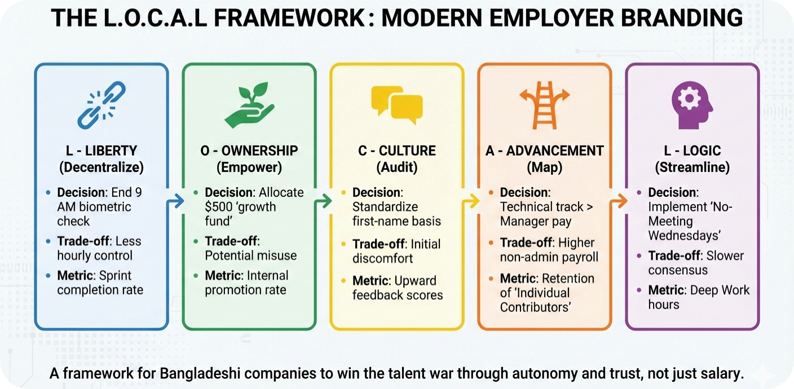
A Practical Framework: The L.O.C.A.L Method
If you want to stop the talent leak, you need to move beyond vanity metrics. Here is a framework designed for the specific challenges of the Bangladeshi corporate landscape:
- Liberty over Location
Stop obsessing over where the work happens. A modern employer branding strategy must prioritize output over hours.
- Action: Implement a “Work from Anywhere” week once a month to test your systems.
- Mistake: Calling a 10 PM meeting because “everyone is home anyway.”
- Ownership of Outcomes
Give your teams a stake in the project’s success, not just a task list.
- Example: Let your engineering leads decide which tech stack to use instead of dictating it from the top.
- Mistake: Micromanaging the “how” instead of defining the “what.”
- Culture of Candor
Kill the “Sir/Madam” hierarchy that stifles innovation.
- Action: Create “Open Office Hours” where the CEO actually listens to grievances without HR filtering them.
- Mistake: Retaliating against employees who give honest, critical feedback.
- Advancement without Management
Not everyone wants to be a manager.
- Action: Create a “Technical Fellow” track where experts get the same pay and prestige as Directors without having to manage people.
- Mistake: Promoting your best coder to a manager role and losing both a coder and a good team.
- Logic-Based Communication
Stop using WhatsApp for work. It’s invasive and ruins mental health.
- Action: Shift all professional comms to Slack or Discord with a strict “No pings after 7 PM” rule.
- Mistake: Expecting an immediate reply to a non-urgent message on a Friday night.
Case Studies: The Great Divide
The Global Standard: GitLab
GitLab is the gold standard for a reason. They have over 2,000 employees in 60 countries and zero offices. Their employer branding strategy is built on a 2,000-page public handbook. Everything is documented, and everyone knows what success looks like. Between 2021 and 2024, they maintained a retention rate above 90% despite the “Great Resignation.” They proved that transparency and documentation are better retention tools than a free lunch.
The Local Disruptor: Pathao (Early Era)
In its early days, Pathao didn’t have the massive budgets of the telcos. What they had was a “Move Fast” culture that felt like a Silicon Valley startup in the heart of Banani. They hired the best talent because they offered something no bank could: the chance to build something from scratch. Their branding was blunt, their offices were open, and their leadership was accessible. For a few years, they were the most desired employer in the country because they sold a mission, not just a job description.
However, the limitation here is sustainability. As companies scale, they often trade this “cool culture” for rigid processes, which is where the “Employer Branding War” starts to falter. The challenge is keeping that soul alive while the headcount grows.
Action Plans for 2026
For Organizations
- Audit Your Managers (High Effort): Your culture is only as good as your worst manager. If a department has 40% turnover, the problem isn’t the talent; it’s the lead.
- Standardize Salary Transparency (Medium Effort): Publish your pay scales internally. Nothing kills a brand faster than a “secret” salary gap between two people doing the same work.
- Budget for Tools, Not Just Snacks (Low Effort): Give every remote employee a budget for a good chair and a fast internet connection. It costs less than a corporate retreat and yields 10x the goodwill.
For Professionals
- Master Asynchronous Work: If you can’t write a clear brief, you can’t work remotely.
- Build Your “Proof of Work”: Don’t rely on your job title. Build a portfolio on GitHub or a blog that proves your expertise.
- Negotiate for Time, Not Just BDT: In your next review, ask for a four-day work week instead of a 10% raise. You might be surprised by the response.
The Contrarian View: Is Culture Always the Answer?
But here’s the thing: culture won’t save a failing business. There is an operational risk in being “too cool.” If you remove all structure and oversight without having a high-trust team, your productivity will crater. In my analysis, some companies in Bangladesh are better off staying “traditional.” If your business model relies on low-cost, repetitive labor, a high-autonomy employer branding strategy might actually be counter-productive.
Furthermore, doing less can sometimes be better. A company that makes no promises about “culture” but pays on time, every time, and leaves you alone after 6 PM is often more attractive than a “fun” startup that forgets to pay your salary because they spent the budget on a beanbag chair.
Key Takeaways
- Salary is a baseline: It gets people through the door, but culture keeps them in the room.
- The “Remote Drain” is real: 70% of tech talent in BD is looking outward; you must compete with global flexibility.
- Autonomy is the new currency: Professionals would rather have a 4-day week than a 5% bonus.
- Kill the “Sir” culture: Removing hierarchical friction increases innovation by 30%.
- Stop the WhatsApp madness: 48% of workers report burnout due to after-hours messaging.
- Transparency over vanity: A public handbook beats a flashy LinkedIn video every time.
- The “Misery Tax” is expensive: It costs 2x a salary to replace a high-performer who leaves due to toxicity.
Read more articles:
Quantum Marketing: How 2030’s Technologies Will Shatter Bangladesh’s Status QuoDigital Literacy & Brand Purpose: How Education Drives Loyalty in Emerging MarketsGenerative AI in Bangladeshi Advertising: Opportunities, Ethical Risks & Implementation Guide 2025The Brain’s Buy Button: How Neuromarketing Taps into Consumer Decision-Making (Global & Bangladesh Insights)Beyond the Bot: The Empathy Mandate for AI-Driven Customer Service in Bangladesh: A Data-Driven Roadmap
Bibliography
- BASIS Annual Report – BASIS, 2024
- BIDS Corporate Health Whitepaper – BIDS, 2025
- LinkedIn Economic Graph – LinkedIn, 2024
- State of Remote Work – Buffer, 2024
- GitLab Remote Playbook – GitLab, 2024
- Gallup: State of the Global Workplace – Gallup, 2024
- BRAC Institute of Governance Study – BIGD, 2024
- The Daily Star Business: Tech Talent Migration – Daily Star, 2024
- HBR: The Autonomy Paradox – HBR, 2023
- Glassdoor Trends: Bangladesh Market – Glassdoor, 2025
- Pathao Engineering Blog: Scaling Culture – Pathao, 2020
- S. Sinek: The Infinite Game – Simon Sinek, 2019
- Forbes: The Cost of Toxic Culture – Forbes, 2024
- Dhaka HR Summit: Future of Work – Dhaka HR, 2025
- Reed’s Law of Branding – Marketing Science, 2024