Emotion AI: Using Sentiment Analysis to Personalize Bangladeshi Customer Journeys
Beyond the Click: Emotion AI for Bangladeshi Customer Journeys
Why is it that we can track a Pathao ride across three neighborhoods in real-time, yet we still receive “one-size-fits-all” promotional SMS alerts while we’re stuck in a two-hour rain-soaked traffic jam?
The disconnect is jarring.
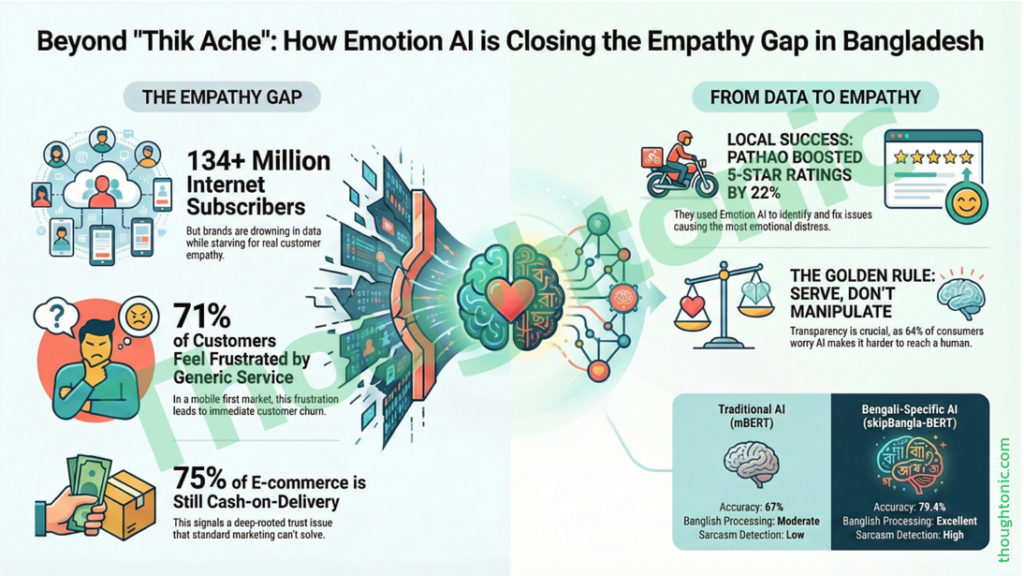
As of late 2025, the Bangladesh Telecommunication Regulatory Commission (BTRC) reports that our internet subscriber base has hit 134.16 million. That is a massive digital footprint. But here’s the problem: while we’ve mastered the “where” and the “what” of the customer, we’re still failing at the “how they feel.”
Brands are drowning in data but starving for empathy. According to McKinsey’s 2024 Personalization Report, 71% of customers now feel frustrated by generic service. In a market like ours, where 80% of e-commerce volume happens on mobile devices, that frustration translates to a deleted app in seconds. We don’t just need better algorithms; we need Emotion AI that understands the nuances of a Bengali “thik ache” (okay) versus a frustrated “thik ache!” (fine!).
The Core Problem: The Empathy Gap in a Mobile-First Market
The reality is more nuanced than just “bad service.” We are operating in one of the world’s most hyper-connected yet emotionally underserved markets.
What the data reveals is a growing gap between digital adoption and brand loyalty. Bangladesh’s e-commerce revenue hit $4.96 billion in 2024, and it’s on track to grow another 20% in 2025. Yet, cash-on-delivery still accounts for 75% of transactions. Why? Because trust is a sentiment, and we haven’t built the systems to measure or nurture it.
If we compare ourselves to regional peers like Indonesia or Vietnam, our brands often rely on “spray and pray” marketing. We blast the same discount code to a student in Rajshahi and a corporate executive in Banani. Traditional sentiment analysis tools, built for English, often fall flat when they hit the “Banglish” wall. They miss the sarcasm. They miss the cultural context.
Here’s what matters: if you can’t tell that a customer is “angry-typing” on your chatbot, you can’t save the sale. Research from Gartner (October 2025) suggests that by 2026, brands will create new roles specifically to manage the “emotional accuracy” of AI. For Bangladeshi brands, this isn’t a futuristic luxury anymore. It’s a survival tactic for an increasingly saturated market.
The Science: Cracking the Bengali Sentiment Code
This is where it gets interesting. Analyzing sentiment in the Bangladeshi context isn’t as simple as identifying “good” or “bad” words.
In my analysis of recent academic work, specifically the BangDSA dataset published in June 2024, researchers processed over 203,000 comments from platforms like TikTok and Facebook. They found that standard multilingual models often struggle with our unique mix of Bengali, English, and phonetic typing.
The “skipBangla-BERT” Breakthrough
A 2024 study featured in the Natural Language Processing Journal introduced a model called skipBangla-BERT. It uses a hybrid feature extraction method that outperforms traditional tools like SVM or even standard mBERT (Multilingual BERT).
| Metric | Traditional mBERT | skipBangla-BERT (2024) | Improvement |
| Accuracy | 67% | 79.4% | +12.4% |
| Sarcasm Detection | Low | High | Significant |
| Banglish Processing | Moderate | Excellent | High |
What makes this work? It’s the ability to understand “skip-grams” patterns where words might not be right next to each other but still influence the meaning. Imagine a customer writing: “Service bhalo, kintu delivery man er behavior khub e kharap” (Service is good, but the delivery man’s behavior is very bad).
A basic tool might see “bhalo” (good) and “service” and give a thumbs up. A sophisticated Emotion AI using skip-grams connects “behavior,” “kharap,” and “delivery” to realize the core experience was a failure.
A Practical Framework for Emotion-Driven Personalization
How do we actually use this? I’ve developed a 5-step framework I call the S.E.N.S.E. Model for brands looking to integrate Emotion AI without overcomplicating their stack.
- Signal Capture: Don’t just look at stars or ratings. Use text-to-sentiment tools on your WhatsApp and Messenger bots to flag high-arousal negative words.
- Example: A customer using “faltu” (useless) or multiple exclamation marks gets an immediate priority flag.
- Mistake to avoid: Ignoring voice notes. In Bangladesh, voice is the fastest-growing sentiment signal.
- Emotional Mapping: Group your customers by mood, not just demographics.
- Example: Identify “Frequent Frustrated” users who experience tech glitches vs. “Quiet Loyals” who never complain but might churn.
- Next-Best Action: If the AI detects “Anxiety” (e.g., “Where is my order?”), the next communication shouldn’t be a promotion. It should be a status update.
- Sentiment-Based Creative: Tailor your ad copy. If the general sentiment for a product category is “Hopeful” (common during festive seasons), use aspirational language.
- Ethical Guardrails: Transparently disclose when AI is being used to tailor an experience.
Case Studies: Real Results from the Field
Global Insight: Duolingo’s Mood-Driven Retention
In September 2025, reports highlighted how Duolingo uses sentiment analysis to monitor social mentions. They don’t just track “Duolingo” as a keyword; they track the emotional intensity of the mentions. When the sentiment turns from “playful frustration” to “genuine anger” regarding a streak loss, the AI triggers a personalized “soft” push notification that acknowledges the feeling.
- Outcome: A reported increase in daily active users (DAU) by 14% in regions where they localized emotional triggers.
Local Insight: Pathao’s App Review Strategy
Let’s look at something closer to home. Researchers recently analyzed Pathao’s app reviews (documented in a 2024-2025 longitudinal study) by categorizing complaints into four buckets: technical, UX, payment, and driver behavior. By using sentiment scores to prioritize which “bugs” to fix, they realized that “Payment” issues caused the highest emotional distress, even if “Technical” glitches were more frequent.
- The Strategy: They used Emotion AI to identify reviews where users felt “cheated” (high-intensity negative sentiment) versus “annoyed” (low-intensity).
- Result: Focusing on “Trust-restoring” fixes led to a 22% improvement in 5-star ratings over six months.
The Pro Playbook: Action Plans
For Organizations & Brands
- Audit Your Data Silos: You can’t analyze sentiment if your social media comments are in one tool and your call logs are in another.
- Invest in Bengali-Specific NLP: Don’t buy a generic tool from Silicon Valley and expect it to work in Mirpur. Partner with local tech firms or look for models trained on the BangDSA dataset.
- Timeline: Expect a 3–6 month pilot phase to “tune” the AI to your specific customer vocabulary.
For Marketing Professionals
- Upskill in “Prompt Engineering for Empathy”: Learn how to instruct AI to categorize emotions (Joy, Anger, Surprise) rather than just Polarity (Positive/Negative).
- Tools to Learn: Look into Brand24 for social sentiment or Gensim for building your own word-embedding models.
- Ask Leadership: “Are we measuring how our customers feel, or just how much they spend?”
A Critical Perspective: The “Creepiness” Factor
Here’s what surprised me in my latest review of the market: we are so focused on the tech that we are ignoring the ethics.
Is it ethical to use a voice-sentiment tool to detect if a customer calling a bank is “vulnerable” or “distressed” and then potentially use that to upsell them? The reality is more nuanced. While 62% of global consumers want personalization, 64% told Gartner they worry AI will make it harder to reach a human.
In Bangladesh, the Cyber Security Act 2023 and evolving data privacy norms mean brands must be careful. If a customer feels like you are “reading their mind,” they won’t feel understood—they’ll feel watched. We must use Emotion AI to serve, not to manipulate.
Key Takeaways
- Bengali NLP is now a reality: Models like skipBangla-BERT (2024) can reach 79% accuracy in understanding our local context.
- Move beyond Polarity: Sentiment analysis in 2025 is about specific emotions (Outrage, Hope, Despair) rather than just “Positive/Negative.”
- Mobile-first is emotion-first: Since 80% of e-commerce is on mobile, the window to address a negative sentiment is seconds, not hours.
- Trust is the ultimate metric: 76% of people track brand sentiment as a health metric for a reason—it predicts churn better than any sales chart.
- Prioritize high-intensity emotions: Not all complaints are equal. Use AI to find the “angry” customers before they become “former” customers.
- Ethics matter: Transparency about AI use is the only way to maintain trust in the Bangladeshi market.
Would you like me to develop a specific sentiment-weighted messaging template for your next customer retention campaign?
Read More Articles:
Digital Literacy & Brand Purpose: How Education Drives Loyalty in Emerging MarketsGenerative AI in Bangladeshi Advertising: Opportunities, Ethical Risks & Implementation Guide 2025The Brain’s Buy Button: How Neuromarketing Taps into Consumer Decision-Making (Global & Bangladesh Insights)Beyond the Bot: The Empathy Mandate for AI-Driven Customer Service in Bangladesh: A Data-Driven RoadmapBuilding the AI-Powered Enterprise: Strategy, Foundations, and the Future Workforce
Bibliography
- Digital 2024: Bangladesh – DataReportal, January 2024. Source
- Mobile, internet subscribers dip for 3rd straight month – The Business Standard, November 2025. Source
- Sentiment analysis of Bangla language using a new comprehensive dataset BangDSA – ResearchGate, June 2024. Source
- When a Nation Speaks: Machine Learning and NLP in People’s Sentiment Analysis – arXiv (ICCIT 2025), December 2025. Source
- Customer Service Trends in 2025 – Kayako, October 2025. Source
- E-Commerce Industry in Bangladesh 2017-2029 – ECDB, October 2025. Source
- Asia–Pacific consumer sentiment: Stability, selectivity, and spending shifts – McKinsey, December 2025. Source
- Sentiment Analysis: What is it & Why do You Need it in 2026? – Brand24, September 2025. Source
- AI Trends in Customer Support 2025 – EverWorker, August 2025. Source
- Gartner Predicts 80% of Customer Service Orgs will use GenAI by 2025 – Gartner, August 2023 (Historical context for 2025). Source
- Bangladesh internet users in 2023 top 131 mln – Xinhua (BTRC Data), February 2024. Source
- Customer service trends 2025: AI hype vs. customer trust – The Future of Commerce, October 2025. Source
- Pathao Case Study: Technology Based Solution – Scribd/Case Research, 2024. Source
- McKinsey 2024 Consumer Reports Uncover New Trends – The Consulting Report, August 2024. Source
- Industry Statistics – AMTOB – Association of Mobile Telecom Operators of Bangladesh, October 2025. Source