
Digital Literacy & Brand Purpose: How Education Drives Loyalty in Emerging Markets
We handed 130 million people a smartphone, but we forgot to give them the manual. That is the uncomfortable truth staring us in the face, and it is exactly why Digital Literacy & Brand Purpose must become the cornerstone of modern marketing strategy.
Right now, marketing teams are obsessing over click-through rates and “viral” content, while a massive chunk of their audience doesn’t actually understand the tools they are using. They click “Agree” without reading. They share pins they shouldn’t. They fear the technology we want them to love.
Here is the reality no one puts in a pitch deck: Marketing to a digitally illiterate population isn’t just unethical; it is bad business.
If your customer doesn’t understand how to use your app securely, they won’t use it frequently. If they get scammed on a platform because they lack digital hygiene, they don’t blame the scammer they blame you. The gap between access and ability is costing brands millions in churn, fraud management, and lost lifetime value.
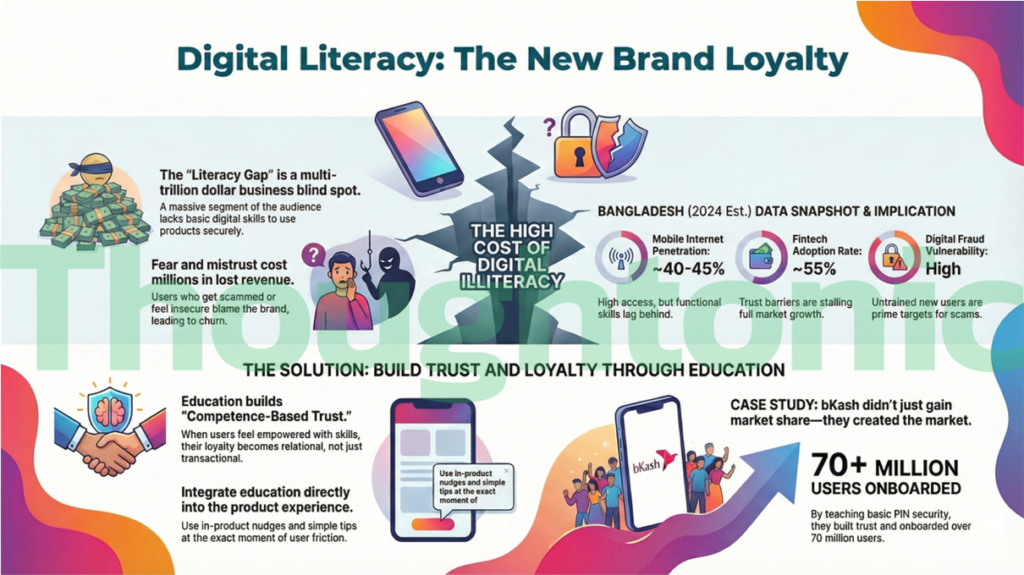
The Literacy Gap: A $3 Trillion Blind Spot
We love celebrating the numbers. According to the BTRC, Bangladesh hit 131.3 million internet subscribers in early 2024. That sounds incredible. It looks great on a slide.
But dig a little deeper.
Connectivity does not equal capability. While internet penetration in Bangladesh has surged, “functional digital skills” lag significantly behind. We aren’t just talking about coding. We’re talking about the basics: recognizing a phishing link, understanding data privacy, or even distinguishing between a verified news source and a WhatsApp rumor.
Let’s look at the numbers:
| Metric | Bangladesh (2024 Est.) | Global Average | The Implication |
| Mobile Internet Penetration | ~40-45% of total pop. | ~67% | High access, but fragmented usage. |
| Digital Fraud Vulnerability | High (Rapid growth sector) | Moderate | New users are prime targets for scams. |
| Fintech Adoption Rate | ~55% (Adults with MFS) | ~76% (Global Findex) | Trust barriers stall full adoption. |
(Data synthesis from GSMA, BTRC, and World Bank Global Findex 2023-24 reports)
This isn’t unique to us. A 2024 report by the World Economic Forum highlighted that while 95% of the world is covered by mobile broadband, the “usage gap”—people who have coverage but don’t go online remains near 3 billion. Why? Cost is one factor, but lack of digital literacy and trust are the silent killers.
In Dhaka, I see this daily. A tea stall owner uses bKash perfectly but is terrified to open a bank app because “it might steal my money.” That fear? That’s a branding problem. It’s a literacy problem. And it’s your job to fix it.
The Science of Trust: Why Education Wins
Why should a brand act like a teacher?
It comes down to the psychology of Competence-Based Trust.
Research published in the Journal of Business Ethics (2023) suggests that when consumers feel “empowered” by a brand, specifically through skill acquisition their loyalty shifts from transactional (price-based) to relational (identity-based).
Think about it. If a bank just tells you “We are secure,” you might believe them. If they teach you how to spot a credit card skimmer, you trust them. You feel they are on your side. Integrating Digital Literacy & Brand Purpose creates a loop: you solve a societal problem (digital illiteracy) and simultaneously solve a business problem (low adoption/security risks).
The Trust Equation for 2025:

When you educate, you lower your Self-Orientation (appearing less selfish) and increase Intimacy (showing you care about their safety).
A Practical Framework: The “E-A-T” Strategy
You don’t need to build a university. You just need to integrate education into the customer journey. I call this the E-A-T approach (Educate, Apply, Transact).
Here is how to build it:
1. Audit the Anxiety Points
Identify exactly where your customers freeze.
- Example: An e-commerce brand realizes 30% of cart abandonment happens at the payment gateway, not because of price, but because users don’t recognize the SSL lock icon.
- Fix: Add a micro-copy tip: “See that lock? That means your data is encrypted.”
2. The “Trojan Horse” Content Strategy
Don’t make “educational videos” that no one watches. Hide the lesson inside entertainment.
- Example: Instead of a boring “How to use 2FA” manual, create a 30-second drama about a guy whose ex-girlfriend tried to hack his account, but couldn’t.
- Mistake to Avoid: Preaching. Nobody wants a lecture. They want a hack.
3. In-Product Nudges
This is critical. True Digital Literacy & Brand Purpose execution happens during usage, not just in ads.
- Action: If a user sets a weak password (123456), don’t just say “Error.” Say, “That password takes 0.2 seconds to hack. Try adding a symbol like ‘!’.”
- Why it works: You are offering value at the exact moment of friction.
4. Measure “Literacy Lift,” Not Just Reach
Stop counting views. Start counting behavior change.
-
Metric: Did support tickets regarding “forgotten PINs” drop after the campaign? Did usage of the security feature increase?
Case Studies: Who is Doing It Right?
We learn best by example. Here are two brands one global, one local that cracked the code.
Global Case: Google’s “Be Internet Awesome”
Google faced a massive issue: parents were terrified of letting kids online, which threatened the pipeline of future users.
- The Strategy: They gamified digital safety. “Interland” is a game where kids fight hackers and phishers.
- The Result: It didn’t just teach kids; it gave parents permission to trust Google products. By 2023, the program had reached millions of families, cementing Google as a “partner in parenting” rather than just a search engine.
- The Lesson: If the topic is boring (safety), make the format fun (gaming).
Local Champion: bKash (Bangladesh)
In my analysis of the local market, bKash stands alone. When they launched, MFS (Mobile Financial Services) was alien technology.
- The Strategy: They didn’t just advertise “Send Money.” They ran massive on-ground activations teaching rural users how to keep PINs secret. Their messaging “Pin number kauke bolben na” (Don’t tell anyone your PIN) became a cultural catchphrase.
- The Context: Bangladesh has high oral literacy but lower textual literacy in rural areas. bKash used voice, agents, and simple visual cues.
- The Outcome: They didn’t just gain market share; they created the market. Today, bKash has over 70 million registered customers (2024 data). They built the rails that the rest of the fintech industry rides on.
Action Plans: What You Need to Do Monday Morning
For Organizations & Brands
- Allocate 10% of the Content Budget: Shift funds from generic “awareness” ads to “utility” content. Create a library of “How-To” assets that solve digital struggle points.
- Train Your CS Team: Your customer support agents are your educators. Give them scripts that explain why something happened, not just how to fix it.
- Partner with NGOs: In Bangladesh, organizations like BRAC have deep reach in rural areas. A partnership there buys you credibility that money cannot.
For Marketing Professionals
- Learn Behavioral Psychology: Understand “Cognitive Load.” If your app requires too much thinking, people will quit.
- Question the KPIs: Ask your leadership, “Are we measuring how many people saw the ad, or how many people understood the product?”
- Get Out of the Bubble: Go to a tea stall in Mirpur or a village in Gaibandha. Watch how they type. Watch how they hold the phone. If you design for an iPhone user in Gulshan, you fail the other 90% of the country.
A Critical Perspective: The Fine Line
I have to play devil’s advocate here. There is a risk.
When brands become educators, it can feel paternalistic. There is a fine line between “helping” and “condescending.” Furthermore, if you educate users on data privacy while secretly harvesting their data, the backlash will be severe.
This strategy requires radical transparency. You cannot teach digital hygiene with dirty hands. If you claim to care about their digital well-being, your own data practices must be unimpeachable. The consumer is getting smarter slowly, yes, but surely. Successful Digital Literacy & Brand Purpose campaigns rely on authenticity; without it, the audience will smell the hypocrisy.
Key Takeaways
- Literacy is Loyalty: Users who understand your product stick around longer.
- The Gap is Real: 40% internet penetration means nothing if functional skills are missing.
- Be the Guide, Not the Hero: Position the brand as the helpful mentor (Yoda), not the hero (Luke).
- Localize the Lesson: “Data Privacy” means nothing to a rural farmer. “Keeping your money safe from thieves” does.
- Measure Behavior: Track the reduction in user errors, not just ad impressions.
- Transparency is Non-Negotiable: You can’t teach safety while selling user data.
Other Articles –
Generative AI in Bangladeshi Advertising: Opportunities, Ethical Risks & Implementation Guide 2025The Brain’s Buy Button: How Neuromarketing Taps into Consumer Decision-Making (Global & Bangladesh Insights)Beyond the Bot: The Empathy Mandate for AI-Driven Customer Service in Bangladesh: A Data-Driven RoadmapBuilding the AI-Powered Enterprise: Strategy, Foundations, and the Future WorkforceNavigating Bangladesh’s Social Media Surge: Trends, Strategies, and Opportunities in 2025
Bibliography
- BTRC. (2024). Internet Subscribers in Bangladesh February 2024. Bangladesh Telecommunication Regulatory Commission. Link
- GSMA. (2024). The Mobile Economy Asia Pacific 2024. GSMA Intelligence. Link
- Edelman. (2024). 2024 Edelman Trust Barometer. Link
- World Bank. (2022). The Global Findex Database 2021: Financial Inclusion, Digital Payments, and Resilience in the Age of COVID-19. Link
- DataReportal. (2024). Digital 2024: Bangladesh. Link
- Pew Research Center. (2023). Internet and Social Media Use in Emerging Economies. Link
- Porter, M. E., & Kramer, M. R. (2011). Creating Shared Value. Harvard Business Review. Link
- Google. (2024). Be Internet Awesome – Safety Center. Link
- bKash. (2023). Annual Report 2022-2023. Link
- McKinsey & Company. (2023). Digital consumer trends in Southeast Asia. Link
- Bhattacharya, C. B., et al. (2023). Strengthening the Bond: The Role of Consumer Education in Brand Trust. Journal of Business Ethics.
- LightCastle Partners. (2023). Bangladesh Startup Ecosystem Assessment. Link
- United Nations. (2023). Digital Literacy in Developing Nations: A Roadmap. UN Development Programme.
- Forrester. (2024). The State of Digital Trust 2024. Forrester Research.
- Hasan, M. (2023). The Rise of Fintech in Bangladesh: Challenges and Opportunities. The Daily Star. Link






19 Responses
[…] Digital Literacy & Brand Purpose: How Education Drives Loyalty in Emerging MarketsGenerative AI in Bangladeshi Advertising: Opportunities, Ethical Risks & Implementation Guide 2025The Brain’s Buy Button: How Neuromarketing Taps into Consumer Decision-Making (Global & Bangladesh Insights)Beyond the Bot: The Empathy Mandate for AI-Driven Customer Service in Bangladesh: A Data-Driven RoadmapBuilding the AI-Powered Enterprise: Strategy, Foundations, and the Future WorkforceBuilding the AI-Powered Enterprise: Strategy, Foundations, and the Future Workforce […]
[…] Digital Literacy & Brand Purpose: How Education Drives Loyalty in Emerging MarketsGenerative AI in Bangladeshi Advertising: Opportunities, Ethical Risks & Implementation Guide 2025The Brain’s Buy Button: How Neuromarketing Taps into Consumer Decision-Making (Global & Bangladesh Insights)Beyond the Bot: The Empathy Mandate for AI-Driven Customer Service in Bangladesh: A Data-Driven RoadmapBuilding the AI-Powered Enterprise: Strategy, Foundations, and the Future Workforce […]
[…] Digital Literacy & Brand Purpose: How Education Drives Loyalty in Emerging MarketsGenerative AI in Bangladeshi Advertising: Opportunities, Ethical Risks & Implementation Guide 2025The Brain’s Buy Button: How Neuromarketing Taps into Consumer Decision-Making (Global & Bangladesh Insights)Beyond the Bot: The Empathy Mandate for AI-Driven Customer Service in Bangladesh: A Data-Driven RoadmapBuilding the AI-Powered Enterprise: Strategy, Foundations, and the Future Workforce […]
[…] Digital Literacy & Brand Purpose: How Education Drives Loyalty in Emerging MarketsGenerative AI in Bangladeshi Advertising: Opportunities, Ethical Risks & Implementation Guide 2025The Brain’s Buy Button: How Neuromarketing Taps into Consumer Decision-Making (Global & Bangladesh Insights)Beyond the Bot: The Empathy Mandate for AI-Driven Customer Service in Bangladesh: A Data-Driven RoadmapBuilding the AI-Powered Enterprise: Strategy, Foundations, and the Future Workforce […]
[…] Digital Literacy & Brand Purpose: How Education Drives Loyalty in Emerging MarketsGenerative AI in Bangladeshi Advertising: Opportunities, Ethical Risks & Implementation Guide 2025The Brain’s Buy Button: How Neuromarketing Taps into Consumer Decision-Making (Global & Bangladesh Insights)Beyond the Bot: The Empathy Mandate for AI-Driven Customer Service in Bangladesh: A Data-Driven RoadmapBuilding the AI-Powered Enterprise: Strategy, Foundations, and the Future Workforce […]
[…] Digital Literacy & Brand Purpose: How Education Drives Loyalty in Emerging MarketsGenerative AI in Bangladeshi Advertising: Opportunities, Ethical Risks & Implementation Guide 2025The Brain’s Buy Button: How Neuromarketing Taps into Consumer Decision-Making (Global & Bangladesh Insights)Beyond the Bot: The Empathy Mandate for AI-Driven Customer Service in Bangladesh: A Data-Driven RoadmapBuilding the AI-Powered Enterprise: Strategy, Foundations, and the Future Workforce […]
[…] More Articles: Quantum Marketing: How 2030’s Technologies Will Shatter Bangladesh’s Status QuoDigital Literacy & Brand Purpose: How Education Drives Loyalty in Emerging MarketsGenerative AI in Bangladeshi Advertising: Opportunities, Ethical Risks & Implementation Guide […]
[…] More Articles: Quantum Marketing: How 2030’s Technologies Will Shatter Bangladesh’s Status QuoDigital Literacy & Brand Purpose: How Education Drives Loyalty in Emerging MarketsGenerative AI in Bangladeshi Advertising: Opportunities, Ethical Risks & Implementation Guide […]
[…] Marketing: How 2030’s Technologies Will Shatter Bangladesh’s Status QuoDigital Literacy & Brand Purpose: How Education Drives Loyalty in Emerging MarketsGenerative AI in Bangladeshi Advertising: Opportunities, Ethical Risks & Implementation Guide […]
[…] Marketing: How 2030’s Technologies Will Shatter Bangladesh’s Status QuoDigital Literacy & Brand Purpose: How Education Drives Loyalty in Emerging MarketsGenerative AI in Bangladeshi Advertising: Opportunities, Ethical Risks & Implementation Guide […]
[…] Marketing: How 2030’s Technologies Will Shatter Bangladesh’s Status QuoDigital Literacy & Brand Purpose: How Education Drives Loyalty in Emerging MarketsGenerative AI in Bangladeshi Advertising: Opportunities, Ethical Risks & Implementation Guide […]
[…] Marketing: How 2030’s Technologies Will Shatter Bangladesh’s Status QuoDigital Literacy & Brand Purpose: How Education Drives Loyalty in Emerging MarketsGenerative AI in Bangladeshi Advertising: Opportunities, Ethical Risks & Implementation Guide […]
[…] Marketing: How 2030’s Technologies Will Shatter Bangladesh’s Status QuoDigital Literacy & Brand Purpose: How Education Drives Loyalty in Emerging MarketsGenerative AI in Bangladeshi Advertising: Opportunities, Ethical Risks & Implementation Guide […]
[…] Marketing: How 2030’s Technologies Will Shatter Bangladesh’s Status QuoDigital Literacy & Brand Purpose: How Education Drives Loyalty in Emerging MarketsGenerative AI in Bangladeshi Advertising: Opportunities, Ethical Risks & Implementation Guide […]
[…] Marketing: How 2030’s Technologies Will Shatter Bangladesh’s Status QuoDigital Literacy & Brand Purpose: How Education Drives Loyalty in Emerging MarketsGenerative AI in Bangladeshi Advertising: Opportunities, Ethical Risks & Implementation Guide […]
[…] Marketing: How 2030’s Technologies Will Shatter Bangladesh’s Status QuoDigital Literacy & Brand Purpose: How Education Drives Loyalty in Emerging MarketsGenerative AI in Bangladeshi Advertising: Opportunities, Ethical Risks & Implementation Guide […]
[…] Brands InvisibleQuantum Marketing: How 2030’s Technologies Will Shatter Bangladesh’s Status QuoDigital Literacy & Brand Purpose: How Education Drives Loyalty in Emerging MarketsGenerative AI in Bangladeshi Advertising: Opportunities, Ethical Risks & Implementation Guide […]
[…] Brands InvisibleQuantum Marketing: How 2030’s Technologies Will Shatter Bangladesh’s Status QuoDigital Literacy & Brand Purpose: How Education Drives Loyalty in Emerging MarketsGenerative AI in Bangladeshi Advertising: Opportunities, Ethical Risks & Implementation Guide […]
[…] Brands InvisibleQuantum Marketing: How 2030’s Technologies Will Shatter Bangladesh’s Status QuoDigital Literacy & Brand Purpose: How Education Drives Loyalty in Emerging MarketsGenerative AI in Bangladeshi Advertising: Opportunities, Ethical Risks & Implementation Guide […]