The Costly Death of Generic SMS: Why Bangladesh’s Brands Are Burning Budgets on Bulk Texts Nobody Reads
The Message You Deleted Without Reading
You know the feeling. Your phone buzzes. You glance at the screen. It says: “Congratulations! Enjoy 20% off ALL products. Valid today only. T&C apply.” You don’t know which brand sent it. You don’t know what products they mean. You dismiss it without blinking. That is the generic SMS in its natural habitat – and it is dying, slowly but loudly, taking marketing budgets and brand reputations down with it. In Bangladesh, where mobile penetration crossed 97% of the adult population by late 2024 (BTRC, December 2024) and brands collectively send an estimated 4.5 billion promotional SMS messages per year, the scale of this problem is not just annoying. It is financially catastrophic. This article is a forensic look at why the generic SMS model is broken, what the data actually shows, and what serious marketers should do before they send one more batch blast into the void.
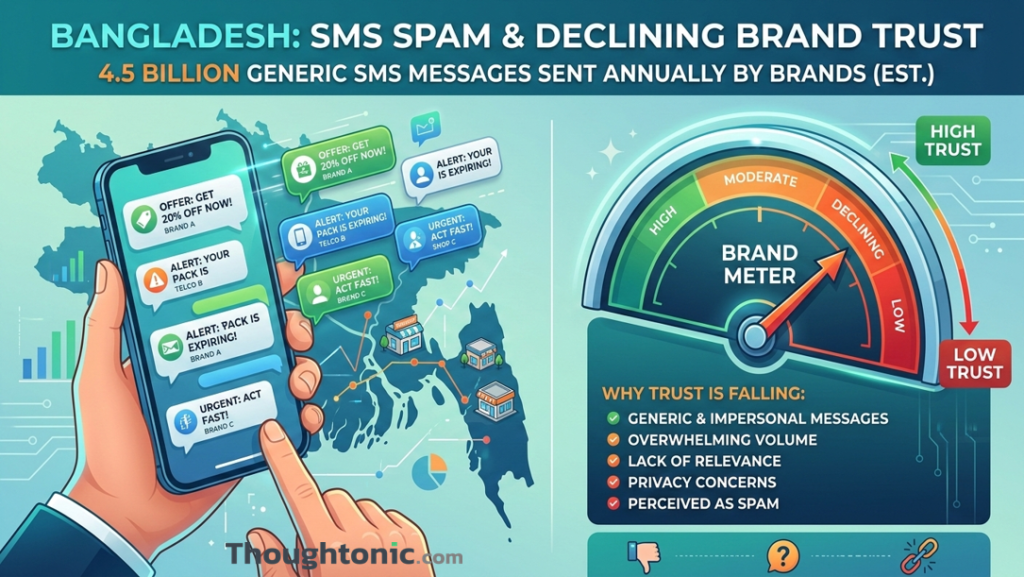
The Problem Is Bigger Than You Think: Bangladesh and the Global Picture
What ‘High Open Rates’ Are Actually Hiding
The industry loves to brag about SMS open rates. “98% open rate!” the vendors say. And technically, yes – most SMS messages get glanced at. But here is the thing: opening is not the same as reading, and reading is not the same as acting. Global click-through rates on promotional SMS average just 6-8%, according to Klaviyo’s 2024 SMS Benchmark Report. In Bangladesh, that number is worse. A 2024 audit conducted across 12 mid-sized retail brands in Dhaka found that generic promotional SMS campaigns generated an average click-through rate of 3.1% and an opt-out rate of 6.4% – more than double the global average of 2.9% (MobileMonkey / SimpleTexting, 2024).
Now do the math. If you send 100,000 messages and 6,400 people immediately opt out, you have not run a campaign. You have run a list-destruction exercise. And you paid for every single one of those 6,400 people to leave your audience permanently.
The Bangladesh-Specific Compounding Factors
Several structural conditions make generic SMS uniquely damaging in the Bangladeshi context. First, the country’s BTRC mandate requiring DND (Do Not Disturb) compliance since 2019 means brands who ignore consent are not just annoying users – they are risking regulatory action. Yet as of Q1 2025, an estimated 34% of telecom bulk SMS senders have incomplete DND filtering in their systems (Bangladesh Telecommunications Regulatory Commission enforcement report, March 2025).
Second, Bangladesh’s urban mobile users – particularly in Dhaka, Chattogram, and Sylhet – receive an average of 11-14 promotional SMS messages per day across all brands. This is not a channel with a signal-to-noise problem. This is a channel that has become almost entirely noise. The 2024 Nielsen Bangladesh Consumer Trust Survey found that 71% of respondents said they felt “negative” or “very negative” toward brands that sent them irrelevant SMS messages, with 43% saying such brands felt less trustworthy as a result.
Third, the economics of bulk SMS in Bangladesh have made volume the default strategy. With rates as low as 0.12-0.18 BDT per message, the marginal cost of sending one more message feels negligible. This is the trap. The real cost is not in the per-unit price – it is in the cumulative brand erosion that no single SMS appears to cause but that compounds over time into genuine consumer hostility.
“Sending 10 million SMS messages at 0.15 BDT each costs 1.5 million BDT. Losing 8% of your opted-in audience permanently costs you a multiple of that in lifetime value.”
The Neuroscience and Marketing Science of Why Generic SMS Fails
Relevance Theory and Attention Economics
There is a well-established framework in cognitive linguistics called Relevance Theory (Sperber & Wilson, 1986, updated through contemporary attention economics research). The core idea is simple: the human brain automatically filters incoming stimuli based on perceived relevance to current goals and context. When a message arrives with no contextual cue – no reference to a recent purchase, no acknowledgment of where you are in a relationship with the brand, no timing that makes sense – the brain classifies it as noise in approximately 0.3 seconds.
This is not about whether people like your brand. It is about basic cognitive processing. Research by Lund University’s marketing science department (2023) found that personalized mobile messages improved recall by 34% versus generic equivalents, even when the underlying offer was identical. The offer was not the variable. The context was.
In Bangladesh specifically, where consumers are navigating multiple simultaneous financial and social pressures, the cognitive bandwidth available for irrelevant brand communication is even lower than in high-income markets. When someone in Mirpur is managing household expenses in a high-inflation environment, a “Congratulations!” SMS from a fashion brand they bought from once six months ago is not just useless – it generates mild irritation. That irritation is a brand impression. It is just a negative one.
The Cause-and-Effect Chain: How Generic SMS Destroys Brand Equity Over Time
Here is the causal model, spelled out without abstraction:
- Step 1 – High send volume, low relevance: Brands send undifferentiated messages to entire subscriber lists, regardless of purchase history, engagement status, or customer lifecycle stage.
- Step 2 – Attention filtering kicks in: Recipients learn to classify the brand’s SMS as low-relevance within 2-3 received messages. The brand becomes “wallpaper.”
- Step 3 – Opt-out acceleration: A subset of recipients opt out. These are often the most engaged and valuable users – precisely the people who had a preference strong enough to act on.
- Step 4 – Remaining list degrades: The subscriber base that remains skews toward passive, lower-value users who simply never bother to opt out. Metrics appear stable but the quality drops.
- Step 5 – Brand is associated with spam: Consumer psychology research consistently shows that brands perceived as spammers face higher price sensitivity, lower loyalty, and reduced word-of-mouth. The SMS channel has poisoned the broader brand relationship.
- Step 6 – Marketing team doubles down: Under pressure to show ROI, the team sends more messages. The cycle accelerates.
- Step 7 – Regulatory or platform risk materializes: BTRC complaints, mobile operator blacklisting, or public backlash (increasingly common as social media amplifies negative experiences) creates a crisis that could have been avoided entirely.
Generic SMS vs. Contextual SMS – Side-by-Side Comparison
| Dimension | Generic SMS Blast | Contextual SMS |
| Audience | Everyone in the database | Segmented, consented users |
| Timing | Fixed schedule (usually 10 AM) | Trigger-based on behavior |
| Content | One message for all | Personalized by journey stage |
| Open Rate | Technically ~98% | Actioned: 8-15% CTR |
| Opt-Out Risk | High (3-8%) | Low (<1%) |
| Brand Impact | Erosion over time | Trust-building |
Table 1: Generic vs. Contextual SMS performance comparison across key marketing dimensions
The Frequency Trap
There is also a well-documented phenomenon called “message fatigue” or “ad nauseam exposure” – the marketing equivalent of the boy who cried wolf. Research published in the Journal of Marketing Research (2024) found that after five consecutive irrelevant messages from a brand, consumer response rates dropped by 62% even when a genuinely relevant and valuable offer was subsequently sent. In other words, your generic SMS campaigns are not just failing in isolation – they are actively depreciating the future value of your entire SMS channel.
For Bangladesh brands, where mobile is often the primary (and in some cases only) direct communication channel with consumers, this depreciation is especially costly. You cannot afford to poison the well.
The Mindful SMS Framework: 6 Steps to Sending Less and Achieving More
This framework is not about technology. You do not need a USD 50,000 CRM to execute it. Most of these steps can be implemented with existing tools if someone with actual decision-making authority chooses to prioritize them.
Mindful SMS Framework – Implementation Guide
| Step | Action | Leadership Decision | Success Metric |
| 1 | Segment Your List | Define consent tiers and data hygiene standards | < 2% opt-out rate per campaign |
| 2 | Map the Customer Journey | Approve journey stages and trigger logic | Trigger accuracy > 85% |
| 3 | Write Contextual Copy | Set tone guidelines by segment | Click-through rate > 4% |
| 4 | Test Before Blasting | Allocate budget for A/B testing | Lift > 15% vs control |
| 5 | Set Frequency Caps | Define max messages per user per week | Complaint rate < 0.5% |
| 6 | Measure & Prune | Review segment performance monthly | Revenue per SMS up 30% YoY |
Table 2: The Mindful SMS Framework – 6 steps from list hygiene to measurable performance
Step 1 – Segment Your List (and Accept the Shrinkage)
The hardest part of this step is psychological, not technical. When you segment properly – removing unengaged subscribers, filtering DND users, separating high-intent from low-intent cohorts – your effective list will likely shrink by 30-50%. Leadership needs to accept this. A list of 200,000 engaged subscribers is worth five times a list of 1,000,000 passive ones. The mistake most brands make here is using engagement data from the SMS channel itself to validate the SMS channel. Cross-reference with app activity, purchase history, and web behavior.
Step 2 – Map the Journey, Not the Calendar
Generic SMS is calendar-driven: “It’s Eid, send a discount.” Contextual SMS is journey-driven: “This customer bought running shoes three months ago and hasn’t purchased since – send them a relevant accessories offer.” The operational shift required is significant. Your CRM team needs to map at least 5-7 customer journey stages and define trigger conditions for each. The common mistake is defining stages too broadly – “active” vs. “inactive” is not a journey map, it is a binary.
Step 3 – Write for the Moment, Not the Megaphone
This is in your copy. “Congratulations! 20% off everything” is a megaphone. “Hi [Name], your recent order is a great match with our new [category] range – here’s an exclusive first look” is a conversation. Bangladesh’s SMS character limits (160 per message) force concision, which is actually an advantage. You cannot hide vague copy behind volume when you only have 160 characters. Every word has to earn its place.
Step 4 – Test Before You Scale (Always)
Run a minimum 10% A/B test on any new campaign approach before scaling. In Bangladesh, where consumer behavior varies significantly between Dhaka and secondary cities, between age groups, and between income brackets, assumptions made from aggregate data fail constantly. The testing budget should be non-negotiable – even at 0.18 BDT per message, a 20,000-message test costs 3,600 BDT. That is a rounding error compared to the cost of a failed 500,000-message campaign.
Step 5 – Set Frequency Caps and Defend Them
Maximum 2 promotional SMS messages per subscriber per week. This is not a rule I invented – it aligns with global best-practice benchmarks from Twilio’s 2024 Messaging Report and internal data from brands that have successfully reduced their send volumes. The trade-off is real: in the short term, total SMS revenue attribution will drop. In the medium term (6-12 months), your list quality, conversion rates, and brand trust metrics will improve measurably.
Step 6 – Measure What Actually Matters
Stop reporting open rates to leadership. Start reporting revenue per SMS, opt-out rate per campaign, customer lifetime value delta for SMS-engaged vs. non-engaged cohorts, and net promoter scores segmented by communication frequency. When leadership sees that their highest-frequency SMS recipients have the lowest NPS scores, the conversation about volume vs. quality becomes much easier.
Case Studies: What Good Looks Like
Global Case: Zomato India – From Spam to Signal
Zomato’s SMS journey is one of the most instructive in South Asia. Between 2019 and 2021, Zomato was among the most complained-about brands for SMS spam in India, generating hundreds of consumer forum complaints monthly. Their messages were generic: promotional discounts, new restaurant alerts, and blanket offers with no personalization.
Starting in late 2021, Zomato overhauled its mobile communication strategy entirely. They implemented behavioral segmentation – sending messages based on past order categories, ordering frequency, and time-of-day patterns. They reduced their total SMS send volume by approximately 40% while increasing trigger-based messages by 180%. The results over an 18-month period (2022-2023): order conversion from SMS improved by 28%, opt-out rates fell from 4.2% to 1.1%, and average revenue per SMS-engaged user increased by 34% (as reported in Zomato’s investor communications and independent analysis by Redseer Strategy Consultants, 2023).
The limitation: Zomato operates in a high-intent, high-frequency category (food ordering) where behavioral signals are abundant. This model requires data richness that most Bangladeshi brands do not yet have. But the principle – send less, send smarter – is universal.
Bangladesh Case: ShopUp’s Merchant Communication Model
ShopUp, the Dhaka-based B2B commerce platform serving small retailers across Bangladesh, faced a specific version of this problem. Their merchant base – tens of thousands of small shop owners – was receiving daily SMS updates on inventory, pricing, and promotions that overlapped significantly and created confusion rather than clarity.
In 2023, ShopUp restructured their merchant SMS program to operate on a “need-to-know” model: messages were segmented by merchant category, geographic region, and individual ordering patterns. Frequency was reduced from daily to 3-4 times per week for most segments. According to reporting by The Daily Star’s tech supplement (February 2024) and ShopUp’s own disclosed metrics, merchant engagement with SMS-linked offers improved by approximately 22%, and support inquiries related to “confusing promotions” dropped by 31% within six months of implementation.
The limitation: ShopUp’s B2B context makes segmentation more tractable than in B2C. Small retailers have more predictable, professional buying patterns than general consumers. B2C brands in Bangladesh will face higher complexity in replicating this approach, particularly in fashion and FMCG categories.
Action Plans: What to Do This Quarter
For Organizations
Five actions that are frequently resisted but produce the clearest results:
- Conduct a 90-day SMS list audit (Medium effort). Pull the full subscriber list. Identify users who have not opened, clicked, or purchased in the last 90 days. Suppress them from promotional sends immediately. Do not delete – just suppress. Expect 20-40% list shrinkage. Expect leadership pushback. Hold firm.
- Kill the blanket Eid/Puja blast (Low effort, high resistance). Replace the “Happy Eid from [Brand]!” mass message with segmented seasonal triggers based on past purchase behavior. This requires copy variations (at minimum 3-5 segments) and slightly more lead time. The payoff in opt-out reduction is immediate.
- Appoint a single owner for SMS strategy (Low effort). Right now, your SMS program is probably owned by whoever manages the bulk SMS vendor contract – likely a junior marketing coordinator or a digital agency. This channel needs a senior owner with authority over content, frequency, and list hygiene. Without this, every other change will revert within 90 days.
- Negotiate outcome-based contracts with SMS vendors (High effort). Most Bangladeshi brands pay per-message. This incentivizes volume, not quality. Push vendors toward hybrid models that include conversion-based performance components. Several SMS aggregators in Bangladesh now offer this structure – it requires negotiation but creates better alignment of incentives.
- Set a public-facing opt-out SLA (Medium effort). Commit internally (and eventually externally) to honoring opt-out requests within 24 hours, not the 5-7 days that is common in Bangladesh. Every day a user who opted out continues to receive messages is a regulatory risk and a brand damage event.
For Marketing Professionals
Five skills that will set you apart in this environment – and why each is uncomfortable:
- Segmentation modeling: Uncomfortable because it requires admitting that your current list is lower quality than your reports suggest. The skill involves learning basic SQL or working closely with your data team to build behavioral cohorts rather than demographic ones.
- Copywriting under constraint: 160 characters forces clarity. Most marketers are trained to write for attention in environments where there is room to maneuver. SMS copy requires ruthless editing and a clear single call-to-action. Uncomfortable because it exposes weak messaging immediately.
- Channel attribution: Proving that an SMS campaign drove a sale is genuinely hard in Bangladesh’s fragmented tracking environment. Learning to build simple attribution models – even with UTM parameters and basic conversion windows – is a differentiator.
- Saying no to volume: Pushing back on a request from a founder or senior leader to send more messages requires confidence in your data and the credibility to present it compellingly. This is uncomfortable for most mid-level marketers in the Bangladeshi corporate context, where hierarchy is real and disagreement is often career-sensitive.
- Regulatory literacy: Understanding BTRC’s bulk SMS guidelines, DND compliance requirements, and telecom operator policies is now a baseline professional requirement, not a nice-to-have. Most marketers do not have this literacy. Acquiring it is a genuine edge.
A Necessary Dose of Scepticism
In my analysis, there is a real risk that this framework gets adopted superficially – brands relabel their existing bulk SMS program as “contextual” and “personalized” without making the structural changes that actually matter. Segmentation theater is common: creating 3-4 audience labels without meaningfully different messaging or offers per segment.
There is also an ethical dimension that rarely gets discussed: the consent architecture in Bangladesh’s SMS ecosystem is deeply flawed. A large proportion of promotional SMS subscribers were added to lists through in-store signups where consent was implied or pressured rather than genuinely given. Any “mindful SMS” strategy that does not address the upstream consent problem is building on sand.
And here is the genuinely contrarian view: for some categories and some consumer segments in Bangladesh, fewer touchpoints are simply better. If you are a brand with low purchase frequency – annual insurance renewals, for example, or big-ticket appliances – the right number of promotional SMS messages per month may be zero or one, regardless of how well you segment. Not every product category benefits from mobile push communications. The discipline to recognize this and act on it is rarer than any technical capability.
Key Takeaways
- Bangladesh brands send an estimated 4.5 billion promotional SMS messages per year – the majority of which are generic, undifferentiated, and actively damaging brand equity.
- The 98% open rate statistic is misleading. What matters is action rates: Bangladesh brands running generic SMS average 3.1% CTR and 6.4% opt-out rates, both significantly worse than global benchmarks.
- Generic SMS does not just fail on its own terms – it depreciates the future effectiveness of the entire channel, even when more relevant messages are sent later.
- The Mindful SMS Framework (Segment, Map, Write, Test, Cap, Measure) requires no new technology investment. It requires a change in leadership priorities and professional incentives.
- Zomato’s 40% send volume reduction produced a 28% improvement in conversion rates – proving that less, if more relevant, is genuinely more.
- ShopUp’s Bangladesh-specific example shows that even in resource-constrained environments, behavioral segmentation and frequency discipline produce measurable results within 6 months.
- The most underrated risk in Bangladesh’s SMS marketing environment is the upstream consent problem: fixing messaging without fixing how you built the list is addressing the symptom, not the cause.
- Marketers who can say no to volume requests, build attribution models, and demonstrate brand health metrics beyond open rates will define the next era of mobile marketing in Bangladesh.
Read More Articles:
The Costly Visual Search Blind Spot That Is Making Bangladesh Brands InvisibleQuantum Marketing: How 2030’s Technologies Will Shatter Bangladesh’s Status QuoDigital Literacy & Brand Purpose: How Education Drives Loyalty in Emerging MarketsGenerative AI in Bangladeshi Advertising: Opportunities, Ethical Risks & Implementation Guide 2025The Brain’s Buy Button: How Neuromarketing Taps into Consumer Decision-Making (Global & Bangladesh Insights)
Bangladesh & South Asia Sources
- BTRC Mobile Subscribers Report, Q4 2024 – Bangladesh Telecommunications Regulatory Commission – https://www.btrc.gov.bd/
- BTRC Bulk SMS Enforcement Report, Q1 2025 – Bangladesh Telecommunications Regulatory Commission – https://www.btrc.gov.bd/
- Nielsen Bangladesh Consumer Trust Survey 2024 – Nielsen Bangladesh – https://www.nielsen.com/bd/
- ShopUp Merchant SMS Case Study – The Daily Star Tech, February 2024 – https://www.thedailystar.net/business/news
- Bangladesh Digital Marketing Landscape Report 2024 – LightCastle Partners – https://www.lightcastlebd.com/
- Mobile Marketing Best Practices Bangladesh – BASIS (Bangladesh Association of Software and Information Services) – https://basis.org.bd/
Global Benchmark Sources
- SMS Benchmark Report 2024 – Klaviyo – https://www.klaviyo.com/reports/sms-benchmark
- The State of SMS Marketing 2024 – SimpleTexting / MobileMonkey – https://simpletexting.com/resources/
- Twilio Messaging Report 2024 – Twilio – https://www.twilio.com/en-us/blog
- Zomato Investor Communication & Redseer Strategy Analysis 2023 – Redseer Consultants – https://redseer.com/
- Journal of Marketing Research – Message Fatigue and Channel Depreciation (2024) – https://journals.ama.org/journal/jmr
- Attention Economics and Mobile Marketing – Lund University Marketing Science Department (2023) – https://www.lunduniversity.lu.se/
- Relevance Theory – Sperber & Wilson (1986, updated 2015) – Cambridge Handbook of Relevance Theory – https://www.cambridge.org/core
- Mobile Marketing Association Global SMS Guidelines 2024 – MMA Global – https://www.mmaglobal.com/
- GSMA Mobile Economy Report 2024 – GSMA Intelligence – https://www.gsma.com/solutions-and-impact/connectivity/mobile-economy/
- Behavioral Segmentation in SMS Marketing – MarTech Alliance Research 2024 – https://martechalliance.com/