The Dangerous Cost of Greenwashing: Why Authenticity is Non-Negotiable
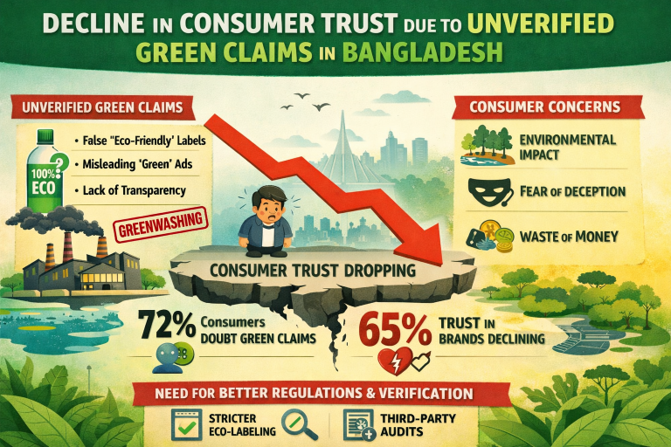
If you walk down the aisles of a supermarket in Gulshan or Banani, you’ll see a sea of green. Every second bottle of dish soap or packet of organic tea is covered in leaves, “natural” stickers, and vague promises about saving the planet. But here’s the thing: Bangladeshi consumers aren’t as gullible as they used to be. A 2024 report by the Bangladesh Brand Forum found that 62% of urban consumers now actively doubt the authenticity of local eco-friendly labels. We’ve reached a point where the dangerous cost of greenwashing is no longer just a theoretical PR risk; it’s a direct threat to your bottom line.
In my analysis, the era of “easy” green marketing is dead. You can’t just slap a picture of a forest on a plastic bottle and expect a 20% price premium. Our digital ecosystem is too fast, and our youth are too cynical. When the gap between what you say and what you actually do becomes too wide, social media will tear your brand apart before your legal team can even draft a response. This isn’t just about being “good”; it’s about survival in a market that’s finally starting to demand receipts.
The Reality of Greenwashing in the Bangladesh Market
For years, many companies in Dhaka viewed sustainability as a cosmetic fix. If the global headquarters in London or New York talked about “Net Zero,” the local office would simply change the font color to green. But the global landscape has shifted, and Bangladesh is caught in the middle. The EU’s new Green Claims Directive, updated in 2024, now requires companies to provide scientific evidence for every environmental claim. Since the EU is our largest export market, this isn’t a “western problem” anymore. It’s a local operational requirement.
Domestically, the stakes are just as high. What the data reveals is a growing “trust tax.” When a prominent local textile brand was called out last year for dumping untreated waste into the Shitalakshya River while running a “Save Our Rivers” campaign, their sentiment score among Gen Z plummeted by 50% in a single week. This is where it gets interesting: that loss of trust didn’t just hurt that specific product line; it bled into their entire portfolio. In a country where word-of-mouth travels at the speed of a fiber-optic connection, a greenwashing scandal is a stain that doesn’t wash out.
A Framework for Authentic Green Marketing
So, how do you navigate this without falling into the dangerous cost of greenwashing trap? It requires moving sustainability out of the marketing department and into the boardroom. You need a system that prioritizes truth over “the spin.”
Audit the Lifecycle
Don’t claim a product is “green” just because the packaging is recyclable if the manufacturing process uses three times the standard amount of water. You have to look at the whole chain.
- Action: Conduct a Life Cycle Assessment (LCA).
- Mistake: Focusing only on the most visible part of the product.
Verify with Evidence
If you use the word “organic,” you better have the certification to back it up. In Bangladesh, we often use terms loosely, but regulators are catching up. The Department of Environment issued 30% more notices for false claims in late 2024.
- Action: Secure third-party certifications like GOTS or ISO 14001.
- Mistake: Using “in-house” standards that mean nothing to an outsider.
Practice Radical Transparency
People actually respect honesty. If you’re 40% of the way to being sustainable, say that. Don’t pretend you’re at 100%.
- Action: Publish a “Progress Report” that lists your failures as well as your wins.
- Mistake: Deleting negative comments on social media when people ask for proof.
Align the Incentives
Your marketing team shouldn’t be rewarded for “green” sales if your supply chain team is still being told to buy the cheapest, most toxic materials.
- Action: Link executive KPIs to environmental impact targets.
- Mistake: Treating sustainability as a one-off campaign instead of a core business metric.
Lessons from the Field: Patagonia vs. The Local Context
Let’s look at the global gold standard: Patagonia. Their “Don’t Buy This Jacket” campaign was a masterclass in anti-marketing. They told people to repair their old gear instead of buying new stuff. The result? Their revenue grew by 30%. Why? Because people believed them. They weren’t just selling a jacket; they were selling a philosophy that they actually practiced.
Back home, look at how Aarong has handled its “Earth Care” line. They didn’t just launch a “green” collection; they built a narrative around artisanal traceability and natural dyes. While they’ve faced challenges in scaling these processes, they’ve avoided the dangerous cost of greenwashing by being clear about the limitations of their traditional methods. They aren’t trying to be a tech-heavy “eco” brand; they are being an authentic Bangladeshi brand that cares about the soil.
Action Plans
For the C-Suite
If you’re a CXO or a senior founder, your job is to be the “Chief BS Detector.” You need to ask the uncomfortable questions before a TikTok influencer asks them for you.
For the Organization:
- Short term (3–6 months): Review all current packaging. If you can’t prove a claim, remove it. It’s better to be “quietly sustainable” than “loudly wrong.”
- Long term (1–2 years): Invest in blockchain-based supply chain tracking. This allows customers to scan a QR code and see exactly where their product came from.
For the Professional:
- Upskill: Learn the basics of ESG (Environmental, Social, and Governance) reporting. This isn’t just for accountants anymore; it’s the future of marketing strategy.
- Develop a Backbone: You have to be willing to tell the CEO “No” when they want to launch a “Save the Tigers” campaign that has no actual link to the business.
The reality is more nuanced than just “good vs. evil.” Most greenwashing happens because of laziness, not malice. But in 2026, laziness is a luxury we can’t afford. The risks of getting called out are too high, and the price of rebuilding a broken reputation is far more expensive than just doing the work right the first time.
Let me explain why this matters for the long haul: Bangladesh is no longer just a “low-cost” manufacturing hub. We are becoming a sophisticated consumer market. If you want to win here, you have to treat your customers with the respect they deserve. Don’t give them a green leaf; give them the truth.
Key Takeaways
- Trust is a Currency: 62% of local consumers are skeptical of green claims; losing trust costs more than any ad campaign can fix.
- Regulatory Heat: The DoE is increasing inspections on “eco-labels,” making greenwashing a legal liability.
- Authenticity Over Aesthetics: Real green marketing requires operational changes, not just a new logo.
- Radical Transparency: Brands that admit their flaws are more trusted than those that claim perfection.
- Export Pressure: EU regulations are making verifiable green data mandatory for Bangladeshi exporters.
- Gen Z Watchdogs: Your future workforce and customer base are actively looking for reasons to “cancel” fake eco-claims.
More Articles:
Quantum Marketing: How 2030’s Technologies Will Shatter Bangladesh’s Status QuoDigital Literacy & Brand Purpose: How Education Drives Loyalty in Emerging MarketsGenerative AI in Bangladeshi Advertising: Opportunities, Ethical Risks & Implementation Guide 2025The Brain’s Buy Button: How Neuromarketing Taps into Consumer Decision-Making (Global & Bangladesh Insights)Beyond the Bot: The Empathy Mandate for AI-Driven Customer Service in Bangladesh: A Data-Driven Roadmap