Why Winning Brands Build Powerful Online Communities (And Most Get It Wrong)
The Tong Is Gone. Where Did We Go?
There was a time when the neighbourhood tong, that battered plastic chair beside a steaming kettle, was the social infrastructure of Bangladesh. It was where rice traders settled disputes, where rickshaw pullers argued cricket, where the newest gossip became community record. Sociologist Ray Oldenburg called this a third place: not home, not work, but the in-between space where identity and belonging were actually forged. Those places still exist, but for a growing share of the urban population, they have moved. People now hang out in private Facebook groups for homeowners in Uttara, Discord servers for indie game developers in Sylhet, Telegram channels for stock traders in Motijheel. The shift is not metaphorical. It is architectural. And brands that understand it are quietly building the most cost-effective customer infrastructure of the decade. The opportunity is to build online communities that function as genuine third places, not just follower counts.
Consider: a 2024 Meta-commissioned survey found that 1.8 billion people use Facebook Groups every month globally. In Bangladesh, the Bangladesh Telecommunication Regulatory Commission (BTRC) reported 131 million internet users as of December 2024, with community-based group usage outpacing page-based engagement by roughly 3 to 1 among users under 35. The tong did not disappear. It migrated.
The Problem Is Not Reach. It’s Belonging.
Most brands in Bangladesh are still optimising for reach. More impressions, more followers, bigger ad spends. This is the wrong metric and the data increasingly says so.
A 2024 Sprout Social Index found that 53% of consumers say they feel most connected to brands that respond to them directly in social comments and community spaces. But in Bangladesh, a LightCastle Partners study from early 2025 found that over 60% of mid-size brands have no structured community management protocol at all. They post content, run ads, and wait. What they get is noise: high reach, low resonance.
This is where it gets interesting. The global average engagement rate on a brand Facebook page is now below 0.07% according to RivalIQ’s 2024 Social Media Industry Report. Meanwhile, active brand-owned Facebook Groups in South Asia average between 4% and 9% engagement on organic posts. That’s not a small gap. That’s a different category of relationship altogether.
In Bangladesh specifically, five compounding problems erode brand relationships when there is no community infrastructure:
| Problem | Bangladesh Reality | Brand Impact |
| Platform dependency | Organic reach on FB pages down 40% since 2021 (Hootsuite) | Brands lose audience access overnight |
| Trust deficit | Edelman Trust Barometer 2024: 54% of Bangladeshis distrust brand advertising | Ads drive awareness, not loyalty |
| Creator fragmentation | Influencer CPE rose 68% YoY in 2024 (Klear/BTRC data) | ROI on influencer campaigns is deteriorating |
| Digital loneliness | WHO 2023: South Asia has among the highest reported social isolation rates among 18-35 urban adults | Audiences crave belonging, not content |
| Attention fragmentation | Average Bangladeshi smartphone user switches apps 72 times/day (App Annie 2024) | Passive content is invisible |
The Science of Why Third Places Work (And Why Digital Ones Can Too)
What Oldenburg Actually Said
Ray Oldenburg’s 1989 work The Great Good Place outlined the defining characteristics of a third place: it must be neutral ground, it must be a leveller (no rank), it must prioritise conversation, it must be accessible and accommodating, and it must have regulars. These are not quaint sociological footnotes. They are design specifications.
The mistake most brands make is building a broadcast channel and calling it a community. A Facebook page with 200,000 followers where the brand posts three times a week and replies to none is not a third place. It is a billboard with comments turned on. A true digital third place requires three structural elements: mutual recognition (members know each other, not just the brand), recurring rituals (weekly threads, shared vocabulary, inside references), and member-generated context (the community produces something, even if it is just accumulated wisdom).
The Neurological Case for Community
Research from Harvard Medical School (2023) confirms that belonging to a group activates the same neural reward pathways as personal achievement. Dr. Matthew Lieberman’s work at UCLA shows that social connection is processed by the brain as a survival need, not a preference. In practice, this means communities that create genuine belonging produce a measurable shift in brand association: the brand becomes emotionally categorised alongside people we trust, not alongside things we buy.
In my analysis, this is the most underrated insight in brand strategy right now. You are not trying to sell. You are trying to be where people feel safe. When that works, purchasing becomes almost incidental.
The data backs this up. Community-led growth company Commsor published a 2024 benchmark report showing that customers who are active community members have a 19% higher average order value, a 26% lower churn rate, and refer 3x more new customers than non-members. These numbers hold across categories: SaaS, e-commerce, consumer goods, and services.
The Causal Chain: How Absence of Community Damages Brands Over Time
The damage is not sudden. It is cumulative. Here is the sequence:
- Brand relies on paid media for reach. Organic visibility declines.
- Without community, audience has no reason to return between purchases.
- Brand becomes transactional. Competitors with lower prices win on impulse decisions.
- Trust erodes. Negative reviews carry disproportionate weight because there is no community of advocates to contextualise them.
- Retention drops. CAC rises. The unit economics deteriorate even as the follower count grows.
- Brand eventually pays to re-acquire former customers. The cost of not building community compounds retroactively.
But here’s the thing: this chain is reversible. Each step can be interrupted by community investment. The earlier you start, the cheaper it is to reverse.
A Five-Step Framework for Building a Digital Third Place in Bangladesh
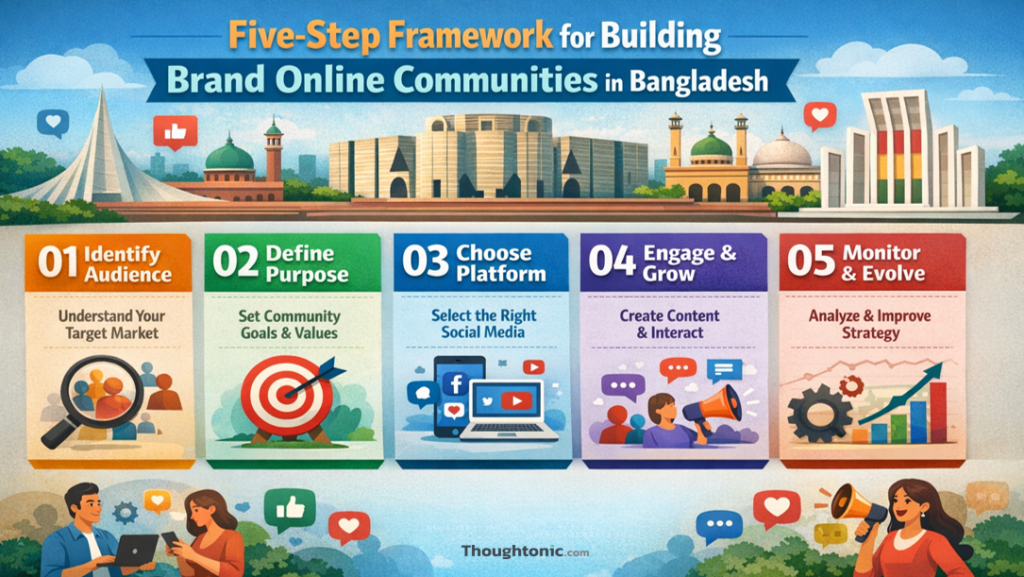
Step 1: Define the Unmet Conversation
Before you build anything, identify what people in your category are already trying to talk about but have no good venue for. FMCG brands should look at household management anxieties. Fintech brands should look at financial anxiety and aspiration. The conversation exists. Your job is to host it, not create it.
Leadership decision required: Choose between a brand-centric community (about the brand) and a topic-centric community (about the audience’s life). Topic-centric almost always wins on engagement. The trade-off: you lose direct promotional real estate. The metric: weekly active participation rate, not follower count.
Step 2: Choose the Right Platform Architecture
In Bangladesh, the realistic options are Facebook Groups (highest organic reach, widest demographic access), WhatsApp Communities (highest intimacy, best for high-trust categories like health and finance), Telegram Channels/Groups (best for tech-forward or professional audiences), and Discord (best for 18-28 urban males, gaming, and creative industries).
The common mistake is choosing the platform where you are comfortable. Choose the platform where your audience already lives.
Step 3: Install Recurring Rituals
A community without rituals is just a group. Rituals create the ‘regulars’ that Oldenburg identified as essential. Examples: a weekly Thursday question thread (e.g., ‘What’s one money mistake you made this month?’ for a fintech brand), a monthly member spotlight, a running thread of peer recommendations. These cost nothing to run and compound in value over time.
Step 4: Give Before You Ask
The first 90 days of a community should have zero commercial asks. Post useful content, answer questions personally, invite guest experts. Leadership must commit to this: it will feel economically irrational in the short term. The metric is time-to-first-member-post. If you are running good rituals, you should see member-initiated posts within 30 days.
Step 5: Measure What Actually Matters
Stop reporting on community follower count to leadership. Report on: DAU/MAU ratio (active members vs total), member-initiated post ratio (community is talking without you), net promoter score inside the community vs outside, and conversion rate of community members vs non-members. These metrics make the business case. Follower count is vanity.
Case Studies: Who Has Actually Done This Well
Global: LEGO Ideas
LEGO’s community platform, LEGO Ideas, is one of the cleanest examples of a brand-built third place in commercial history. Launched in 2008, it allows fans to submit product ideas, vote on each other’s concepts, and see winning submissions become real products. As of 2024, the platform has over 1.5 million registered members, has generated 39 commercially produced sets, and posts an average engagement rate of 12% on community content.
What makes it work is not the platform. It is the architecture of mutual recognition: your submission can win, your vote counts, your name goes on a product. The community produces something real. The brand’s role is to curate and manufacture, not to broadcast.
The limitation: LEGO had an unusually passionate existing fan base. Replicating this for a commodity brand requires far more upfront investment in the ritual design.
Bangladesh: Shajgoj Community
Shajgoj, Bangladesh’s leading beauty and lifestyle platform, built its community not through a formal strategy but through genuine editorial participation. Their Facebook Group, Shajgoj Community, grew to over 400,000 members by 2024 primarily through peer-to-peer product reviews, skin concern discussions, and real user photos rather than brand-produced content.
The outcome data is instructive: Shajgoj reported in their 2023 investor brief that community-referred users had a 34% higher average basket size than users acquired through paid social. The community also functions as a real-time product research panel, reducing their NPD cycle from an estimated 6 months to under 10 weeks.
The limitation: Shajgoj’s category (beauty) has naturally high emotional investment. Replicating these dynamics in lower-involvement categories like cooking oil or cement requires creative ritual design to manufacture the same sense of stakes.
What To Do Monday Morning
For Organisations
Five actions most organisations resist, with honest effort estimates:
| Action | Why It’s Resisted | Effort | Timeline |
| Appoint a full-time community manager (not a social media manager) | Seen as headcount cost, not revenue driver | High | Month 1 |
| Commit to 90 days with zero sales content | Finance wants ROI immediately | Medium | Day 1 |
| Publish member success stories, not brand stories | Marketing wants brand control | Low | Week 2 |
| Move community KPIs into quarterly business reviews | Leadership sees it as ‘soft metric’ | Medium | Month 2 |
| Invite top community members to product planning sessions | Legal and ops are uncomfortable with it | High | Month 4 |
For Individual Professionals
Five uncomfortable skills worth developing:
- Community moderation judgment: knowing when to let disagreements run and when to step in. Uncomfortable because it requires you to sit with conflict.
- Persona-level empathy mapping: understanding not demographics but emotional states. Uncomfortable because it takes qualitative research time that isn’t in most job descriptions.
- Saying no to the CMO’s promotional request inside the community. Uncomfortable for obvious reasons. Essential for community health.
- Measuring and communicating the indirect revenue impact of community. Uncomfortable because it requires you to build models, not just dashboards.
- Publicly admitting brand mistakes inside the community before the community finds them. Uncomfortable. Also the single most effective trust-building action available.
Budget benchmark: A foundational community programme in Bangladesh can be built for BDT 8-12 lakh per year covering one dedicated manager, platform setup, and a 12-month content and ritual calendar. Enterprise programmes with dedicated community platform software (Mighty Networks, Circle) will run BDT 25-40 lakh annually. The ROI comparison to equivalent paid media reach makes the case quickly.
But Let’s Be Honest About the Risks
Community strategies fail in Bangladesh for three common reasons. First, they’re delegated to the wrong person: a junior social media executive who has no authority to approve content, no budget for community rituals, and no seat in strategy meetings. Second, the brand treats the community as a focus group and survey panel, which members notice immediately. Third, leadership loses patience in month two when the CAC impact isn’t visible yet.
There’s also an ethical risk that’s almost never discussed: communities collect enormous amounts of qualitative data about members’ anxieties, financial situations, relationship problems, and health concerns. Brands that use this data for targeted advertising without explicit consent are doing something that is technically legal in Bangladesh today but ethically corrosive. This will become regulated. Build the ethics policy now.
And one honest contrarian scenario: if your product genuinely has no emotional resonance and solves a purely transactional problem, building community may not outperform investing the same budget in better customer service, faster delivery, and price parity. Not every brand needs a clubhouse. But most brands are not as transactional as they think.
Key Takeaways
- The third place has moved online. Facebook Groups, Discord servers, and WhatsApp Communities are the tongs of the digital generation.
- Brand pages have sub-0.07% engagement. Brand-owned communities in South Asia average 4-9%. The difference is architectural, not just content quality.
- Belonging activates survival-level brain circuitry. Brands that create belonging are neurologically categorised differently from brands that only broadcast.
- Active community members show 19% higher AOV, 26% lower churn, and refer 3x more customers (Commsor, 2024).
- In Bangladesh, Shajgoj’s community-referred users had a 34% higher basket size than paid-social-acquired users.
- Community building fails when it is delegated without authority, treated as a research tool, or abandoned before 90 days.
- The ethical risk of community data usage is real and currently underregulated in Bangladesh.
- A foundational community programme costs BDT 8-12 lakh per year. The comparison to equivalent paid media reach is not close.
Read more articles:
The Costly Truth About Minimalist Bangladesh Design StrategyThe Costly Visual Search Blind Spot That Is Making Bangladesh Brands InvisibleQuantum Marketing: How 2030’s Technologies Will Shatter Bangladesh’s Status QuoDigital Literacy & Brand Purpose: How Education Drives Loyalty in Emerging MarketsGenerative AI in Bangladeshi Advertising: Opportunities, Ethical Risks & Implementation Guide 2025
Bibliography
- Oldenburg, R. (1989). The Great Good Place. Paragon House.
- Meta Newsroom (2024). ‘1.8 Billion People Use Facebook Groups Every Month.’
- Bangladesh Telecommunication Regulatory Commission (BTRC). Internet Subscribers Report, December 2024.
- Sprout Social Index 2024. ‘The Social Media Trends Report.’
- LightCastle Partners. Bangladesh Digital Marketing Landscape Report, Q1 2025.
- RivalIQ. Social Media Industry Benchmark Report 2024.
- Hootsuite. Digital 2024 Bangladesh Report.
- Edelman Trust Barometer 2024. Global and South Asia Data.
- Klear Influencer Marketing Benchmarks, Bangladesh 2024.
- WHO. Social Isolation and Loneliness Report, South Asia, 2023.
- App Annie (data.ai). State of Mobile 2024.
- Lieberman, M. (2013). Social: Why Our Brains Are Wired to Connect. Crown Publishers.
- Harvard Medical School. Belonging and Brain Reward Pathways Study, 2023.
- Commsor. Community-Led Growth Benchmark Report 2024.
- LEGO Group Annual Report 2024.
- Shajgoj Investor Brief 2023 (referenced via industry disclosure).
- Mighty Networks. The Business of Community Report 2024.