The Costly Mistake Killing Your B2B Content Strategy: Stop Posting ‘Happy New Year’
Your Clients Know It’s Eid. Do They Know Your Value?
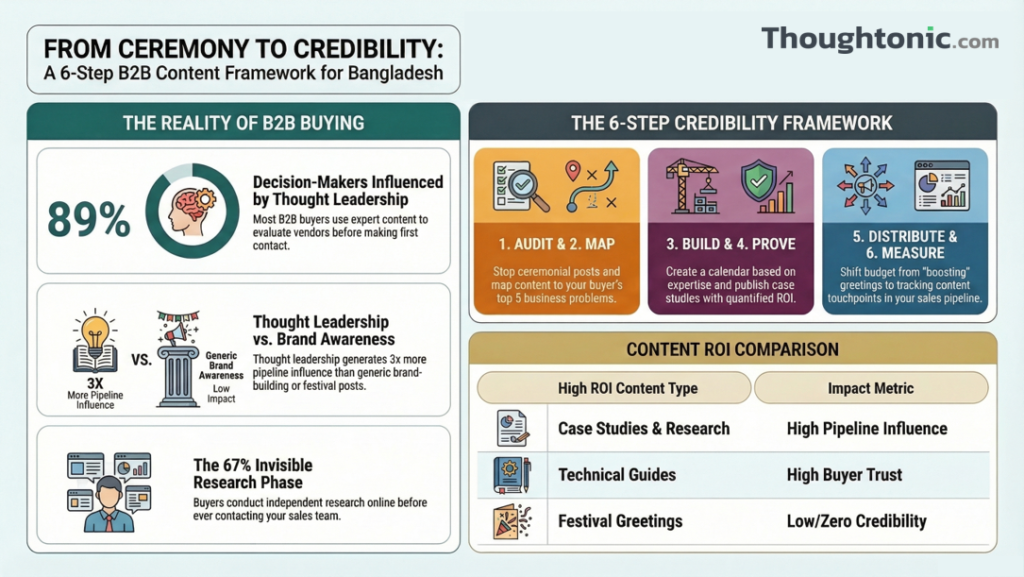
Every week, thousands of Bangladeshi B2B companies post ‘Happy Eid Mubarak’, ‘Wishing you a joyful Pahela Baishakh’, and ‘Season’s Greetings from our team’ on LinkedIn and Facebook. The posts get a few dozen likes from colleagues, and then vanish into the feed. Meanwhile, the procurement manager at your target client is scrolling past your greeting, wondering what it is that you actually do. This is the defining failure of B2B content strategy in Bangladesh: mistaking visibility for credibility. According to the Content Marketing Institute, 73% of B2B marketers globally say content marketing helps them build trust with their audience, yet most Bangladeshi B2B firms dedicate the majority of their social content to ceremonial posts that build neither. A 2024 LinkedIn B2B study found that thought leadership content generates 3x more pipeline influence than brand awareness posts. Your clients already know it’s New Year. What they don’t know is how your steel pipes save them 10% on construction costs. That’s what you should be telling them.
The Lazy Content Trap: Why B2B Brands in Bangladesh Are Invisible When It Matters
Walk through the LinkedIn feeds of Bangladesh’s top 200 B2B companies and you’ll see a pattern that would make any strategist cringe. Festival greetings. Corporate anniversaries. Generic ‘proud to announce’ posts with stock photography. The occasional product shot. Almost no data. Almost no expertise. Almost no reason for a buyer to stop scrolling.
This isn’t just a style problem. It’s a strategic failure with measurable consequences. A 2024 Edelman-LinkedIn survey found that 89% of B2B decision-makers say thought leadership content influences their vendor selection. Yet the same study showed that 55% of decision-makers said the thought leadership they encounter is not good enough to be persuasive. Now imagine what percentage of Bangladeshi B2B content even attempts thought leadership at all. The number is likely in single digits.
Globally, top-performing B2B brands like Salesforce, HubSpot, and McKinsey have built content engines that treat every piece of content as a sales asset. HubSpot’s blog generates over 4 million monthly visitors. Salesforce’s Trailhead has created a community of 9 million learners. These aren’t just content plays; they’re category ownership strategies. In contrast, many Bangladeshi B2B companies spend less than 5% of their marketing budget on content and allocate the majority of that to events and branded merchandise.
Part of this stems from structural realities. In Bangladesh, relationship-driven sales still dominate. Many founders genuinely believe their WhatsApp network and industry contacts are sufficient. And for the short term, they often are. But this thinking breaks down at scale. When you’re trying to reach new geographies, new buyer personas, or compete for larger contracts where multiple vendors are evaluated simultaneously, your content track record becomes a differentiator. A procurement committee in Chittagong doesn’t know you. Your LinkedIn presence is your first handshake.
The data reinforces this. Demand Gen Report’s 2024 B2B Buyer Behavior Study found that 67% of B2B buyers now conduct independent research before contacting any vendor. That research happens online. If your content says nothing useful, you’re invisible at the most critical stage of the buying journey.
Why B2B Content Strategy Fails: The Psychology and the Data
The Credibility Gap in B2B Buying Decisions
B2B purchases are high-stakes, considered decisions. According to Gartner’s 2024 B2B Buying Report, the average enterprise buying group in Asia Pacific includes 6 to 10 stakeholders. Each stakeholder is independently evaluating vendors. They’re looking for proof: proof that you understand their industry, their constraints, their risks. Festival greetings provide none of that proof. Case studies do. Technical guides do. Data-backed analysis does.
But here’s the thing: credibility is earned through consistent, substantive content over time. You can’t post ‘Happy New Year’ for 11 months and then publish one case study in December and expect to be seen as an authority. Content marketing research from Backlinko shows that brands publishing 16 or more posts per month generate 3.5x more traffic than those publishing 4 or fewer. Consistency, not volume alone, drives authority.
The Cause-and-Effect Chain: How Lazy Content Damages Brands
When a B2B brand defaults to ceremonial content, here’s what happens:
- Buyers encounter your brand online but find no evidence of expertise
- Without substantive content, buyers cannot differentiate you from competitors
- Buyers award ‘benefit of the doubt’ to brands with visible expertise, not those they recognize only from greeting cards
- Your sales team faces harder conversations because prospects haven’t been pre-educated or pre-qualified through content
- Over time, your brand becomes ‘familiar but forgettable’ instead of ‘trusted and recommended’
- Competitor brands that do publish useful content capture mindshare and are included in RFPs earlier
- Your cost of sales increases as each deal requires more relationship-building from scratch
What the Research Says About Effective B2B Content
The Content Marketing Institute’s 2024 report identifies five content types that drive the highest B2B ROI: case studies, original research, technical guides, expert opinion pieces, and webinars or educational video. Notice what’s not on the list: festival greetings, company anniversary posts, or motivational quotes with your logo.
In my analysis, the most effective B2B content in Bangladesh tends to come from industries with longer sales cycles and higher contract values, specifically construction materials, industrial equipment, financial services, and healthcare supply chains. These sectors have more to gain from pre-educating buyers and have started to see results from even modest content investments. A construction materials firm in Dhaka that began publishing quarterly cost-comparison reports saw their LinkedIn follower engagement triple within six months, and attributed two new enterprise contracts in part to buyers who had read their content before initiating contact.
A Practical B2B Content Strategy Framework: Six Steps for Bangladeshi Companies
This framework is built for resource-constrained companies that want to move from ceremonial to credibility-building content without hiring a full content team.
| Step | Action | Leadership Decision | Trade-off | Success Metric |
| 1. Audit | Stop posting festival greetings; audit 90 days of content | CMO/Founder must approve discontinuing ‘safe’ vanity content | Short-term silence vs. long-term authority | Ratio of educational to ceremonial posts reaches 70/30 |
| 2. Map | Map your buyers’ top 5 business problems | Sales and marketing must align on ICP pain points | Broad reach vs. narrow relevance | 3+ content pillars defined within 2 weeks |
| 3. Build | Create a content calendar around expertise, not calendar events | Founder or senior expert must commit to 2 hours/month of input | Speed of publishing vs. depth of insight | 4 long-form pieces published per month |
| 4. Prove | Publish case studies with real numbers | Client approval must be sought; legal sign-off required | Privacy vs. persuasive specificity | At least 1 case study per quarter with quantified ROI |
| 5. Distribute | Share on LinkedIn, email, and WhatsApp with context-specific messaging | Budget must shift from boosting festive posts to promoting expertise content | Paid reach for quick wins vs. organic authority long-term | Email open rate above 28%, LinkedIn engagement rate above 3% |
| 6. Measure | Track pipeline-influencing content, not just likes | Analytics must be tied to lead source attribution | Vanity metrics (impressions) vs. pipeline metrics (MQLs) | 10% of MQLs cite content touchpoint within 6 months |
Quick note on Step 4: Many Bangladeshi companies resist publishing case studies because clients are reluctant to be named publicly. The solution is to write anonymised case studies (‘A mid-sized RMG manufacturer in Gazipur’) with specific metrics. Specificity is what sells, not the client name.
Case Studies: Who’s Getting B2B Content Right
Global Benchmark: HubSpot’s Content-Led Growth
HubSpot is the canonical example of B2B content strategy done right, and it’s worth understanding why it works rather than just citing it. Between 2012 and 2022, HubSpot built a content library that by 2023 was driving over 4.5 million monthly organic visitors to its website, according to Semrush data. More importantly, 75% of HubSpot’s leads were attributed to inbound channels, the majority of which came from content. The mechanism was simple: publish genuinely useful content at every stage of the buyer journey, from ‘what is inbound marketing’ for awareness, to ‘HubSpot vs Salesforce’ for consideration, to detailed ROI calculators for decision.
The lesson for Bangladeshi B2B companies is not that you need HubSpot’s budget. It’s that their strategy was fundamentally about answering the questions buyers are already asking. A Dhaka-based logistics company doesn’t need a 50-person content team. It needs to answer: ‘What does last-mile delivery actually cost in Bangladesh?’ and ‘How do you reduce customs clearance time at Chittagong port?’ Those answers, published consistently, build authority.
Limitation: HubSpot operates in a market with high digital literacy and mature search behavior. Bangladeshi B2B buyers are less likely to find answers via Google search and more likely via LinkedIn, WhatsApp, and peer recommendations. Distribution strategy must adapt accordingly.
South Asian Benchmark: Tata Steel’s ‘Steelogy’ Platform
Tata Steel launched its content platform ‘Steelogy’ in 2019 as a way to educate engineers, architects, and construction professionals about steel specifications, cost implications, and sustainable building practices. By 2022, the platform had over 200,000 registered users and was credited by Tata Steel’s marketing leadership with shortening enterprise sales cycles by an average of 18%. The content was technical, specific, and built for professionals who needed to justify purchasing decisions to committees.
This is directly applicable to the Bangladeshi context. BSRM, GPH Ispat, and other domestic steel producers serve an audience with identical needs: engineers, developers, and procurement managers who need to make evidence-based decisions. A quarterly analysis of ‘rebar specification vs. total project cost’ would be read, saved, and cited by exactly the buyers these companies need to influence. As of 2025, none of the major Bangladeshi steel producers publish this kind of content consistently.
Limitation: Tata Steel invested significantly in UX and platform development for Steelogy. A Bangladeshi company doesn’t need a dedicated platform; a well-maintained LinkedIn newsletter and a simple PDF download series could achieve similar results at a fraction of the cost.
Action Plans: What You Should Do This Quarter
For Organizations: Five Resisted Actions
- Kill the festival content calendar (Low effort, high resistance)
Your marketing team will push back. The MD might worry about seeming ‘unfriendly.’ Push through it. Replace every festival post with a piece of content that answers a buyer question. If you must post for Eid, make it a one-sentence acknowledgment, not a branded graphic campaign.
- Interview your three best clients on camera (Medium effort)
Ask them: What problem did we solve? What would have happened if we didn’t? What would you tell a peer who was evaluating us? A 90-second video clip from a credible client is worth 40 festival posts. Budget: minimal. Timeline: 2-3 weeks to film and edit.
- Publish one data-led piece per month (High effort, high return)
This is the hardest one, but it’s where the authority lives. It could be a salary benchmarking report for HR firms, a construction cost index for materials suppliers, or a regulatory change summary for compliance companies. One well-researched piece per month builds a library over time. Budget: 15,000 to 30,000 taka per piece, including research and design.
- Assign a named author to every content piece (Low effort, often skipped)
Content that is attributed to a real person with a real title gets 2x more engagement on LinkedIn than brand-posted content, according to LinkedIn’s own data. Your Head of Operations knows more about logistics than any marketing copywriter. Get their name on the piece.
- Set a 90-day content review with business metrics (Medium effort)
Track which content pieces influenced deals in your CRM. Ask your sales team: ‘Did any prospect mention our content?’ If you’re not tracking this, you’re flying blind.
For Marketing Professionals: Five Uncomfortable Skills
- Writing with specificity, not safety
The uncomfortable truth: most B2B marketers in Bangladesh write vaguely because specificity requires knowing the product deeply and having the confidence to make a claim. ‘Our pipes reduce construction costs by 10%’ is specific. ‘We deliver quality solutions’ is not. Learn to write the specific version even when it feels risky.
- Pushing back on senior leadership’s content instincts
When the MD wants to post his award ceremony photo, you need to be able to say: ‘That’s great for your personal brand. Here’s what would better serve our pipeline.’ This requires both data literacy and organizational courage.
- Building editorial calendars tied to buyer stages
This is more sophisticated than it sounds. Most marketers plan content around internal milestones (product launches, company anniversaries). Effective B2B content planning maps content to buyer journey stages: awareness, consideration, decision. Very few marketers in Dhaka are doing this consistently.
- Interviewing subject matter experts for content extraction
The knowledge in your company sits in the heads of your engineers, operations managers, and senior consultants, not your marketing team. Learn to interview them and translate technical knowledge into buyer-relevant insights. This skill is underrated and highly valuable.
- Measuring content influence on pipeline, not just engagement
Likes and followers are easy to report. Tying content to lead source, deal velocity, or sales cycle length requires CRM discipline and usually some political willpower. This is where most marketers stop. Don’t stop here.
A Candid Assessment: Where This Strategy Can Fail
Let’s be honest about the limits of this argument. Content marketing takes time. In Bangladesh’s relationship-driven B2B market, a well-timed lunch meeting can still close a deal faster than six months of LinkedIn posts. For companies with a small, well-defined customer base and strong existing relationships, doubling down on content at the expense of relationship management is a real mistake.
There’s also an ignored operational risk: publishing specific, data-driven claims creates accountability. If you publish ‘our system reduces delivery errors by 30%’ and a client doesn’t see those results, you’ve created a credibility liability, not an asset. This is why some companies consciously avoid specificity. It’s not always laziness; sometimes it’s legal or reputational caution. The answer is to be specific about process and methodology, not just outcomes.
And one more scenario where doing less might win: if your product genuinely has a weak differentiation story, producing more content about it will simply surface that weakness faster. Before investing in content, make sure you have something worth saying.
Key Takeaways
- B2B content strategy in Bangladesh is dominated by ceremonial posts that create visibility but not credibility.
- 73% of B2B marketers globally say content builds trust, yet most Bangladeshi firms invest primarily in non-substantive content.
- 89% of B2B decision-makers say thought leadership influences vendor selection. Most Bangladeshi companies produce none.
- Effective B2B content types include case studies, technical guides, original data, and expert opinion. Not festival greetings.
- The six-step framework (Audit, Map, Build, Prove, Distribute, Measure) can be implemented with existing teams and a modest budget.
- Named authorship and specificity are two of the most underpracticed tactics in Dhaka’s B2B marketing ecosystem.
- Content marketing should be measured by pipeline influence, not follower count or post impressions.
- This strategy works best when paired with a clear differentiation story. Content amplifies your position; it cannot substitute for one.
Read More:
The Costly Visual Search Blind Spot That Is Making Bangladesh Brands InvisibleQuantum Marketing: How 2030’s Technologies Will Shatter Bangladesh’s Status QuoDigital Literacy & Brand Purpose: How Education Drives Loyalty in Emerging MarketsGenerative AI in Bangladeshi Advertising: Opportunities, Ethical Risks & Implementation Guide 2025The Brain’s Buy Button: How Neuromarketing Taps into Consumer Decision-Making (Global & Bangladesh Insights)
Bibliography
- Content Marketing Institute, B2B Content Marketing Report 2024
- LinkedIn-Edelman B2B Thought Leadership Impact Report 2024
- Gartner, The B2B Buying Journey 2024
- Demand Gen Report, 2024 B2B Buyer Behavior Study
- HubSpot Marketing Blog Traffic Data, Semrush 2023
- LinkedIn Marketing Blog, Employee Advocacy and Content Engagement 2023
- Backlinko, How Often Should You Blog? 2023
- Tata Steel, Steelogy Platform Overview 2022
- Bangladesh Investment Development Authority (BIDA), Digital Readiness of Bangladeshi SMEs 2024
- LightCastle Partners, Bangladesh B2B Market Trends Report 2024
- BASIS (Bangladesh Association of Software and Information Services), Industry Survey 2024
- Deloitte Insights, The CMO Survey Bangladesh Context 2023
- McKinsey & Company, B2B Pulse Survey: Asia Pacific 2024
- HubSpot, State of Marketing Report 2024
- Salesforce Trailhead Platform Statistics 2023
- Dhaka Tribune, Bangladesh LinkedIn Usage Among Professionals 2024
- BGMEA (Bangladesh Garment Manufacturers and Exporters Association), Digital Communications Survey 2024