The Costly AI Strategy Gap: Why Your Team Is Playing, Not Executing
The Subscription Doesn’t Make the Strategy
Let’s be honest for a second. Your team isn’t using AI – they’re playing with it. The AI strategy gap between what organizations claim to be doing and what they’re actually executing is the defining business problem of 2025. Almost every organization in Dhaka’s corporate corridor now has a ChatGPT subscription, a pilot project someone ran during a workshop, and a slide deck that says “AI-first.” But ask how many of them have a documented prompt library, a workflow that replaced a manual process, or a measurable output tied to revenue – and the room goes quiet.
The numbers are sobering globally, and the situation is more acute in Bangladesh. According to MIT’s 2025 GenAI Divide study, only 5% of AI pilot programs achieve rapid revenue acceleration despite $30-40 billion in enterprise investment. RAND Corporation found that over 80% of AI projects fail – twice the failure rate of non-AI technology projects. And yet, McKinsey’s 2025 survey shows 92% of executives plan to increase AI spending. This is not a technology problem. It’s a strategy problem.
Where the AI Strategy Gap Actually Lives
The Bangladesh Reality: Impressive Numbers, Shallow Roots
Bangladesh’s AI market is projected to grow 27.82% annually through 2030, reaching $3.9 billion in market volume (Statista, 2025). The country has over 1,000 AI startups and the government’s National AI Policy 2024 outlines sector-specific deployment strategies. On paper, this is a country leaning into the future. In practice, however, Bangladesh trails South Asia by 10-15% in enterprise AI adoption, even as 65% of under-30s report AI skills exposure (Thoughtonic, CES 2025 Analysis). The access is there. The execution isn’t.
The gap is particularly stark in marketing and brand strategy. A 2024 study found that only 13% of Bangladeshi SMEs have a proper digital marketing strategy – even as 38.9% of the population are active Facebook users. When AI is layered onto an already weak strategic foundation, it amplifies the dysfunction rather than fixing it. Teams use AI to generate more content at higher volume – but content without a coherent voice, audience insight, or conversion architecture is just noise produced faster.
This is where it gets interesting. Globally, the GenAI adoption rate more than doubled from 33% to 71% in a single year (2023-2024). But as Gartner bluntly states, at least 30% of generative AI projects will be abandoned after proof of concept by end of 2025 due to poor data quality, escalating costs, and unclear business value. The pattern is consistent: rapid adoption, shallow integration, abandoned projects, wasted budgets. Bangladesh organizations are running this same cycle, just with less institutional memory to learn from it.
Five Specific Problems Driving the AI Strategy Gap
1 # No Defined AI Ownership
In the absence of a Chief AI Officer or even a designated AI lead, every department makes ad hoc decisions. According to McKinsey, fewer than 30% of companies report that their CEOs directly sponsor the AI agenda. In Bangladesh, where hierarchical decision-making is strong, this leadership vacuum is even more damaging. AI initiatives get kicked between IT, marketing, and operations without clear accountability – and die quietly.
2 # The Horizontal AI Trap
Most organizations deploy horizontal AI – generic tools like ChatGPT or Copilot given broadly to staff. McKinsey research found that nearly 70% of Fortune 500 companies use Microsoft 365 Copilot, yet most see diffuse, hard-to-measure gains. Horizontal AI makes individuals 15% faster. Vertical AI – built for specific workflows – can produce 3-4x business impact. Bangladeshi brands choosing the “give everyone a subscription” approach are choosing the comfortable option over the effective one.
3 # Data Unreadiness
Gartner warns that 85% of AI projects fail due to poor data quality. Its 2024 survey of 248 data management leaders found that 63% of organizations either do not have, or are unsure if they have, the right data management practices for AI. For Bangladesh’s large RMG sector, financial services, and FMCG brands, data sits in siloed spreadsheets, disconnected CRMs, and undocumented processes. You cannot build intelligent systems on a foundation of legacy chaos.
4 # No Clear ROI Metrics
In my analysis of how organizations in Dhaka approach AI investment, the most common failure point isn’t the technology – it’s the absence of a measurement framework defined before deployment. McKinsey found organizations with significant AI returns are twice as likely to have redesigned end-to-end workflows before selecting modeling techniques. The sequence matters: define the outcome, build the workflow, then select the tool. Most organizations in Bangladesh do this in reverse.
5 # The Skill Gap Is Wider Than Admitted
Informatica’s CDO Insights 2025 survey identifies insufficient generative AI expertise as a top obstacle to AI success at 42%. In Bangladesh, this is compounded by a digital marketing sector where, despite explosive growth (over 1,000 agencies as of 2025), employers consistently report that fresh graduates possess theoretical knowledge but lack practical experience. The skill gap is real, and organizations pretending it doesn’t exist by handing subscriptions to unprepared teams are setting themselves up for expensive disappointment.
The Causal Chain: How the AI Strategy Gap Damages Brands Over Time
The damage doesn’t happen in a single quarter. It compounds. Understanding the causal chain is what separates organizations that course-correct early from those that write off an entire AI budget after 18 months.
Step 1: Unanchored Adoption. An organization adopts AI tools without a defined use case. The decision is driven by competitive pressure, executive interest after a conference, or a single vendor’s demonstration. No business objective is specified.
Step 2: Volume Without Quality. Teams use the tools for the easiest tasks – generating captions, drafting emails, summarizing documents. Output volume increases. Quality and strategic alignment remain flat. No one is measuring either.
Step 3: Brand Voice Dilution. Without a proprietary prompt library or editorial governance, AI-generated content starts sounding generic. Brand voice – built over years of messaging discipline – erodes. Audiences begin to notice the sameness before internal teams do.
Step 4: Data Chaos Surfaces. As AI tools scale, the absence of clean, structured data becomes a hard constraint. The 42% of companies that cite data readiness as their top AI obstacle find this out when they attempt to move from content generation to actual intelligence – predictive analytics, customer scoring, demand forecasting.
Step 5: The Measurement Void. Six to twelve months in, leadership asks for ROI. Because no metrics were defined upfront, teams scramble to correlate AI usage with outcomes. The data isn’t there. Projects stall or get quietly abandoned – which is precisely what S&P Global’s 2025 survey documented: 42% of companies walked away from most AI initiatives, up from 17% the prior year.
Step 6: Institutional Skepticism Sets In. After a failed or inconclusive AI cycle, organizations become risk-averse about the next initiative. This is the most dangerous phase for Bangladeshi brands competing in categories – FMCG, banking, telecom – where competitors with better AI execution are accelerating.
Step 7: Competitive Displacement. While local brands cycle through failed pilots, global and regional brands with mature AI workflows – better personalization, faster content loops, more efficient ad spend – take share. By the time the local brand restarts its AI initiative with proper governance, the gap is structural, not just tactical.
Closing the AI Strategy Gap: A 5-Step Execution Framework
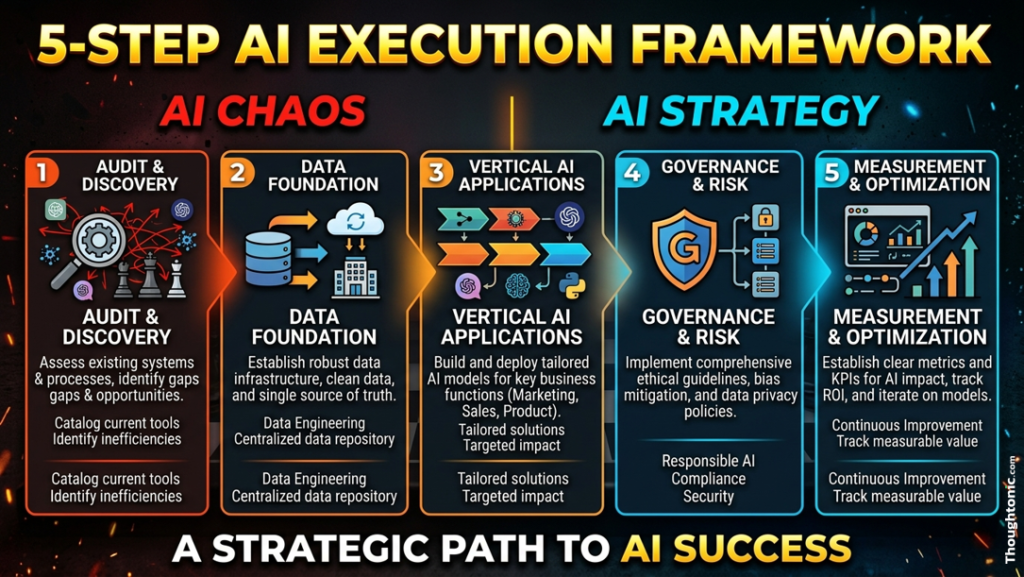
5-step AI execution framework infographic showing audit, data foundation, vertical AI, governance, and measurement stages for closing the AI strategy gap
This framework is not a technology adoption guide. It’s a strategic sequencing model. The order matters as much as the steps themselves.
Step 1: Audit Before You Adopt
Before purchasing any AI tool, map every manual workflow across marketing, customer service, and operations. Identify which ones are high-frequency, rule-based, and have measurable outputs. These are your AI candidates. Leadership decision required: Which business outcomes matter enough to bet a budget on? Trade-off: You’ll slow down the team’s desire to “just start using AI.” Success metric: Documented list of 5+ specific use cases with baseline metrics defined before deployment. Common mistake: Treating the audit as an IT task. It’s a business strategy exercise.
Step 2: Fix Your Data Foundation
Companies with strong data integration achieve 10.3x ROI from AI versus 3.7x for those with poor data connectivity (Integrate.io, 2024). Before scaling any AI initiative, conduct a data readiness assessment. For Bangladeshi brands, this typically means consolidating CRM data, standardizing customer identifiers, and establishing data governance policies. Leadership decision: Who owns data quality – and what budget does that person control? Trade-off: 3-6 months of preparation time before visible AI outputs. Success metric: AI-ready dataset covering at least 18 months of clean transaction or interaction data.
Step 3: Build Vertical, Not Horizontal
Rather than giving everyone a general-purpose AI subscription, build or customize AI for specific workflows. For a Bangladeshi FMCG brand, that might mean a proprietary prompt library for retail copy in Bengali and English, tuned to brand voice guidelines. For a bank, it might mean a credit risk assistant trained on local market signals. Leadership decision: Do we build custom or configure existing? Trade-off: Higher upfront investment, lower long-term cost per output. Success metric: Vertical AI tool producing outputs that require 50% less editing than generic AI outputs.
Step 4: Govern the AI Outputs
AI without editorial governance is a brand liability. Establish a review process for AI-generated content before it reaches customers. Create brand voice guidelines that AI systems can be prompted against. Assign a human accountable for AI output quality – not the IT team, not the vendor. Leadership decision: What is the approval workflow for AI-assisted communications? Trade-off: Slows content velocity initially. Success metric: Zero brand voice violations in AI-generated content over a 90-day period.
Step 5: Measure in Business Terms, Not AI Terms
Resist the temptation to report on “number of AI tools deployed” or “prompts generated per week.” Those are vanity metrics. Track revenue impact, cost reduction, customer satisfaction delta, and time-to-market improvement. Organizations that report significant AI returns are twice as likely to have defined their success criteria before deployment. Leadership decision: What does success look like in taka and time – not tool usage? Trade-off: Harder to show early wins. Success metric: Quarterly AI ROI report tied to at least two P&L lines.
Two Brands That Got This Right – and One Lesson Each Leaves Behind
Global: Zara – Iteration Over Perfection
Between 2022 and 2025, Zara built one of the most operationally effective AI workflows in retail – not by deploying enterprise-wide AI simultaneously, but through disciplined phase-by-phase integration. The brand started with AI-powered demand forecasting, reduced overproduction, then moved to personalized digital experiences. The result was a measurable reduction in markdown volume and a significant improvement in inventory turns. Zara’s AI isn’t just in a product recommendation widget; it’s in the supply chain, the assortment planning, and the regional pricing logic. The key decision Zara made: redesign workflows before selecting AI tools. McKinsey confirmed this as the distinguishing behavior of AI success stories. The limitation: Zara operates with supply chain data infrastructure most South Asian brands cannot yet replicate. The lesson isn’t to copy the technology – it’s to copy the sequencing discipline.
South Asia: bKash – Financial Inclusion Through Vertical AI
Bangladesh’s own bKash offers a compelling case study in deliberate vertical AI deployment. Rather than experimenting with general-purpose AI tools, bKash has systematically invested in AI for fraud detection, customer risk profiling, and micro-credit eligibility assessment – all high-stakes, data-intensive use cases where AI’s pattern recognition genuinely outperforms manual processes. The company operates in a context where data privacy concerns are real and regulatory expectations are increasing, and it has navigated this by maintaining strong human oversight over algorithmic decisions. Between 2022 and 2024, bKash expanded its registered user base to over 60 million while maintaining fraud loss ratios significantly below regional fintech peers. The limitation: bKash operates at a scale that gave it both the data volume and the institutional capacity to invest seriously in vertical AI. Smaller financial institutions attempting to replicate this without equivalent data depth will struggle. The lesson is the principle, not the playbook: build for your specific risk, with your specific data, in a specific workflow.
What Organizations and Professionals Should Actually Do
For Organizations (The Uncomfortable Actions)
- Cancel the subscriptions you’re not using with intention. Every idle AI subscription is a signal that you adopted for optics, not outcomes. Conduct a quarterly AI tool audit. Cut what isn’t tied to a specific workflow. Effort: Low. Timeline: 30 days.
- Assign a named AI lead – not a committee. Committees make AI decisions slowly, political, and without accountability. One person, with a defined mandate and budget authority. Effort: Medium. Timeline: 60 days.
- Build and document your prompt library. A proprietary prompt library is the closest thing to a competitive moat in AI-assisted content. It encodes your brand voice, audience intelligence, and regulatory constraints into replicable instructions. Effort: Medium. Timeline: 90 days.
- Commission a data readiness audit before your next AI initiative. Not from an AI vendor. From a neutral data consultant who has no incentive to overstate your readiness. Budget: 3-5 lakh BDT for a serious engagement. Effort: High. Timeline: 90-120 days.
- Tie AI metrics to P&L in every board report. If your AI activities can’t be represented in business terms in a board presentation, you don’t have an AI strategy – you have an AI activity. Effort: High. Timeline: Next quarterly cycle.
For Professionals (The Uncomfortable Skills)
- Prompt engineering with brand specificity. Not just “write a social caption” – but prompts that encode audience persona, channel context, brand tone, and compliance requirements. Uncomfortable because it requires knowing your brand deeply before knowing the tool.
- AI output auditing. The ability to systematically review AI-generated content for accuracy, voice consistency, and factual integrity. Uncomfortable because it requires slowing down what AI was supposed to speed up.
- Workflow redesign. The ability to map a current process, identify AI entry points, and redesign the human workflow around AI augmentation – not just add AI as an afterthought. Uncomfortable because it requires owning outcomes, not just activities.
- Data interpretation without a data scientist. Senior marketers and strategists who can read output dashboards, question model assumptions, and catch statistical artifacts. Uncomfortable because it requires numeracy many communications professionals have consciously avoided.
- Saying no to AI adoption that isn’t ready. The professional courage to tell leadership that an AI initiative needs 60 more days of data preparation before it goes live. Uncomfortable because it requires resisting peer pressure and executive impatience simultaneously.
A Critical Perspective: When Doing Less Wins
Here’s the contrarian view that most AI consultants won’t give you: for some organizations, a single well-executed AI workflow will outperform a multi-tool AI ecosystem every time. The MIT 2025 study is explicit about this – AI’s most consistent successes come when organizations tackle one pain point at a time, not broad unfocused rollouts. A mid-sized Bangladeshi RMG exporter that builds one vertical AI tool to optimize shipment scheduling will generate more measurable value than a conglomerate with 12 AI subscriptions spread across 5 departments and no governance.
There is also an ethical dimension that almost no organization in Bangladesh is discussing openly. AI tools trained primarily on Western, English-language datasets carry embedded cultural assumptions that can misrepresent Bangladeshi consumer contexts, produce culturally insensitive outputs, and generate factually incorrect local market intelligence. A brand that publishes AI-generated content without auditing for local relevance isn’t just making a communication error – it’s eroding the cultural credibility that Bangladeshi audiences reward most.
The organizations most at risk right now are those in the middle: too invested in AI activity to admit it isn’t working, not invested enough in AI governance to make it work. The fix isn’t more tools. It’s more strategy.
Key Takeaways
- The AI strategy gap – the distance between adoption and execution – is the core business problem of 2025, not access to AI tools.
- Over 80% of AI projects fail globally (RAND Corporation, 2024), at twice the rate of non-AI technology projects. Bangladesh organizations are not exempt from this pattern.
- Only 13% of Bangladeshi SMEs have a proper digital marketing strategy, meaning AI is being layered onto an already weak strategic foundation.
- Horizontal AI (give everyone a subscription) makes individuals 15% faster. Vertical AI (build for a specific workflow) can deliver 3-4x business impact.
- Organizations that report significant AI returns are twice as likely to have redesigned their workflows before selecting tools – sequence matters as much as selection.
- A proprietary prompt library is the closest thing to a defensible competitive asset in AI-assisted brand work. Most Bangladeshi organizations don’t have one.
- Companies with strong data integration achieve 10.3x ROI from AI versus 3.7x for those with poor data connectivity (Integrate.io, 2024).
- For some organizations, one well-executed vertical AI workflow will outperform an ecosystem of underused tools. Restraint is a strategy.
Read more articles:
The Costly Truth About Minimalist Bangladesh Design StrategyThe Costly Visual Search Blind Spot That Is Making Bangladesh Brands InvisibleQuantum Marketing: How 2030’s Technologies Will Shatter Bangladesh’s Status QuoDigital Literacy & Brand Purpose: How Education Drives Loyalty in Emerging MarketsGenerative AI in Bangladeshi Advertising: Opportunities, Ethical Risks & Implementation Guide 2025
Bibliography
Sources are listed in the order they appear in the article.
- MIT NANDA Initiative – “The GenAI Divide: State of AI in Business 2025”, MIT Media Lab, 2025
- RAND Corporation – AI Project Failure Rate Analysis, 2024
- McKinsey & Company – “The State of AI”, McKinsey Global Survey, November 2025
- Statista – “Artificial Intelligence Market in Bangladesh”, 2025
- Thoughtonic.com – “CES 2025 AI Insights for Bangladesh”, October 2025
- Gartner – “Gartner Predicts 30% of Generative AI Projects Will Be Abandoned After POC”, July 2024
- S&P Global Market Intelligence – Enterprise AI Initiatives Survey, 2025
- IMBDAGENCY.com – “SMEs in Bangladesh Need Digital Marketing”, 2024
- Informatica – “CDO Insights 2025: AI Obstacles and Data Readiness”
- Gartner – “Lack of AI-Ready Data Puts AI Projects at Risk”, February 2025
- Integrate.io – Data Integration and AI ROI Study, 2024
- Gallup – Workplace AI Strategy Communication Survey, Late 2024
- Gartner – “Over 40% of Agentic AI Projects Will Be Canceled by 2027”, June 2025
- Notionhive – “Is AI the Future of SEO in Bangladesh?”, 2025
- MarTech – “Lessons from AI’s 2024 Rise and a Pragmatic Path for Marketing in 2025”
- OECD – “AI Adoption by Small and Medium-Sized Enterprises”, 2025
- WalkMe – “50 AI Adoption Statistics in 2025”, November 2025
- AllAboutAI.com – “Global AI Adoption Rate by Country 2026”