Your Proven Secret Weapon in B2B Influencer Marketing: Employees Beat Celebrities Every Time
The Post That Outperforms Your Entire Ad Budget
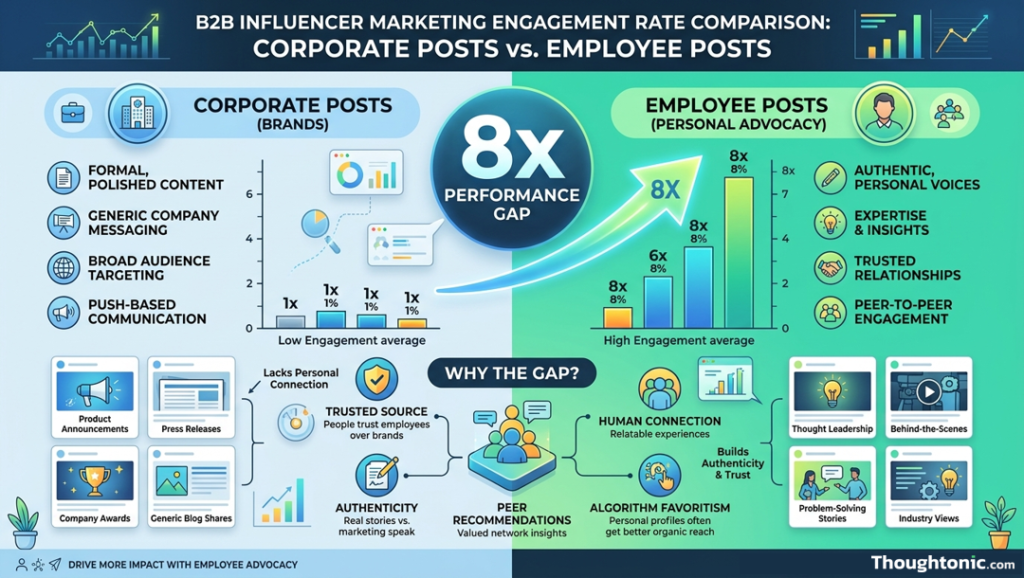
Your Head of Engineering publishes a 400-word post on LinkedIn about a technical decision your team wrestled with last quarter. No paid promotion. No agency. By Monday morning, it has 12,000 impressions, 200+ reactions, and three inbound messages from potential enterprise clients. Now compare that to your company’s last press release, which got picked up by two trade publications and generated exactly zero leads. This is the core of B2B influencer marketing that most Bangladeshi companies are still sleeping on: the most powerful media channel you own is not your company page, it is your people. Research shows employee-shared content generates 8 times more engagement than the same post published through an official corporate account. Yet in 2025, the average Bangladeshi company still invests the bulk of its digital marketing budget in boosted Facebook posts and brand campaigns that speak to no one in particular.
The argument here is not subtle. If you want credible, high-converting content that actually reaches decision-makers, stop chasing celebrity influencers and start building your internal ones.
Why Corporate Channels Are Losing the Trust War
The Trust Deficit in Bangladesh B2B
Bangladesh crossed 10 million LinkedIn users in January 2025, growing 1.1% in a single month. The 25-to-34 age group alone accounts for nearly 4.9 million of those users , these are your buyers, decision-makers, and procurement influencers. Yet most companies treat LinkedIn as a broadcasting tool: publish the press release, share the award photo, tag the CEO. The result is a feed full of content that nobody trusts and few people engage with.
The trust gap is measurable. Globally, 92% of B2B buyers say they are more likely to engage with sales professionals who are recognized thought leaders. A 2024 Edelman and LinkedIn study found that 75% of senior decision-makers say a piece of thought leadership has led them to research a product or service they had not previously considered. And yet, 67% of those same executives say they prefer thought leadership that has an identifiable human author rather than a faceless corporate logo. Humans trust humans. Not letterheads. Not brand accounts. Not stock photography.
In Bangladesh, the trust problem runs even deeper. This is a high-context, relationship-driven market. Business decisions are rarely made on the basis of a brochure. They are made because someone’s brother-in-law works at the vendor, or because a respected CXO endorsed the solution at a roundtable. The transition to digital has not changed that calculus , it has simply moved the relationship-building online. When your Head of Product shares a genuine lesson from a failed feature launch, it generates the kind of credibility that a six-month brand campaign cannot buy.
But here is the thing: most organizations in Dhaka still do not have a structured program for this. They may have one or two naturally vocal executives, but there is no framework, no coaching, no content calendar, and no measurement. Employee voices exist. They are just uncoordinated, underused, and unsupported.
The Science Behind Why Employee Voices Convert
What the Data Reveals About B2B Influencer Marketing
Let us be precise about what we mean when we say employee advocacy outperforms corporate content. The numbers are not marginal , they are dramatic.
Employee-generated posts reach 561% more people than the same message shared from a brand’s official social media channels. The conversion rate on leads developed through employee-shared content is 7 times higher than leads from other channels. And companies with active employee advocacy programs grow revenue 20% faster than competitors without one. These are not soft brand metrics. These are pipeline numbers.
The mechanism behind this is rooted in social psychology. In B2B contexts, purchase decisions involve multiple stakeholders and carry significant risk. Buyers default to trusted signals when the stakes are high. A post from your VP of Operations explaining how your platform cut their procurement cycle by 40% is a trusted signal. A carousel from your brand account saying you are a ‘leading solutions provider’ is noise. The brain processes these two inputs very differently.
There is also a reach multiplier that companies chronically underestimate. LinkedIn research shows that 30% of a company’s total platform engagement comes from content published by employees, not the company page. If your company has 200 professionals on LinkedIn with an average of 800 connections each, that is a combined organic reach of 160,000 people , most of whom your paid advertising will never touch efficiently. This is where it gets interesting: that audience is not random. It is curated by professional affinity. Your engineers follow other engineers. Your sales managers are connected to procurement heads at client companies. The targeting is already done.
The table below maps content type to average performance outcomes in B2B contexts, based on aggregated industry data:
| Content Type | Avg. Engagement Rate | Trust Level (B2B Buyers) |
| Corporate brand post | 0.5% | Low (logo-sourced) |
| CEO / founder post | 2.8% | High (executive credibility) |
| Senior engineer / SME post | 3.4% | Very high (peer expertise) |
| Paid sponsored content | 0.3% | Very low |
| Employee case story | 4.1% | Highest (authentic + specific) |
Source: Compiled from Edelman/LinkedIn B2B Thought Leadership Report 2024, DSMN8 Employee Advocacy Benchmark 2025, Sociabble research.
In my analysis, the most underutilized employee tier in Bangladeshi organizations is the senior individual contributor , the Staff Engineer, the Senior Legal Counsel, the Principal Researcher. These professionals have deep domain credibility that no junior marketing manager can manufacture. They speak the language of the buyer. They understand the problem set. And when they write about it authentically, buyers notice.
The causal chain works like this. When senior employees share original insights, three things happen simultaneously: they build personal authority in their professional network, they generate organic traffic and visibility for their company, and they create a discovery pathway for buyers who are in early-stage research mode. B2B research consistently shows that 83% of a purchase decision is already made before a buyer ever contacts a vendor. Your employee content is either shaping that 83% or it is not. There is no neutral position.
The Employee Thought Leader Framework: A Proven 5-Step System
Step 1: Identify Your Internal Experts (Not Just Executives)
Start by mapping your organization against two axes: domain credibility and network reach. You want people with genuine expertise in areas your buyers care about , cloud architecture, regulatory compliance, supply chain optimization , who also have an existing LinkedIn presence. This is not exclusively a C-suite exercise. A Senior Business Analyst with 2,000 engaged LinkedIn connections may outperform your CMO who has 8,000 followers but posts three times a year. The mistake here is defaulting to titles over relevance.
Step 2: Build a Content Coaching Program, Not a Policy
Most employee advocacy programs fail because they publish a social media policy and call it done. What actually works is coaching. Pair each internal advocate with a content strategist or marketing partner for biweekly 30-minute sessions. Identify two or three topic territories the employee owns. Help them turn internal knowledge , war stories, decision frameworks, lessons from failures , into publishable insight. The goal is not to ghostwrite for them. It is to give them a process that makes content creation feel manageable rather than intimidating.
Step 3: Create a Content Rhythm, Not a Content Calendar
A content calendar implies centralized control. A content rhythm means the employee posts when they have something real to say, within a rough cadence , say, two to three times per month. This distinction matters because authenticity is the entire value proposition. The moment employees start posting pre-approved corporate talking points, engagement drops. Buyers can feel the difference between a professional sharing a genuine observation and a marketer ventriloquizing through an employee’s profile. The common mistake is over-scripting. Give your advocates a topic brief, not a draft.
Step 4: Activate Cross-Functional Amplification
When one employee publishes a strong post, the rest of the team should engage with it within the first two hours , the window during which LinkedIn’s algorithm decides whether to extend a post’s reach. This is not inauthentic; it is how communities operate. Create a simple internal Slack or WhatsApp notification for advocacy moments. Make it opt-in, not mandatory. The key success metric here is amplification ratio: the number of unique employee profiles engaging per post versus the company baseline.
Step 5: Measure What Actually Matters
Vanity metrics , likes, follower counts , are not your objective. Track inbound enquiries attributed to employee content, sales cycle length for leads that engaged with employee posts versus those that did not, and earned media value generated by the program. According to the DSMN8 Benchmark 2025, 74% of social media managers already track employee advocacy by sales outcomes and earned media value. Set a six-month benchmark and review quarterly.
Two Case Studies Worth Studying
Global: IBM’s Advocate Army Program
IBM’s employee advocacy journey is one of the most documented in B2B marketing, and for good reason. Their ‘#AdvocateArmy’ initiative, which gained momentum around 2011 and matured through the mid-2010s, was built on a three-tier model: executives received dedicated marketing support; subject-matter experts got coaching and content tools; everyone else had on-demand resources. The program produced nearly 2,000 thought leadership blogs across 11 business topics, generating over 1.1 million visits. More importantly, IBM reported that content shared by digitally engaged experts produced a 2x higher conversion rate compared to traditional marketing tactics. The earned media value from a single advocacy campaign saved the company between $300,000 and $1.2 million in media spend.
What made it work: IBM did not force participation. Executives who were not naturally social were not pushed into it. The focus was on people who wanted to build their personal brands and needed structural support to do so. The limitation: the program required a dedicated team to sustain, which is a resource investment that smaller organizations in Bangladesh cannot easily replicate at the same scale.
South Asian Context: BASIS Secretariat and Bangladesh’s Tech Ecosystem
While a single branded Bangladeshi case study is difficult to isolate, the pattern is visible across the tech sector. Bangladesh’s IT trade body BASIS and several of its member firms have quietly demonstrated the power of executive personal branding on LinkedIn. Fahim Mashroor, CEO of Delivery Tiger and co-founder of AjkerDeal.com and Bdjobs.com, is a visible example , recognized as one of Bangladesh’s top LinkedIn influencers, he regularly posts about the startup ecosystem, logistics technology, and fintech. His personal reach and engagement significantly exceeds that of any formal brand campaign his companies could run for the same cost.
The data point that matters here: according to BASIS Bangladesh, visibility on LinkedIn correlates with 2.5 times higher funding success for early-stage startups. And 63% of local startups use LinkedIn for recruitment, investor outreach, and B2B partnerships. This is not celebrity influencer territory. This is subject-matter authority converting to commercial outcomes , which is exactly the B2B influencer marketing model this article argues for.
The limitation in the Bangladesh context is that most company leaders who are visible on LinkedIn have arrived there organically, without a structured program behind them. What is missing is the institutional framework that turns individual brilliance into a scalable, company-wide asset.
What You Should Actually Do This Quarter
For Organizations
The first action most organizations resist is giving employees editorial freedom. Companies want to approve every post, and that impulse kills the program. Start with a content guideline , topics that are in-bounds, topics that require legal review, and topics that are off-limits , and then let employees write within it. The review bottleneck is the program’s biggest killer.
Second, budget for this as a media channel, not a side project. A mid-sized organization in Dhaka running a proper employee advocacy program , including a content coach, an advocacy platform subscription, and quarterly training , should expect to spend between BDT 8 and 15 lakh annually. Compare that to what a six-month Facebook ad campaign costs for equivalent reach among professional audiences. The economics are not close.
Third, start with five advocates, not fifty. Pick your best thinkers, give them intensive support for 90 days, build a proof of concept, and then scale. The worst thing you can do is send a company-wide email asking everyone to ‘please share our LinkedIn posts.’ That generates compliance, not advocacy.
For Professionals
If you are a senior professional who has been told you should be more visible on LinkedIn but have not started yet, here is what you need to understand: the discomfort you feel about ‘putting yourself out there’ is normal, but it is also costing you commercially. In B2B contexts, your personal brand is a business asset , for your company and for your own career. The skill that is most uncomfortable to develop is specificity: writing about one real, concrete thing you know deeply, rather than broad industry commentary that sounds like everyone else.
Practically: commit to two posts per month. Make one of them a lesson from a real project or decision you were involved in. Make the other a take on an industry question your clients frequently ask you. You do not need a ghostwriter. You need 45 minutes and a willingness to be direct. The professionals generating the most engagement on LinkedIn in Bangladesh right now are not the ones with the most polished writing , they are the ones who are most willing to share a genuine point of view.
Where This Strategy Fails: An Honest Assessment
Employee advocacy programs fail for predictable reasons, and organizations in Bangladesh face a few specific structural risks worth naming.
First, authority hierarchy. In many Dhaka-based organizations, junior employees will not publicly disagree with or write independently of their senior leadership’s preferred narrative , even if their insights would be far more credible. This cultural dynamic reduces the authenticity that makes the strategy work. If your advocacy program becomes a channel for amplifying the MD’s preferred talking points, it will produce exactly the kind of corporate-sounding content that buyers ignore.
Second, platform risk. As of January 2025, LinkedIn has 10 million users in Bangladesh, but the professional audience that actually reads industry content is probably closer to 500,000 to 1 million active daily users. This is a real but finite audience. Over-posting the same narratives from multiple employees can produce fatigue faster than in larger markets.
Third, and this is the contrarian view: sometimes doing less outperforms doing more. If your senior engineers are spending time crafting LinkedIn posts instead of solving client problems, you have misaligned your incentives. Employee advocacy should complement excellent work, not substitute for it. A professional who is genuinely expert and occasionally shares insights will outperform someone who is posting frequently but saying nothing new.
Key Takeaways
- B2B influencer marketing is most effective when built on internal subject-matter experts, not external celebrities or paid influencers.
- Employee-shared content generates 8 times more engagement than the same content posted on a corporate brand account, and leads convert at 7 times the rate.
- Bangladesh’s LinkedIn user base reached 10 million in January 2025, with the 25-34 age group (your buyers and procurement influencers) being the dominant demographic.
- 75% of B2B decision-makers say a single piece of thought leadership has led them to research a product they had not previously considered (Edelman/LinkedIn, 2024).
- Start with five internal advocates, not fifty. Give them 90 days of structured support before scaling.
- The biggest program killer is the approval bottleneck , establish content guidelines, then give employees editorial freedom within them.
- In high-context markets like Bangladesh, relational trust is the purchase driver. Employee content digitizes that trust signal at scale.
- Measure success through inbound enquiry attribution, sales cycle length, and earned media value , not vanity metrics like follower count.
Read more articles:
- The Costly AI Strategy Gap: Why Your Team Is Playing, Not Executing
- The Costly Truth About Minimalist Bangladesh Design Strategy
- The Costly Visual Search Blind Spot That Is Making Bangladesh Brands Invisible
- Quantum Marketing: How 2030’s Technologies Will Shatter Bangladesh’s Status Quo
- Digital Literacy & Brand Purpose: How Education Drives Loyalty in Emerging Markets
Bibliography
- DSMN8 – Employee Advocacy Benchmark Report 2025, December 2025
- Sociabble – 12 Employee Advocacy Statistics You Need to Know in 2026, January 2026
- DSMN8 – 35+ Employee Advocacy Statistics You Need To Know, December 2024
- Oktopost – Employee Advocacy and Corporate Social Strategy in 2025, November 2025
- Peer to Peer Marketing – 21 Mind Blowing Employee Advocacy Stats [2025 Guide], July 2025
- GaggleAMP – Key Employee Advocacy Statistics That Prove Its Impact, 2024
- ClearView Social – Employee Advocacy Statistics: Boost Your Marketing, July 2025
- Speakap – Employee Advocacy Statistics You Actually Want to Read, October 2025
- Markedium – Bangladesh’s LinkedIn User Base Grew By 1.1% In January 2025, February 2025
- Vocal Media – LinkedIn and Bangladesh’s Digital Workforce Transformation, December 2025
- Ngital – Bangladesh Social Media Trends 2025, May 2025
- Favikon – Top 20 LinkedIn Influencers in Bangladesh in 2025, 2025
- Tribal Impact – The Power of Employee Advocacy at IBM, November 2023
- Business Explained – TOP 10 Employee Advocacy Examples: Real-World Success Stories, January 2025
- Lesniak Swann – The Biggest B2B Influencers of 2025: How Marketing Managers Can Get Employees to Advocate, July 2025
- Edelman & LinkedIn – 2024 B2B Thought Leadership Impact Report, 2024