The Brutal Truth About Email Newsletters: Why the Inbox Is Becoming the Only Channel That Matters in 2026
Social media is a rented house. You furnish it, you pay for it, you build community in it, and then the landlord changes the lease without notice. In 2024, Facebook organic reach settled at a dismal 1.37% (Social Status, 2024). Instagram dropped 18% year-over-year. And in Bangladesh, where over 60 million people are on Facebook and most brand marketing budgets follow them there, this collapse is not an abstract global statistic, it’s a local crisis happening in slow motion. The email newsletter is re-emerging not because it’s trendy, but because it’s the only channel where you actually own the relationship. This article unpacks why that shift is real, why it’s happening faster than most Bangladeshi marketers realize, and what to do about it before the opportunity window closes.
Why the Social Media House Is Getting Harder to Live In
Let’s start with the numbers that matter. In 2012, when Facebook was still the scrappy underdog, organic reach for brand pages averaged 16%. By 2024, that number had fallen to under 2%. Not because Facebook got worse at showing content, but because it got better at making brands pay for visibility. The business model was always headed here. Platforms need revenue. Revenue comes from ads. Ads compete with organic content. Organic content loses.
This isn’t a Bangladesh-specific problem, but Bangladesh has a specific version of it. Facebook had 60 million users in Bangladesh in early 2025, making it the dominant social platform by an enormous margin. And digital ad spend in Bangladesh reached approximately $331 million in 2023, the vast majority social-first. That concentration is both the opportunity and the trap. Brands went all-in on one channel. That channel is now a pay-to-play environment. By March 2025, Meta had fully removed detailed targeting exclusions from all ad campaigns, meaning ads now reach more people but not necessarily the right ones, so brands may need to spend more to get equivalent results.
The July-August 2024 internet disruption in Bangladesh demonstrated the single-channel risk even more starkly. Brands with no email list had zero communication with their customers. Brands with email lists had a direct line that didn’t require a platform to mediate it.
Global social media ad spend reached $219.8 billion in 2024, representing nearly 30% of all digital ad spending. That’s how much money is chasing visibility on platforms that are structurally designed to constrain it. Something has to give. And it is, back toward owned channels.
What the Data Actually Says About Email in 2025–2026
Here’s where it gets interesting. While marketers were pouring money into social feeds, email was quietly accumulating an extraordinary track record.
Email usage reached unprecedented scale in 2025, with 4.59 billion global users exchanging 376.4 billion messages daily, a volume projected to grow to 392.5 billion by 2026. This is a channel growing at 4% CAGR, not dying.
But raw volume isn’t what makes email compelling. Engagement is. Email users spend close to six hours a day on email, compared to just 2.5 hours on social media, and 99% of email users check their inboxes every day. That ratio, 6 hours vs 2.5 hours, is a marketer’s attention allocation problem laid bare. We’re spending budget where eyeballs are, not where attention is.
The newsletter format specifically is having a structural moment. Newsletters experienced a resurgence in 2025, with 58% of marketers including them in their strategy, up from 46% in 2024. And importantly, this growth is happening for the right reasons, not because of novelty, but because of what newsletters uniquely offer: a person,led, editorial relationship that algorithms can’t disrupt.
The average ROI from email sits between $36 and $42 for every $1 spent, higher than paid ads, social media ads, and SEO. In my analysis of the Bangladesh market, this ROI advantage is likely even more pronounced for professional services, B2B companies, and brands targeting the upper-income urban segment, precisely because that audience checks email rigorously, often more than social media.
The B2B case is particularly sharp. 81% of B2B marketers use email newsletters as their main form of content marketing, making it the most widely used content distribution channel in the B2B space. And 73% of B2B buyers prefer that sellers contact them via email. For founders, CXOs, and senior decision-makers, the exact audience of this article, the inbox is not just a communication tool. It’s where serious professional information is processed.
The E.D.I.T. Framework: Building a Newsletter That Actually Works
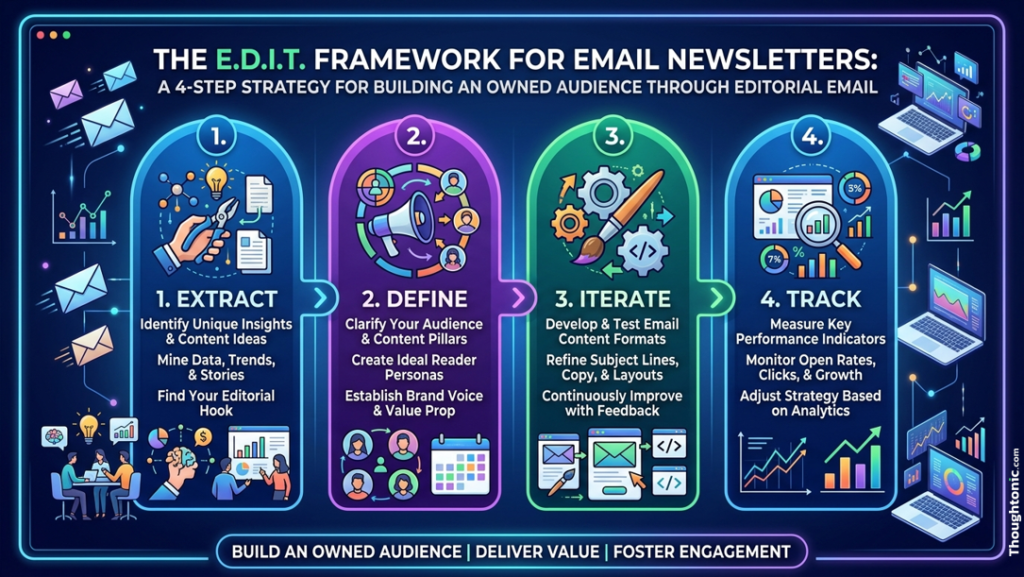
Most newsletters fail not because email doesn’t work, but because the newsletter was never really designed to serve a reader. It was designed to serve the sender. Here’s a framework that reverses that logic.
Step 1: Extract, Own Your Audience Before You Need It
The first mistake brands make is waiting until they need a list to start building one. By then, they’re starting from zero under pressure, which leads to bad decisions like buying lists (which ruins deliverability) or spamming existing customers who never opted in.
The right approach is to make email capture a default behavior at every touchpoint: website, checkout, event registration, social bio links, offline activations. In Bangladesh, where physical events and trade fairs are still significant for B2B, the “drop your card here” bowl should have a digital equivalent asking for explicit email consent.
The metric to track: your email list size as a percentage of your total social following. If you have 50,000 Facebook followers and 400 email subscribers, your audience ownership ratio is critically low.
Common mistake: Importing existing WhatsApp contacts into an email platform without consent. This is both a legal risk and a deliverability guarantee, those people didn’t sign up for email and they will mark it as spam.
Step 2: Define, Pick an Editorial Position Nobody Else Holds
This is where most corporate newsletter attempts die. The brief comes from marketing, goes through legal, gets approved by the CEO, and arrives in the inbox as a beige list of achievements and product announcements. Nobody subscribes to read about a company’s Q3 milestones.
The newsletters that work have an editorial identity. Think about what your audience does not get from anywhere else, and give them exactly that. A Bangladeshi logistics company could own the “supply chain intelligence for South Asia” space. A fintech startup could own the “regulatory and policy digest for BD financial professionals” niche. These are real editorial positions that serve a defined reader with something they genuinely need.
The most successful newsletters adopt a person-led, editorial voice rather than corporate marketing speak. Readers respond to authentic perspectives, hot takes, and curated insights from recognized experts.
The leadership decision required here is genuine: assign a named human as the voice of the newsletter and give that person editorial independence. If every issue requires three rounds of legal and comms approval, you’ll publish quarterly at best, and the voice will be so sanded down it won’t be recognizable.
Common mistake: Treating the newsletter as a content repurposing bin, dumping social posts and blog summaries into an email template and calling it a newsletter. Your reader’s inbox is premium real estate. Treat it accordingly.
Step 3: Iterate, Test and Commit to a Cadence
Frequency is one of the most debated topics in newsletter publishing, and the honest answer is: it depends on your editorial capacity. A weekly newsletter you can sustain for 52 weeks is worth more than a daily one you abandon in month three.
Research on optimal email frequency reveals that 9–16 emails per month generates a 46:1 ROI, versus just 13:1 for once monthly. But those numbers reflect a high-quality, consistent operation, not a brand that goes dark for two months and then sends a “we’re back!” issue.
For most Bangladeshi brands starting out, weekly or fortnightly is the right cadence. It’s frequent enough to build habit, infrequent enough to demand quality per issue.
Subject lines deserve more attention than they get. Personalized email subject lines increase open rates by 26%. But personalization doesn’t just mean inserting a first name, it means writing subject lines that feel written for a specific person’s concerns, not broadcast to a generic list.
Common mistake: A/B testing the wrong things. Don’t spend weeks testing button colors when you haven’t nailed the fundamental question: does the content earn a read?
Step 4: Track, Measure What Actually Matters
Open rate got us into trouble as a primary KPI. Apple’s Mail Privacy Protection has made open rate data increasingly unreliable, a significant portion of “opens” recorded are now pre-fetched by Apple’s servers, not actual human reads.
The metrics worth tracking in 2026: click rate (which pages or links did people actually care about?), reply rate (did anyone respond to what you wrote, the highest-signal engagement possible?), and unsubscribe patterns (which issues caused people to leave?).
Click-to-conversion jumped 53% year-over-year in 2025, rising from 5.9% to 9%, meaning fewer people clicked but those who did were far more likely to buy. This signals a maturing audience: subscribers are more selective, but more qualified when they act.
Common mistake: Reporting open rates to leadership as proof of success without contextualizing the platform/privacy noise in that number. This creates a false sense of performance and delays the harder work of building genuine engagement.
Case Studies: What Good Looks Like
Morning Brew (USA), The Blueprint
Morning Brew is now on track to surpass $70 million in annual revenue in 2025, following a full buyout by Axel Springer in February 2025. It started as a PDF email in a University of Michigan dorm room in 2015. The founders had one insight that turned out to be a $75M thesis: business professionals needed the news written for them in a voice that respected their intelligence without demanding their full attention.
The morning Brew’s open rate held at 45% consistently, at a time when industry standard was 15-25%. That’s not a platform achievement. That’s an editorial achievement. They built a newsletter people actually wanted to open, and the audience growth followed from there.
Their referral program accounted for 30% of total subscribers and was described as the “secret sauce” that accelerated their growth flywheel. This is the compounding effect of a newsletter people are proud to share, you’re no longer just building an audience, you’re building a community.
The limitation to note: Morning Brew operates in an English-language, high-income, highly educated professional segment. The blueprint works, but direct translation to a Bangla-language newsletter for a mass-market audience requires significant content and format adaptation.
The Bangladesh Context, Building for the Urban Professional
Here’s what I observe in the Bangladeshi market: there is a real and underserved audience of urban professionals, corporate employees, startup founders, senior NGO staff, financial sector professionals, who want curated, high-quality information about business, policy, and industry trends, delivered in a format that respects their time. This audience uses Facebook out of habit, not preference. They check email compulsively, often before social media in the morning.
Email marketing remains a powerful tool for businesses in Bangladesh to nurture leads and maintain relationships with customers, with email marketing providing high return on investment and being essential for customer retention.
The brands that are quietly winning in this space are not making noise about it. A few digital consultancies, one or two fintech startups, and select media publishers have begun investing in email-first content strategies. They’re building lists now, at a time when the cost of subscriber acquisition is still low. In six months, when everyone else wakes up to the opportunity, that early-mover advantage will be visible in their customer retention numbers.
Action Plans: What to Do This Quarter
For Organizations (with realistic timelines):
- Audit your current list quality, How many email addresses do you have? How many were genuinely opted-in? Kill the dead weight now. A clean list of 2,000 engaged readers outperforms a bloated list of 20,000 disengaged ones every time. (Effort: Low, Timeline: This week)
- Install email capture with a real value offer, Not “subscribe to our newsletter.” Give them something: a weekly digest, an industry report, a curated resource. In Bangladesh’s professional market, “Get 5 insights from the BD startup ecosystem every Friday” will outperform “Stay Updated” by a significant margin. (Effort: Medium, Timeline: 2 weeks)
- Assign a human voice, Pick someone on your team who writes well and has genuine opinions. Give them 4 hours per week and a mandate to write something worth reading. Not press releases. Not product announcements. Editorial content. (Effort: Medium, Timeline: This month)
- Choose a platform suited to growth, Mailchimp, Brevo, or Beehiiv for English content; Mailjet or SendGrid if you need Bangla character support and have a developer. Don’t let tool selection become a 3-month decision-making exercise. (Effort: Low, Timeline: 2 weeks)
- Set a 12-month commitment before evaluating ROI, Newsletters compound. Month 1 will disappoint you. Month 6 will show signals. Month 12 will show you whether you have something real. Brands that pull the plug at month 3 are the ones writing “email doesn’t work in Bangladesh” on their LinkedIn posts. (Effort: High, Timeline: Ongoing)
For Professionals:
- Build a personal newsletter, Not your company’s newsletter. Yours. Pick one topic you know better than most people and write about it weekly. This is uncomfortable because it requires a public professional opinion, which Bangladeshi professional culture still often discourages. Do it anyway.
- Learn basic deliverability hygiene, If you’re sending newsletters at any reasonable volume, understand SPF, DKIM, and DMARC records. This is not optional if you want your emails to reach inboxes. It’s technical, unglamorous, and absolutely necessary.
- Study your unsubscribe data with intellectual honesty, Every unsubscribe is a data point. That issue had something wrong: wrong topic, wrong tone, wrong timing. Treat it as feedback, not rejection.
Where This Gets Complicated
Let me be honest about the limits of this argument. Not every brand should have a newsletter. Brands without a clear editorial point of view, without the internal capacity to publish consistently, and without a defined professional audience are likely to produce content that adds to inbox noise rather than competing with it. In those cases, a well-maintained social presence with a modest paid amplification budget may genuinely outperform a mediocre newsletter.
The email-first narrative also carries an implicit assumption about audience literacy and behavior that doesn’t apply uniformly across Bangladesh. Internet penetration in Bangladesh reached 44.5% of the total population by January 2025, with 77.7 million individuals online, but significant disparities persist between urban and rural areas. For mass-market FMCG brands targeting Tier 2 and Tier 3 cities, Facebook remains where the audience actually is, and that reality doesn’t change because of a global trend toward owned media.
The ethical dimension that almost nobody discusses: consent and data practices in Bangladesh’s email marketing space are still murky. Purchased lists, scraped contacts, and implicit “consent” from product registration forms are widespread. These practices not only damage sender reputation, they also erode consumer trust in email as a communication channel. The brands investing in permission-based list building right now are building a long-term asset. The ones cutting corners are building a long-term liability.
Key Takeaways
- Facebook organic reach collapsed to 1.37% in 2024 (Social Status), brands that built on social alone are now paying rent on audiences they thought they owned
- Email delivers $36–$42 ROI per $1 spent (multiple sources, 2024–2025), consistently the highest-return digital channel
- 58% of marketers now include newsletters in their strategy, up from 46% the year before, the shift is structural, not seasonal
- The newsletter is not a promotional blast, it’s an editorial product, and editorial products require an editorial mindset
- In Bangladesh, the urban professional segment is underserved by email, despite checking it compulsively, this is a real acquisition opportunity for B2B and professional services brands
- The inbox is the only “owned” real estate in digital marketing, no algorithm, no policy change, no platform shutdown can take your list from you
- The greatest risk is not that email won’t work, it’s that you’ll launch a newsletter badly and conclude that email doesn’t work in Bangladesh when the problem was the content
- List quality beats list size every time; a clean, opted-in list of 3,000 professionals will outperform a purchased list of 30,000 by every metric that matters
Read more articles:
The Costly AI Strategy Gap: Why Your Team Is Playing,
Not ExecutingThe Costly Truth About Minimalist Bangladesh Design Strategy
The Costly Visual Search Blind Spot That Is Making Bangladesh Brands Invisible
Quantum Marketing: How 2030’s Technologies Will Shatter Bangladesh’s Status Quo
Digital Literacy & Brand Purpose: How Education Drives Loyalty in Emerging Markets
Bibliography
- Facebook Organic Reach Benchmark 2024, Social Status, 2024
- Instagram Organic Reach Decline, Hootsuite Social Trends Report, 2024
- 60+ Newsletter Statistics for 2026, Whop, January 2026
- Email Marketing Statistics 2025, InboxAlly, 2025
- Email Marketing Statistics & Trends 2026, Omnisend, February 2026
- Email Industry Data Report 2025–2026, Clean.email, January 2026
- Email Marketing Trends for 2026, Litmus, December 2025
- Email Marketing Statistics & Trends 2026, Constant Contact, January 2026
- 40+ Email Marketing Statistics for 2026, OptinMonster, November 2025
- Digital 2025: Bangladesh, DataReportal, March 2025
- Top Digital Marketing Trends in Bangladesh for 2025, Implevista Digital, 2024
- The Impact of Digital Marketing in Bangladesh 2024, Implevista Digital, 2024
- The Decline of Organic Reach on Social Media in 2026, Addictive Digital, January 2026
- Social Media Trends in Bangladesh: A Data-Driven Analysis for 2025, Ngital Limited / SlideShare
- How Morning Brew Uses Data to Grow from a Dorm Room Newsletter to a $70M B2B Media Empire, News Machines / Substack, June 2025
- Meta Algorithm Changes Impacting Global Organic and Paid Reach, Vera Content, April 2025
- Is Organic Reach Dead In 2025?, Boston Institute of Analytics, August 2025