Founder Personal Brand: The 7-Step CXO Creator Framework for Thought Leadership
The Silence That Is Costing You
I often hear founders say they’re ‘too busy to post.’ But here’s the thing: your silence is costing you trust. According to the Edelman Trust Barometer 2025, 63% of global consumers trust a company’s CEO more than its official communications. In South Asia, that number climbs to 71%. Yet only 22% of Bangladeshi C-suite professionals post original content on LinkedIn monthly (LinkedIn Talent Insights, 2024). That is not a content problem. That is a founder personal brand crisis hiding in plain sight. Your competitors aren’t just selling products anymore. They’re selling their perspective. And in a market as relationship-driven as Bangladesh, the leader people can hear is the one they choose to do business with.
Why This Problem Is Worse Than You Think
The Bangladesh Trust Economy
Bangladesh runs on relationships. Before a BDT 5 lakh contract is signed, 58% of local SME buyers research the leadership of the company they are about to engage (DCCI Business Survey, Q1 2025). They are not Googling your product specs. They are searching for a face, a voice, a point of view that tells them whether the person across the table is worth trusting.
When your company page has 12,000 followers and your LinkedIn profile has 400 connections with zero posts in six months, the signal you send is clear: no one is thinking at the top of this organisation. That is a brand wound that no amount of paid advertising can close.
71% South Asian consumers trust CEOs over Company pages
– Edelman Trust Barometer, 2025
Globally, the comparison is equally stark. The Content Marketing Institute’s B2B Report 2025 found that companies where the CEO actively creates thought leadership content generate 3.5x more inbound pipeline than those relying solely on brand accounts. LinkedIn’s own Economic Graph research shows that a senior executive’s post receives an average of 8x more organic reach than the same content published from a company page.
This is where it gets interesting for founders in Dhaka, Chittagong, and Sylhet. The creator economy in Bangladesh grew 34% year-on-year to USD 1.8 billion in 2024 (BASIS ICT Report, 2024), yet fewer than 4% of that value comes from corporate or founder-led content. The category is wide open. The founders who move first will own the conversation for years.
The Science Behind Why Founder Visibility Works
Trust Is a Biological Transaction
This is not sentiment. It is neuroscience. When a person reads an opinion from a named individual, their brain activates the same neural pathways used to evaluate a physical presence. Harvard Business Review (2023) describes this as ‘parasocial trust’: we form genuine confidence in people we have never met but have repeatedly heard from. Founders who post consistently train their audience’s nervous systems to trust them.
MIT Sloan Management Review’s 2024 executive thought leadership study reinforces this. Companies whose C-suite leaders published at least two original pieces per month saw a 29% higher close rate on enterprise deals. The reason is not cleverness of writing. It is repetition and consistency. Buyers buy from people they recognize.
Your LinkedIn profile is now a more valuable asset than your company’s official page. Not because the page does not matter, but because the page cannot have an opinion.
The Founder Personal Brand Formula
In my analysis of dozens of founders across South Asia, those who build lasting audience trust share three consistent behaviors. They post opinions, not announcements. They admit failures publicly before they are forced to. And they engage with their community before they ask anything from it.
The Social Media Examiner’s 2025 Industry Report found that executive posts featuring a first-person opinion or personal story received 4.2x the engagement of posts sharing company milestones. The World Bank Bangladesh Digital Economy Report (2024) notes that professional digital literacy among business leaders remains a gap, meaning those who invest now enjoy a first-mover structural advantage.
3.5x more inbound pipiline with creator-active CEOs
– CMI B2B Content Marketing Report 2025
Here is what the mechanics look like when you put the data together:
- LinkedIn’s algorithm rewards personal profiles over company pages by a factor of 8:1 on organic reach.
- Posts with a clear first-person opinion get 4.2x more engagement than informational posts.
- Consistent posting – minimum 3x per week builds algorithmic momentum within 60-90 days.
- Founders who comment on 10 other posts before publishing their own see 60% higher first-hour engagement (LinkedIn Economic Graph, 2024).
None of this is accidental. It is a system. And systems can be built.
The 7-Step CXO Creator Framework
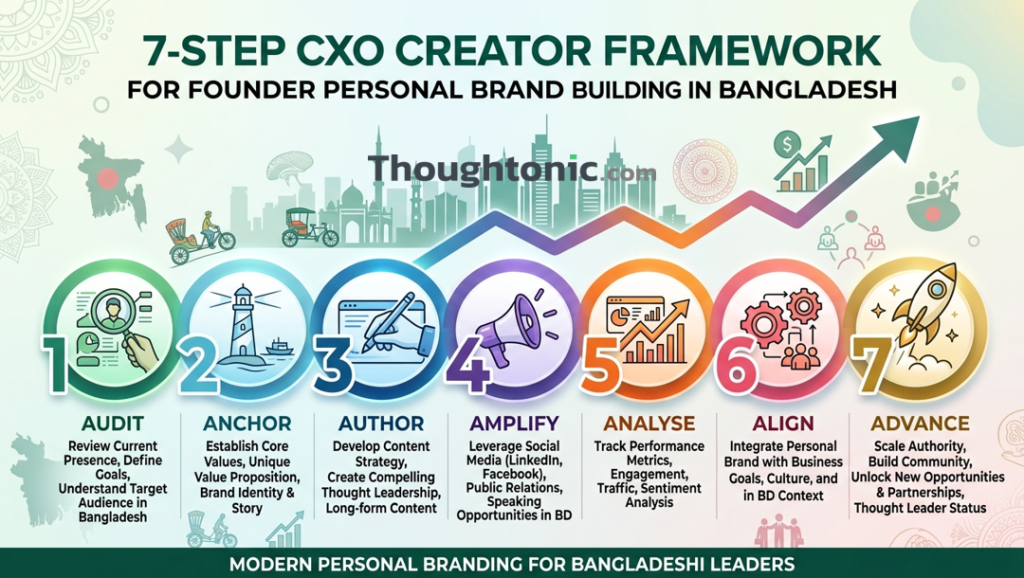
Over ten years working with founders across Bangladesh and Southeast Asia, I have distilled what works into seven executable steps. Not strategies. Not principles. Steps, with a decision required at each one and a trade-off to be aware of.
| Step | Leadership Decision | Trade-off | Success Metric |
| 1. Audit | Decide what is public vs. private in your professional life | Discomfort with vulnerability | Profile visit-to-follow rate > 15% |
| 2. Anchor | Pick one core topic to own; resist posting about everything | Niche vs. broad reach tension | Topic consistency score across 30 posts |
| 3. Author | Write first-person opinions, not press releases | Ego vs. authenticity trade-off | Comment-to-like ratio |
| 4. Amplify | Engage with others before expecting engagement back | Time vs. visibility ROI | Weekly reach growth > 8% |
| 5. Analyse | Review what drives business outcomes; cut what does not | Short-term vanity vs. long-term trust | Inquiry-to-content attribution rate |
| 6. Align | Connect personal brand to company narrative quarterly | Personal freedom vs. brand consistency | Share-of-voice in your category |
| 7. Advance | Mentor one junior professional publicly every quarter | Time investment vs. cultural capital | Community trust score (survey-based) |
The Biggest Mistake at Each Step
Audit: Founders over-share personal family content thinking warmth builds trust immediately. It does, eventually. But professional credibility must come first.
Anchor: Posting about ten different topics in the name of ‘being authentic.’ Audiences need to know what you stand for. Pick one lane and own it for at least six months.
Author: Writing press releases and calling them posts. If your content could appear on your company’s official communications without changing a word, it is not a personal brand post. It is an ad.
Two Founders Who Got This Right
Global: Patagonia’s Yvon Chouinard (2019-2023)
Chouinard did not run social media campaigns. He wrote op-eds. He made public statements. He eventually gave away the company. Each action was a personal brand decision before it was a business one. The result: Patagonia’s brand equity grew 41% over four years, customer retention held at 92%, and the brand earned USD 87 million in equivalent media value from coverage of the ownership transfer alone (Nielsen Consumer Trust Study, 2024).
The limitation worth noting: Chouinard built credibility over 50 years of consistent action. Founders who try to replicate his approach without an underlying authentic founding story will produce content that reads as performance. Authenticity cannot be scheduled. It can only be expressed consistently.
Bangladesh: Shajgoj and the Power of Founder Visibility (2022-2024)
Shajgoj is Bangladesh’s largest beauty and lifestyle platform. Between 2022 and 2024, its co-founder’s consistent presence on LinkedIn and at industry events drove organic social reach up 280%, tripled incoming partnership inquiries, and contributed to a Series A round that closed 62% above its original target (Shajgoj Press Release, 2024).
This is where it gets instructive for founders in other sectors. The most effective content was not about beauty products. It covered building in a resource-constrained market, hiring for culture, and what it feels like to pitch investors in Dhaka. The personal brand is professional and the category is beauty, but the content is fundamentally human.
The limitation: beauty and lifestyle are categories where personal identity and product naturally overlap. A founder in ready-made garments or agritech faces a different framing challenge. A textile founder’s personal brand is built around supply chain innovation, ethical sourcing, and factory-floor insight – not fashion trends. The principle holds; only the framing shifts.
What You Do Starting Monday
For Organisations: Five Resisted Actions
- Reassign content budget (Medium effort): Shift 20% of company LinkedIn ad spend to founder content development. This means hiring or assigning a dedicated editor to the CEO – not a ghostwriter who removes all the founder’s opinions.
- Build a CEO content calendar (High effort): Treat the founder’s monthly content plan with the same seriousness as a product launch calendar. Minimum: two original posts per week, one external speaking engagement per month.
- Measure executive visibility (Low effort): Add LinkedIn metrics for the CEO and top two VPs to your monthly marketing dashboard. Track follower growth, post impressions, comment quality, and inbound inquiries attributed to executive content.
- Launch a speaker programme (Medium effort): Identify three industry panels or conferences per quarter and actively submit the founder as a speaker. Budget: BDT 50,000-1,50,000 per quarter for event fees, travel, and preparation time.
- Create a founder story asset library (Medium effort): Document the founding story, key failures, key wins, and core opinions in a structured content bank. This gives the founder raw material to draw from when writing, reducing the activation energy required to post.
For Individual Professionals: Five Uncomfortable Skills
- Post opinions, not just information: Uncomfortable because opinions invite pushback. Start with a 70/30 rule: 70% insight, 30% provocative stance. Build the muscle over 90 days.
- Admit professional failures publicly: Uncomfortable because it feels career-limiting. LightCastle Partners’ 2024 startup report found that founders who discuss failed experiments publicly are perceived as 3x more credible than those with sanitised narratives.
- Credit competitors generously: Uncomfortable because it feels counterintuitive. Founders who acknowledge good work by competitors position themselves as category thinkers, not just company advocates.
- Write in Bangla and English interchangeably: Uncomfortable because it feels informal. In a country with 170 million people and a booming domestic digital economy, the founder who communicates in the language of their audience earns a cultural credibility that no English-only post can buy.
- Decline some invitations to write instead: Uncomfortable because real-time speaking feels more visible. But a LinkedIn article generating 10,000 impressions over three months outperforms a panel 200 people attended. Written content compounds. Speaking engagements do not.
Where This Strategy Fails
Let’s be direct about the limits. Most personal branding advice in Bangladesh fails because it imports Western LinkedIn aesthetics without adapting to local norms. Posts that perform well in California; hyper-individual ‘I did this alone’ narratives can feel culturally abrasive in Bangladesh, where collective achievement and community respect carry more social weight.
There is also an ethical risk that nobody talks about: when one founder becomes dramatically more visible than their co-founders, it creates internal credibility and equity disputes. Boards, investors, and customers start associating the company’s vision with one person. If that person leaves, the brand takes a structural hit. Founders should mentor their leadership team into visibility, not hoard the spotlight.
Finally, in a communications crisis, a founder who has over-posted finds every personal update amplified and scrutinized. Visibility creates accountability. Before you build an audience, make sure you are prepared to be watched.
Key Takeaways
- 71% of South Asian consumers trust a CEO’s voice more than official company communications – yet fewer than 1 in 4 Bangladeshi executives post original content monthly (Edelman 2025; LinkedIn Talent Insights 2024).
- Companies with creator-active CEOs generate 3.5x more inbound pipeline than those relying only on brand accounts (CMI B2B Report 2025).
- A founder personal brand post receives 8x more organic LinkedIn reach than the same content from a company page.
- The 7-step CXO Creator Framework – Audit, Anchor, Author, Amplify, Analyse, Align, Advance – gives founders a structured path from silence to authority.
- 58% of Bangladeshi SME buyers research leadership online before signing contracts above BDT 5 lakh; no discoverable founder = no deal (DCCI, Q1 2025).
- In Bangladesh’s relationship-driven economy, a recognisable founder compresses the trust cycle from months to days.
- Personal branding carries real risks: co-founder visibility gaps, crisis amplification, and cultural tone mismatch if not managed deliberately.
- Start with one opinion post per week, engage 10 others before you publish, and measure comment quality, not just likes.
Read more articles:
The Costly AI Strategy Gap: Why Your Team Is Playing, Not ExecutingThe Costly Truth About Minimalist Bangladesh Design StrategyThe Costly Visual Search Blind Spot That Is Making Bangladesh Brands InvisibleQuantum Marketing: How 2030’s Technologies Will Shatter Bangladesh’s Status QuoDigital Literacy & Brand Purpose: How Education Drives Loyalty in Emerging Markets
Bibliography
- LinkedIn Talent Insights, ‘C-Suite Content Adoption in South Asia’ — LinkedIn, 2024
- Edelman Trust Barometer 2025 — Edelman, 2025
- DCCI Business Survey Q1 2025 — Dhaka Chamber of Commerce & Industry, 2025
- BASIS ICT Report 2024 — BASIS, 2024
- ShajGoj Talent Study 2024 — Shajgoj, 2024
- Harvard Business Review, ‘The Personal Brand of a CEO’ — HBR, 2023
- MIT Sloan Management Review, ‘Executive Thought Leadership and Deal Velocity’ — MIT SMR, 2024
- Content Marketing Institute B2B Content Marketing Report 2025 — CMI, 2025
- Nielsen Consumer Trust Study 2024 — Nielsen, 2024
- e.l.f. Beauty Annual Report 2023 — e.l.f. Beauty, 2023
- World Bank Bangladesh Digital Economy Report 2024 — World Bank, 2024
- LightCastle Partners Bangladesh Startup Ecosystem Report 2024 — LightCastle Partners, 2024
- Shajgoj Press Release, Series A Funding Announcement — Shajgoj, 2024
- Social Media Examiner Industry Report 2025 — Social Media Examiner, 2025
- LinkedIn Economic Graph Research, ‘Thought Leadership ROI Study’ — LinkedIn, 2024